AN ACCOUNT OF THE GHOSTS I KNOW is a digital travel journal and part of the ongoing project The Ghosts I Know, in which my research led me on a pilgrimage to visit every location in Thirteen Alabama Ghosts and Jeffrey (1969), a book by legendary Alabama folklorist Kathryn Tucker Windham (1918-2011).
Taking her text as my guide, I mapped out a route to each place which I documented over two years with photographs, and video. The sites visited were in Newton, Kinston, Mobile, Thomasville, Furman, Demopolis, Selma, Lawrence County, Montgomery, Carrollton, Pennington, Marion, Newbern, Tuscaloosa and the Old Cahawba Archaeological Park—a long since deserted former state capitol.
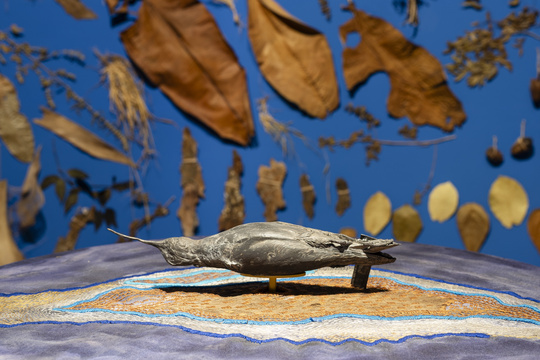
From each site I collected samples like red clay, oyster shells, moss, and river water which I archived. I wanted to explore the context between the folklore, the history, the contemporary layers of habitation and the rural space between each destination.
This digital research and travel journal is inhabited by the relics, along with documentation in the form of polaroids, text, drawings, and ephemera and is presented here as an ongoing algorithmic composition in which a script determines the sequence, layering, and rhythm of visual and sonic elements.
For those that would like to follow my route, in part or whole, I am including location information below. I began in the southeast corner of the state, then drove to the southwest, up through central Alabama and eventually made it to the northwest corner for my last stop.
Below is the order, visiting the first site in December 2022 and then taking up the project more seriously in spring 2023, where I visited eleven of the thirteen locations. The first chapter, The Angry Architect, was the last site which I visited in spring 2024. It is also isolated from all the others which are mostly concentrated around the region where Windham grew up.
The Hole That Will Not Stay Filled
Alabama Highway 134, Bill Sketoe bridge over the Choctawhatchee River
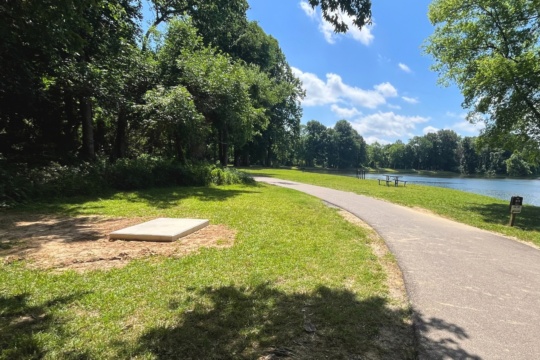
The hole was finally filled. By hundreds of tons of rip rap rock to stabilize the banks of the Choctawhatchee. At this site there is a small park with picnic shelters and river access where people come to fish and swim in the muddy water.
The Dancing Ghost of Grancer Harrison
Harrison Cemetery, Kinston, AL
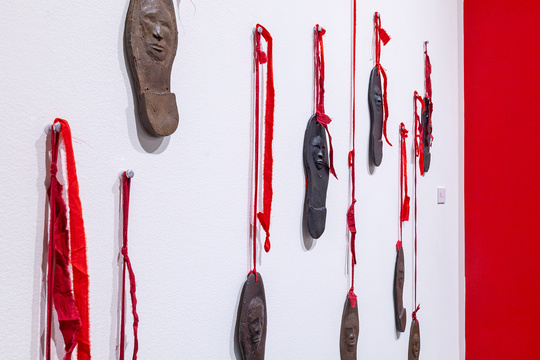
Grancer Harrison, an enslaver of human beings, asked to be buried with his dancing shoes. His grave is an unusual shape, a semi-cylinder with minimalistic, almost chimney-like shapes on both ends. Originally it was housed within a ‘grave house’ that has since been removed. The grave is located in an active cemetery.
Mobile’s Pipe-Smoking Captain
State Street, Mobile, AL
There is no location specified in this story other than State Street which is now a kind of mini-French Quarter in the historic sector of Mobile. We made our way down State Street to where it dead-ends near a post-industrial and highly polluted section of the Mobile River.
Detour: Kathryn Tucker Windham Library and Museum
Located on the campus of Coastal Alabama Community College, Thomasville, AL
Kathryn Tucker Windham, the author of this volume of ghost stories lived most of her life in Selma, AL, but was originally from the small town of Thomasville, where her archive is housed in a community college library. There is also a large sculpture of her made by one of her closest friends, the famous outsider artist and her next door neighbor, Charlie Lucas.
The Phantom Steamboat of the Tombigbee
Tombigbee River, Pennington, AL
We do not know the exact location of where the Eliza Battle steamboat burned and sank but its apparition is said to be seen up and down the Tombigbee River. The name Tombigbee (itumbi ikbi) comes from the Choctaw language meaning “coffin maker”. We found a boat ramp at the end of a long red clay road where we could access the river as close to where it is believed the ship sank. There was a wild boar leg washed ashore, and the clay filled river was opaque and flowing violently.
The Unquiet Ghost at Gaineswood
Gaineswood Museum, 805 S Cedar Ave, Demopolis, AL 36732
This massive former plantation home, a site of horrific violence against those enslaved in Demopolis, is now a museum run by warm, welcoming and diligent local volunteers. Strangley, the plantation owner fancied himself an artist and made a painting of the Eliza Battle steamboat burning in the Tombigbee River.
Recommended Detour: Rural Studios, 8448 AL-61, Newbern, AL 36765
Rural studios is one of my favorite sites in Alabama. In one of the poorest regions of the United States, you can find contemporary architectural gems designed and built by students of Auburn University’s architecture program using recycled materials. The program was founded by Samuel Mockbee in 1993, who later won a MacArthur fellowship for his work. This site, like Gee’s Bend, has long been a source of inspiration for my work.
The Faithful Vigil at Carlisle Hall
Kenworthy Hall, Marion, AL
This is a private residence and it was for sale when we visited. We were unable to see the home due to the gated driveway. I photographed the gate and took samples from the clay driveway where oysters were being used as gravel.
The Specter in the Maze at Cahaba
Old Cahawba Archaeological Park, 9518 Cahaba Rd, Orrville, AL 36767
I highly recommend visiting this massive archaeological park that spans the entirety of Alabama’s first capital city. The site, mostly abandoned after the Civil War was still somewhat occupied until the early 20th century.
The Return of the Ruined Banker
Sturdivant Hall Museum, 713 Mabry St, Selma, AL 36701
We were not able to go inside of this museum while in Selma but a main focus of this story takes place in the Old Cahawba Archaeological Park.
Detour: Gee’s Bend Quilters Collective, Boykin, AL
While making our way through the Black Belt we were drawn to Gee’s Bend. We visited the shop and watched as China and Mary Ann Pettway worked in their fabric studio. After buying a quilt, and then borrowing $2.00 we were able to put our car on a nearby Gee’s Bend Ferry (cash only) which took us over the Alabama River and dropped us off on the south side landing near Camden, AL.
The Crying Spirit of the Well
Purifoy-Lipscomb House, south side of Hwy 21, Furman, AL (Private Residence)
It would be easy to miss this historic home, built in 1840, located along the side of a highway.
The Red Lady of Huntingdon College
Pratt Hall at Huntingdon College in Montgomery, AL
We did not try to access the building as it remains part of a private college. I photographed the site and took away roofing shingles that had fallen off and were lying in the grass.
Death Lights in the Tower
Historic Drish House, 2300 17th St, Tuscaloosa, AL
This site was photographed by Walker Evans in 1936. At the time, this mansion was being used as a mechanic shop and auto parts store. A print of this photograph is in the collection of the University of Alabama.
The Face in the Courthouse Window
Pickens County Courthouse, 1 Courthouse Square, Carrollton, AL 35447
A woman drove by while we were outside trying to see and photograph the face in the attic window. She turned out to be a volunteer and had a key to the building. We were able to go inside and look around but the attic where the face is said to be permanently fixed to a glass pane was off limits.
The Ghost of the Angry Architect
Rocky Hill Castle, Courtland, AL
This ‘castle’ site is on private land and has since been demolished, no structures remain. We visited a historic neighborhood down the street in Courtland.
Jerstin Crosby (he/him) is an artist born in Dothan, Alabama, and now based in North Carolina. He received his MFA from the University of North Carolina at Chapel Hill and his BFA from the University of Alabama. His work has been featured in New American Paintings, Art Papers, and Artforum, and has been exhibited at SPRING/BREAK Art Show (New York), Atlanta Contemporary, the Nasher Museum of Art (Durham, NC), Knockdown Center (Queens, NY), International Print Center New York, Ada Gallery (Richmond, VA), Tiger Strikes Asteroid (Greenville, SC), the Contemporary Art Museum (Raleigh, NC), and LUMP.