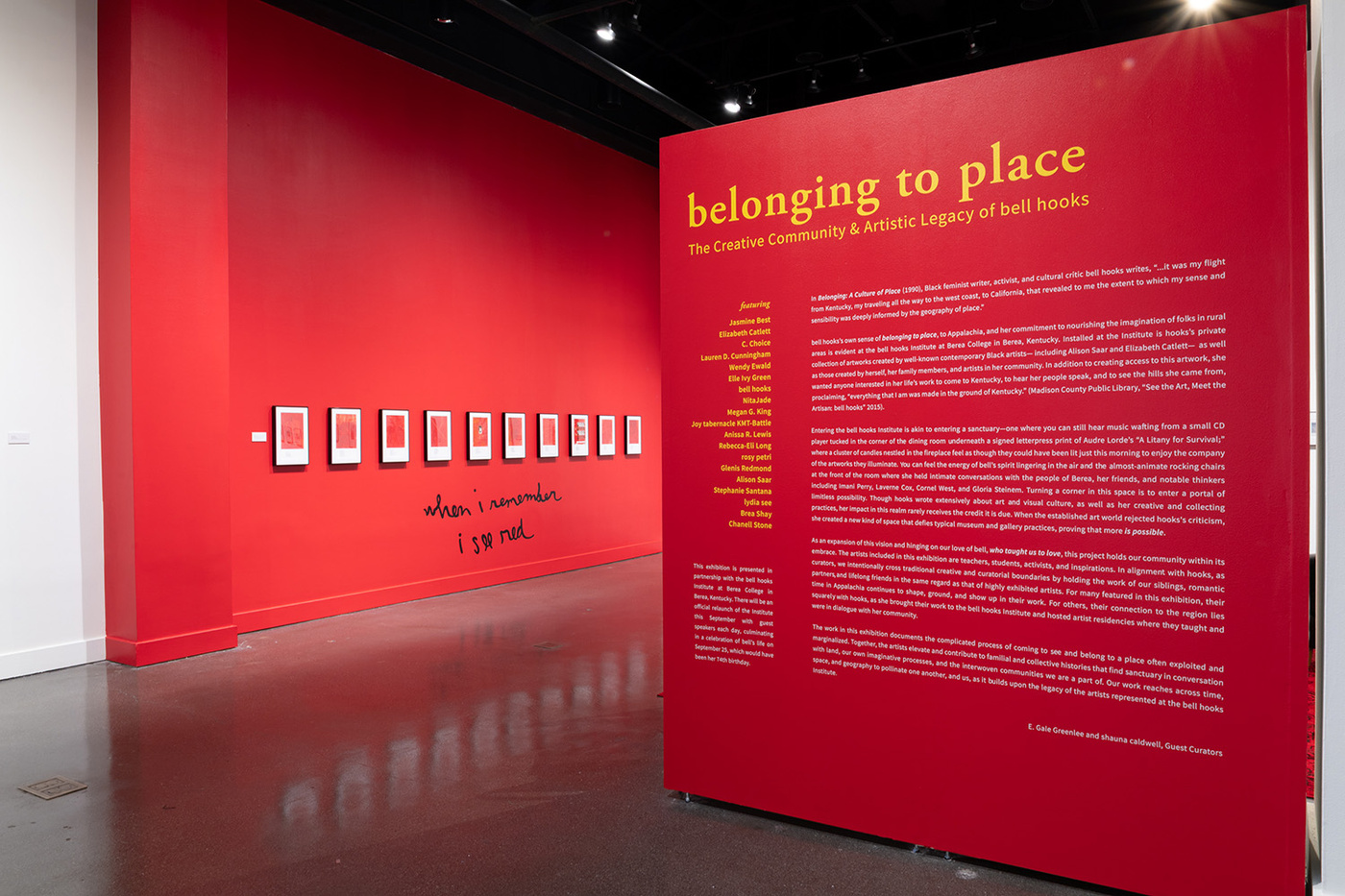
Long renowned as a scholar, theorist, teacher, and Black feminist intellectual, the late bell hooks was also an artist and art collector from the Appalachian Mountains of eastern Kentucky. hooks’ work and legacy are the nexus around the exhibition belonging to place: The Creative Community & Artistic Legacy of bell hooks, at Boone, NC’s Turchin Center for Visual Arts, presented in partnership with the bell hooks Institute at Berea College in Berea, KY.
Curated by writer E. Gale Greenlee and artist shauna caldwell, who connected through their research and mutual contacts at the bell hooks center, the exhibition brings hooks’ legacy to western North Carolina in order to foster a dialogue across the broader Appalachian region about art and feminist praxis. hooks’ archive in Berea College Special Collections & Archives showcases the records and archives of the writer’s many lives, including her personal papers, while her artwork and art collection can be found on view at the bell hooks Institute. hooks founded the Institute with the intention to, “[…] give back to the world I came from […] I grew up in the hills of Kentucky, and I wanted these students to see you can be a cosmopolitan person of the world but still be connected positively to your home roots.”[1]
As an outgrowth of Greenlee and caldwell’s research, scholarship, and work cataloging the array of artworks in hooks’ personal collection, the exhibition checklist comes from a mix of sources and relationships: some from hooks’ collection now housed at the Institute, some by artists represented in the collection but borrowed from other sources, some who are former artists-in-residence at the bell hooks center, and others by contemporary artists inspired by hooks’ writings. As Greenlee and caldwell write, “The work in this exhibition documents the complicated process of coming to see and belong to a place often exploited and marginalized.”[2] The exhibition’s curatorial aim, expanded upon in an upcoming book the two are releasing in summer 2027, is to ultimately build a shared sense of, “[…] sanctuary in conversation with land, our own imaginative processes, and the interwoven communities we are a part of.”[3]
Walking in, a stark red wall confronts viewers, one that echoes an artist book by hooks herself: when i remember i see red (date unknown), which features paintings that, in her own words, “[…] evoke the strength of my first memory of color, the primacy of red […] merging with the passion of remembrance of both personal intimacy—the evocation of childhood trauma, abuse, and political remembrances.”[4] Here, hooks’ when i remember i see red is displayed as a series of 10 framed prints of works on paper, combining energetic strokes of red paint with text and images complementing the stark red wall.
hooks’ layered and non-objective brushwork in her i see red series recalls her own stated affinity for abstract expressionism as an arena for transcending text, writing in 1995 that “[…] one can be critically aware of visual politics—the way race, gender, and class shape art practices (who makes art, how it sells, who values it, who writes about it)—without abandoning a fierce commitment to aesthetics.”[5]
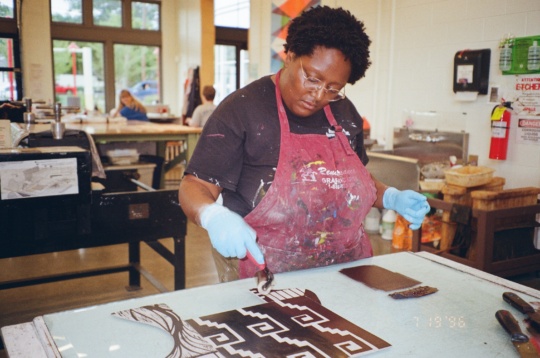
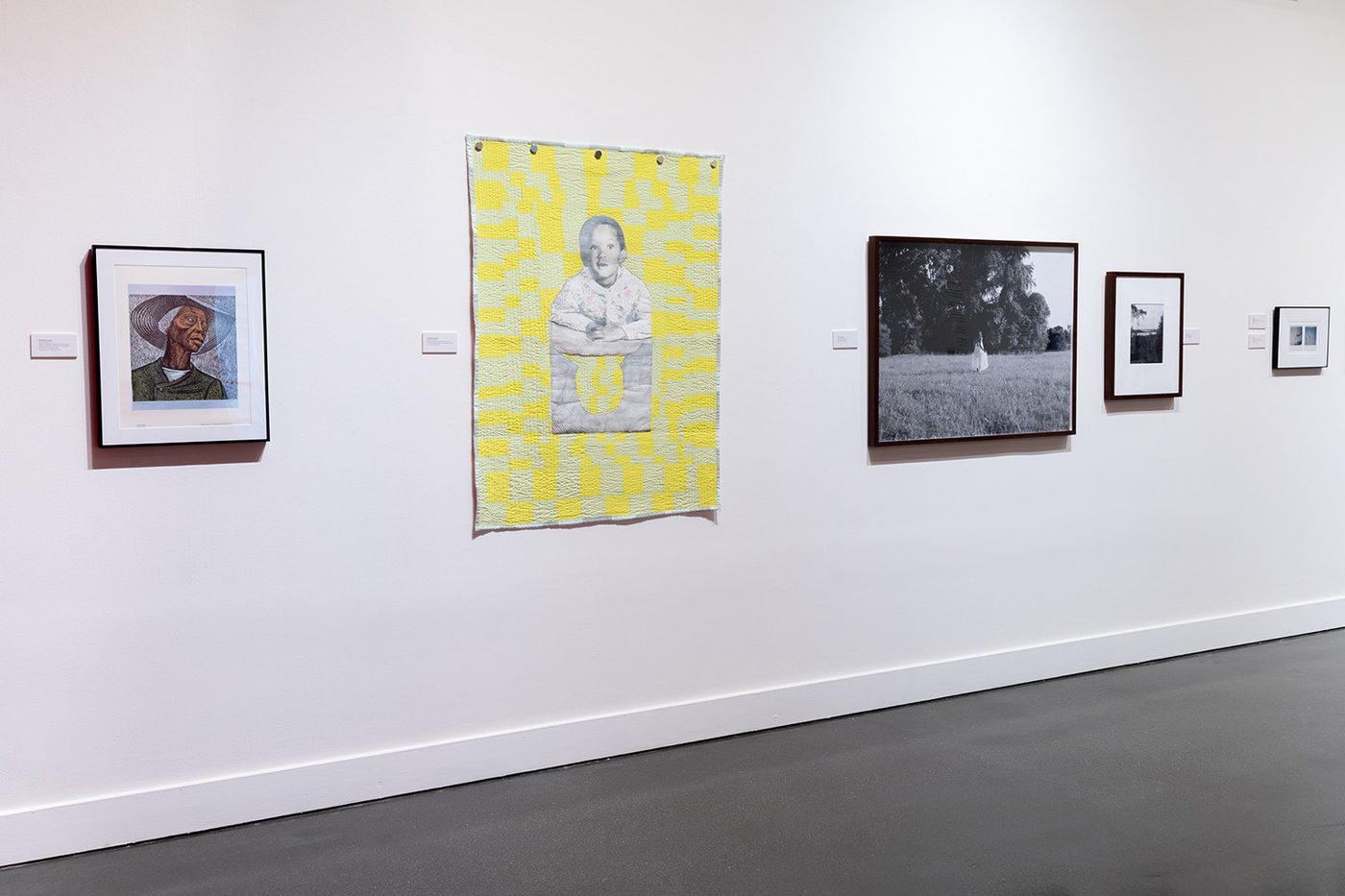
Adjacent to hooks’ red work are pieces by Alison Saar and Elizabeth Catlett, both represented in the collection and deeply significant to the writer. Saar’s Razin’ Cane II is a 2025 screenprint printed on a sugar sack that depicts women and girls with cane knives and torches gazing directly at the viewer. Catlett’s Sharecropper, a 1972 offset lithograph poster from an original woodcut print depicting a cropped-in face of an African American woman sharecropper, visualizes life, dignity, resistance, and imagination against multiple kinds of power and oppression—a commitment hooks shared in her writings as well.
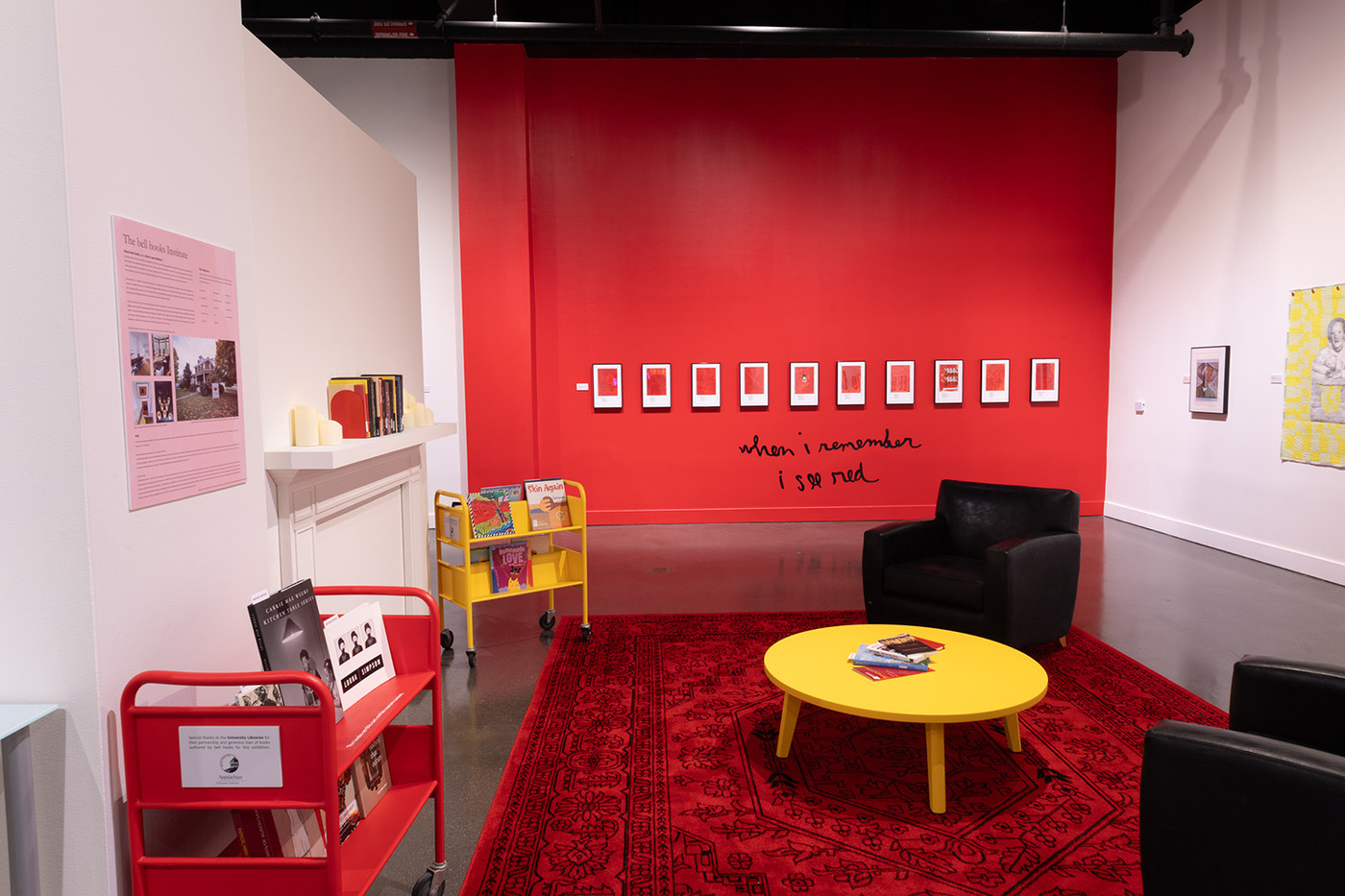
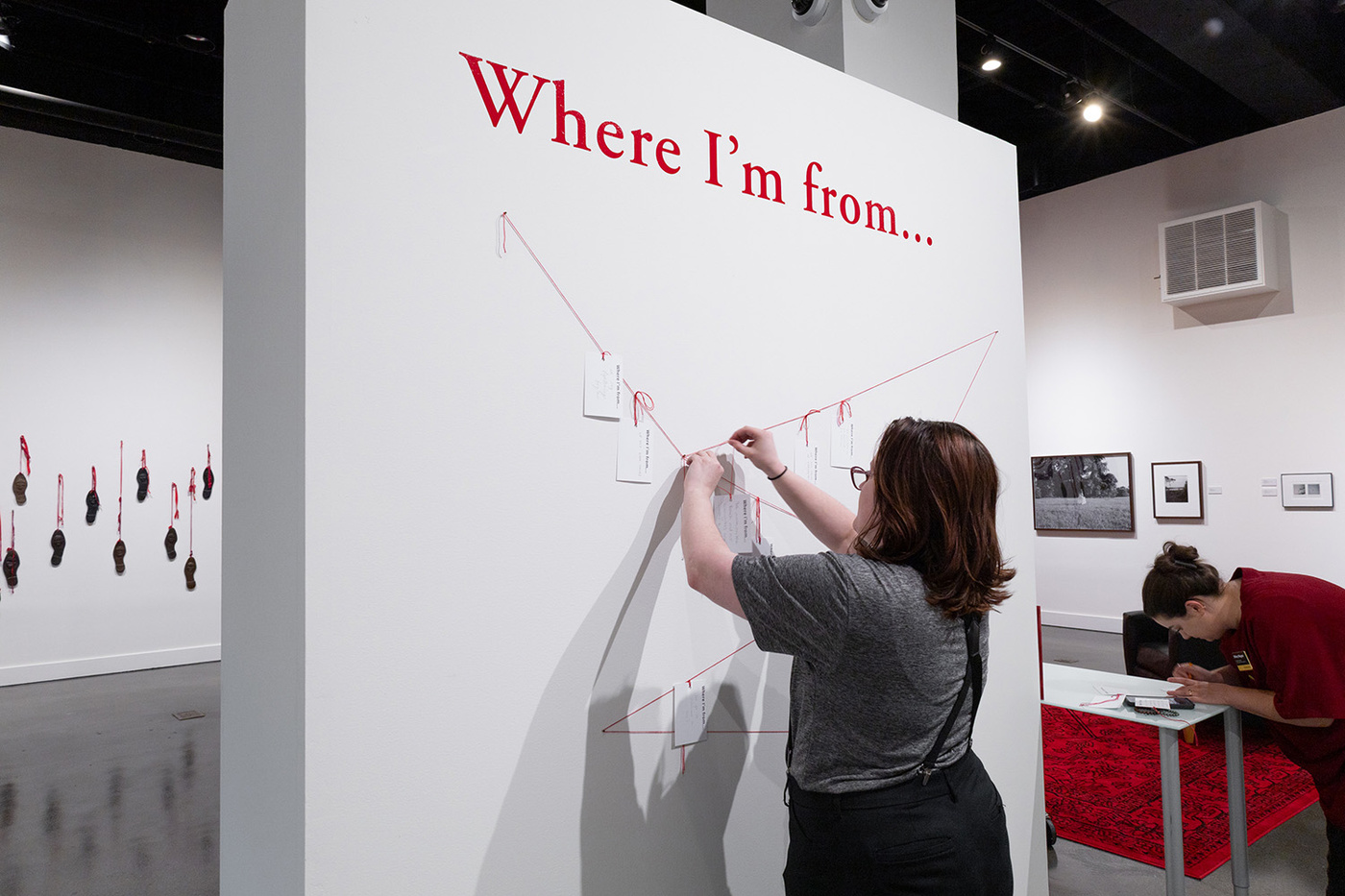
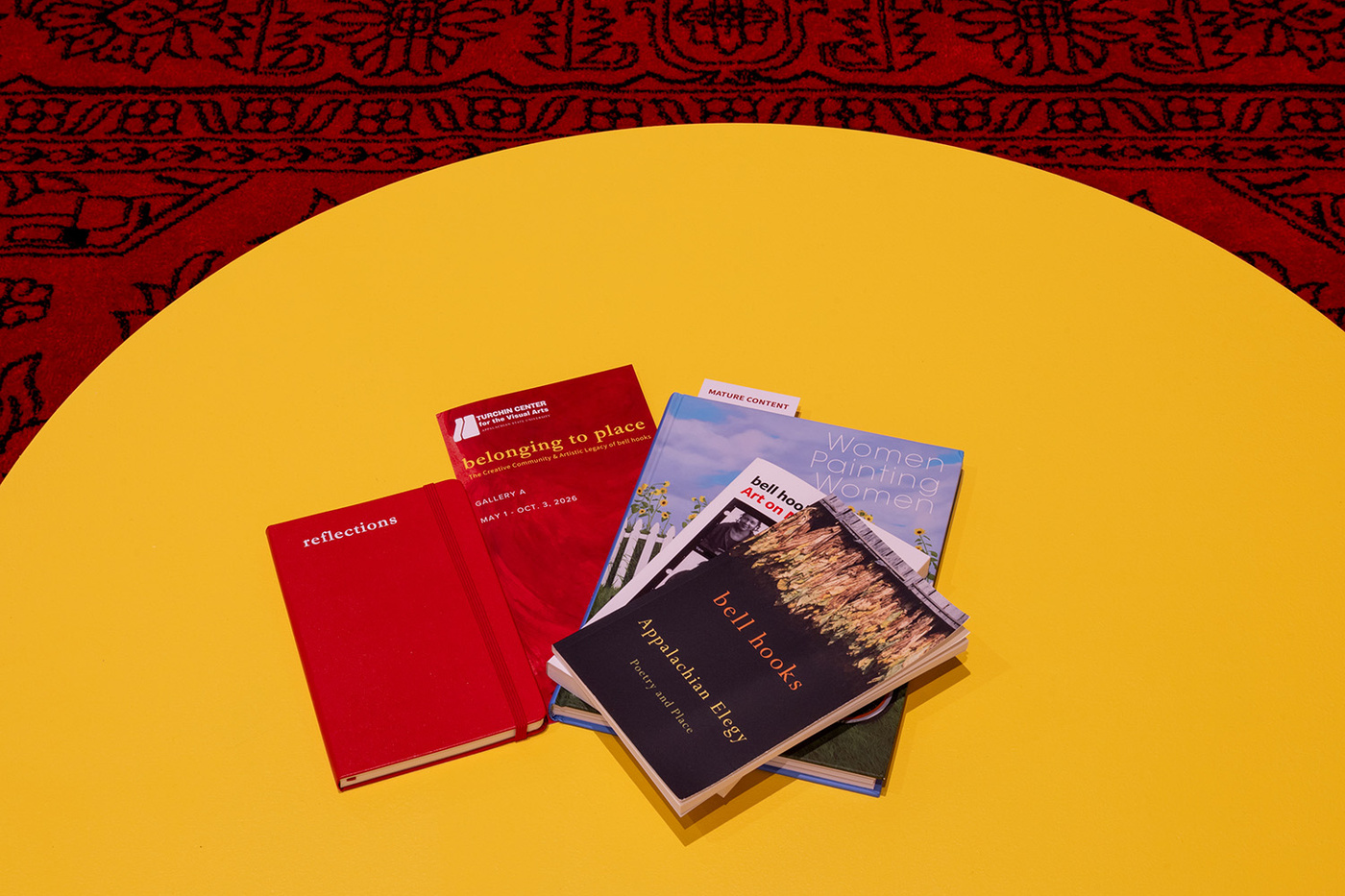
Following these works is a living-room-style installation with book carts holding publications related to additional artists collected in the bell hooks Institute, and cataloging the astounding breadth of writing authored by bell hooks herself. This central space, with comfortable chairs and a reconstructed fireplace mantle, invites viewers to stay and engage with hooks’ prolific work, serving as a proxy for the bell hooks Institute, which was closed in 2019 due to the author’s health and eventual passing and reopening in September 2026.
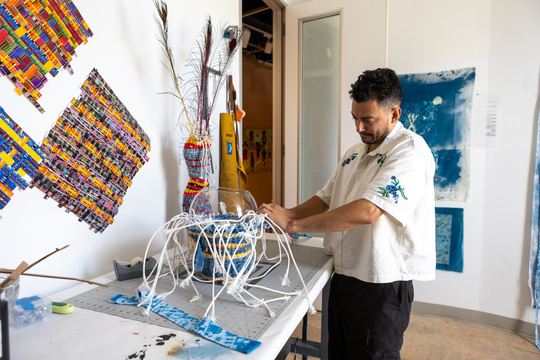
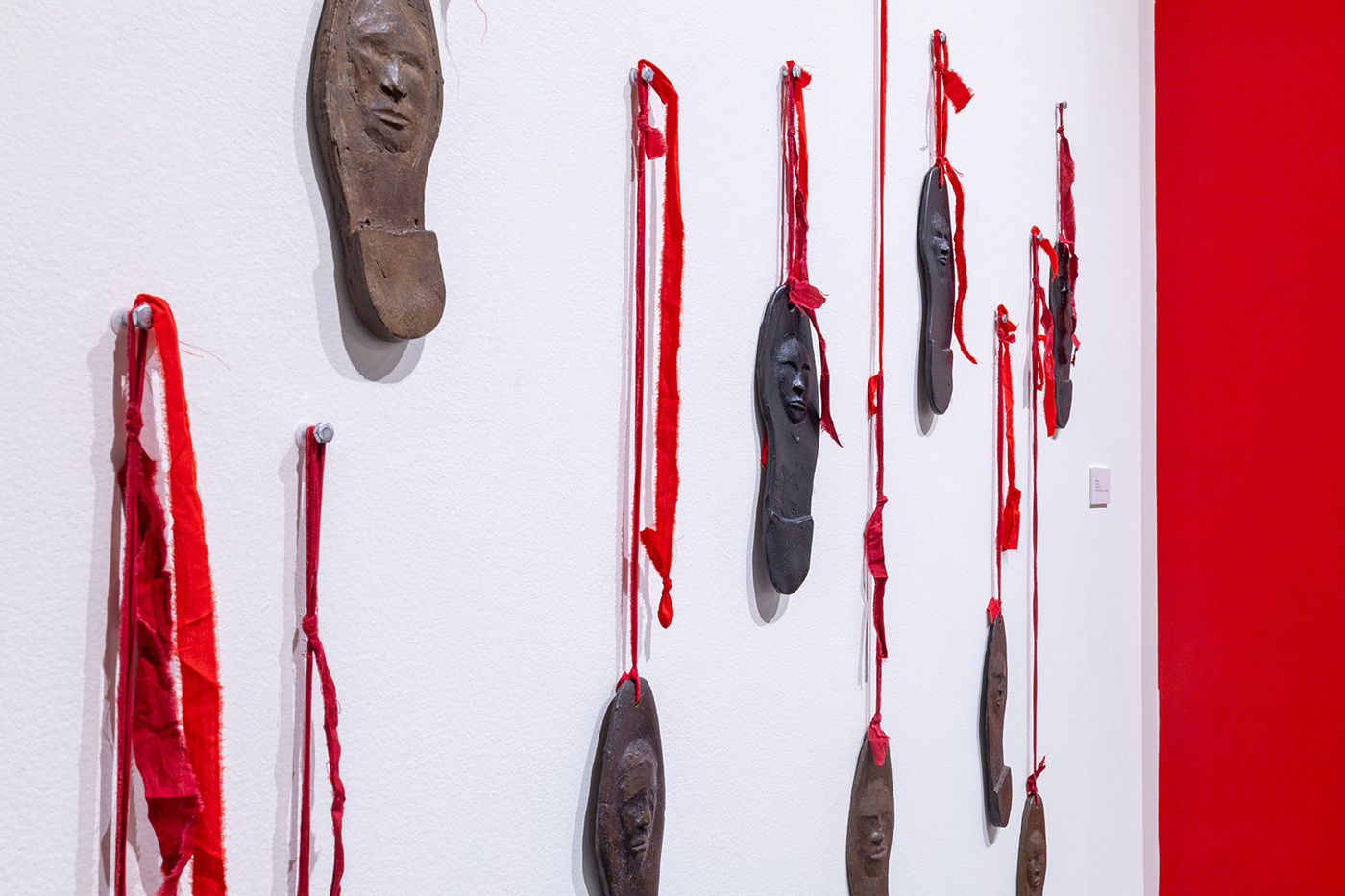
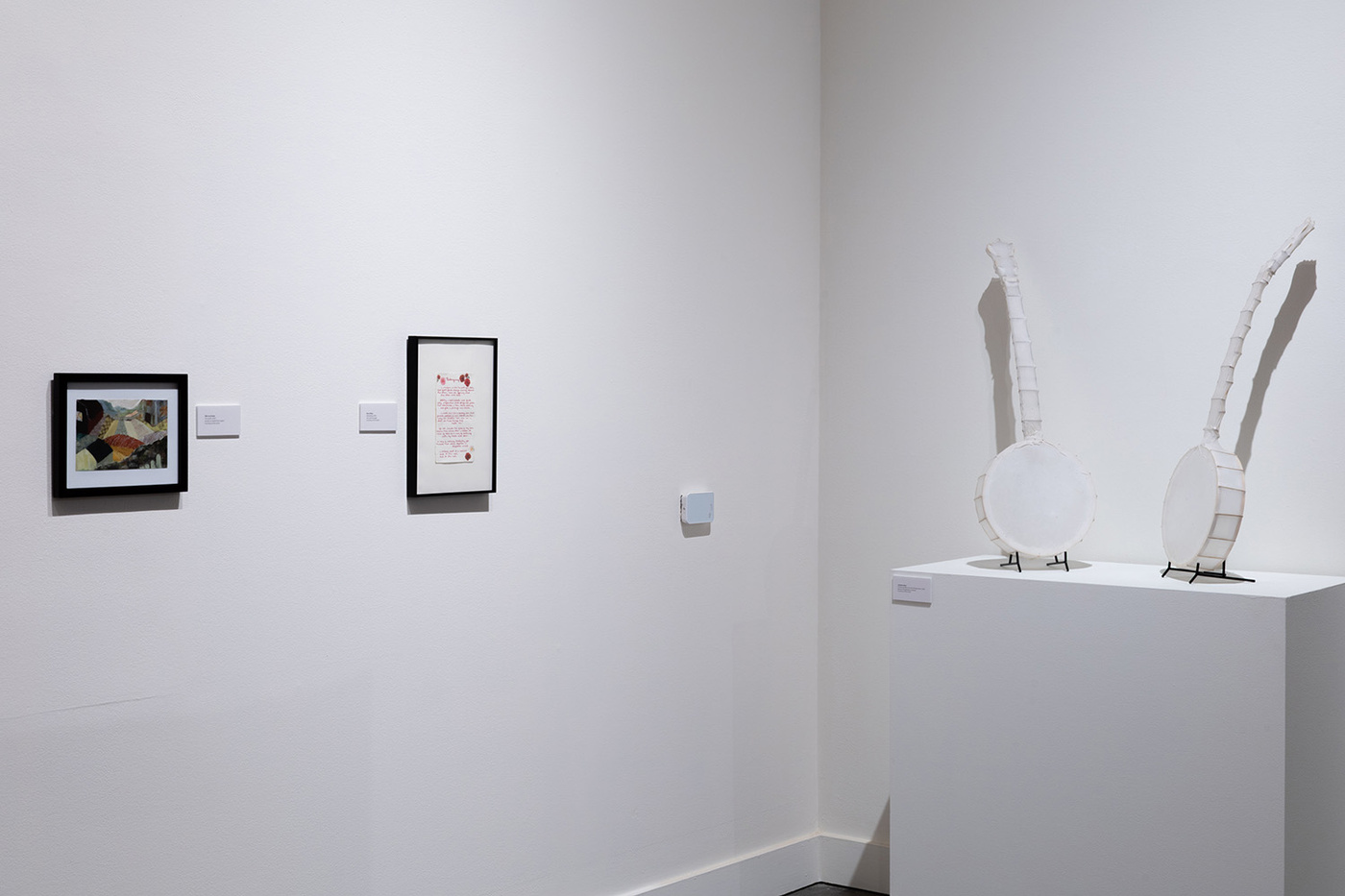
In her writings, hooks identified quilting and textiles as vernacular encounters with an “aesthetic inheritance” of Black women’s creative labor.[6] The exhibition adds these practices to a broader Appalachian tradition, through the exuberant textile works of rosy petri, Stephanie Santana, Megan G. King, and Rebecca-Eili M. Long. Joy tabernacle KMT-Battle and Jasmine Best’s sculptures reflect the process of cultural reclamation in Appalachia and the American South from the African diaspora, with works inspired by Hoodoo-based ritual broommaking in service of greater spiritual purpose.
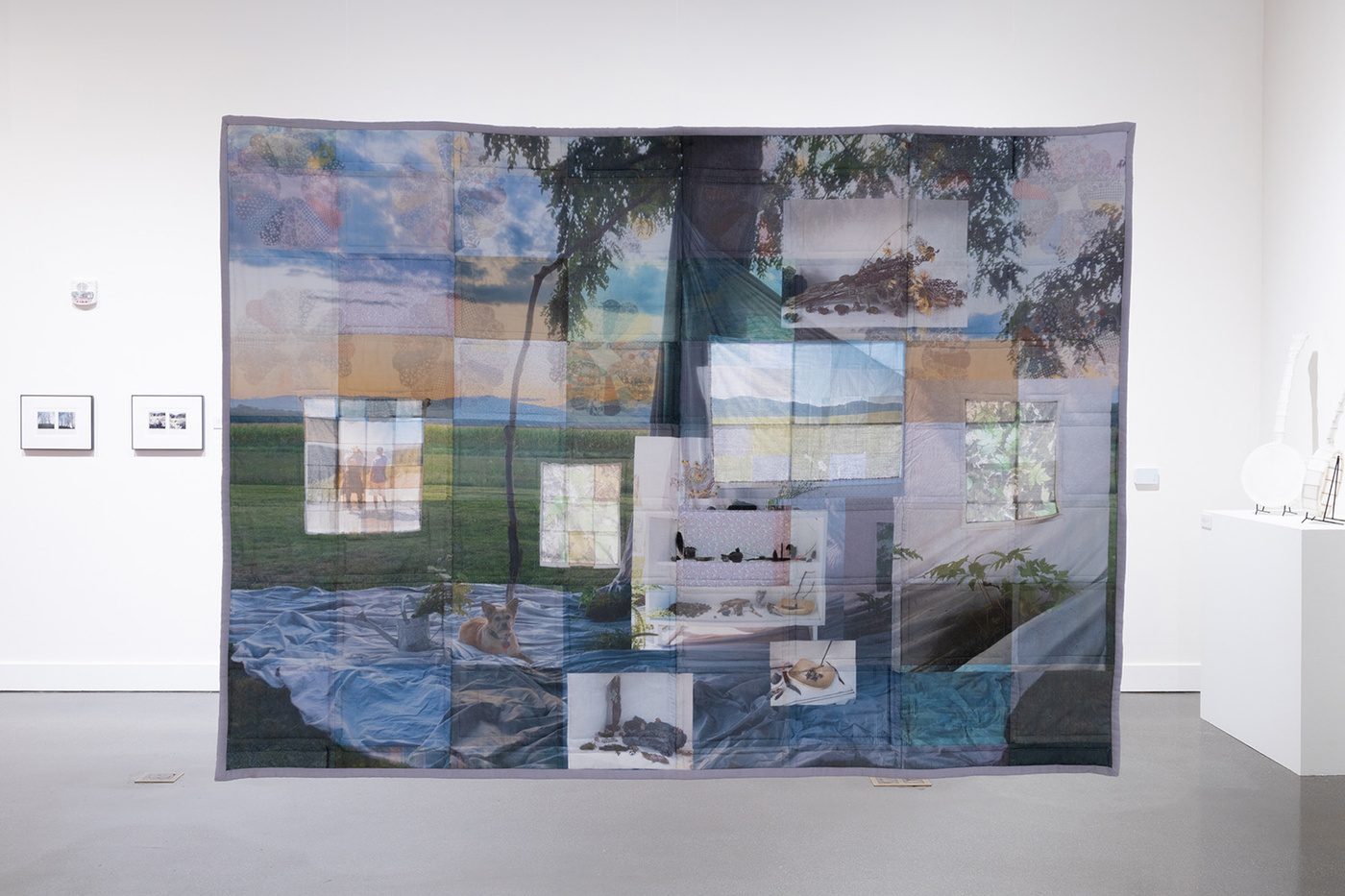
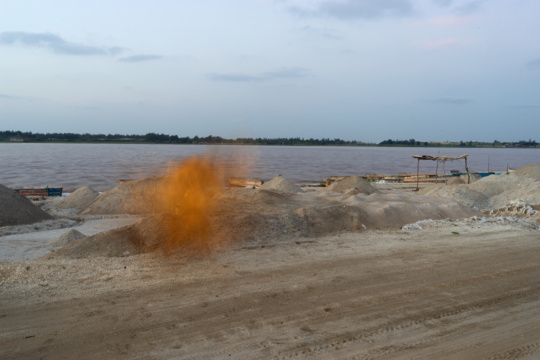
Other works in the show reflect on the nature of land and place invoked by hooks’ writings. Inspired by western North Carolina, Elle Ivy Green’s mountain landscape paintings showcase a psychedelic and colorful fractured harmony: a transformative perspective on the exhibition’s immediate context of Watauga County. Anissa R. Lewis’ 2022 video work, Exposed to the Air, To View/Not Covered, features a first-person perspective of walking around empty neighborhood lots, spliced with graphics of recognizable yard signs altered with quotes from bell hooks’ famed All About Love (1999). One such graphic reads: “There can be no love without justice/Construction Area: Keep Out.”
Guest curators Greenlee and caldwell have organized belonging to place around multiple purposes, with hooks as the interlocutor of the show’s capacious and multifaceted vision to uplift art in Appalachia. Whether through media or conceptual schema, belonging to place refuses any single mode, carrying forward hooks’ repeated disavowal of essentialist narratives and appearing here as the polyphonic result of her influence today. There is no single way to be Appalachian, but there are many ways to be in community with people, place, and creativity.
[1] “Get to know bell hooks.” Berea College, November 20, 2025. https://www.berea.edu/centers/the-bell-hooks-center/about-bell. Quote listed as part of Berea College’s Women’s Studies 1999 “Love and Spirituality” convocation address.
[2] E. Gale Greenlee and shauna caldwell, Guest Curators, “Belonging to Place: The Creative Community & Artistic Legacy of bell hooks | Turchin Center for the Visual Arts | Appalachian State University.” 2026. Turchin Center for the Visual Arts. March 3, 2026. https://tcva.appstate.edu/exhibition/belonging-to-place-the-creative-community-artistic-legacy-of-bell-hooks/.
[3] Ibid.
[4] bell hooks, when I remember, I see red. 2002, Courtesy of The Estate of Gloria Watkins aka bell hooks. https://openlibrary.org/works/OL33282006W/When_I_remember_I_see_red
[5] bell hooks, “Introduction: Art Matters,” in Art On My Mind: Visual Politics (New York: The New Press, 1995), xii.
[6] bell hooks, “Aesthetic Inheritances: History Worked by Hand,” in Yearning: Race, Gender, and Cultural Politics (Boston: South End Press, 1990), 115–122.