At the end of May, I had the privilege of visiting Annalee Davis at Walkers Dairy Farm in Barbados, situated in the mahogany grove that surrounds her family home, studio, and the Fresh Milk Art Platform. Just weeks earlier, Davis’ work had premiered at the Venice Biennale. This is the first time Barbados has been officially represented in the main exhibition, a landmark moment since the island became a republic fully independent from British colonial rule in 2021.1 While I wouldn’t be in Venice until August, Davis generously took the time to discuss her experience and after showing me around her studio, full of drying seeds and fronds for forthcoming projects, we sat on the patio that bridges her personal and professional spaces. The sound of mahogany seed pods crashing onto the roof punctuated our conversation, an audible cue that added to the sensory experience.
Visiting Davis at home gave me privileged access to appreciating her work. The land we were on was previously a plantation, and in Barbados, one grows accustomed to the relentless reminder of the sugarcane fields that once covered most of the island. Davis’ practice is deeply entrenched in this Caribbean ecology, highlighting the continued impacts of colonialism; from the sanitisation of the land for tourism to contemporary systems that inform, and in some cases stifle, local artists’ work. In Venice, Davis translates these site-specific ecological legacies across oceans, stressing the inseparability of Caribbean history, the environment, and social realities that persist today.
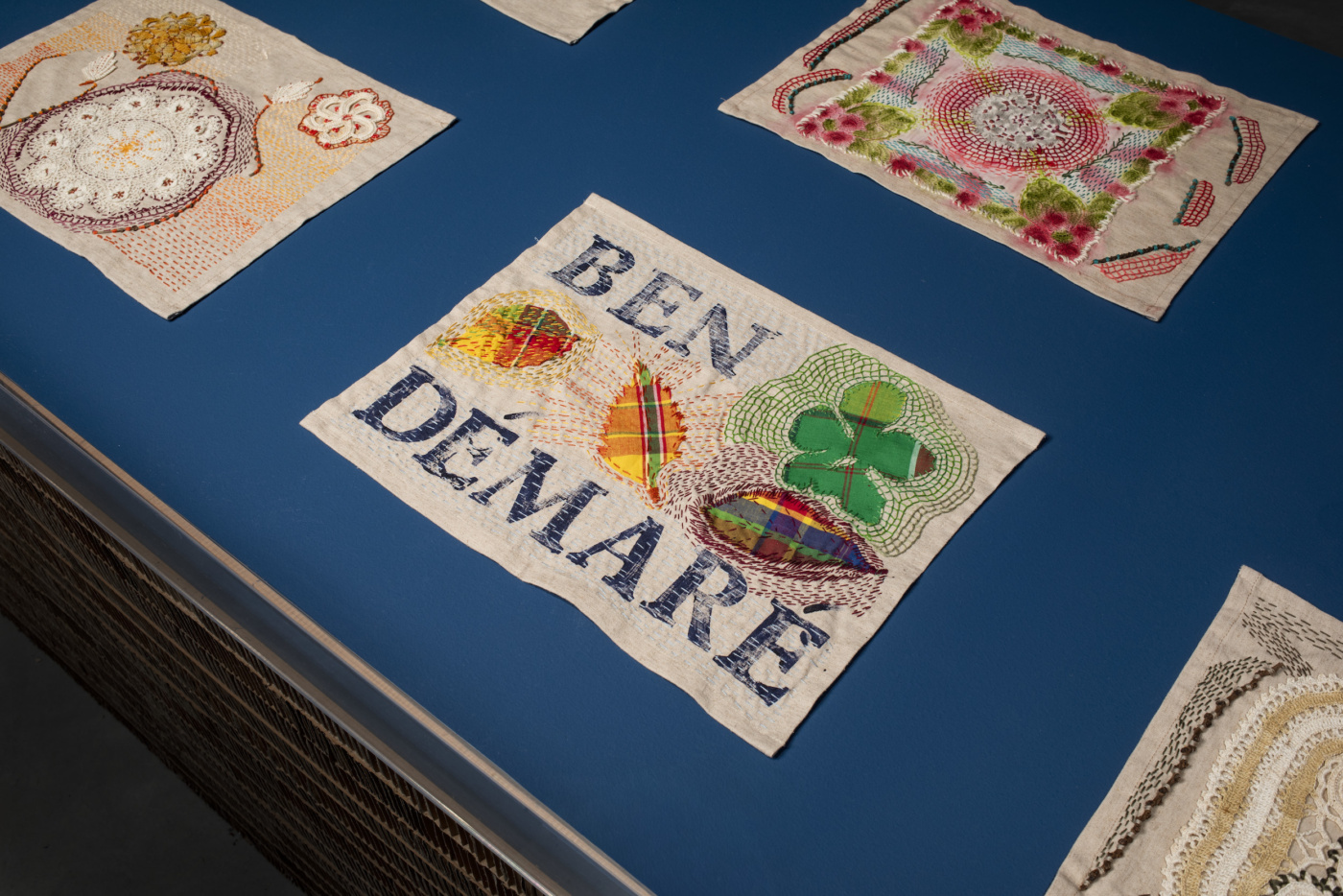
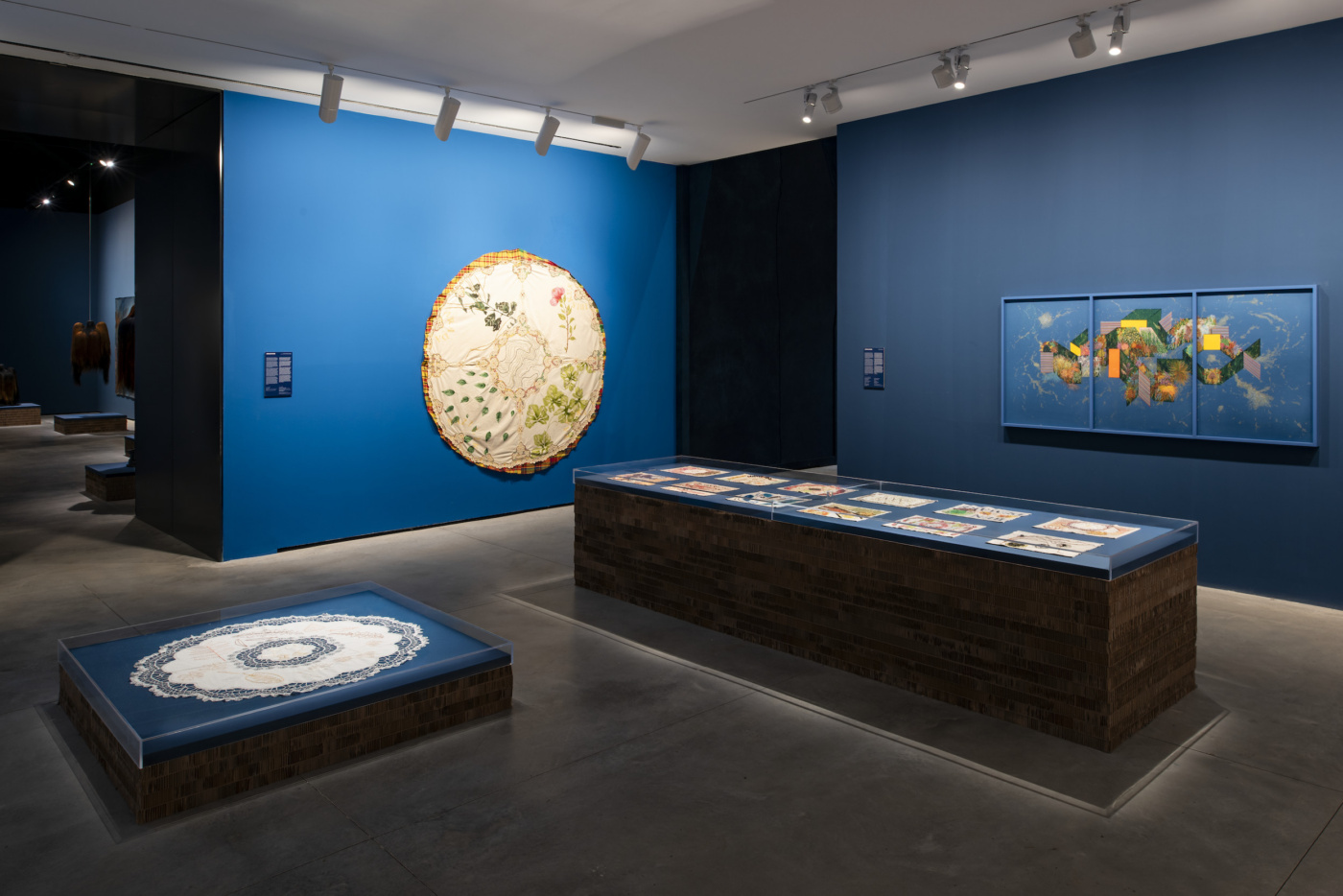
Below: Installation view of textile-based work by Barbadian multidisciplinary artist Annalee Davis, as seen in In Minor Keys for the 61st Venice Biennale. Photo credit: Matteo Losurdo.
Come mid-August in Venice, Europe’s climate-change-intensified heat mirrored spring in Barbados. My first stop was the Giardini’s central pavilion, where I wandered through an overwhelming number of objects and people before recognising Davis’ textile artworks, An Unbound Book of Prayer – Series II (2025-2026), Bush Bath in the Glasi (2025), and Be soft (2023-2024), amid the visual and auditory cacophony. Slowing down, every stitch, every intention is legible in compositions that feel at once organic—both in material and execution—and meticulous. Davis weaves sticks and seeds onto recycled fabric, her hand palpably present in the running threads.
Shown alongside other textile works, I had a moment of panic that the pieces had been reduced to their medium, their softness cut against by the sharp edges of the necessary plinth displays. This is work that demands time, not just to make, but to sit with, and the tenderness of the fabric diverged from the abrupt immediacy of a tourist’s experience (myself included). Our desire to consume and capture the work on phones and film felt contradictory, yet people don’t blink when this happens to the Caribbean landscape. Having experienced her practice so personally months earlier, I found myself asking: what does it mean for the work to sit in this space and in this context?
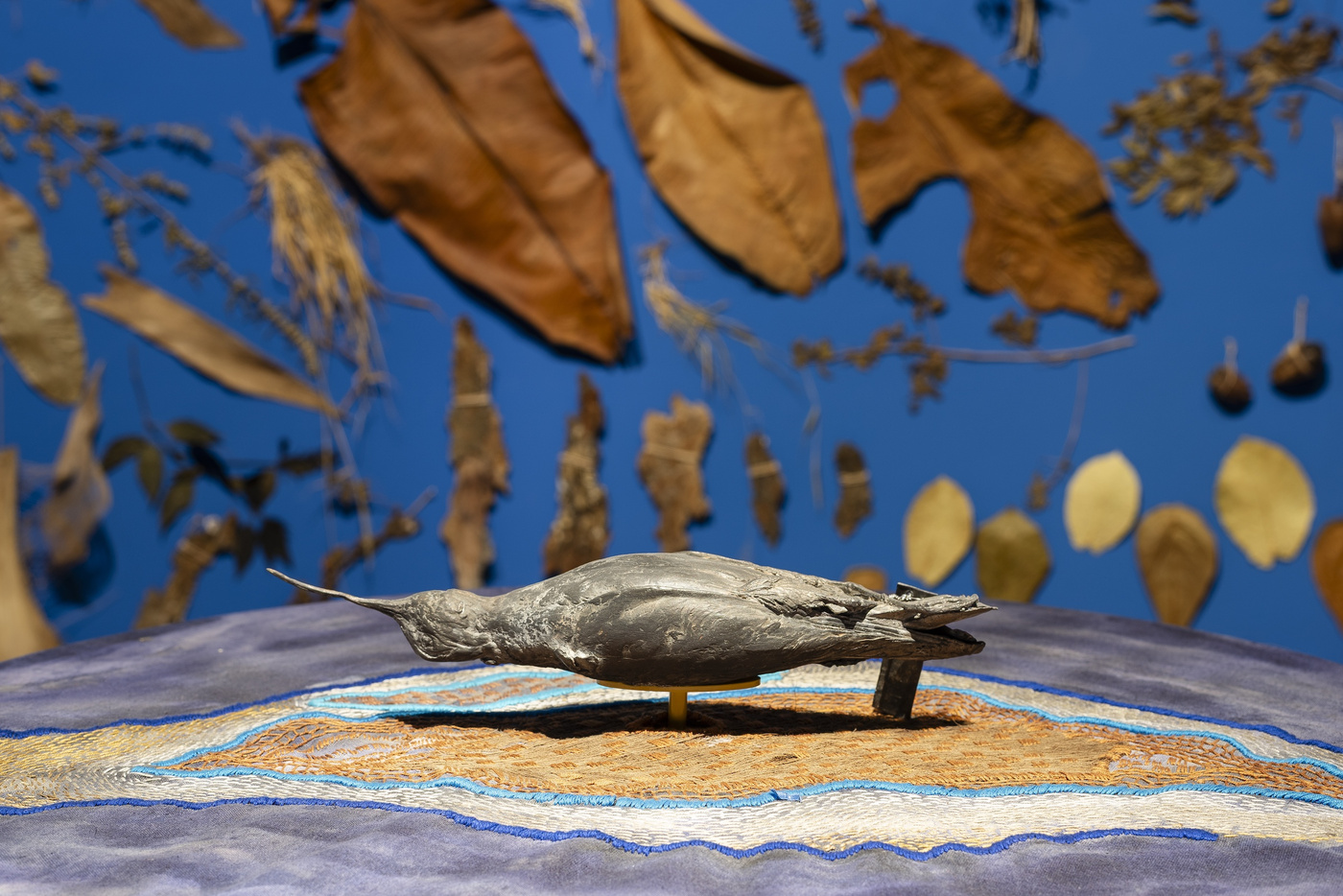
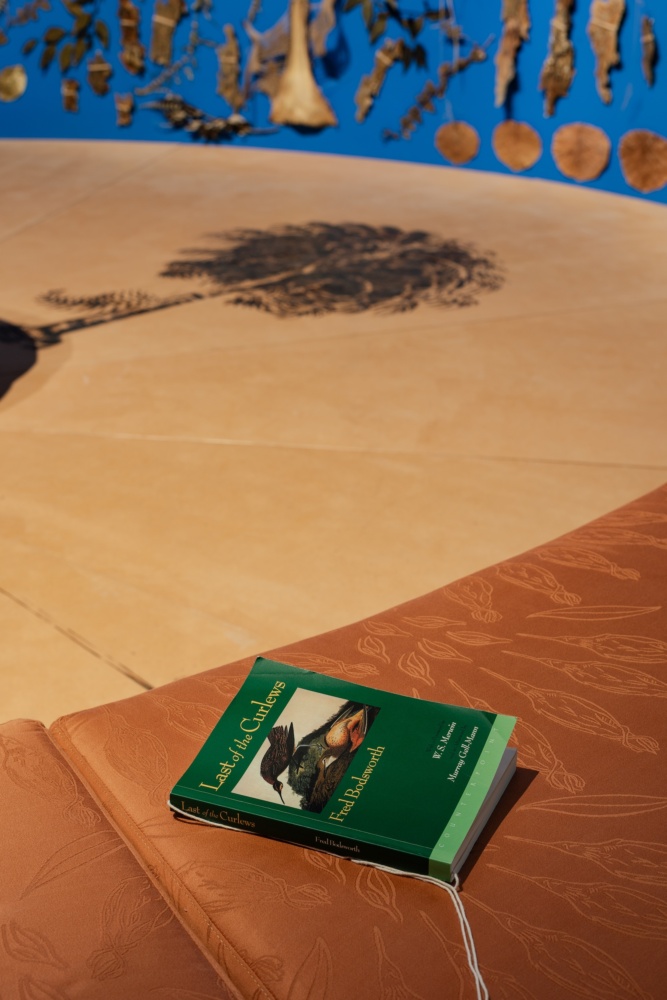
Below: Detail from Let This Be My Cathedral (2026), showing burnished palm flooring and copies of The Last of the Curlews available for viewers for context. Image credit: Matteo Losurdo.
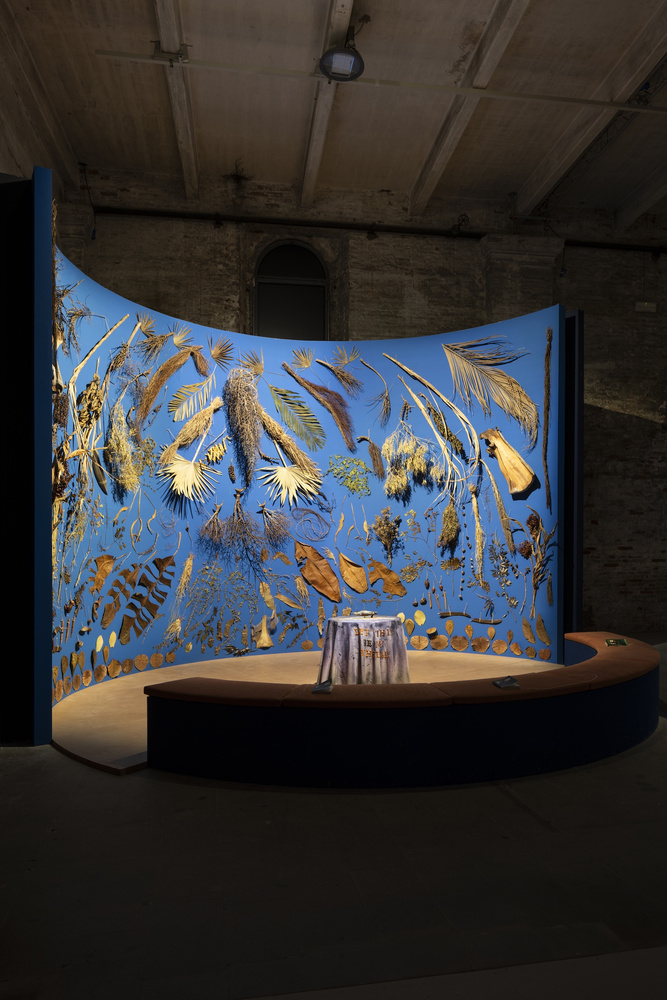
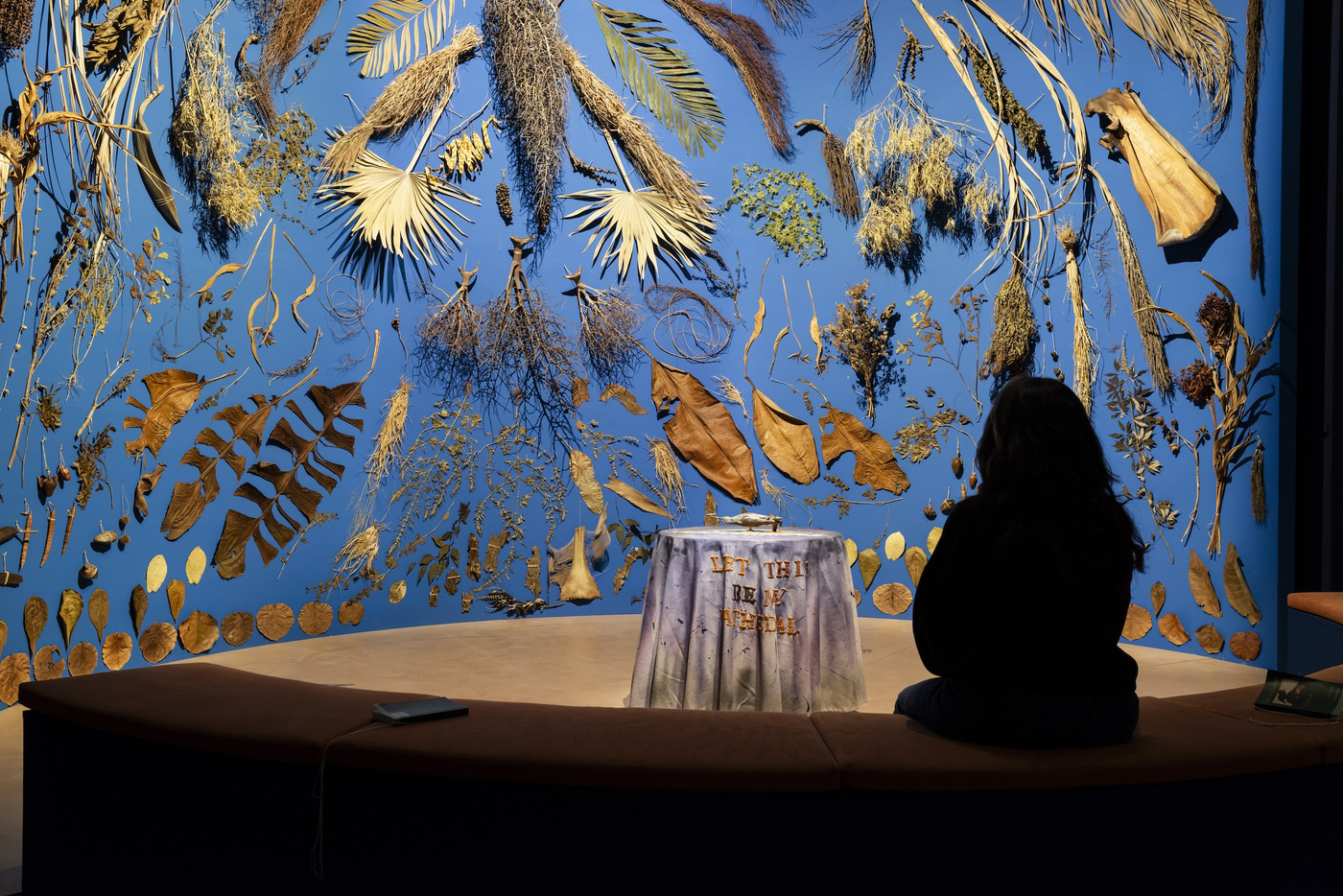
The Arsenale is where Davis really shines. Let This Be My Cathedral (2026), a new work created for the Biennale, centres the story of the Eskimo curlew, a now-extinct species of bird whose migratory route spanned the entirety of the Americas, from Alaska to Argentina, and the last of which was shot over Barbados in 1963. Copies of The Last of the Curlews (1955), the devastating fictionalised story of a curlew desperately searching the Americas for a mate, sit on a curved bench. At the heart of the installation is a lead cast, taken from the taxidermy mount of the same felled bird, gently placed on a round table like an altar. The bird had already passed through two removes before reaching Venice: shot, then stuffed, then cast. What sits on the altar is not a likeness of the curlew but a copy of a corpse, each stage carrying it further from the living animal it once was.
Covering the floor are blow-torched reproductions of English writer Richard Ligon’s 1657 drawings of palm trees from his colonial-era account, A True and Exact History of the Island of Barbadoes. As popular symbols of Caribbean tropicality, the trees are stand-ins removed from their environment, yet first introduced to Europe as ‘true and exact’ to the landscape. In stark contrast, on a rich blue wall above, is a flamboyant presentation of foraged foliage from Walkers Dairy Farm—the real thing. Even as the experiential context has decidedly changed, I’m immediately transported back to Davis’ studio and the sound of the mahogany seed pods slamming onto the patio roof. But this recognition gradually morphs into something strange: this is foliage I know, arranged in a form I don’t. The impulse to touch them is overwhelming, but in its journey across the Atlantic, the organic matter that grows wild and underfoot in Barbados has been rendered untouchable, venerated behind the same barrier that separates an exhibited object from a living thing.
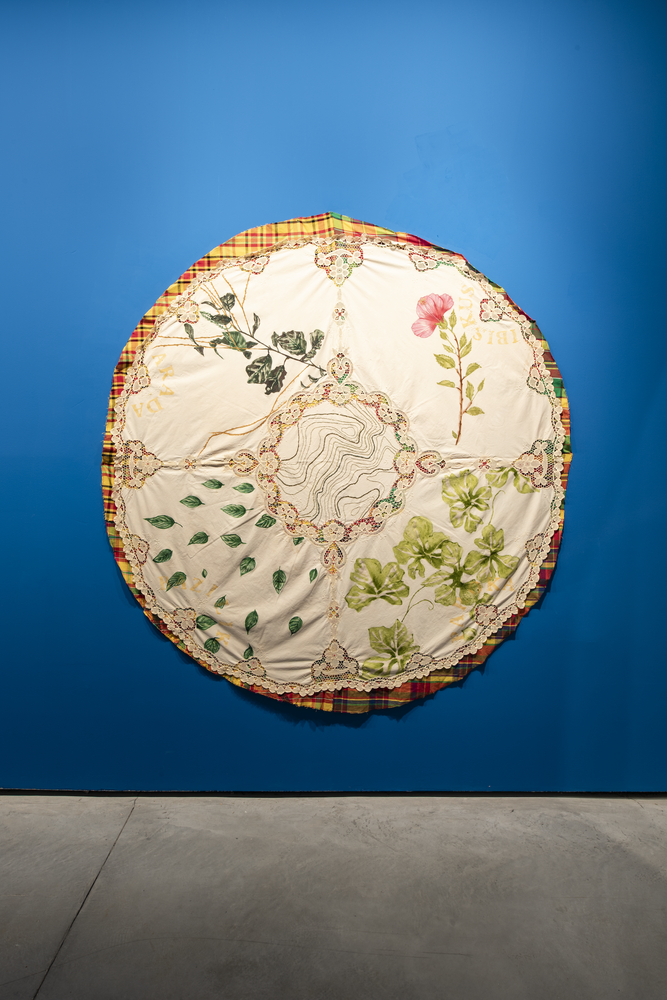
It is uncanny: not unfamiliar, but perhaps too familiar in the capacious surrounds of the Arsenale where such intimate familiarity has no right to exist. The staging recalls the manicured resorts that bombard Caribbean shorelines, facsimiles that conceal the extractive practices that create such displays at the expense of local life and a rapidly changing climate. I think of the curlew at the centre of the installation, also arrested, rendered permanent—its leaden stillness one degree further removed in a chain that started with a gunshot. Davis is pointing to the moment that endemic Barbados became unrecognisably staged for European consumption. The foliage and the curlew are both living things fixed into reverence, each further from where, and what, they once were.
As I reflect on my time with Davis and the subsequent experience of her work in the Biennale, I am struck by the impact these changing geographies have on my perception of her materials and work. I am left thinking what it means for an artistic practice so embedded, and in many ways dependent on, the ecology and land upon which it is made, to be uprooted, transported, and reassembled in this European context, so starkly different from Walkers Dairy Farm, where we sat together earlier in the year. Does this process in fact create another degree of poignant removal?
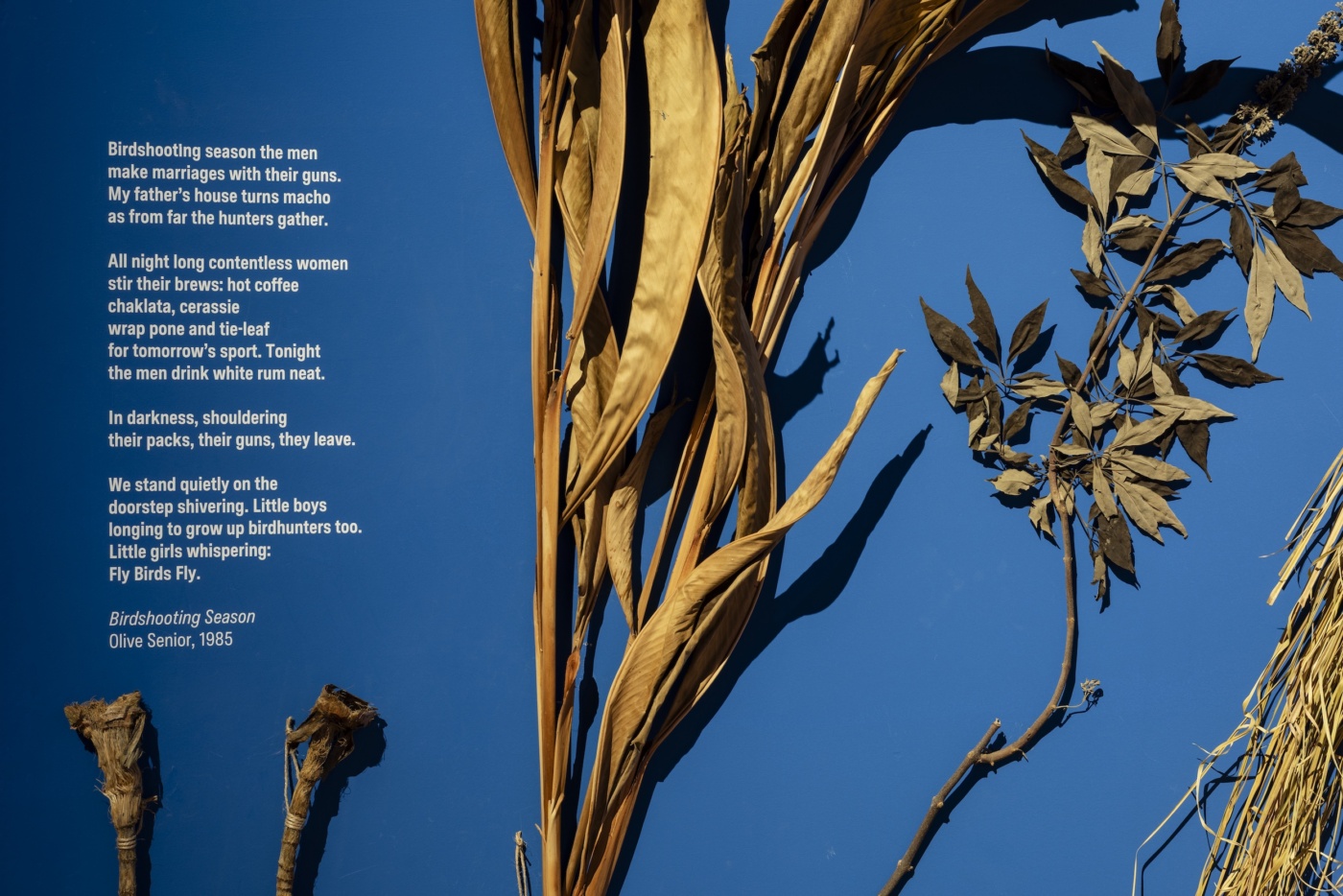
Perhaps that’s exactly the point. Davis’ work transforms these materials, revealing them as representatives of the odd falsification of ‘paradise’ that consumes the Caribbean image abroad, revealing the extreme human intervention in this construction. The friction is not a failure of translation; it is the translation working as intended. She pinpoints how endemic ecologies became unrecognisably staged for European consumption. It is a refusal to be fully at home in Venice, just as the lead cast of the curlew is not the bird itself but a record of everything that was done to it before it arrived. It’s thrice removed: a knowing copy of a copy of a copy. The uncanniness of its displacement is doing exactly what colonial specimen gathering never could: making the viewer feel the distance, rather than erasing it. The lead curlew was forged from a stuffed corpse, a metaphor for the falsified image of Barbados projected to the world; the foliage sits inches from my hand, but is further than it has ever been.
Both ask the same question: what does it cost to bring the Caribbean here to be believed?
1. Alberta Whittle, a Barbadian-Scottish interdisciplinary artist, showed for Scotland’s National Pavilion at the 59th Venice Biennale in 2022.