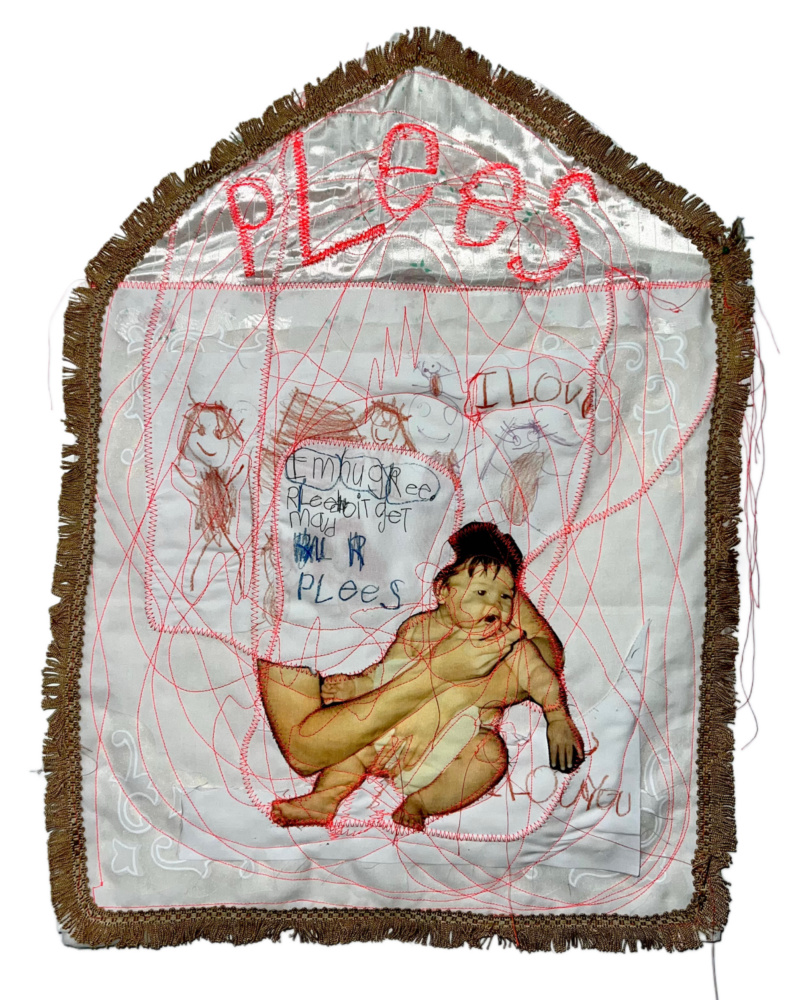
A house-shaped quilt is lined with dark gold tassels. Frayed red stitches careen aimlessly across the white pearlescent fabric. Across the roofline, the word “PLeeS” appears in the unmistakable scrawl of a young child. Below it, a family photograph is interrupted. A handwritten note reading, “Im hungRee Pleese doiT get mad PLeeS,” covers Ruiz’s mothers face, leaving visible only her arms wrapped around the infant Sara Jean Ruiz. This autobiographical piece i’m hungree plees doit get mad (2025) holds a painful truth for Ruiz; the walls of her childhood home were not incubators of familial warmth, but enclosures of isolation and neglect. This is not merely a quilt. It is an artifact of a child learning that even her most basic needs had to be expressed carefully—that hunger itself could provoke anger and that asking to be cared for required an apology.
Growing up on her family farm in Orange Grove, Texas — a rural conservative town outside of Corpus Christi — Ruiz, a textile artist and printmaker, spent her childhood within a harsh domestic crucible of generational trauma and abuse. Her siblings and her were homeschooled, and their lives revolved around the upkeep of their deeply religious, conservative household. Yet, Ruiz was the nail that refused to be hammered down. Outspoken by nature, Ruiz was frequently caught in the middle of family disputes, defending the innocent party, only to watch those same relatives fail to reciprocate the love and protection she fiercely and freely extended. She was being conditioned to believe that silence was safer than speech and survival, more important than expression.
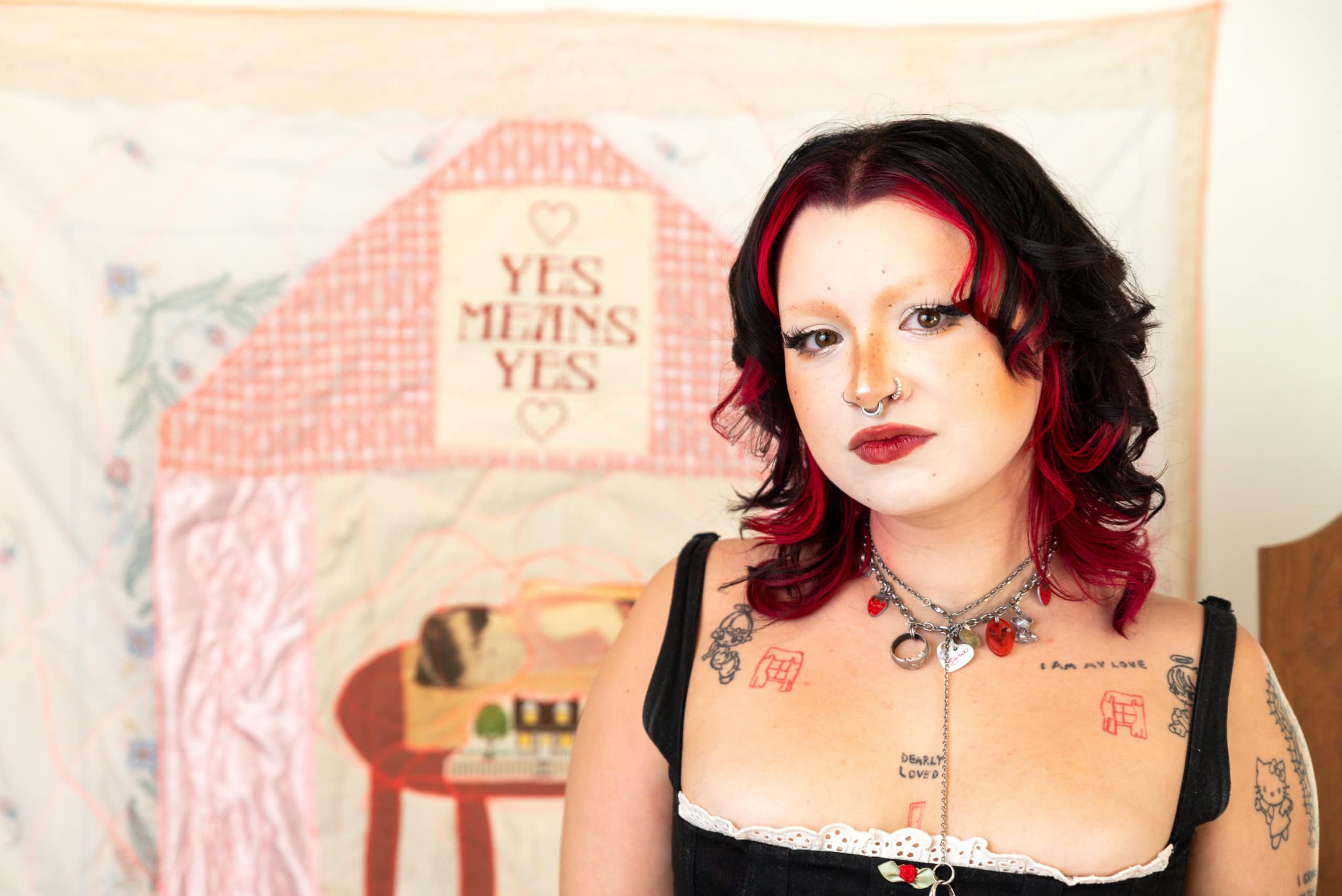
Making became Ruiz’s first form of autonomy. She learned to sew and scavenge materials and tools from her mother’s carpentry studio to construct small pieces of her own. At age ten, she learned to crochet from an elderly woman at the local bingo hall, exchanging card-watching favors for lessons. In these early acts of construction, Ruiz could determine what belonged together, what could be repaired, and what shape something might take. When so much of her life was dictated by others, making gave her a world over which she had authority.
Ruiz eventually left Texas, earned her MFA in printmaking from The Ohio State University in 2023, and relocated to Pittsburgh, where she is based today. Her life was a study in survival: a raw terrain marked by steep highs and devastating lows. Through experiences of prolonged abuse and assault, she came to understand her anger, fear, and bodily responses through the language of complex post-traumatic stress disorder, or CPTSD.[1] The diagnosis placed her on a path toward reflection and self-compassion—a path on which art became the thread binding her rawest pain to her softest vulnerabilities with unbreakable tension.
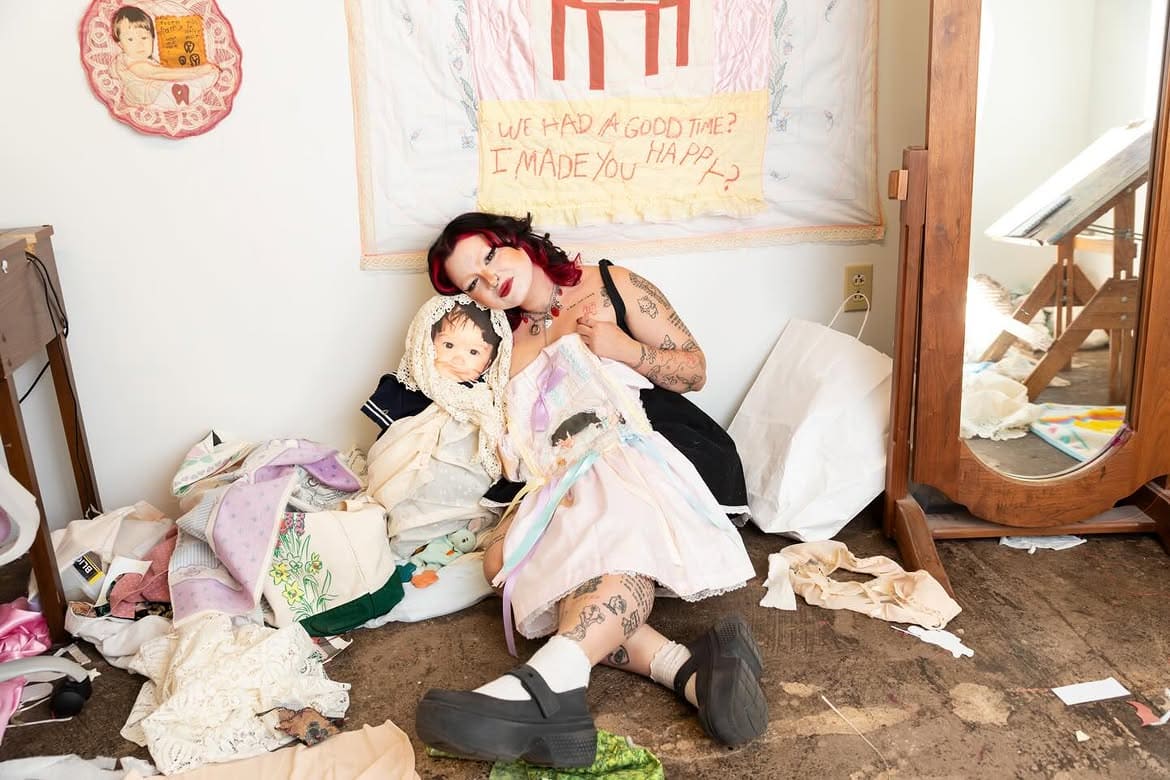
In her work, quilts comfort and testify. Blankets shelter and remember. The home becomes a canvas for the emotions beneath the words of her childhood and adulthood. A single object can comfort, conceal, preserve, and testify all at once.
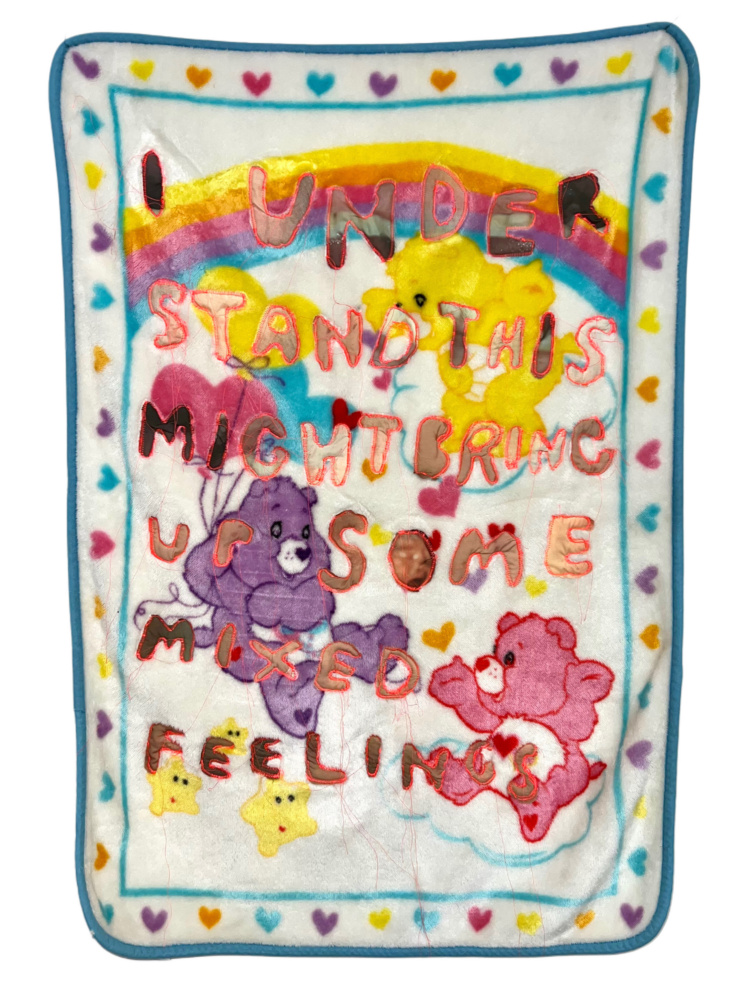
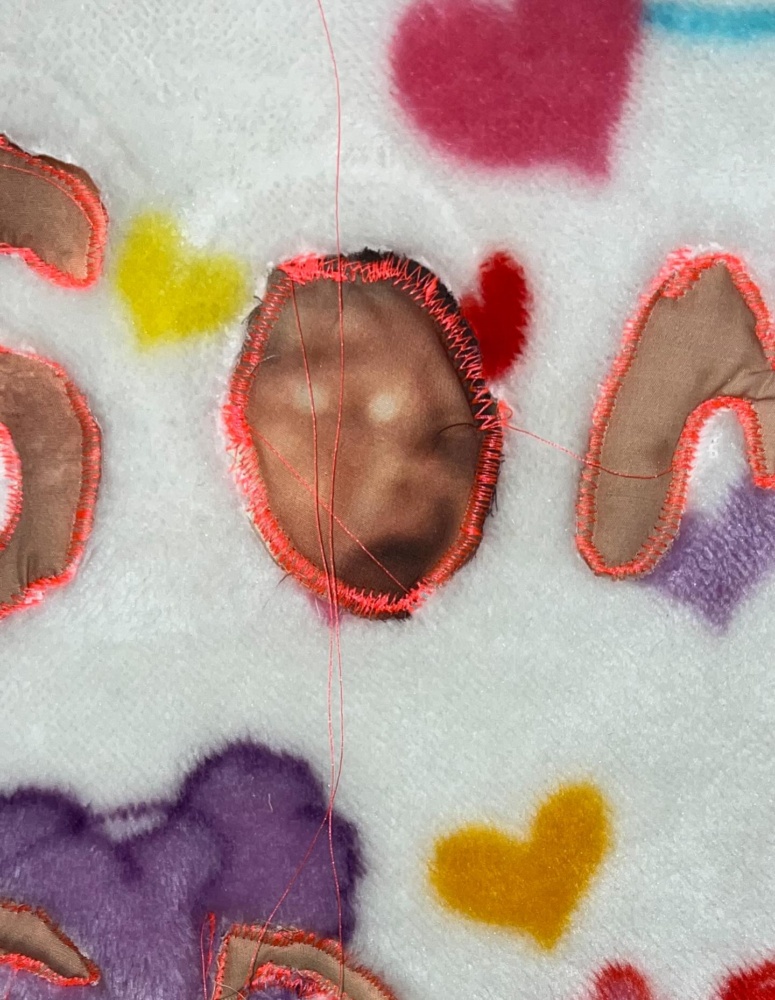
Those same materials return in i understand this might bring up some mixed feelings (2025), titled after a text message from Ruiz’s estranged mother during an unsuccessful attempt to reconnect. Her own pastel Care Bears baby blanket stretches across the wall, its softness arriving before its message. Across the blanket reads, “I understand this might bring up some mixed feelings.” Each letter is assembled from photographs of Ruiz screaming and crying as both an infant and an adult.
Reflecting on the piece, Ruiz says, “I was thinking about how sometimes the screaming and the crying never really stops in your life. I was born screaming and crying and reading that text I felt the same natural reaction—to want to scream and cry.”[2]
Despite the deeply abusive dynamic between them, Ruiz’s mother maintained an extensive archive of her daughter’s life: baby blankets, dresses, early creations, and hundreds of photographs that Ruiz now possesses and incorporates into her work.
The archive complicates any simple division between care and harm. These objects were preserved by someone who also caused pain. They contain evidence of attention without guaranteeing safety, and of intimacy without protection. Ruiz’s work does not resolve that contradiction. It holds the materials close enough for their conflicting meanings to remain visible.
Today, Ruiz has reclaimed the archive— she returned to her childhood home and collected the artifacts of her youth. Every photo, artwork, and journal is now hers to redefine and contextualize, serving as integral tools of her trade. Each piece is a stream of consciousness, much like the journal entries she has written throughout her life. Each begins with the written word, such as a journal entry or phrase that is lingering in her head. Then begins the sifting and sorting: selecting photos and materials that embody the memory and emotion she intends to evoke. After that, the piece comes together swiftly, taking no more than three hours, before it is completed and ready to share on her social media.
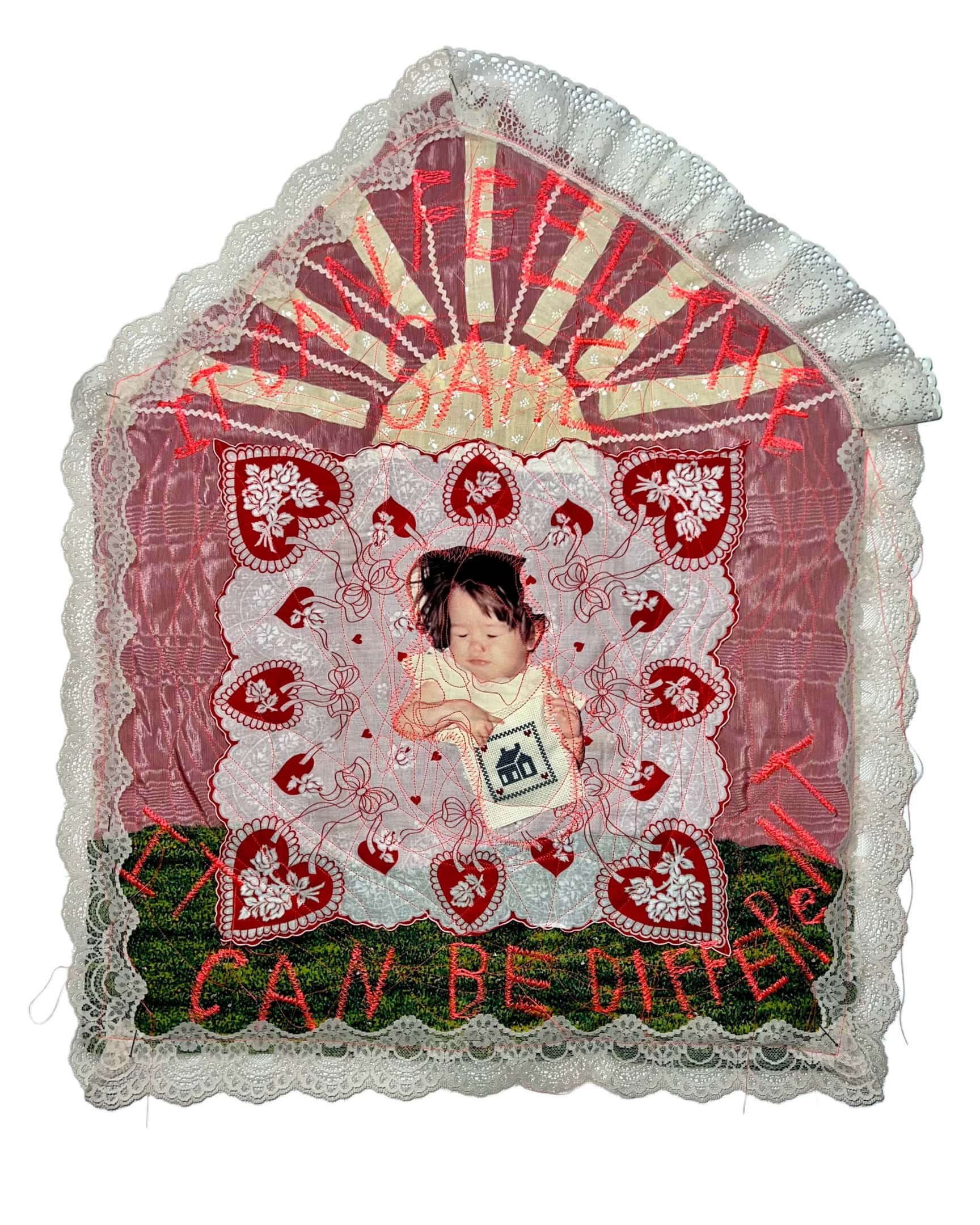
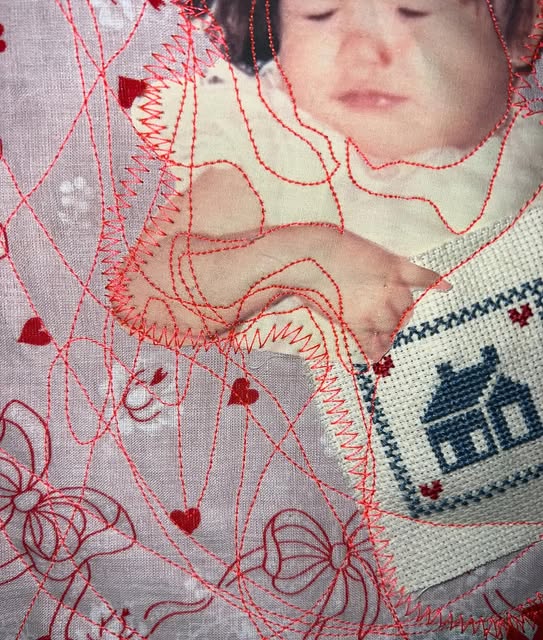
Her piece same but different (2025) returns once again to the image of the house. Framed by delicate white lace, another house-shaped quilt encloses a quiet landscape beneath a pale pink sky and yellow sun. At its center sits a childhood photograph of Ruiz with her eyes tightly closed, a handkerchief pressed into her hands. The sentence, “It can feel the same, it can be different,” surrounds her image in orange threaded text.
The sun’s radiating stitches and gentle pink background do not erase the child’s distress. Instead, they place it beneath a different horizon—one in which fear may still exist, but no longer possesses the authority to define what comes next.
This is the future Ruiz is constructing: a life in which self-expression intersects with public accountability. She creates pieces that dissect trauma, then shares them through social media to foster conversations about abuse, estrangement, survival, and recovery. The past remains present. The materials retain their contradictions. The house can still wound even after it has been left behind, but it is Ruiz who now controls the needle.
[1] CPTSD can develop in response to prolonged or repeated trauma, particularly when escape feels difficult or impossible. In addition to symptoms associated with PTSD, it may profoundly affect emotional regulation, self-perception, relationships, and one’s sense of safety within the body.
[2] Sara Jean Ruiz, interview with the author, July 9th, 2026.