Semi-realistic Buddhist-inspired paintings, abstract photo-derived pigment transfers, and readymade objects: this unlikely triumvirate make up the exhibition “Triple Hits” at Barbara Davis Gallery in Houston, Texas. The works are made by Maisie Luo (Buddhist paintings), Jade Mellor (abstract transfers), and Devin T. Mays (readymades). However different their practices, the artworks come together as objects that straddle abstract distortions and utilitarian communications.
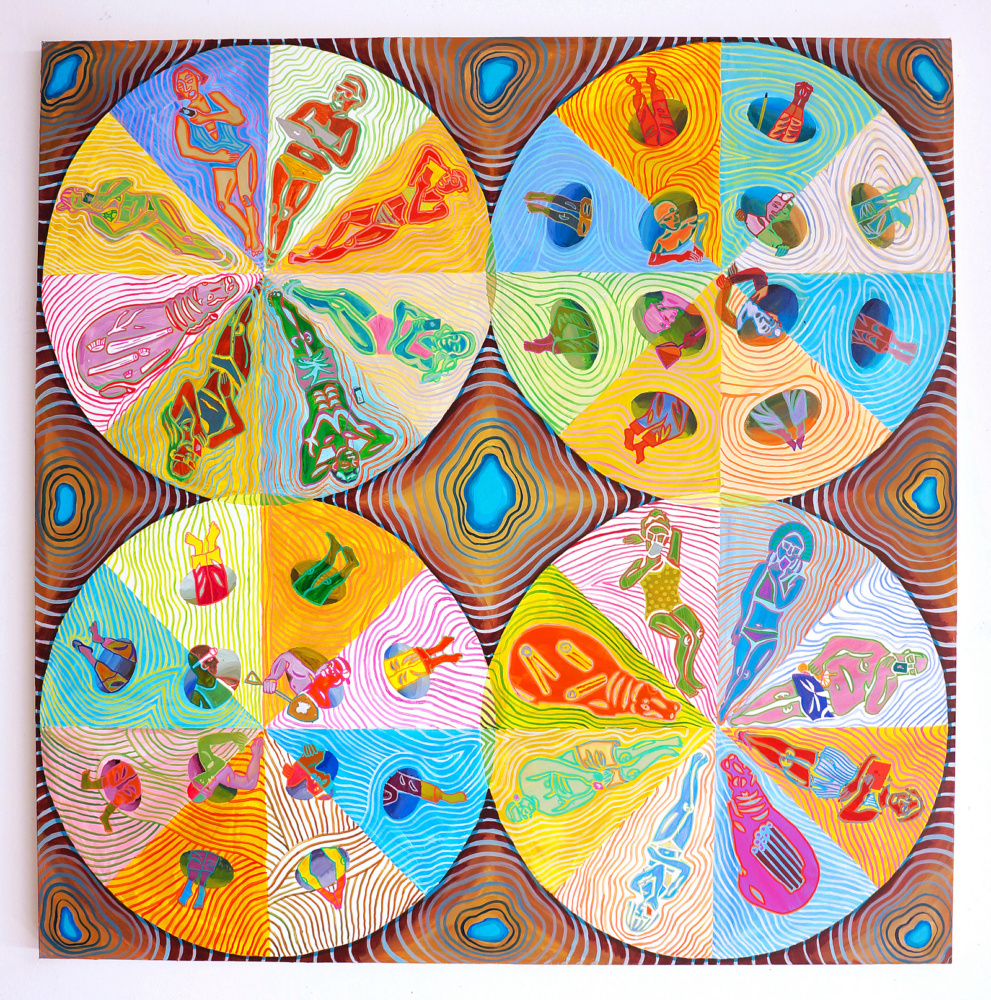
In Sunbathing with Pygmy Hippo (2025), Luo divides the canvas into four parts each comprised of a circular form. The segmenting shapes represent parasols, or chatra, and are symbols of protection in Buddhism. Two of the multi-colored flattened umbrellas are populated with bodily figures—mostly humans and a few hippopotami—surrounded by radiating lines. The reclining human figures have cell phones or laptops, while the hippos seem to have tree stumps and cut branches in their abdomen. There is an opposition to be found here: human/technology versus animal/nature. The other two flat parasols show people diving into or emerging from a set of neatly arranged holes. Those figures emerging have headlamps and shovels, which again signal a human-nature split (one might think of rare earth mining here). But the hippos resemble the shape of conch shells—another Tibetan Buddhist symbol—which radiate awakening sound throughout the entire painting. If there is a general call for ecological awareness in Sunbathing with Pygmy Hippo, there is also emphasis on the bodily (e.g., sound) and even the extra-sensorial (spiritual).

In the adjacent room, Mellor too challenges straightforward communication. This time the object is not ecologically motivated painting but rather a digitally and hand-worked photographic distortion. The works are large scale pigment transfers onto silk, and the resulting images are highly abstract. Untitled 23 (2025) is exceptional in that a vague but clearly human silhouette is decipherable; in most, no clear form is discernible. Mellor constructs the works by digitally combining several photographs, she then enlarges and prints the resulting, already abstract, composites onto several sheets of paper to construct a large-scale image as Untitled 23 is 72 x 52 inches. Using a binding agent, Mellor adheres the prints to stretched silk, transferring the image before she abrades the surface until the paper is worn away. The resulting abstract images carry the outline of the paper shapes that form an irregular grid across the surface, yet this does not expose the full process of making; instead, photographs are transformed over several stages that build increasingly opaque fields of light and color. The layers of distortion, in other words, complicate one’s engagement with the supposedly transparent photographic originals.
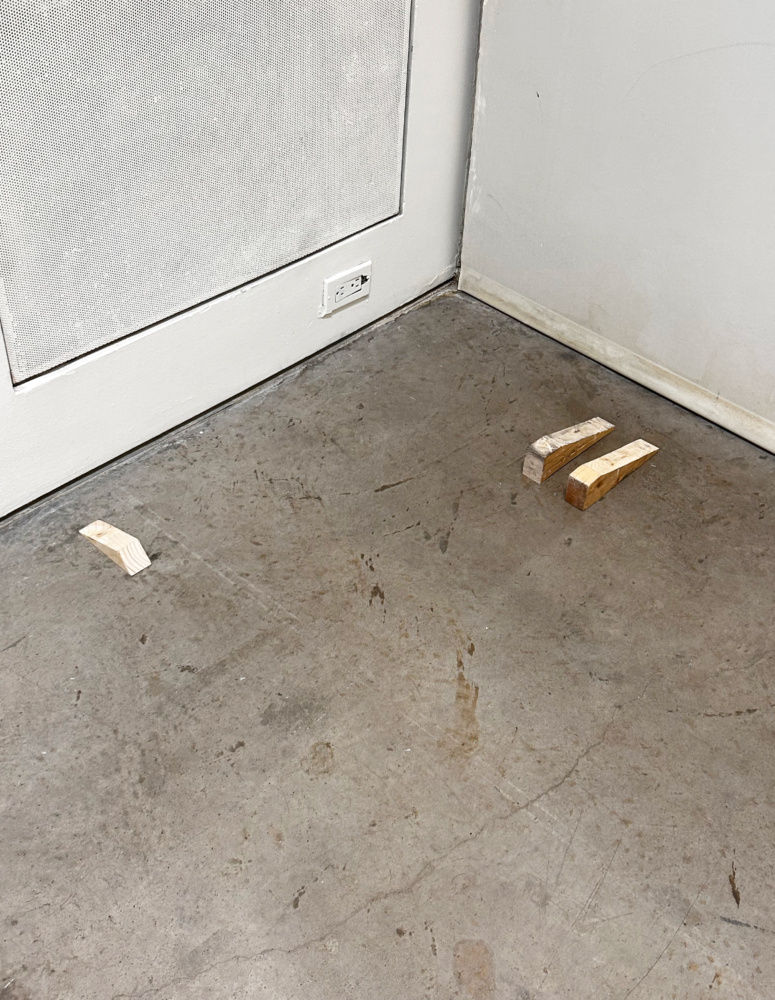
Mays’s Untitled (Unnamed) (2025) shares the room with Mellor and is situated on the floor. The work is comprised of several wooden doorstoppers placed between the wall-mounted objects. Perhaps coincidentally Mays’s early graduate study was in photography, and as he transitioned to found object sculpture he emphasized the tension of legibility. In this work a pair of door wedges placed just a few inches from one another with pointed ends aimed at the wall sparked several gallerygoers to wonder if the objects where remnants of the installation process—as if they had served to keep Mellor’s works off the ground before they were hung. The misreading gives way to a different form of recognition once one appreciates the well-known shape, which of course would not support a two-dimensional artwork. Recognizing the elements as doorstops, but doorstops out of place, the familiar-objects-made-strange point to the space of the gallery: one might look around to see where these came from and then appreciate the ways they are placed between the wall works.
The three artists come together around a thematic of distortion—shifting ecological and Buddhist representation, translating straightforward photographic capture, and questioning conceptions of space itself. Throughout these works, uncertainty (tension between the visible and the invisible) is of increased importance; replacing the strictly graspable, one is asked to experience.
Triple Hits was on view at Barbara Davis Gallery, Houston through December 27, 2025.