I recently found myself sitting in the North Carolina Museum of Art’s auditorium on Super Bowl Sunday, opting to attend a lecture by writer Fred Moten in lieu of preparing for an afternoon of snacks and beer. Moten began his presentation by declaring that he would endeavor to end early, not out of concern for standing between guests and Bad Bunny’s halftime show, but because he wanted to engage in a conversation with attendees, in community.
I lingered on that subtle shift in perspective, from being in dialogue instead of being spoken to. As Moten continued, he talked about our metaphorical movement through art as we experience it. Art does not require passive engagement where interpretation is the final destination. Instead, the exploration the art engenders is the journey; there are multiple vantage points and iterative forms of analysis.
Artists, and by extension writers, largely tend to their work in solitary environments, emerging from their isolation with something to present and share publicly. Creatives release work into the world for it to be processed, leaving the audience up to their own devices to interpret and engage with it as they move on to the next idea that piques their interest. But when one’s critique is successful, it plants seeds of curiosity that blossom into inquiry, thought, and, hopefully, a conversation.
This winter, I paid a second visit to see ‘the halls of a changing sea’ by artist Claire Alexandre at the Gregg Museum of Art & Design in Raleigh. The exhibition opened in the fall, but revisiting this show in the dead of winter, during this season of dormancy, allowed me to experience the show in an entirely different light, which sparked a new conversation with the work.
Bare trees reveal what’s otherwise hidden when stripped of their lush foliage–scars and empty nests become visible and invite inquiry into who or what was left behind as one season ends and another begins. The trunks and branches remain to bear witness. Plants are the storytellers, and artist Claire Alexandre uses plant material as an artistic medium that demonstrates soil’s capacity as a container of history.
In ‘the halls of a changing sea,’ Alexandre introduces her subjects through portraits painted from pigments she has created from the ground they trod. Using collaged fragments of dried plants like pressed pecan, dogwood, and magnolia leaves, Alexandre then embellishes her portraits with personalized attributes loaded with symbolic gestures. These unconventional materials are the byproduct of her exploration of ecology and history, studying the ways Africans across the diaspora have transformed physical and social landscapes as a mode for survival.
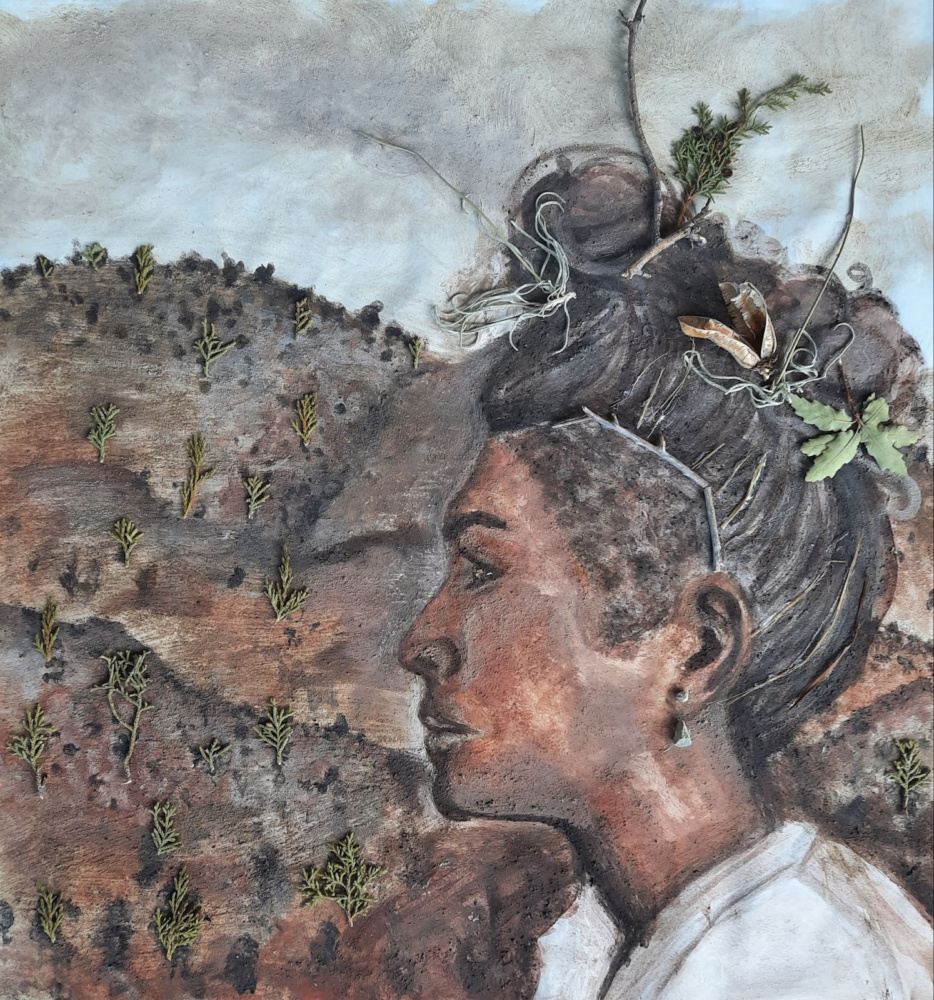
One painting central to the show, titled Desert Child (2021)—a self-portrait against a series of rolling hills representing the artist’s childhood origins in New Mexico—is rendered in shades of tawny brown and copper russet, with paint created from charcoal ash and soil collected from the New Mexican desert. Details are equally pulled from contextual, place-based materials—fragments from a raw turquoise nugget become a dainty earring, while twigs, leaves, and seed pods adorn her hair that’s placed in an updo.
Next to Alexandre’s self-portrait are portrayals of writer and folklorist Michelle Lanier, Director of North Carolina Historic Sites, and Justin Robinson, a Grammy-winning musician, ethnobotanist, and foodway historian. (Michelle, of AfroCarolina, 2021 and Justin, of AfroCarolina, 2021.) Each rendering features soil collected from a formative place for each subject, representing, as the artist describes, “sites of power” that played a profound role in shaping their personhood.
Bare trees reveal what’s otherwise hidden when stripped of their lush foliage–scars and empty nests become visible and invite inquiry into who or what was left behind as one season ends and another begins.
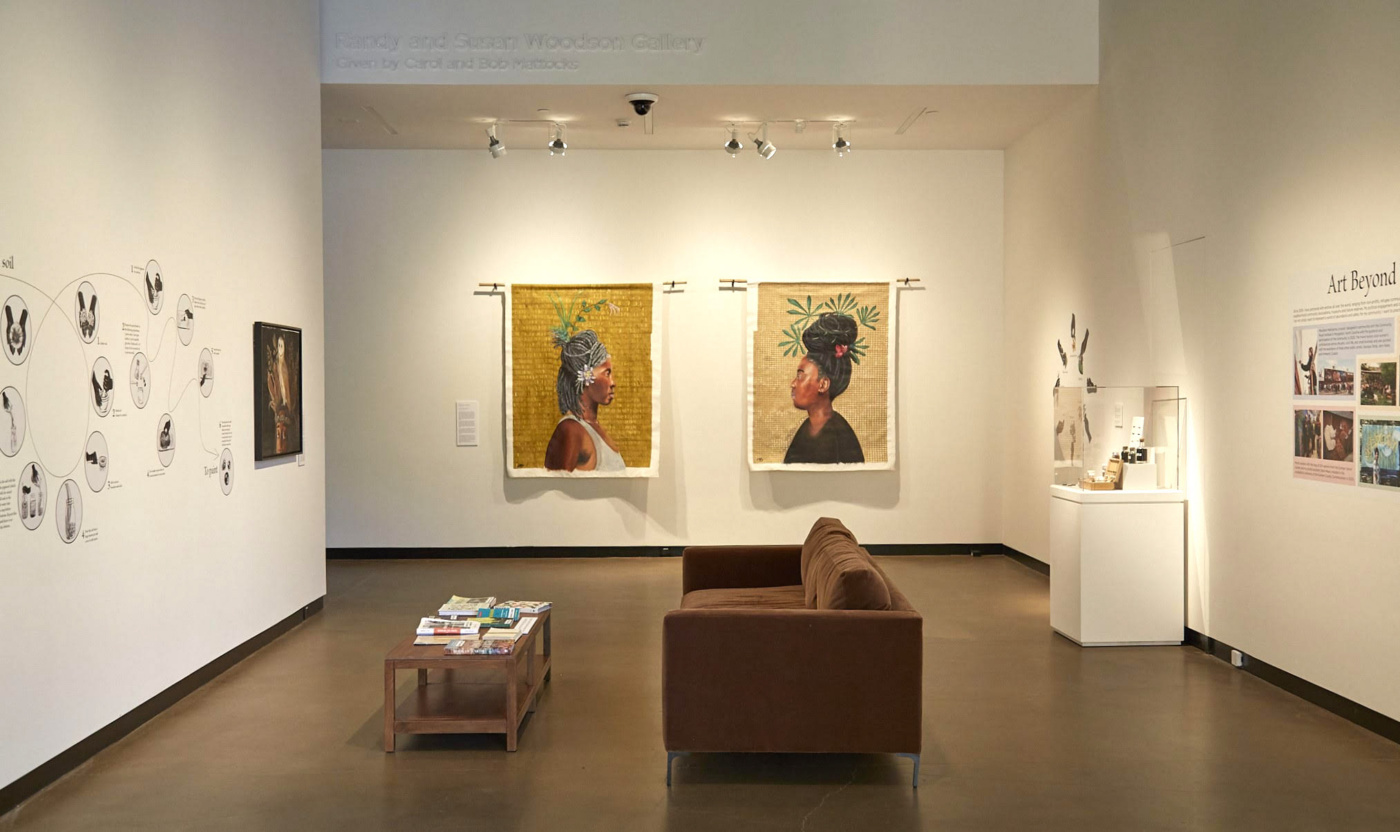
These personal composites also traverse the terrain of time; Alexandre connects these sites of power through the historical political economies that shaped them. In another set of works, two large unstretched canvases of Black women face one another, their braided hair is adorned with plants and flowers that drape like feathered plumage. (Of Place of Power, Courtney, 2022 and Of Place of Power, Azzan, 2022.) Suspended from polished tree branches fashioned into tapestry rods, the portraits lithely float. In each backdrop, Alexandre uses repeated motifs: a banana in one and a sugar cube in the other, symbols of single-crop agriculture that represent parallel systems of extractive labor in the U.S. and the Caribbean.
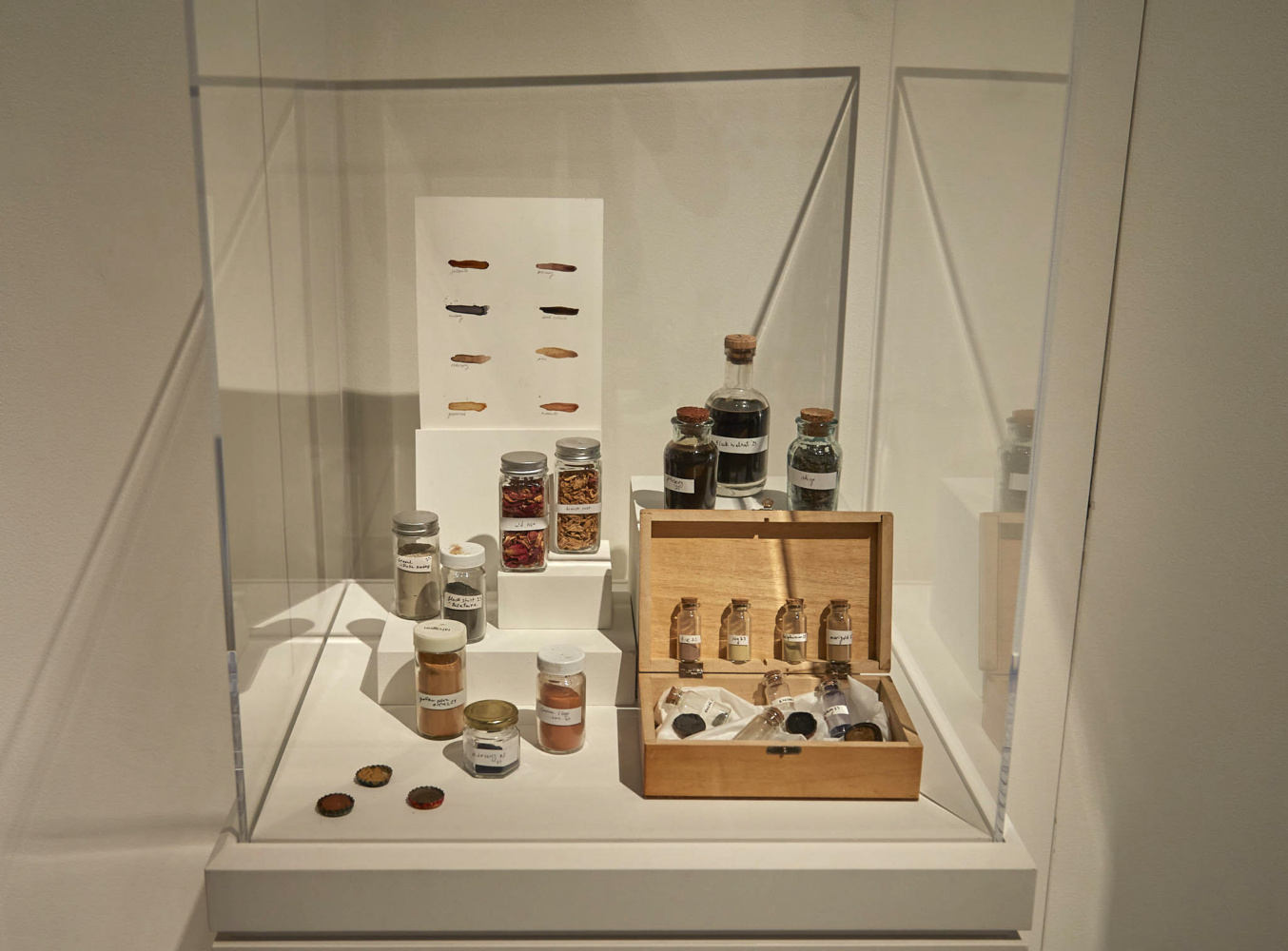
Within the exhibition, Alexandre demonstrates her process through a series of diagrams that detail how she creates her pigments and physical displays of pigment samples. While they offer a glimpse into her technical process, they also offer subtle nods to historical figures that connect Alexandre’s subjects to the land that represents them. One mural illustrates indigenous plant species from North Carolina.
Among the examples, the sight of a bright yellow Carolina Jessamine flower caught my eye. Known for its early spring fragrance, one sense memory flows into another. Harriet Jacobs, abolitionist and author of the book, A Life of a Slave Woman, once said that the sugary sweet scent of the flowers “bear the fragrance of freedom.” (As I write this piece, it is Harriet Jacobs’ birthday.) The conjuring of the Jessamine flower and Jacobs is intentional—they also point to the portrait of Michelle Lanier, who, as the Director of the Harriet Jacobs Project, has long served as a stalwart custodian of the memory of Jacobs and her life’s work.
Harriet Jacobs was an enslaved woman from Edenton, North Carolina, who fled her abusive enslaver in 1835. After hiding within a small garret in the attic of her grandmother’s home for seven years, Jacobs escaped north and lived in fugitivity as a writer and abolitionist until she was manumitted in 1852. When she first fled, she sought temporary refuge in the southern flank of the Great Dismal Swamp, likely with the aid of maroons living in the region.[1]
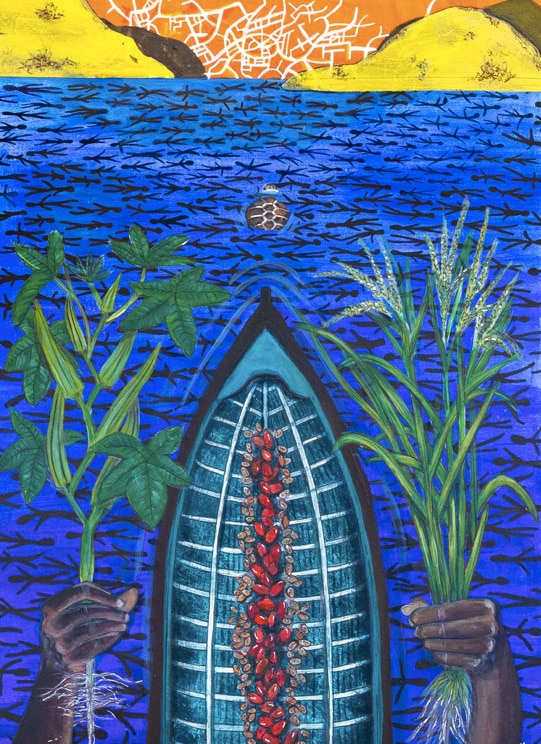
Alexandre, in her exhibition, also evokes the concept of marronage—a form of survivalist self-emancipation where enslaved Africans escaped plantations and sought refuge in remote environments, including swamps and wetlands that were notoriously inaccessible due to the terrain and dangerous wildlife. Maroons developed communities built on the subsistence of the land, using their knowledge of the terrain to facilitate the escape and refuge of other enslaved people. The artist represents these liberatory practices in many of her pieces through plant materials known in Indigenous cultures for their medicinal and healing properties.
The two Of Place of Power portraits draw the viewer’s attention to these aforementioned plant materials used by Black and brown communities for sustenance and survival, while also situating her subjects within a framework of labor exploitation. Of Place of Power, Courtney, shown on the left, wears a crown of West Indian Lemongrass, anamú, and passion flower: plants known for their antioxidant, spiritual-cleansing, and protective properties. Similarly, in the accompanying portrait Of Place of Power Azzan, Alexandre accessorizes her subject with yucca leaves and achiote pods whose dried, red seeds were historically used by indigenous Brazilians and Americans to create red body paint used for adornment and regalia.
These paintings, part of the artist’s Resistance Series, use symbols of sovereignty that cut through the layers of colonial history embedded with their capitalistic backdrops, urging a re-examination and re-negotiation of these calcified, codified layers of existence. Viewing the pair of portraits and their associations with labor and exploitation, my thoughts drifted toward present-day modes of captivity, including carceral systems and extractive digital spaces that control and exploit our physical, intellectual, and cultural capital. As some people grow weary of and disillusioned with the virtual platforms, there has been a noticeable cultural flight to analog. It seems as though some social media users are embracing a form of digital marronage, opting for an offline existence that’s free from algorithms, online extremism, and AI slop.
While the work invites reflection on these captive systems, practices, and behaviors, Alexandre turns that knowledge and reflection into action. She leans into history and works through it, in dialogue and in community, using land as both a teacher and a tool to illustrate her process. As Moten’s recent talk reinforced the idea of art as a prism, Claire Alexandre offers a unique lens through which we can view the many layers of history that influence and shape us over time.
1. Bacon, Camille, Daria Simone Harper, and Niara Simone Hightower. “‘Let Us Draw Nigh’: Remembering A Sojourn for Harriet Jacobs,” Burnaway, August 1, 2024. https://burnaway.org/magazine/let-us-draw-nigh-remembering-a-sojourn-for-harriet-jacobs/