
“Whiter still I am a reversed silhouette
against the black backdrop where I pose, now,
for photographs, a man named Bellocq.
He visits often, buys time only to look
through his lens. It seems I can sit for hours,
suffer the distant eye he trains on me.”
—Natasha Trethewey, “Letters from Storyville” (March 1911)[1]
Scene Direction Acts I–III
A woman known as Lady #1 stands draped in blush fabrics in front of a photographer’s black studio backdrop. On pedestals of varying height and strewn about the floor, books open, pages turn on their own. Vessels of water, model’s stools, a few pairs of black and white striped stockings dangling from a flower covered trellis. A breeze blows through and a chorus of seven women, in partial states of dress and undress, walk into the frame. The clothing is in the style of the nineteenth-century baroque fashion of France, New Orleans, and the Kanem-Bornu Empire.[2] Archival silent movies and new clips of an imagined contemporary, cut with scenes from the work of the filmmakers Sergei Parajanov, Melvin Van Peebles, and Horace Jenkins, are projected onto the backdrop behind her, and across the skin of all the women.[3]

I
Lady #1 reads.
My relationship with the camera unless it’s in my hands, and honestly even then, has thus far been fraught. The lesson in America is that anything and everything can be stolen, can be lost, especially yourself, in the blink of an eye or a flash of light. Yet, more and more I continue to desire to look through my own lens for new ways to tell stories; I write in order to wonder if there is more.
In her essay “Toward a Radical Cinematic Horizon: The unrealized works of Toni Cade Bambara and Gloria Naylor,” the scholar Randi Gill-Sadler brings readers into the intimate world of the Bambara’s and Naylor’s cinematic dreams.[4] Gill-Sadler posits the novelists’ works and their designs, realized and not, as antithetical to what Bambara refers to as “Hollyweird.” Bambara had coined the term in her 1987 essay “Why Black Cinema?,” honing in on Hollywood’s ultimate product, for which movies are but a proxy. Paraphrasing Bambara, Gill-Sadler reveals that Hollywood is selling the viewer the idea that things never change.[5] No matter how far the narrative may go to titillate you to change’s very borders, it is ultimately the status quo’s victory. Funnily, I love movies but often battle anxiety about movie theaters. I worry about the monsters that lay waiting outside the bubble of fantasy, making me uneasy; the vulnerability of sitting in the dark with strangers. At a friend’s invitation, I opted for another feeling about them and went to the movies to see the feature film IS GOD IS (2026).
The camera cuts to a pinhole view of the women. Depending on their movement, who and what is visible varies.
Lady With A Purple Veil reads:
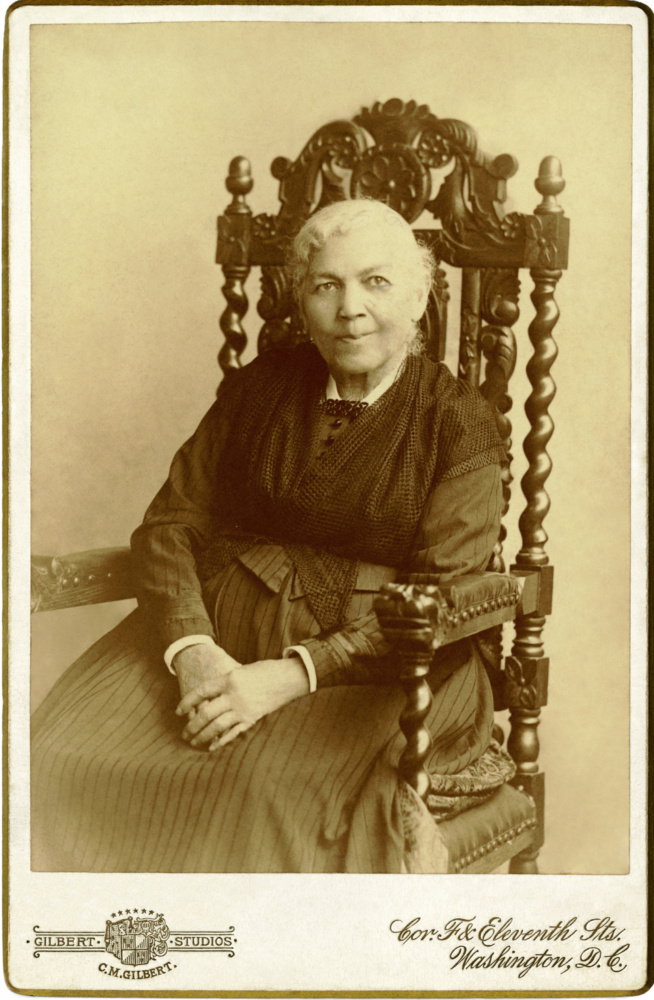
“The camera obscura, an invention important in the development of later photographic technology, projects an inverted version of an image through a pinhole of light onto a surface near its opening.” In my essay, “The Darkroom in the Attic: Blackness and Visibility,” I think about the life of the abolitionist and writer Harriet Jacobs.[6] Her autobiography, Incidents in the Life of a Slave Girl, published in 1861, narrates Jacobs’s journey from captivity to freedom, including a seven-year concealment in a tiny attic above the home of her grandmother. Through a one-inch hole, Jacobs saw glimpses of the lives of her children and family, watching the condition of enslavement unfold and plotting her escape.
In “Camera Obscura After All: Racist Writing With Light,” a chapter in his book The Message is Murder: Substrates of Computational Capital, the critic Jonathan Beller likens Jacobs’s positionality to that of the camera obscura, through which the images of her children and others are projected and become a part of a visual field which she can only observe. It is through confinement that Jacobs disrupts her enslavement to reclaim her own life and image.
The camera returns the viewer to a full view of the women. Two ladies from the chorus read without moving to center:
Rejoining Jacobs as she departs the attic and steps into her literal afterlife of slavery, did she hear of the way manipulating images with light could make words and ideas move? Given she had watched many lives unfold through the narrow opening in the garret, had she looked through a lens, what might Harriet have seen?
In the late 1880s came celluloid. Film made featherlight, no longer requiring the cumbersome weight of glass. Still images began to gain motion. Harriet Jacobs would die in 1897 in Washington, D.C., her time on earth taking her right to the edge of these moving images’ debut and transformation of Black American life.
The chorus of women cover their faces with black lace veils, one by one with the exception of Lady #1 and Lady With A Purple Veil.
II
Countess writes my description for the book—
“Violet,” a fair-skinned beauty, recites
poetry and soliloquies; nightly
she performs her tableau vivant, becomes
a living statue, an object of art—
and I fade again into someone I’m not.
–Natasha Trethawey, “Storyville Diary” (June 1911)[7]
Lady #1 reads:
In Envisioning Freedom (2014), the scholar Cara Caddoo looks at the cultural implications of the simultaneous advent of moving pictures with the codification of Jim Crow laws via the 1896 Plessy v. Ferguson Supreme Court decision. Both the Vitascope’s premiere in New York City and the court’s hearing of the case arrived on the same day.[8] Caddoo asserts that the convergence of these two historic events forever marked the relationship between Black people and the media. She traces early Black cinematic culture and practices in the late 1890s and 1900s to reveal its roots in the South and West and foundations in the Black Church. Before its industry consolidated into the Hollywood structure of today, film and cinema lived and grew its wings in the outskirts of American society among its most marginalized citizens. The work of Black women in the South and Midwest was critical in shaping the course of the genre’s history. Black women’s auxiliaries and benevolent societies played a key role in organizing film presentations in Black sacred spaces, as elucidated throughout Caddoo’s research.
Itinerant Black projectionists in the 1890s and early 1900s took their exhibitions on the road, their routes growing with the expansion of American railways and then out to the further reaches of Mexico and Cuba. Often shown accompanied by lectures, live music, and other performing acts, films of less than a minute long were juxtaposed, cut, and spliced together. Caddoo in particular cites William G. Hynes’s presentation of scenes from great American fires alongside images of racial uplift. Films made by white production companies were also reenvisioned through the inclusion of still and moving images of exotic and familiar locales and racial progress.
The chorus of women remove their black veils and replace them with purple, white, blue, red, yellow and pink, alternating.
Lady With A Purple Veil reads without coming to the center:
Many of the stories I write are mystical in nature. Right now, the challenge is trying to figure which ones should be embodied and which ones demand the right to the private opacity of the imagination. Sometimes the learning curve is painful. In Brenda Marie Osbey’s “Why We Can’t Talk to You about Voodoo,” Osbey speaks to the distortions of New Orleans’s famed, but misunderstood, spiritual traditions on both page and screen.[9] Tourists to the city can readily purchase the fictional and commercialized ephemera of Black sacred and cultural practices. Transplants to it, who work in the realm of the arts, can elect easily to profit from their cursory observations. Observations that often pull conclusions about the city’s people toward stereotypes and away from self-definition.
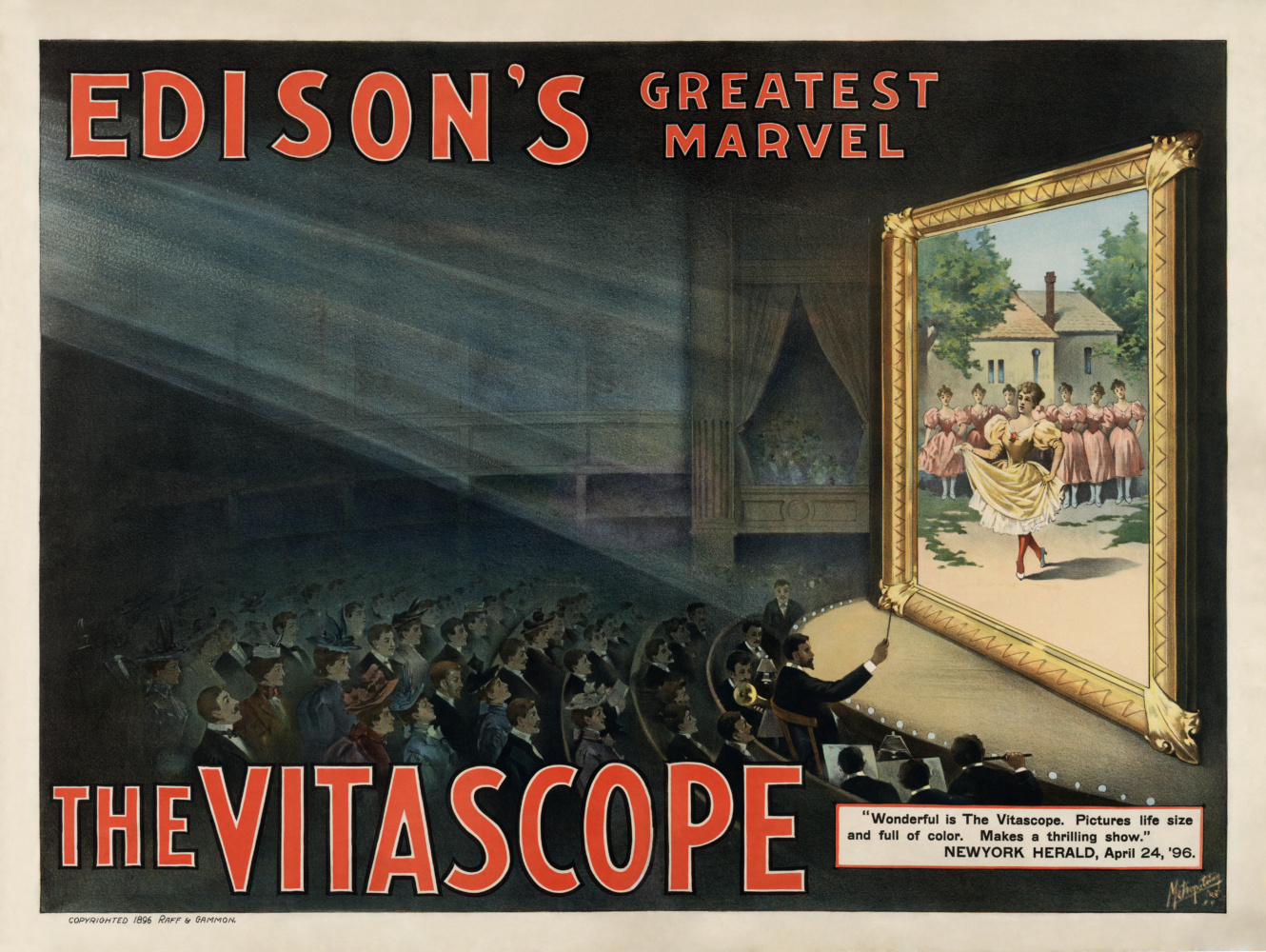
in); width: 73 cm (28.7 in) 29057B U.S. Copyright Office, 1896. Image by Metropolitan Print Company; Copyright 1896 by Raff & Gammon and courtesy of Wikimedia Commons, CC by 2.0.
III
punctuating each new thing taught. There
at school, I could escape my other life of work:
laundry, flat irons and damp sheets, the bloom
of steam before my face; or picking time
hunchback in the field— a sea of cotton,
white as oblivion—where I would sink
and disappear. Now I face the camera, wait
for the photograph to show me who I am.
—Natasha Trethewey, “Letters from Storyville” (March 1911)[10]
Two women from the chorus read:
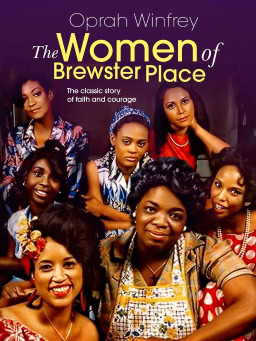
In Gill-Sadler’s essay “Toward a Radical Cinematic Horizon,” we follow Gloria Naylor forming her own production company on the heels of Oprah Winfrey’s adaptation and production of Naylor’s novel The Women of Brewster Place into a 1989 television miniseries for ABC Network. Gill-Sadler also explores Naylor’s M’Dear, a teleplay and proposed episodic series that follows the relationship between Fannie, a young mother, and M’Dear, an elder and conjure woman. Fannie, in grief, turns to M’Dear for assistance in retribution, testing M’Dear’s spiritual moral code.
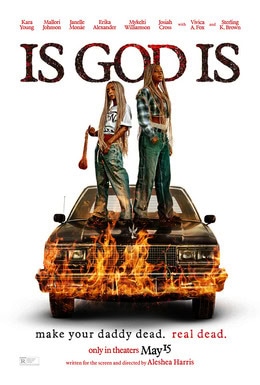
The question of retribution echoes also in Toni Morrison’s Song of Solomon (1977). In the novel, a secret league of Black people known as The Seven Days avenge every Black person extrajudicially murdered by white supremacists, choosing a white person at random to be killed in the same manner. I considered Gill-Sadler’s essay and Morrison’s novel again while watching IS GOD IS, which was adapted by the director Aleshea from her original stage play. Harris sets viewers in the world of Racine and Anaia, referred to in the film as “those burning twins.” Badly “disfigured” in a fire set by their father, the twins are called to vengeance by their long absent mother, who has been bedridden by her burns, also suffered in the same blaze.
Truth, lies, and memory collide in the retelling and the twins’ journey southward to their origin story and respective destinies. Shot in New Orleans, the film features the city’s lush landscapes, which with its relics of ruin form a quiet but poignant accompaniment through the terror and absurdity of the tropes within the Black Southern Gothic, one being the journey back South—where, of course, all the monsters reside. I read this movie, through my own lens, as a duel between patriarchal and matriarchal aesthetic conceptions of God. An investigation into what the wages of representation are in truth, if the warring gods share the same epistemological root—the single, jealous, vengeful god who requires that there be no others.
As the action progresses, we begin to see that Racine has inherited her father’s more straightforward bloodlust and psychopathy, while Anaia mirrors her mother’s festering wounds, bloody resentment, and quiet, seething anger. In one retelling, it is their father god who nearly kills both them and their mother, and in another, it is their mother god who pulls them toward herself and their lifetime of cooling their skin with ice. In the end, one that comes and goes on screen too quickly, it is Anaia who leaves her sister to die—this time abandoning her more easily than she did her mother god, whom she had fought hardest to save, and leaving her much more badly burned. The consequences of her bravery condemning her ironically, to be deemed as ugly and, maybe more offensively, weak.
Lady With A Purple Veil:
Racine’s and her father’s deaths are deemed by the film’s conclusion as brutal yet necessary to the creation story of a new mother god. There is no such thing as sister god, in case you were looking for a change. We don’t ever learn the female Titan’s fate, when or if the mother god actually passes away, or how she feels with now only one daughter on who to stake her claim. Viewers are told Anaia’s singular existence is the only kind of life that will bring her the freedom, the happiness, or even the elusive vanity that she desires. Blood is the cost, the gore of another is the sacrifice that all the gods of Hollywood require.
The camera reverts to a pinhole view, leaving only the view of Lady #1.
Lady #1 reads:
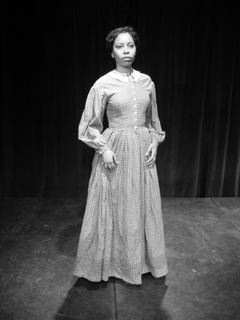
Song of Solomon ends with the character Guitar’s decision to murder his friend, Milkman, whom he has stalked for almost the duration of the novel. Guitar, who wants his friend’s inheritance, has his mind made. Incidents in the Life of a Slave Girl has been adapted into a theatrical solo performance by the theatre director Wynn Handman. The filmmaker Karen Hayes adapted it for the screen with a nineteen-minute short film, and the website IMDb suggests potential television development, but no production yet. There has not yet been a feature, but as the writer Hanif Abdurraqib remarked on an episode of the podcast Passages regarding Song of Solomon, I’m not sure there should be. Not without that elusive eye for change that I so crave. In IS GOD Is, we learn the cost of Racine’s anger but not of Anaia’s decision to walk away from her. IS GOD IS’s concluding moments feature the lone voice of Anaia, no more a twin, and shots of the top of her newborn’s head. A new star in flight leaping, toward false light.
[1] Natasha D. Trethewey, ”Letters from Storyville,” in Bellocq’s Ophelia: Poems (Graywolf Press, 2012), 20.
[2] The Kanem-Bornu Empire is a historical state (ca. 700–1900) centered around Lake Chad, covering parts of modern-day Nigeria, Niger, Chad, Libya, Algeria, and Cameroon.
[3] Sergei Parajanov (1924–1990) was a Soviet film director and screenwriter of Armenian descent, whose films are distinguished for their poetic, experimental and nonlinear nature. Parajsnov is popularly known for The Color of Pomegranates (1969), which attempts to reveal the life of the Armenian ashug Sayat-Nova (1712–1795) visually and poetically, rather than literally. Melvin Van Peebles, (1932–2021) was an American actor, filmmaker, writer, and composer. His best-known work, Sweet Sweetback’s Baadasssss Song, is a 1971 independent thriller about a Black man fleeing from the white police authorities. Fellow American filmmaker Horace Jenkins (1941–1982) is widely recognized for his 1982 romantic drama, Cane Rive. Considered lost until its rediscovery in 2013 (and re-release in 2018), the film narrates the lives of several Black Americans in Louisiana.
[4] Randi Gill-Sadler, “Toward a Radical Cinematic Horizon: The unrealized works of Toni Cade Bambara and Gloria Naylor,” Oxford American, September 5, 2023. https://oxfordamerican.org/magazine/issue-122-fall-2023/toward-a-radical-cinematic-horizon.
[5] Gill-Sadler later discussed elements of her essay in the podcast Millennials Are Killing Capitalism. See Josh Briond and Jared Ware, hosts, Millennials Are Killing Capitalism, podcast, season 1, episode 285, “Divesting from Hollywood and State Narrative: On Toni Cade Bambara & Gloria Naylor With Randi Gill-Sadler,” December 15, 2024, https://millennialsarekillingcapitalism.libsyn.com/divesting-from-hollywood-and-state-narrative-on-toni-cade-bambara-gloria-naylor-with-randi-gill-sadler.
[6] Kristina Kay Robinson, “The Darkroom in the Attic: Blackness and Visibility,” Burnaway, June 29, 2020, https://burnaway.org/magazine/the-darkroom-in-the-attic-blackness-and-visibility/.
[7] Natasha Trethewey, ”Storyville Diary”, in Bellocq’s Ophelia, 40.
[8] Cara Caddoo, Envisioning Freedom: Cinema and the Building of Modern Black Life (Harvard University Press, 2014), 2.
[9] Brenda Marie Osbey, “Why We Can’t Talk to You About Voodoo,” Southern Literary Journal 43, no. 2 (2011): 1–11, https://doi.org/10.1353/slj.2011.0001.
[10] Trethewey, “Letters from Storyville,” 21.