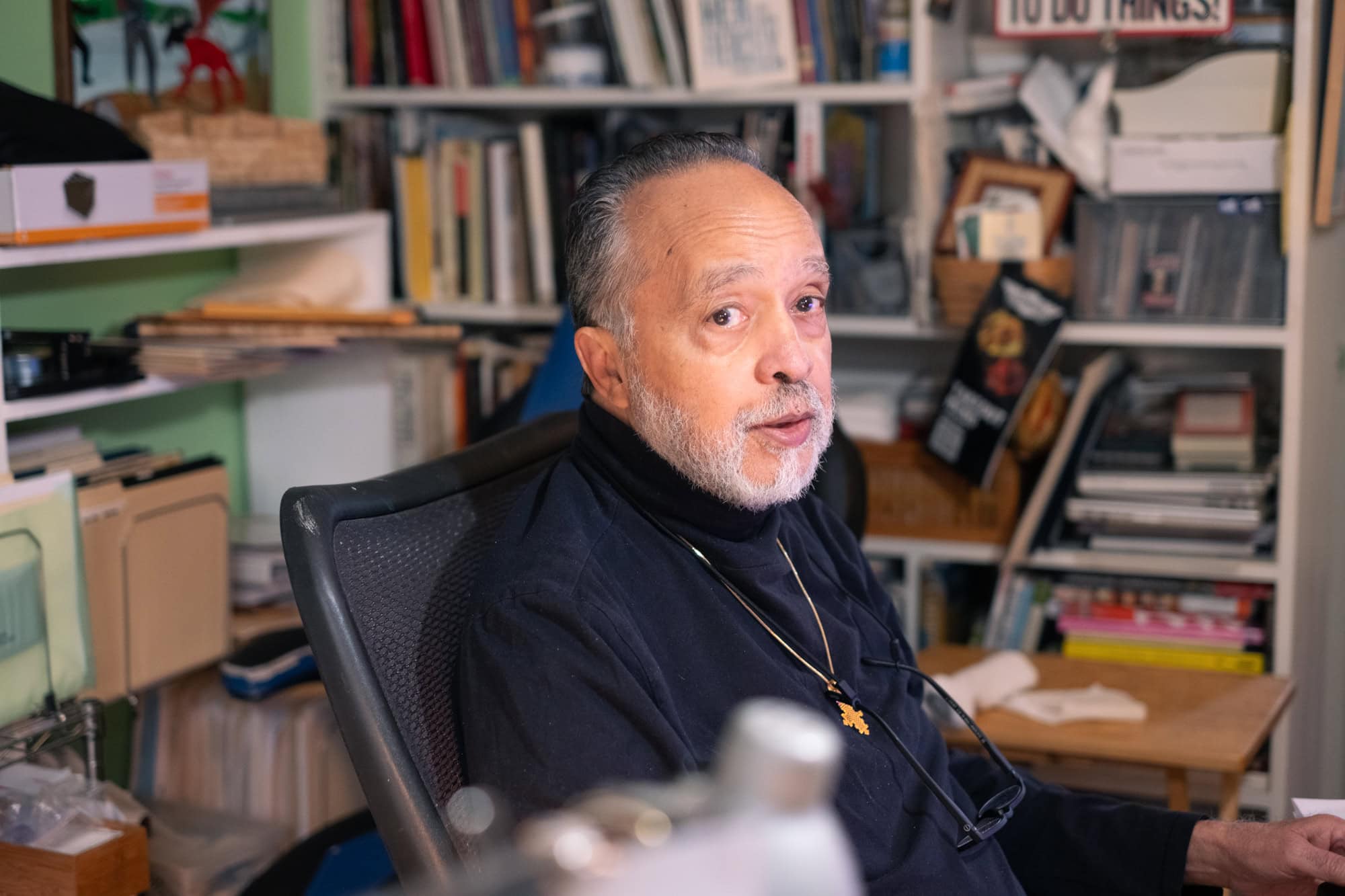
“God is from Colón”, Arturo Lindsay says about his home in Panama*.[1] He continues, “then she sends us on our way, but she always keeps us close to her heart as we keep her close.”
This statement permeates our conversation at the African Diaspora Art Museum of Atlanta (ADAMA). The show Patacones, Paintbrushes, & Power, co-curated by Tosha Grantham, Dr. Fahamu Pecou, and Dr. Renée Alexander Craft, features the work of Lindsay along with a collection of artists of African American and Afro-Latino heritage, many of whom the artist lovingly calls his godchildren.
The exhibition was a homecoming of sorts, combining the Taller Portobelo (Portobelo Workshop) collective that Lindsay co-founded with renown artists Sandra Eleta and Virgilio ‘Yaneca’ Esquina, alongside the artists Lindsay mentored during his tenure at Spelman College, namely Pecou, founder of the museum. With a number of artists, friends, and mentees in the show, Lindsay, a decorated professional with an international career that has spanned for decades, says he took a backseat only including one of his own works.
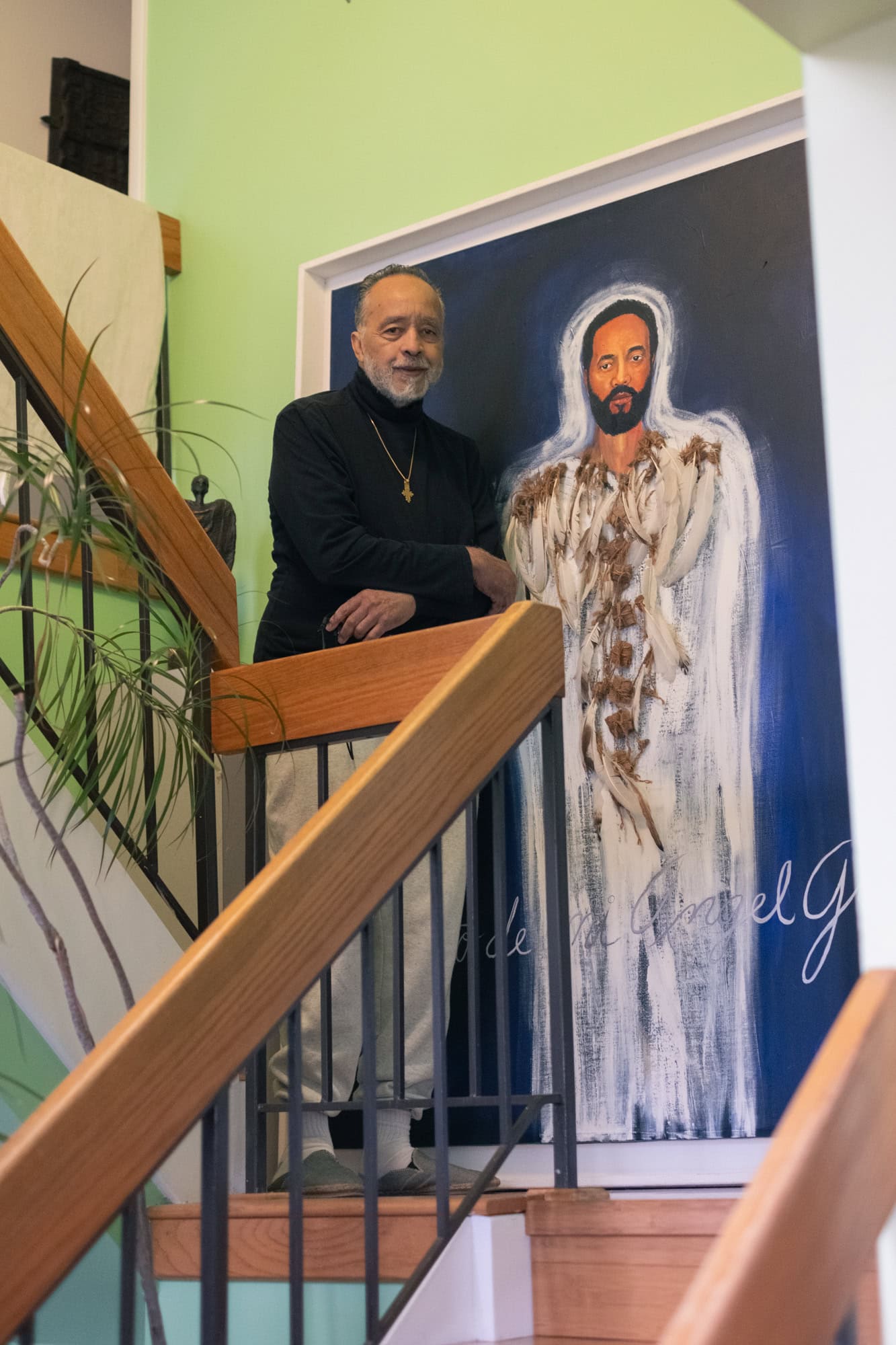
Made over twenty years ago, typically taking up a more casual display in his home archive, Retrato de mi ángel guardián (Portrait of My Guardian Angel) (1999) inspired my discussion with Lindsay. The work prominently features an angel, wings folded, in front of an indigo background with eyes facing the viewer. It is a likeness of Lindsay himself. The quiet curiosity that the piece incites leaves me with double vision when the artist is beside it—two pairs of eyes look out, one younger, made with paint, from the past, and one older, in flesh, from the present. It produces an array of questions from me and Lindsay answers not withholding.
We go from place to place, childhood to adulthood, angel to freedmen to spirit to demon.
This interview has been edited for length and clarity.
Demetri Burke: What makes you excited about the show at ADAMA?
Arturo Lindsay: There are many levels. First and foremost it being organized by some young people that I’ve worked with for many years, my ahijados and ahijadas, and to see what they have done in terms of bringing together the Congo artists of Portobelo with the artists of the US, mainly through Atlanta.
It’s a great accomplishment because I remember when Panama was invaded by the US back in the late 80s. I was in Lancaster, Pennsylvania, and it was cold, and it was around Christmas time, and I was on my way to a party. Folks were saying, I’m really sorry to hear about Panama being invaded. And then the question would be, are any family members hurt, and I can’t tell because the phone lines were down. And then another series of caring questions. And finally, it would burrow down to [one lasting] question: are there any Black people in Panama?
When I was finally able to get through after a couple of weeks, my cousin Linda said, “Arturo the Panama you know, no longer exists.”
That’s how devastating the invasion was.
I had to try to figure what is the Panama that I know, and I thought about being seven years old and going on an errand for my parents [during the Congo Carnival].[2] This Carnival is a performance art ritual that tells of the story of the enslavement. Devils walk around with whips, and they represent the evil that had possessed the Spaniards to enslave folk. The devil has the right to whip anybody during Carnival. It’s never anything above the knee and some kids know this so they’ll put on three or four packs of socks.
Anyway, my mother sent me on this errand and told me not to go through the alleyway. That’s like telling, “Turo go through the alleyway!” I was not a well behaved kid.
When I saw the devil in that very alleyway, I couldn’t scream because my mother would hear me, which meant that I was going to get whipped by the devil, then I’m going to get home and get whipped by my mother, and then be whipped by my father, just because I wanted to go through the alleyway. I was frozen.
Then the Congo came sliding through the legs of the diablo and began to do this Congo dance, this is sort of cross legged thing. It distracted the devil, which made me turn around and run back home. Thank God my mother didn’t know what had happened. I just finished experiencing the devil, and the devil is wearing this huge costume, right? And it scares the living so and so out of you, and I wet myself.
I buried that memory. You know, back then, it took the damn invasion to bring that memory back up. Wow. And then the question was, who were the Congos?
I had just finished doing a book on Santeria aesthetics. I could tell you anything about the Yoruba tradition, and the “new world” but I didn’t know much about the Congos. After the invasion, I talked to my tío Carlos and he said, “Turo you are not going to find out anything about the Congos in the libraries. You have to go home. And you have to go to Portobelo, where the Congos are seeped into the culture.”
I didn't need the Quran and I wasn’t using the Bible so love poems would protect my guardian angel.
And I did. I went to Portobelo with the expressed idea to understand but to also build bridges. Gringos here in the US had no idea who Panamanians were. “What the hell difference does it make?” We diminish the humanity of a person. And that is what happened, the humanity of the Panamanians had been diminished.
So to see this exhibition with artists that I helped train in Portobelo with US American artists, and everyone working together, it’s a sense of satisfaction.
DB: Featured in the show is Retrato de mi ángel guardián. The painting is a likeness to yourself. Is that you in the portrait, the same man standing before me?
AL: My guardian angel is by far a much better person than I am. My guardian angel, I think, keeps me out of trouble.
I have this theory. On the day that I pass from this life into the other, that there is going to be a company of archangels sitting around, “Come here, bro, we need to talk.” I think my brother Luis might be standing there with them. “You see the child being born right now, that child’s going to be a pain in the ass, and you are going to be their guardian angel.” Okay, at least can I get a bit of a vacation?
Now, to get specific to this particular painting, once I started dealing with the Congo culture, I already told you about two characters. I told you about the devil and the Congo. But then there are angels. And the angels run around town trying to capture devils, and take them up to the priest who will bless them so that they can rejoin humanity. As I started working on my self -portrait, the notion is, “Why not go beyond just painting yourself and try to paint your guardian angel.” And if you notice something that runs throughout my work, I’m seeing more of the origins of it as I’m going through my older stuff, you’ll see the face in some kind of realism representation, but then the body just becomes ephemeral, right?
And when you’re looking at the [Congo performer’s] chest you see these little packets. Throughout regions of Africa, people have war jackets or hunter jackets. The packets on the jacket would have the horns of boar, antler, and things like that. The whole idea is that the spirit of the wild animal is on you like a bulletproof vest. When I was looking at the jackets of the Congos, and I said, man, this stuff has to come from Africa.
I wanted to have this sort of protective thing from my guardian angel. I had photocopied love poems, and cut them down small enough to put it into the packet. Based on the research that I had done, many of those packets in West Africa are pieces from the Quran. So it becomes an amulet, a protective thing. I didn’t need the Quran and I wasn’t using the Bible so love poems would protect my guardian angel.
DB: Why love poems?
AL: Because I prefer love over everything else.
DB: What are things that you pay attention to now as an artist or just as a person that you probably weren’t paying attention to back then when you made the piece?
AL: Now I can’t remember the actual year, but Kamau, who was the son of my godson got murdered in Brooklyn on Fulton Street, an area that I’m very familiar with. I got a phone call that Kamau was murdered, and he was this brilliant young man. That scene I cannot erase from my mind but I definitely can put some balance to it.
How do I mourn Kamau? I decided I would turn to art. When a young man is murdered, where does that spirit go? So I did a series called Celestial Maps. The spirit is trying to get to the land of the ancestors.
And I began to realize that not more can be said, quietly, if you let color speak. I’m dealing with color right now. I’m tempted to put more stuff in there but I don’t know how that’s going to go. Anyway that’s where I am. I’m trying to get a lot of this other stuff out the way so I can get back to painting.
DB: What is your goal as an artist today?
AL: Figuring out what the land of the ancestors looks like, feels like. Getting my legacy in a safe place. But I’m also working on a project called Stories of My Grandchildren’s Grandchildren that would take me to the five Caribbean islands that are related to my ancestry. Six if you include Scotland. There’s this migratory question. The bottom line is that the Lindsay name begins in Scotland, most importantly there’s a ruin of Lindsay castle. I’d like to go walk that castle and just feel the energy that’s there. And I’d like to hear the nitty gritty stuff. It scares the living crap out of me. You know, it sounds directionless, but that’s how I got started in Portobelo. What happens when I get there, knowing me, I just start getting involved in stuff, and thirty years later, we got what we got.
[1] Arturo is referencing Paula Kupfer’s Harper Magazine article, “God is From Colón”.
[2] The Congos, also known as the Cimarrones, were the African people that escaped slavery during the colonization of Panama. They are celebrated in many different ways today and are featured characters in the Congo Carnival along with devils.