
水流浪的远方
便是我们流浪的开始和理由
—— “水的断章” (1991),收录于《海边的心跳》(1994), 方舟 1994
the water wanders toward an elsewhere:
it becomes the beginning and grounds for our sojourning
—— “Fragments of Water” (1991), in Heartbeat by the Sea (1994), Fang Zhou. Translated by huiyin zhou.

A wetness that inhabits my skin and bone marrow. The fickle teasing of 回南天 — the “return of the south” – the Spring giggling in dew and mold all over the floors and windows. A river that names itself Deep Sea. An extra break day because of typhoons. Cruising in lotus fields across the 洪泽湖Hongze Lake, imagining myself in 李清照Li Qingzhao’s poetry, biting lotus seeds that explode in a sweet bitterness on my tongue.
My memories of home are blurry and coated with subtropical humidity – just like how my summer polaroids are always fuzzy on the edges, almost as if melted by heat.
The first time I felt an inkling of home in Durham, oceans away from the city that birthed me, was during a furious thunderstorm. I subletted a summer apartment from another international student who was from Thailand. I moved in with my three suitcases; visa documents; receipts, plane tickets, and a few books on Anthropology. I decided these things only deserved to inhabit flimsy FedEx boxes, which I had saved from the sparse mail I received during my first year living in the US. Having no furniture, I debated over buying a second-hand rice cooker for five dollars. I had no intention of making a home for myself. I was a sojourner. I would not be able to stay, anyway.
And yet, as I listened to the rain drops throbbing louder than tears and watched them slice through thick summer air, I was transported to the rainy windows of my childhood bedroom. That afternoon, I learned that typhoons and hurricanes are cousins from different parts of the oceans.

~ ~ ~ ~ ~ ~
Born in the belly of a ravenous industrial beast, I did not grow up feeling close to the water. My mother spent her early childhood on the now-abandoned 木墩岛Mudun island, surrounded by lotus flowers and seeds. Her family worked as fishermen and grocers. My father’s hometown, 双龙村Shuanglong village, is named after the two mythical dragons from its well; his resentment for the village is as deep as his longing and love.
Adults often joked about my loyalty to their home provinces. To my mom’s friends, I was from 江苏Jiangsu; to my dad’s, 湖南Hunan. I had barely spent time in these two places, except for 清明节Qingming (the Tomb-Sweeping Festival) or 国庆节, the National Day Holiday. I only remembered digging up bamboo shoots on the ancestral burial mountains in Shuanglong with a now-estranged cousin. I remembered my maternal family playfully disowning me for clumsy crab-eating skills while piling readily peeled leg meat and creamy, golden roe onto my bowl. I loved watching my mom deshell her shellfish without even getting her hands dirty. Daughters of water are born with magic teeth.
waipo reading, Dongguan, March 2024

For a long time I refused to claim myself as being from 广东Guangdong, land of the 粤Yue. I rehearsed a long and winding response to people’s questions: “I was born and raised here, but —”. I watched many times as my dad argued with security guards at public parking lots, believing that he was slighted as a 北佬 — “Northern folk”, a derogatory term for non-Cantonese migrants. He was from the South, but to Cantonese people, “North” meant anywhere north of Guangdong. His face would redden; sparks of saliva would sputter from his teeth yellowed by decades of dancing with cigarettes. I often sat in a quietly burning shame as dad tried to defend himself, in his version of Cantonese heavily laced with 湖南-accented Mandarin.
Somehow I never attempted to learn Cantonese. I refused to yearn for a place of no ancestry, before my Cantonese classmates could even try to differentiate linguistic markers of my migrancy. I was proud to proclaim my alienness, in a complete and guttural refusal of home.
-1400x937.jpg)
July 2025, Durham, North Carolina:
I have always been afraid of water, even though I’ve never drowned. But in my dream, I was a whale. I did not become; I simply was, as if I always had been and always will be. I was simultaneously inside and outside of my body, watching the slimy feeling of water glide through my thick and slick skin. I could almost lick myself and taste the salty waves washing over me. With every slow and steady breath the ocean erupted through the back of my head. I tried to swirl my big body the same way I improvised water ballet in our neighborhood swimming pool in third grade. The entire ocean undulated under my belly.
For days after the dream, the cool sensation still lingered on my skin; so did the feeling of unapologetic e x p a n s i v e n e s s I felt, dancing in the water.

July 2023, leaving the now-abandoned Mudun Island with my cousin, niece, and nephew
July 2023, leaving the now-abandoned Mudun Island with my cousin, niece, and nephew
I never knew that 外婆 waipo almost turned into a whale. In a recent video call, we shared film photos we had taken for each other as a diary exchange. When we got to the photo of her altar for the water deity, with chicken, pork, and flowers neatly arranged next to burning incense sticks, she shared the story of how she nearly drowned while coming back to Mudun island from a market day. Two fellow villagers, who happened to be boating to go to a movie, came to rescue. Most of the people on her boat survived except for a 13-year-old boy. He was the same age as my uncle.
Waipo stuck her feet into two vinegar crocks,
praying that if the water god let her live,
she would make dutiful sacrifices every year.
外婆 almost became a whale before she could ever become 外婆: the outside grandma to her outside granddaughter. The names we use to address each other readily implicate us in patrilineal logics of separation. 奶奶nainai would always remind me of that: that she was my only real grandma. 外婆 and 奶奶 never reconciled their conflicts. To this day, 外婆 still suffers from the insomnia and night terrors that began ever since my birth. She doesn’t know that in the cloud, our conversation was automatically saved next to recordings of my nainai’s funeral, which I only witnessed from my cousin’s shaky phone camera. One day, we will all meet again as deities in the clouds.
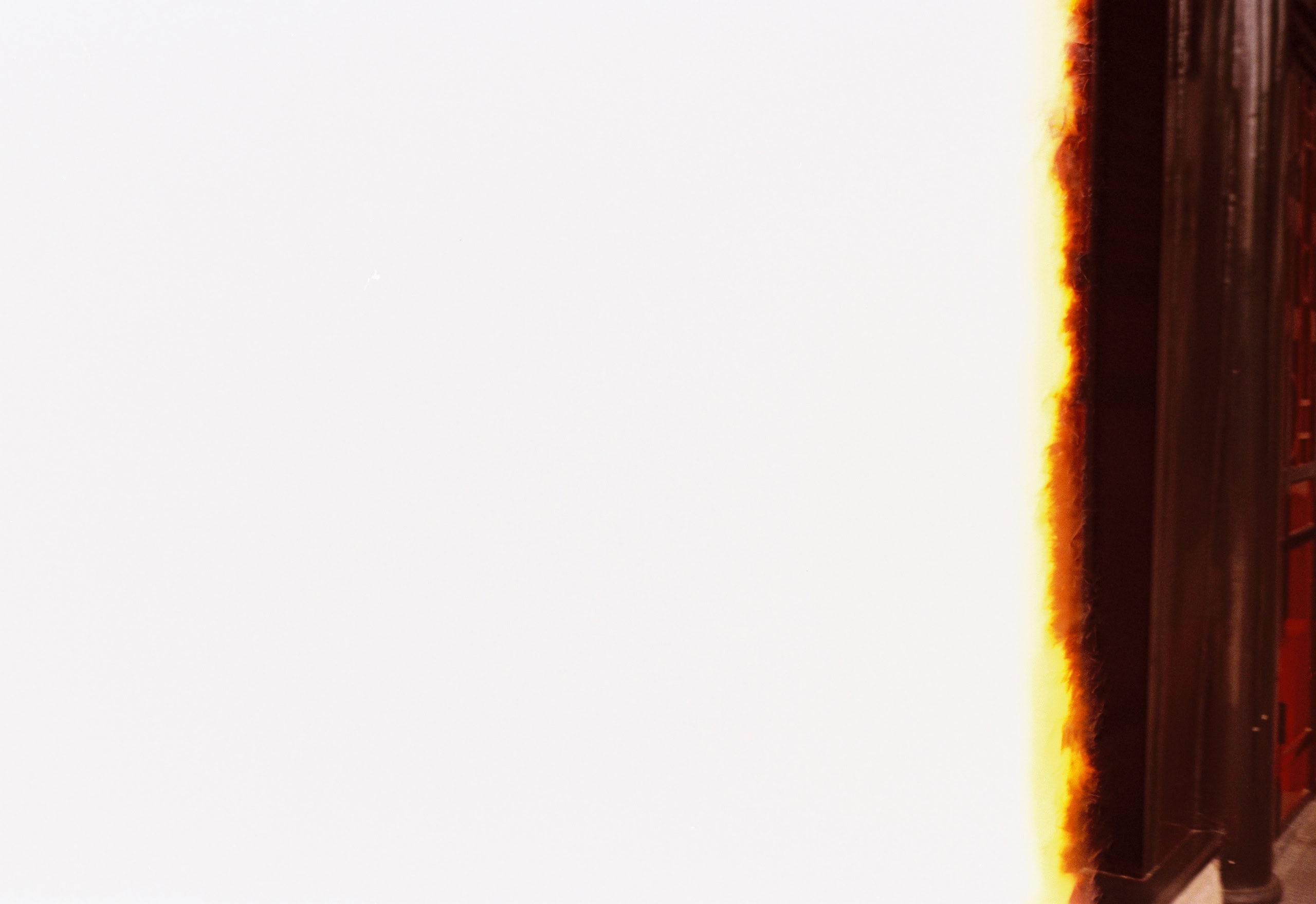

waipo’s altar, Dongguan, Jan 2026, taken on her disposable film camera
waipo’s altar, Dongguan, Jan 2026, taken on her disposable film camera
Before 奶奶 became one with the cherry blossoms, she would sing revolutionary songs every day at the family dining table. One of the old songs was about a son bidding goodbyes to his family after being drafted into the military. The brother and sister debated if he would die like a river gushing into the ocean. “Just like how water always flows back even after many turns, you will make it home safely,” the sister prayed.
In the song, the brother came home after the army’s victory. The folk song was likely sung throughout the numerous wars ravaging the country. It was unclear which sides he fought for during drastic power turnovers that felt like it had no end. Or maybe it was all of them. In one parallel universe, the brother could have killed my 外婆’s father if he hadn’t sailed across the Taiwan straits in a rushed attempt at exile. My great grandfather was around 20 years old and 外婆 was only 29 days young. He died before he could ever visit her again. This time, the water god did not bring him home.
What if home is a place of no return – when only by standing on the shorelines of departure, do we conjure up meanings of home?

~~~~~~~~~
They say a married daughter is like water spilled: 嫁出去的女儿,泼出去的水
When a migrant daughter becomes water, does she run off the cliff?
Does she ever return?[1]
~~~~~~~~~
籍:bamboo slips used to document a family’s occupation, class, and social roles.
贯:the land inhabited by one’s ancestors; a connective thread for heritage.
雨,于,雩,粤。
It turned out all of these pieces and places of (not) home are named after water – we are agricultural people, after all. The Yangtze river running into the East Sea and south of the Dongting lake converged in the site of divine sacrifice: for rain, for abundance, for communion with the earth and sky. Water is our land, our home.

Spring 2022, Wilmington, North Carolina:
I walked by the Cape Fear River and listened to the waves of winds brushing through my face and ears. A dear friend Tashia stood with me in silence. Later, they shared with me how they would feel emotional whenever they visited the Atlantic East Coast, and not elsewhere.
We were on an ethnographic research trip centered on the Wilmington race massacre of 1898, where blood dyed the river red. It shook me – how my friend sensed ancestral connection to land even when they did not personally inhabit it in their conscious lifetime; when there is so much unknown that cannot be known between the shores of West Africa and the Americas. Or more so, there is a knowing carried by the river that refuses to be named in the parameters of human language.

One of our interviewees Cynthia Brown shared stories of her great grandmother hiding in the cemetery alongside snakes and alligators to escape from white mobs. Her story reminded me of oral historian Michelle Lanier’s remark that each oak tree she passes by reminds her of lynching. My partner Trin told me recently that they are allergic to oak trees; the predominantly white institution they attended was full of them.
I wonder about what memories these trees and soils and waters bear of refuge, life and death. Stories that don’t have to be legible to us; stories that hold and will continue to hold regardless.[2] How do we, as descendants of our peoples and the earth, allow ourselves to witness or enter histories that have been taken from our conscious mind and known lineage?

我想划着小船回家了
I want to row the boat home now
但我的家又在哪里
but where is my home
我想把身体变回一艘小船,
I want to transform my body back into a boat
把我分解。
Dismember me.
我想和我的伙伴一起建成一个
I want to build a house with my companions
属于我们的房子,
a house that belongs with us,
我们的家。
our home.[3]

Profuse sweats rained down our spine in the August heat as we poured over the engravings on each tombstone. For an amorphous duration of time that felt like forever, we couldn’t find them. “They must be between these two rows,” dad mumbled. His chubby fingers were strangled by red plastic bags loaded with stacks of joss money. “Pardon our disturbance, neighbors.” He apologized to the inhabitants of nearby graves we kept pacing around with. I could smell an aura of panic from his heavy and arrhythmic panting.

In late March, my friend Eli Chen invited me to go on a photojournalism trip to the Siamese Twins Museum in Mt Airy, a two-hour drive west of Durham. I snapped photos as Eli interviewed the descendants of the ethnically Chinese conjoined twins, Chang and Eng Bunker. [4] They were born on a fishing boat in present-day Thailand, toured their “physical abnormality” internationally, and operated a plantation with their White wives. In 1850, they enslaved 18 people, including 10 children under the age of seven. [5] [6] They were among the first Asians to become naturalized citizens of the United States.
After the interview, we chatted about the Twins’ resistance to and complicity in racial oppression while wandering in the uneven terrains of the grave sites around the White Plains Baptist Church. I suddenly remembered sweeping the tombs of Black ancestors buried in Geer Cemetery, Durham’s first African American burial ground. The cold rain and wind gust slapped against my face, blasting open my hair follicles. 湿冷: It felt like winter in Guangdong, where no coats could protect you from the wetness seeping into your bones. We gazed over the garden of tombstones under a sign that said they are buried “100 yards west.” We eventually found that the twins were buried in the first graves we passed by, hidden in plain sight.[7]

This wasn’t the first time I got lost in a cemetery. Before I departed for the US a second time the summer of 2023, my dad took me to 奶奶爷爷 nainai and yeye’s graves. We walked up and down the stairs on this neatly organized burial site: they had always imagined they would be buried in the ancestral mountains, but selfishly, we wanted to keep them close. The thought of ever leaving them unattended on the mountains pained me.

I still found talking to my dead ancestors at their graves strange. I couldn’t muster up the strength to move my lips the same way my grandparents always taught me to, in front of incense and yellow paper money burning in golden metallic mooncake boxes.
I’d always stare at the incense ashes tip over themselves and fall while 爷爷奶奶 prayed to ancestors whose names I didn’t recognize. “Who are my ancestors?” I remember asking 爷爷one time after dinner; it was one of my only, and failed, conscious attempts to have a real conversation with him. He laughed and pointed at himself.
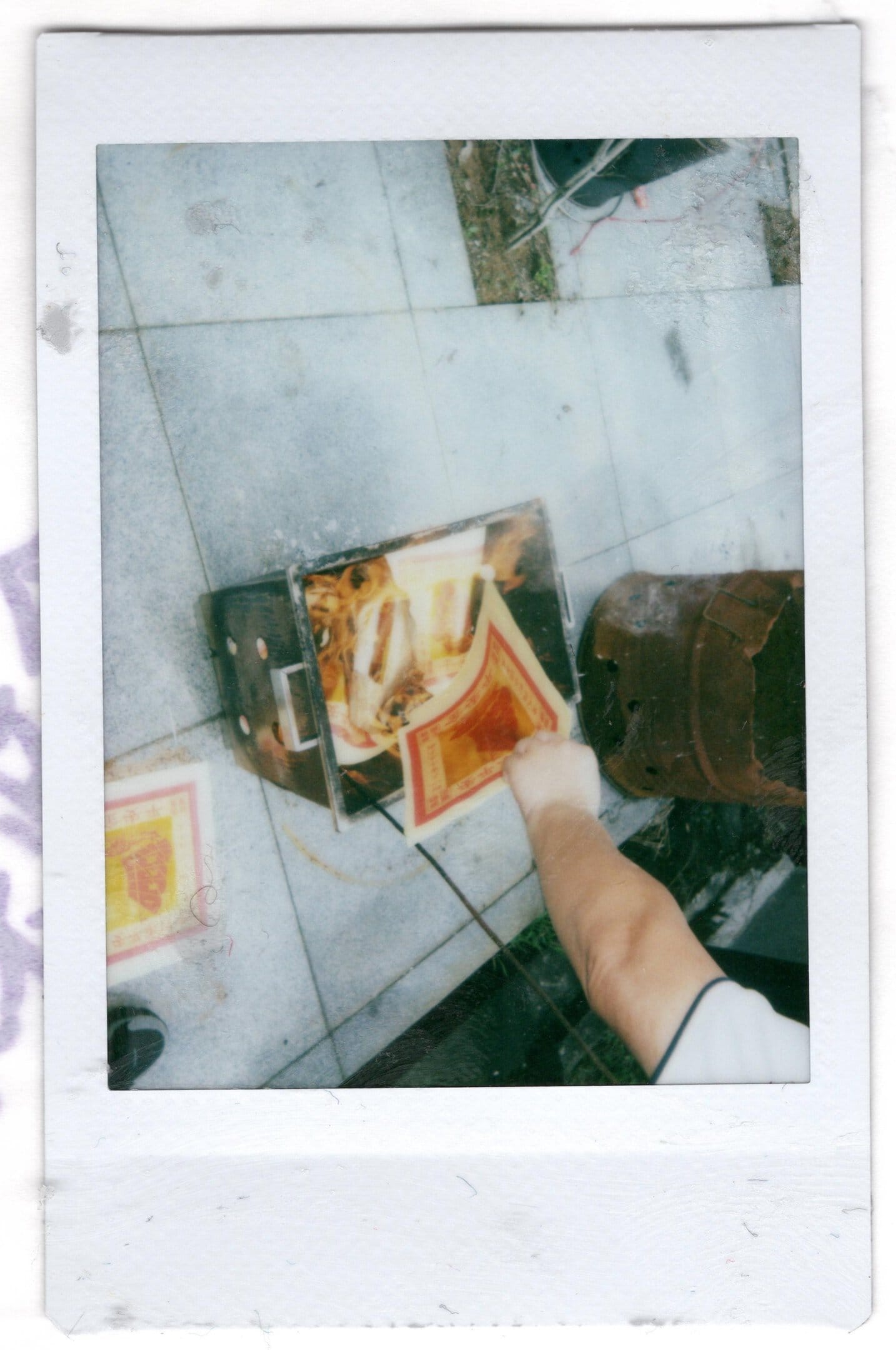

Dongguan, August 2023, joss paper burning ceremony
Dongguan, August 2023, joss paper burning ceremony
爷爷became an ancestor when I was working on my first writing project in Finland. 奶奶 departed two months before I returned to China from the States for the first time. It took me five months to pay her a visit after her death. Having been away from home mostly since I was 14, I don’t register their deaths much differently than when they were alive. I could still hear her songs right by my ears. The cost of the cosmopolitan dreams that were sold to me, a 6-year-old watching news about America in front of a chunky TV in a southern Chinese town, is home.
I cried as I apologized for not finding them sooner. Finally, my prayers solidified the material realities of our earthly separation.
~~~~~~~~~~~
After our video chat, 外婆waipo boarded the train back to Jiangsu. She wanted to visit the ancestral graves for 清明Qingming. She also wondered if the old friend who came to her dream recently was alive or dead. I don’t know when she can take me again to the piles of soils that now bear the names of our ancestors: the same soils her mother, my 太太taitai, let out long and winding wails over the loss of their family name, 祖Zu. My mother and her siblings had taken their dad’s last name 刘 Liu instead, to avoid punishment due to their maternal side’s overseas connections.
That same weekend, Dad sent me photos of my 爷爷yeye and 奶奶nainai’s graves. 福乐十区31行21号: Fu (fortune) Le (happiness) Zone 10, Row 31, No. 21. He reminded me as he reminded himself. “You should sweep their tombs online,” he proposed. I didn’t find any buttons for a digital sweep. I wish I hadn’t been too busy with my bamboo shoots adventure to remember the serpentine paths on the ancestral grounds. Dad sent a screenshot of texts from cousins whose names I haven’t learned, who swept the village mountains for us. He prayed for his parents to live in a big house in the afterlife.


As I was sharing a work-in-progress draft of this essay over phone, mama revealed to me that the old tombs I visited after my 外公waigong’s death no longer have the same soils or tombstones from the original burial. The Tomb-Flattening Movement feverishly swept over their region in the 1990s and flattened the soil piles to make space for residential and commercial use. Ancestral practices were also frowned upon as cultural backwardness and superstition. After the zest died down, 外婆 and 太太 restored the soil piles based on muscle memory of where their ancestors were buried. Rumors had it that adamant participants of the movement suffered ghostly retaliations.

Spring 2009: The teacher called on me as mom suddenly turned up to the classroom door, an hour before the class was supposed to end. I was learning math on a Chinese abacus the same way my illiterate great grandmother used it to operate the only grocery store on Mudun island, her fingers flying among the crisp clashes of the black and white beads. We boarded the train to 湖南Hunan in a haste. I sat on our bags in the narrow passageway next to the bathroom, breathing in the mixture of sweat and dirt from other restless ancestral pilgrims.
Spring 1979: 爷爷 suddenly appeared in my father’s middle school and took him to 挂枪 [8] hang papers on the burial mountains for 清明Qingming. Such practices were a punishable crime during the Cultural Revolution. He was an inconsequential man who decided to take the new Reform and Opening Up policy into his own hands.
爷爷 climbed the mountains every year until he physically couldn’t anymore. Even my dad can no longer remember the folk talismans he used to help write that bear the name of the village in the Ming dynasty.

~~~~~~~~~~~
In early April, I attended Nashville-based Iranian feminist artist Raheleh Filsoofi’s performance of BITE at the Nasher Museum of Art. With each bite the artist pressed the weight of her memories onto clay plates she made from locally sourced soils, a collection process that has become a throughline in her works across different Southern states.
I watched quietly as she made repetitive bite marks around the plate’s edges. The embodied, poetic, political, and relational possibilities of soil interlaced in each tooth’s imprint. I could almost feel her jaw tremble. I remembered the soreness rising behind my teeth as I sucked on bites of 外婆’s salted bighead carp, our last dinner before my most recent departure. 咬牙切齿: you desire something so deeply that you gnash your teeth and tongue. A bite for grief. A bite for rage. A bite for solidarity, for dreams. We are biting into soil bodies, water bodies, land bodies, ancestral bodies. Our (future) bodies. Water evaporates; soil stays.

The artist’s talk left me pondering about the intimacies between soil and water that transcend our conscious experience of time. When dad messaged me on Qingming, I was digging knee deep into the sciences of cremation. The average cremated ashes of an adult weigh 4 to 6 pounds and take up around 200 cubic inches. Water distributes cremains quickly. It can take weeks for ashes to mix with soil. Ashes are inorganic materials that can last a million years. Our memory is precarious, fragile, fleeting, mortal; but also indestructible, fluid, breathing in the mundanity of death’s echoes.
“I stay so your ghosts can rest beside me; I travel so my ancestors can meet yours,” Raheleh wrote in a series of clay-printed poems.[9]
If the brother in my 奶奶’s song threw his ashes into the river, how long would it take for him to get home? 奶奶always talked about how much she missed the fishes in her village. I watched 奶奶’s toothless body being pushed into the crematorium through the screen. 尘归尘,土归土。Soil moves much slower than water.
She is now buried 434 miles away from her ancestors.
In the residual death of memory, has your ghost traveled home now, 奶奶?


~~~~~~~~~~~
Water is boundless. With each movement, water creates its own maps. And yet, water refuses to be mapped, defined, pinned down. [10]
Every time I go/leave home, I take the 50-minute ferry rides between 香港Hong Kong airport and 虎门南沙港Humen Nansha port. In this suspension of time, space, and memory, every return already implicates a departure. I’d often look out the window, my body swaying to the waves splashing against the ferry’s hums. At times green, silver, or mercury, coated with a sliver of gold at sunrise, the ruffled skin of the Pearl River 珠江 maps onto the reflection of my face. If we are perpetual sojourners of memory, could the nostalgia knotted in my chest unravel and flow with the passion and slowness of water?

“gradients of memory | 记忆过渡” is a photo diary of water from my three trips back to southern China between 2023-2024. They document the different water bodies witnessed with my family: ocean, river, lake, rivulet, the parts of us they embody. As I organized the images, tears rushed into my cheeks. Sour, sore, bitter, with a bit of sweet aftertaste. I could still taste the undercooked chive dumplings 外婆 made in haste at 5 a.m., the beef noodle rituals I shared with dad, and the tangerines mama stuffed into my hands before boarding.
The opening excerpt, 水的断章 Fragments of Water, is among my favorites of my dad’s poetry. His original poem is structured loosely like different segments of a river and meditates on the poetic possibilities of water as a carrier of memories in southern China. It could also be translated as Tangents of Water: constantly digressing, circulating, never reaching.
Being with, photographing, and writing about water have taken me to places I never imagined being ready to arrive at.
For the diasporic birdlings perching from South to South, perhaps home is not a place to be reached; it is a feeling we carry.[11]


外婆at my first exhibition in China, photographed on her disposable camera.[12] Dongguan, China, January 2026.
Exhibition documentation photos by Wei Haoliang.
Notes and References
[0] 外婆 shared this story with me during the first oral history project I made with her, “Re-membering, through (the absence of) photographs”, with guidance from Prof. Lou Brown. I keep returning to this project as I continue to deepen my collaboration with my family, for whom I am forever grateful.
[1] These lines are adapted from my poetry, Island Dreams 岛·梦. The poems were primarily composed in fall/winter 2022, with guidance and peer support in Q.M. Zhang’s Writing into Silence workshop for AAPI writers and Prof. Jaki Shelton Green’s Documentary Poetry class.
[2] Part of this text is adapted from my research project, Re-membering Wilmington 1898, conducted in spring 2022. I thank Prof. Charlie Thompson, Mike Wiley, America’s Hallowed Ground Project, and other mentors, interviewees, and descendants for their support.
[3] This poem, collectively written by members of Chinese Artists and Organizers (CAO) Collective离离草 and workshop participants, was first published in Cha: An Asian Literary Journal in “Chinese Queer Feminist Poetic Intimacies: A Translation Play” in summer 2023. Translators: huiyin zhou and fran yu. I also thank Prof. Eileen Cheng-yin Chow for her support of the project.
[4] To read more about the Siamese Twins, refer to Eli Chen and Anisa Khalifa’s WUNC article published on May 18, 2026. This story was also part of The Broadside’s“An Evening of Asian American Storytelling” sold-out live show hosted by Anisa Khalifa at the Cary Theater, May 13, 2026.
[5] Orser, Joseph Andrew (2014), The Lives of Chang & Eng: Siam’s Twins in Nineteenth-Century America, University of North Carolina Press, ISBN 978-1-4696-1830-2. P.126.
[6] Chang and Eng: The Original “Siamese Twins”, UNC Libraries.
[7] In Plain Sight was an exhibition put together by the Friends of Geer Cemetery, which “works to reclaim, restore, and respect one of Durham’s first burial grounds for the African American public.”
[8] There are different dialectical variations of 挂青 such as 挂枪, which is closer to my dad’s dialect and sounds like “hanging guns”; and 挂亲, hanging (paper for your) kin.
[9] I found this poem from Raheleh Filsoofi’s website documentation of At the Edge of Arrival Exhibition (2025).
[10] Inspired by an advisory circle meeting of Queen Street Magic Boat (QSMG), January 5, 2026. I am thankful for the advisory circle members especially sumi dutta, Danielle Purifoy, Destiny Hemphill, adé Oni, Laura Ritchie, Sarah Long and Catherine Edgerton/ed (steward of QSMG) who were present during the meeting.
[11] I came up with the name of one photo, “home is a feeling we carry”, inspired by Gabrielle Widjaja 黄上恩 / Gentle Oriental’s flash tattoo named “home is a place I carry.”
[12] huiyin zhou 徽音 “gradients of memory | 记忆过渡“ (2023-ongoing), photography, bilingual poetry, installation. On view as part of group exhibition 无界·共生 Boundlessness · Coexistence (Haoliang Wei, huiyin zhou, and Feng Luo), January 23-March 31, 2026, curated by Liu Wanyi, in 莞商会T1-23F云境空间, Dongguan, China