Among the works first seen in Caribe por venir [Caribbean-Yet-To-Come] at the Museo de Arte Contemporáneo de Puerto Rico (MAC) is an ink drawing of an empty school desk before the sea. Insinuating sand and water into the privileged space of scholarly authority, the work’s artist, Javier Orfón, invites viewers into an open pedagogical encounter with earthly, aquatic, and atmospheric agencies—a compelling proposition given current environmental and sociopolitical concerns.
While sand and sea are hardly novel terms in the region’s visual lexicon, Caribe por venir, curated by Arnaldo Rodríguez Bagué, approaches this all with an eye to recent history. Caribbean experience now coexists with a broader reconceptualization of the ecological. Rather than isolated incidents, disasters form part of an accelerating pattern: from the 2011 Haitian earthquake to Hurricanes Irma and María in 2017, Dorian in 2019, and 2025’s Melissa, frequency and devastation continue to intensify.[1] Against more conventional discourses of natural disaster, chroniclers of these events often point to their underlying social dimensions to emphasize how disaster exacerbates ongoing antiblack racism, colonial inequities, and state exhaustion.
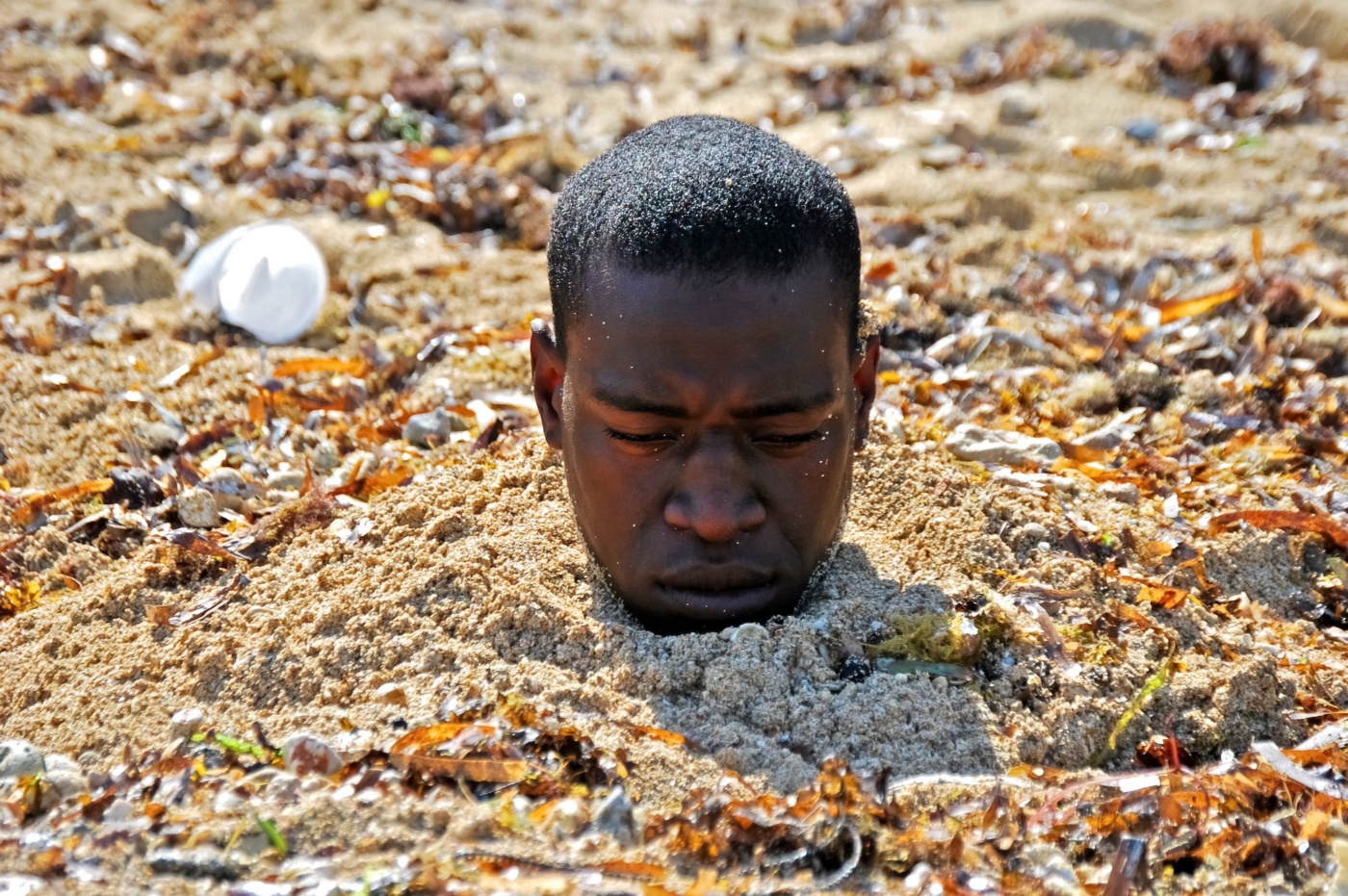
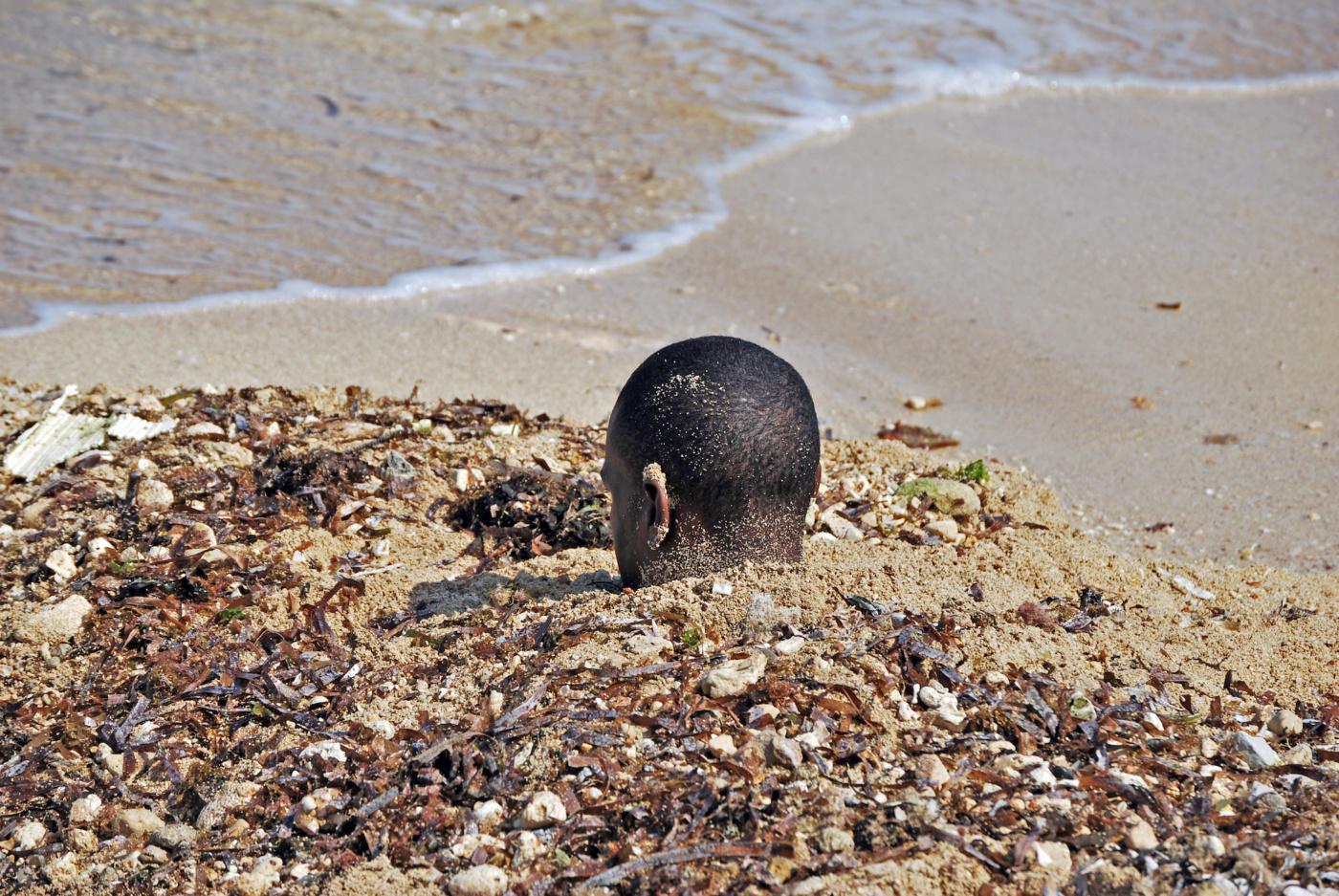
Caribe por venir enters into this fray, highlighting minoritarian performance and aesthetic strategies within the theoretical frame of critical posthumanist and Anthropocene thinking. Featuring nineteen artists and collectives, the exhibition considers contemporary work where ongoing ecological precarity, and social and infrastructural breakdown, coexists with emergent, coalitional demands for a more capacious horizon of Caribbean vitality and livability. Drawing on the sea, a number of the exhibition’s works consider undercurrents across the Caribbean Sea and Black Atlantic. Photographs of Carlos Martiel’s Tide (2009) find the ever-vulnerable performance artist buried neck-deep in sand as water slowly rises around him. Even when not posing an immediate threat, water more directly evokes the Middle Passage in works by Luis Vasquez La Roche and James Jordan Johnson. Across these works, the idea of national histories recedes for an archipelagic framework in which sea and shore are themselves overflowing with historical memory. In doing so, they put posthumanist thinking into practice, attending to people long denied full recognition, while treating the sea as a living witness to history.
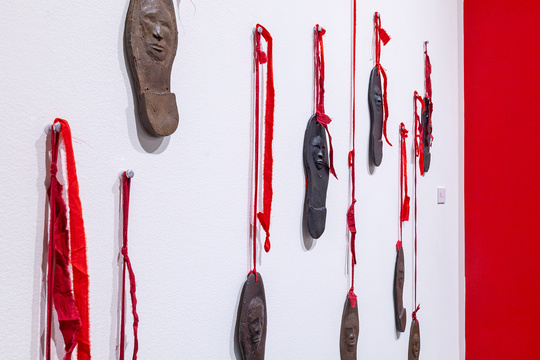
Other artists approach the geological as a channel for palimpsestic excavations of history. In The House of Souls (2021), also by Orfón, charcoal rubbings from the pre-colonial period bring an abundance of history into sensuous proximity. By treating geology as a medium for colonial history, Orfón’s work aligns with critical Anthropocene thinking that posits the onset of a new geological record in the wake of colonial encounter. In the following room, Las Nietas de Nonó’s Salt Interpretations (2016) considers the various histories of las Salinas of Cabo Rojo, where salt was mined by aboriginal Arahuacos, enslaved Taíno laborers, and, now, private companies. Caribbean crucibles, these works opt for sheer accumulation as a critical strategy to bring disparate temporalities into a unified material plane of experience. In Las Nietas de Nonó’s video, the occasional intimation of human form intensifies this compression, marking the racialized labor that underwrites these altered landscapes.
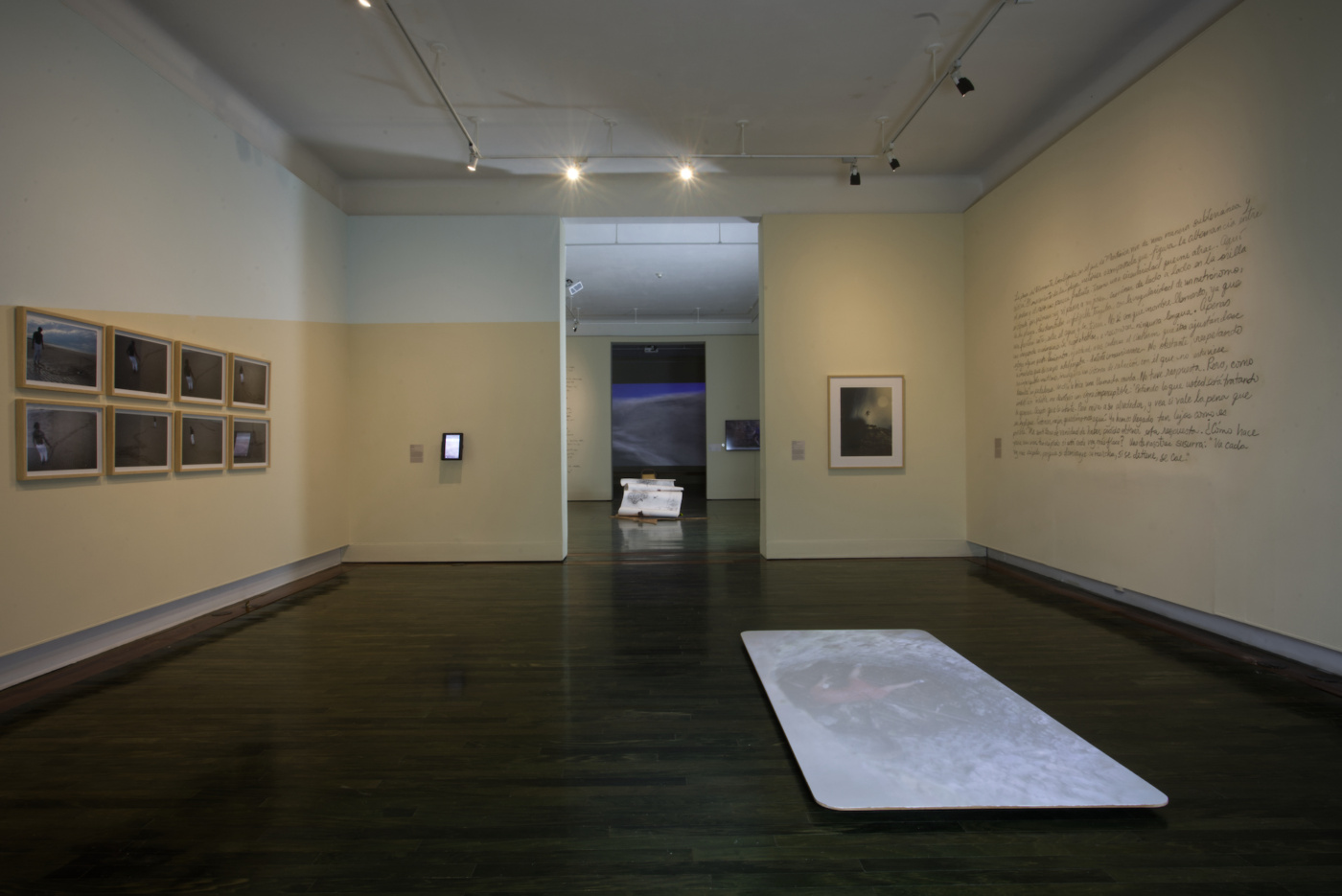
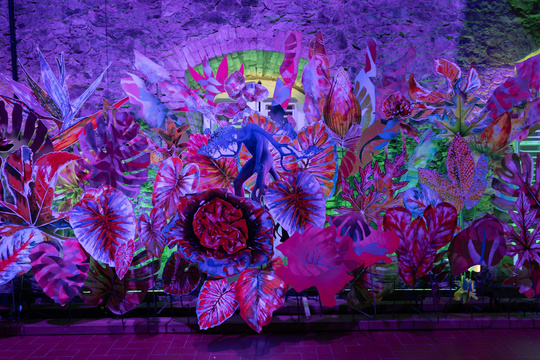
Central to imagining and enacting alternative futures, works on view envision aquatic and botanic comrades as models of queer relation and becoming. In The Container/Tsunami (2014), a music video by Puerto Rican band Alegría Rampante, a figure emerges from the sea as singer Eduardo Alegría lilts, “Yo fui hecho en el mar / Fue mar que me hizo así.” At first stilted and crustacean-like in their movements, the figure migrates into the city, developing a commanding saunter that evokes an archive of queer gesture. Johan Mijail’s Vegetal Love (2015), which documents the artist with a plant inserted in their anus, reads at first as a wry rejoinder to heteronormative imperatives like reproductive futurism. Shown as a screen capture after the original work was lost, Mijail has elsewhere elaborated that Vegetal Love is, moreover, an afro- and transfeminist treatise, “[…] a process of poetic, political, and aesthetic transsexuality where I build my fiction myself, my path to face the fears and insecurities that this heterosexual culture makes you face when you experience yourself within your abnormal sexuality.”[2] Across these works, sea and plant life form the basis for a queer unsovereign.
As it draws to a close, two videos anticipate loss by moving cautiously toward the specter of ecological collapse. Farmacopea (2013), by Beatriz Santiago Muñoz, inventories species under threat of extinction while, nearby, a black and white video by Claudia Claremi, The Memory of Fruits (Puerto Rico) (2025), shares empty hands miming the peeling and preparation of already extinct produce. Forwardly elegiac, Muñoz and Claremi both understand the ongoing loss of biodiversity alongside the cultures and memories bound up in its death.
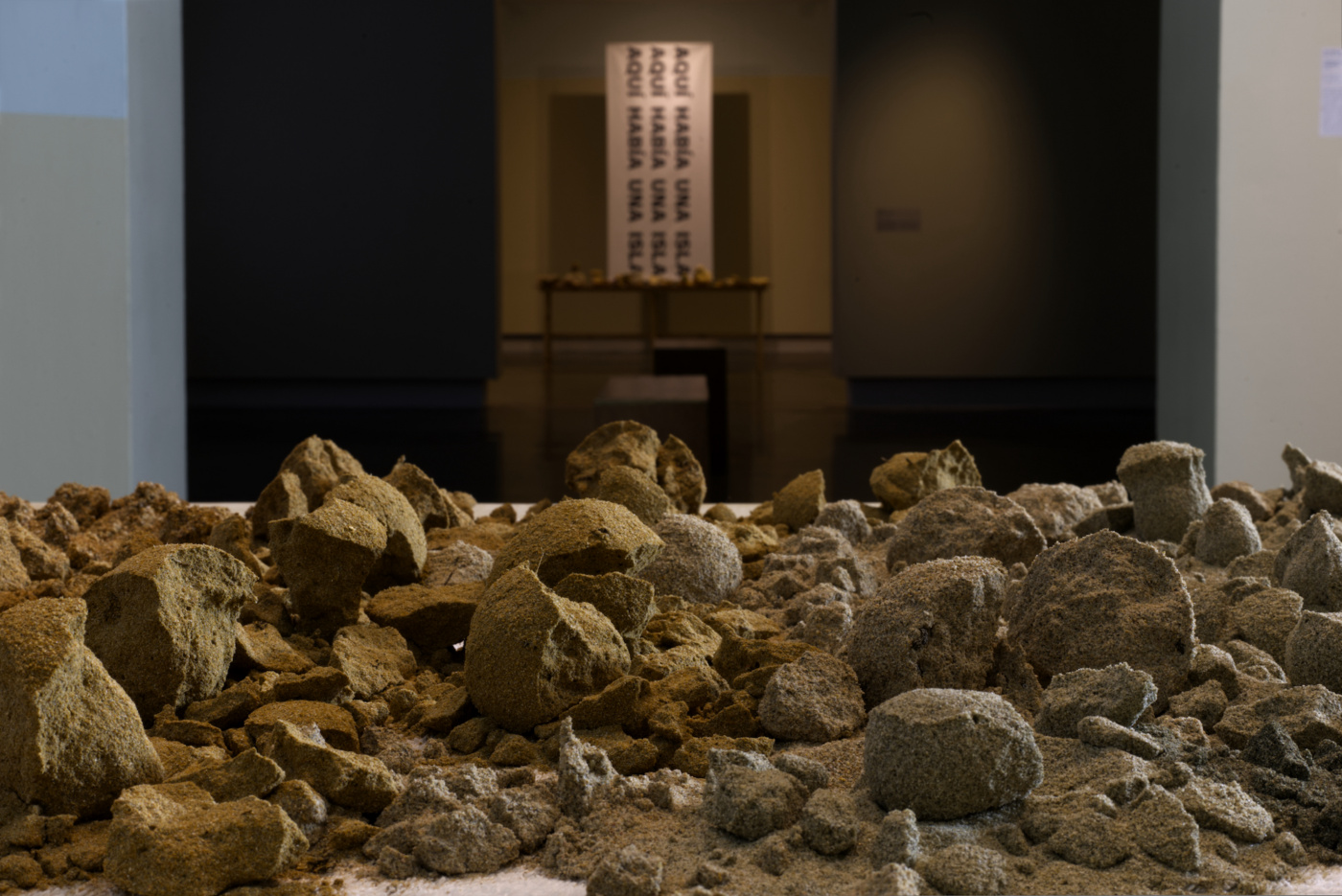
The exhibition concludes with nibia pastrana santiago’s 2019 performance ephemera, a hanging banner with three emphatic lines declaring “AQUÍ HABÍA UNA ISLA,” which translates to “THERE WAS AN ISLAND HERE.”[3] Counterbalancing the future-oriented grammar of the show’s title, the banner memorializes a lost island that would seemingly still exist. If the banner relinquishes an optimism for what’s ahead, it does so by foregrounding an ethic of heartfelt witnessing, even when repair appears to be out of reach. Indeed, the exhibition’s most enduring contribution may be its suggestion of witnessing beyond repair as a mode of remaining accountable to losses—both historic and yet-to-come—outside the promise of redemption.
While sand and sea are hardly novel terms in the region’s visual lexicon, <em>Caribe por venir</em>, curated by Arnaldo Rodríguez Bagué, approaches this all with an eye to recent history.
Caribe por venir highlights emergent frameworks emphasizing the Caribbean’s critical role in a global rethinking of agency and ethics. As an exhibition spun off from a performance platform of the same name, the show emphasizes human form within expansive Caribbean ecologies, which the exhibition disambiguates across the oceanic, terrestrial, and atmospheric. The artists display an understanding of sea, rock, and earth as alternative witnesses to history, agents of change, and precarious scenes of reverence and care. Putting theory into practice, the Caribe por venir points toward a redistribution of responsibility and care across both human and nonhuman actors in situations of ongoing precarity.
1. The earliest work in the exhibition dates to 1986, a video by Merían Soto in collaboration with Pepón Osorio, that features dancers across the diaspora in Vega Alta, Puerto Rico and South Bronx, New York.
2. Johan Mijail, “Un Manifiesto Analquista: Tra(N)Splantar. Poéticas Anales Y Amor Vegetal,” X-TRA Contemporary Art Journal, Fall 2022, https://www.x-traonline.org/article/un-manifiesto-analquista-transpiantar-poeticas-anales-y-amor-vegetal.
3. nibia pastrana santiago’s aquí había una isla (here was an island) (2019) performance ephemera is part of the series not accidentally given: pesimismo tropical, created during an artist residency at the Robert Rauschenberg Foundation, Captiva Island, FL.