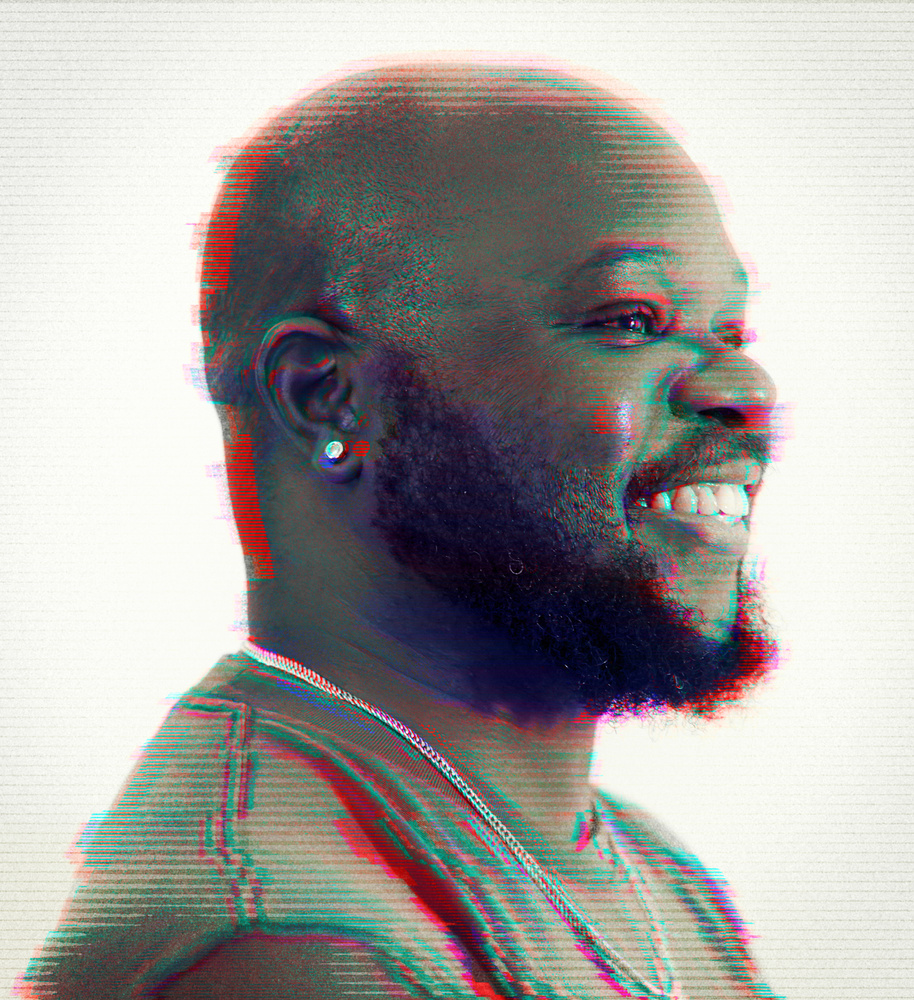
In a world filled with fleeting technology that intends to destroy or escape reality, David Gumbs utilizes modern tools as a means to achieve archival immersion that is both familiar and imaginatively expansive. By fusing technology with ecological and cultural markers influenced by his upbringing in Saint-Martin, life in Martinique, and time spent abroad, he reframes the lived environment.
Gumbs’ work responds to the places he finds himself in, rather than being bound to a singular environment. As a Martinique-based artist, Gumbs is all too familiar with the confines and tropes that artists in the tropics can be limited by—the notions of sea, sand, and carnival presenting a paradisical environment in which histories can be whimsically ignored. Instead, Gumbs brings a resonant response to the relational histories of the Caribbean, but has also made interactive work in Asia and Europe, a testament to the adaptability and versatility of his practice. In doing so, he shares expertise across cultural and linguistic differences through quotidian reflections.
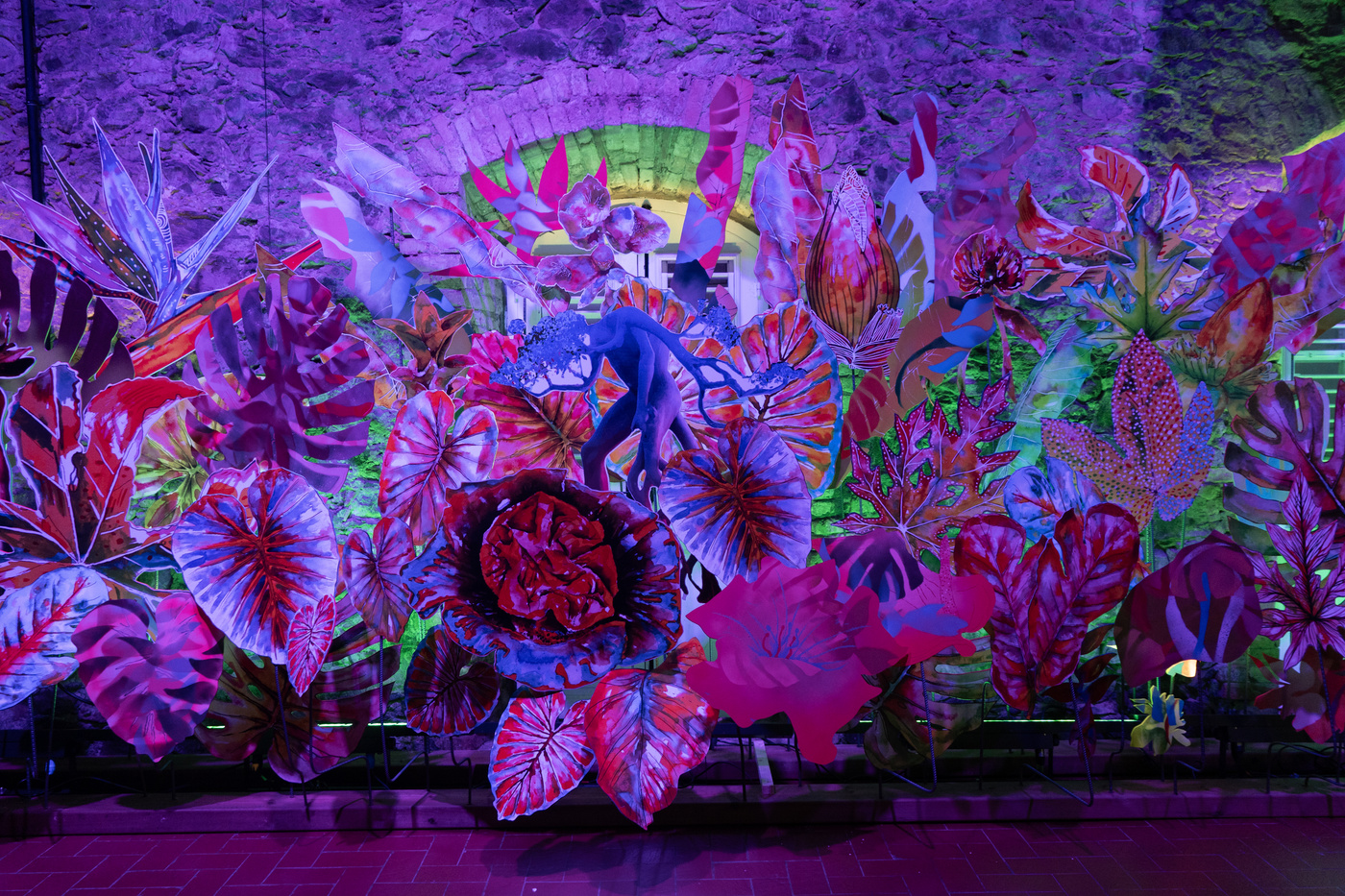
Ethno Spirits (2023), a Mondes Nouveaux-award winning work, is an audio reactive, ethereal, and immersive light installation that illuminates ancestral histories in Saint Martin and Martinique. By positioning his work at historical sites, Gumbs engages audiences in an audiovisual symphony that provokes the imagination. The audience experiences a twenty minute light loop of the movement of Saint-Martin butterflies through the animations of flora and fauna. The imagery is paired with traditional drum rhythms, provocatively conjuring the deep communions between nature and people.
Gumbs’ practice is contemplative and intuitive, centering the sensorial experience that transports viewers so that they are more than just spectators, they are witnesses. In doing so, the artist harnesses the power of virtual reality. By expanding the experience and making it relational, Gumbs counters what technology typically does—flatten experiences so that the aesthetic is present but the lasting effects can be forgotten. For Gumbs, the aesthetic marks the viewer, allowing them to seed their own relationship within the experience.
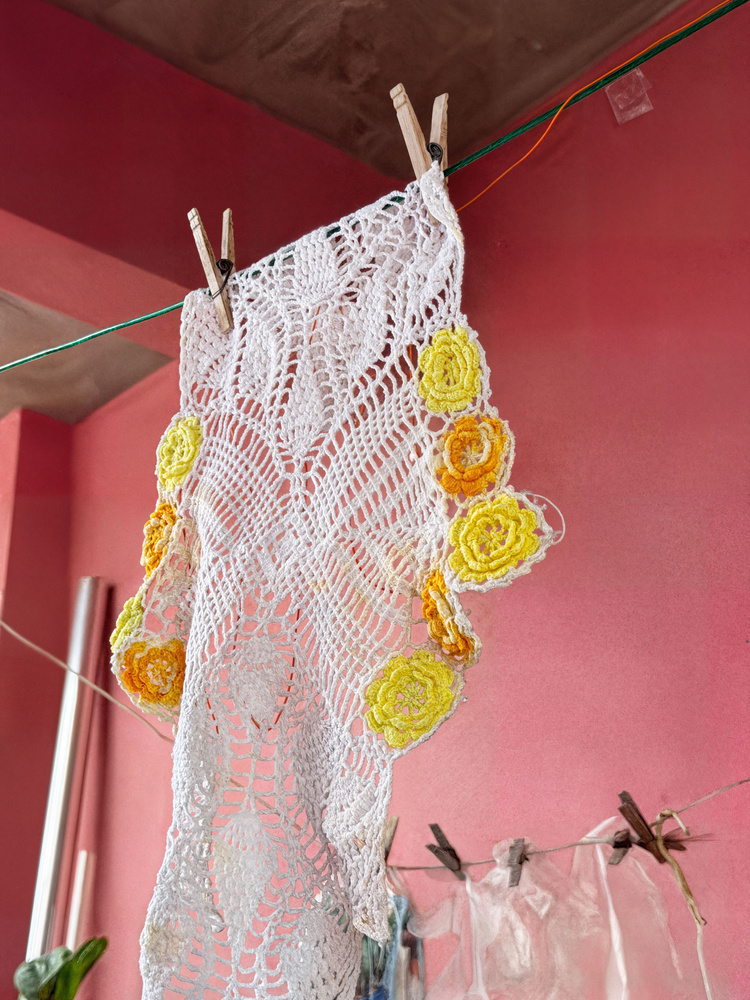
Mummy’s Crochet (2026), Gumbs’ most recent work, takes a white crochet piece with yellow and orange flowers made by his mother in Saint-Martin and transforms it into a tableau vivant. Touching the cloth elicits sound, a kind of memory-sensory that fuses nostalgia and deep sentiment of a family relic. Crocheted fabric, which can be found in households around the world including the Caribbean, is suspended on a traditional clothes line. When activated by the hand, the sound of the artist’s mother’s voice transforms into something monumental, a technological immortality that traces family bonds, cultural history, and future artifacts. This immortalization is consent based and non-exploitative, which is a notable turn from how artifacts have generally been acquired and displayed by institutions, and makes one consider new possibilities of the future of archival practices.
The artist’s use of everyday objects opens up potential for relating across space and time, between human, plant, and object. A currently untitled project, involves light research that responds to the energetic frequencies emitted by common houseplants. Gumbs draws from his own memories of plants from the tropics like pothos, snake plants, croton, and Joseph’s Coat. In the resulting work, the plants, when touched, elicit either light based or sonic responses. The amplification of the mundane transforms their presence.
Gumbs’s practice is contemplative and intuitive, centering the sensorial experience that transports viewers so that they are more than just spectators; they are witnesses.
These interactive works are a timely articulation, particularly in the Caribbean when disaster capitalism and corporatization, land theft, and recolonization are ongoing. Considering the Caribbean as a nexus of colonization, displacement, imperialism, global and silent capitalism, and continuous extraction, yet hidden under layers of distraction, speaks to the Caribbean experience. It is fitting that an artist can explore beneath surfaces, literal and metaphorical, through the use of familiar materials.
Gumbs’ origins in drawing and photography have spiraled into digital installations that are increasingly interactive, more intimate, and subsequently, more consequential. Gumbs functions as a griot and translator, carrying the story while also utilizing virtual technologies to allow objects and plants to speak for themselves. This kind of work requires sensitivity and intuitiveness that recent technological advances disregard, but for the artist, technology that adapts to the environment through the tactile intervention of the artists’ hand, offering an equalizing, rather than dominating, force.
This feature was originally published in print for the Atlanta Art Fair 2026 broadsheet publication, taking place from October 1 to 4, 2026.