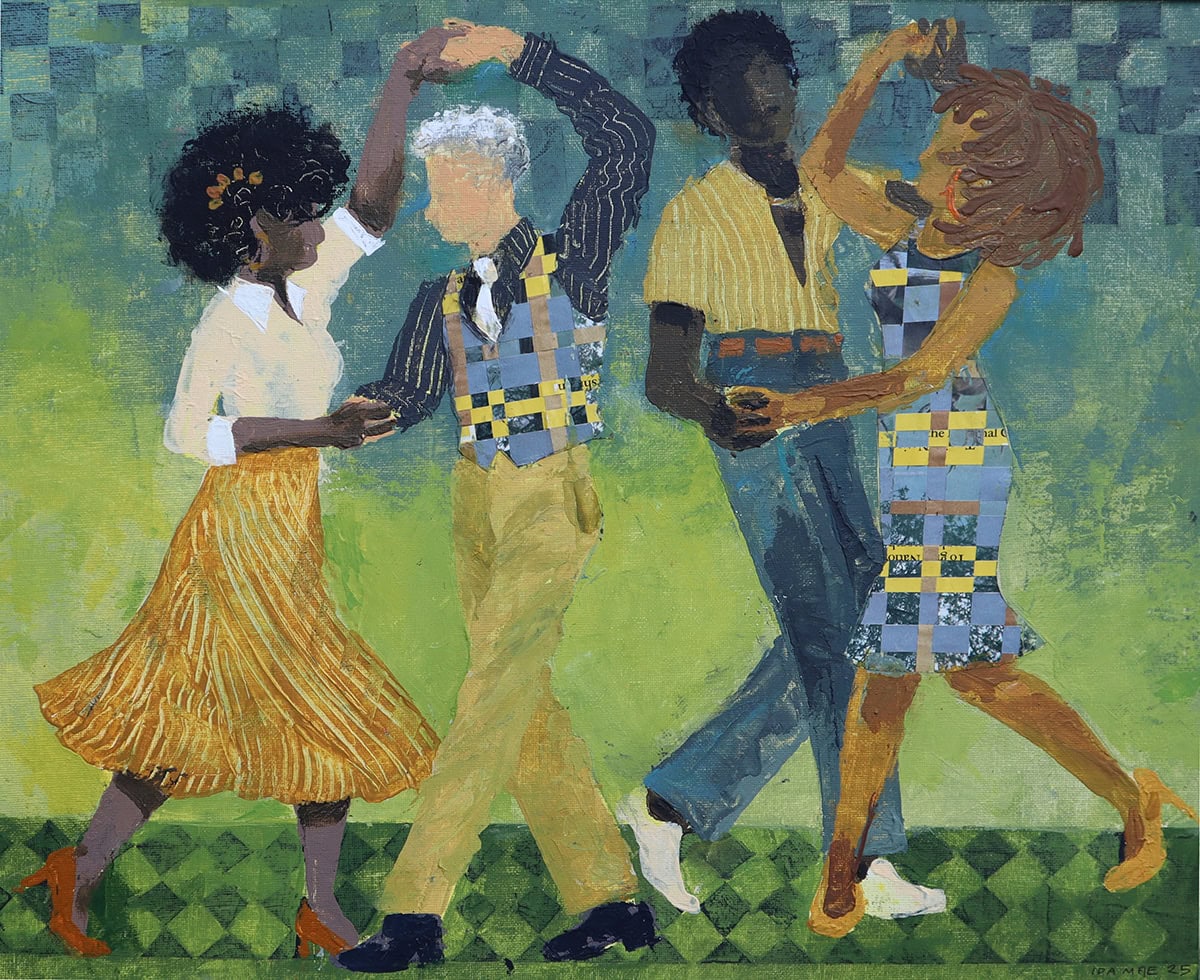
Ida Mae’s Harlem Swing (2025) is a flat, figurative landscape: three couples dancing, arms raised and swinging, on a series of patterned base layers. Those textured paint constructions form the recognizable symbols of a Harlem Renaissance era social dance. But it is a composition that rewards lingering within the movement of the painting.
Its foundation begins with patterns, alternating rectangular blocks and semi-translucent bright yellows and blues, a checkerboard gem green floor contrasted with the organic yet geometric palette-knife layers of acrylic scraped onto the canvas. The figures overlap and twist, each couple’s gaze implicitly focused on each other, even as their faces’ features are absent from the painting, and a series of overlaid yellow dots brings the painting’s deep background colors into a textured, immediate foreground.
This painting is where Ida Mae began the collection that would become her featured artist exhibit at the Luca Gallery in Fort Mill, South Carolina. Harlem Swing was originally a commissioned piece, but it led Ida Mae to iterative figurative explorations of color, gesture, historical exploration, and dialogues on identity undergirded by what she terms “inherited patterns.”[1]
“I asked myself, ‘If I was an abstract artist, what would my abstract artist look like?’” Ida Mae said. “I don’t want to have too much of a departure from who I am as an artist—which I feel like this is a huge departure, and it feels a little bit uncomfortable to be this vulnerable.”[2]
Ida Mae lists the late Barkley Hendricks and Aaron Douglas as direct influences on the collection, alongside contemporaries like Lowcountry painter Jonathan Green and collage artist Jess Owens-Young. Her overall process hinges on color stories, drawing on the legacies of brightly colored geometric profiles and heavy use of three-dimensional texture to represent fabric, people, and abstract backgrounds.
Suited Swingers (2025) sees interrelated gestures, backgrounds, and patterns expand, with a woven paper collage composing the texture of some figures’ garments. Wash, Rinse, Repeat, & Rest (2026) is modeled after a Mt. Holly laundromat, again rearranging time and place through an iterative piece Ida Mae said she has painted before. The artist brings in a comic strip inspired by 1980s Sunday newspapers as the backdrop behind a row of colorful plastic chairs outside.
In our own world (2025) narrows the collage to a paper landscape and repurposed pattern, in a pared-down color and emotional dynamic, with more organically blended greens on top of brushed-over darkened blues and browns, and multicolor polka dots encircling the figures, floating off-kilter on the right side of the frame.
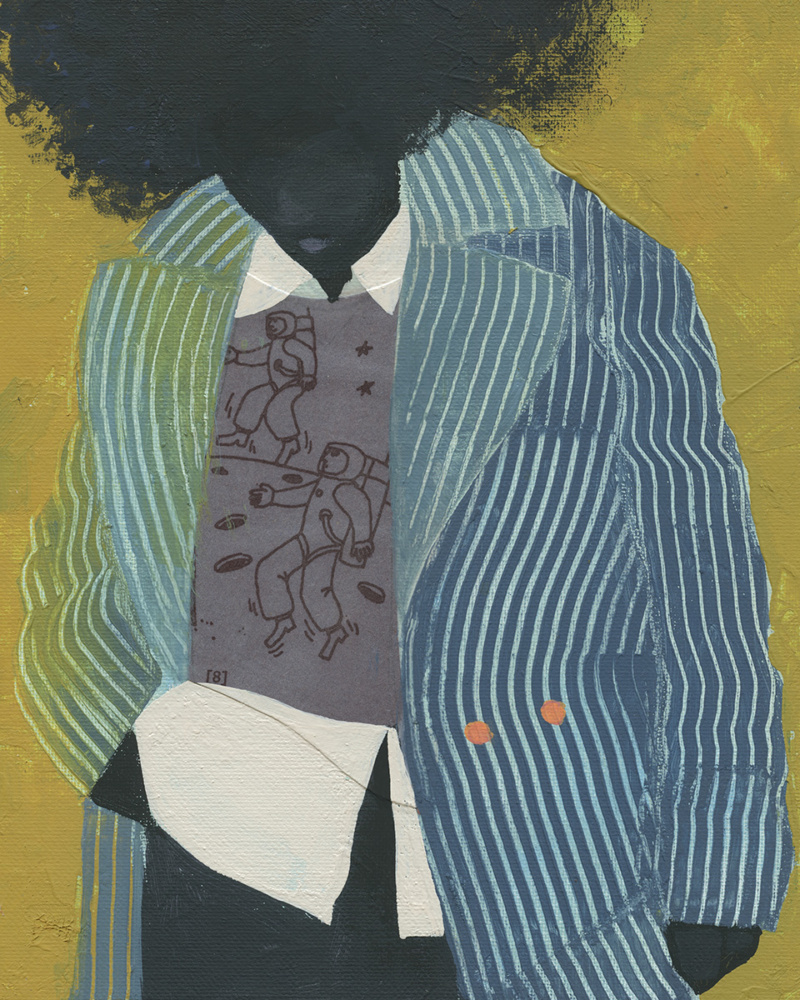
The three-dimensional woven clothing was inspired by her daughter’s explorations of texture with children’s weaving. The interactivity of the works, from paint curling off the canvas to the highly textured surface of the interlocked paper, is key to how she considers audience interaction and engagement with her paintings, partially influenced by the first half of her career rooted in jewelry-making and metalwork.
“How can I get this piece to vibrate and move?” Ida Mae said she asks herself when painting figurative works.[3]
Central to, and among the last works to be added to, the collection are a series of abstracted figurative paintings, each centered on a single silhouette, often creatively cropped and situated. Sheet music composes a man’s jacket just under the painted surface; a photocopy of a children’s book illustration becomes the basis for a woman’s sweater. Ida Mae doesn’t transplant the representations in her paper source material into the painting. Instead, she takes each material on its original terms and intentionally creates unexpected depth in her own postmodern framing.
In exploring the gesture, using a figure as reference material rather than an endpoint, Ida Mae reimagines layers of gazing through her own iterative process-building.
While Ida Mae has an extensive background in portraiture, she doesn’t consider these works to be portraits under that definition. If Hendricks, a major influence on the figurative series, was concerned with reclaiming European Masters’s techniques, often creating intimate depth through the use of light and realism in figurative depictions, Ida Mae consistently creates a newfound depth from a perspective of awareness and creativity via the work of patterning these already layered references.
Ida Mae considers this collection a turning point for her work, after years closer to realism and feeling a lack of pressure to be dynamic in her work’s style. She pointed to a series of insect collages she made in 2024 as an experimental starting point for some of the themes and techniques she is exploring now.[5]
“I think that my dream is to be an Afrofuturist,” Ida Mae says. “Because I feel like that takes a lot of bravery to push yourself into a speculative idea of reimagining the future, or even reimagining the past, reimagining the present as if the past didn’t exist.”[6]

- [1] Ida Mae, email message to author, January 25, 2026.
- [2] Ida Mae, interview by Caelan Bailey, February 6, 2026, Fort Mill, S.C.
- [3] Ibid.
- [4] Ibid.
- [5] Ida Mae. “Buzzing with Resistance: ‘The Actual Enemy.’” Instagram, March 10, 2024. https://www.instagram.com/ida.mae/p/C4UV70TMI9K/.
- [6] Ida Mae, interview by Caelan Bailey, February 6, 2026, Fort Mill, S.C.