Location/Address: Fried Fruit Art Space | Cargo District – The Alley, 615 S. 16th Street, Wilmington, NC
Hours: viewable 24/7 from outside; doors open during receptions and scheduled visits
Website: https://friedfruit.art/
Founded by: Madison Creech & Matthew Creech
Operated by: Madison Creech & Matthew Creech & rotating summer interns
Opened: first location – 2021; current location – 2023
Most Recent Exhibitions / Programming: Infinite Jest by Bain Bennett
Upcoming Exhibitions / Programming: Department of Terrestrial Magnetism by Michael Webster
Isabella Marie Garcia: In the last couple of years, mobile art galleries have been popping up more and more across contemporary art landscapes. I think of the U-Haul art galleries and the cargo container that houses Fried Fruit Art Space speaks to this housing that considers transience and movement. Can you speak more to the origin of Fried Fruit Art Space, from the concept of it being housed in a cargo container to the namesake?
Madison and Matthew Creech: Fried Fruit has been an iterative process. It really started in 2019 in DeLand, Florida with our collaborators Katie Baczeski and Chad Serhal as a gallery we started in the detached garage of the house we were renting. At the openings, Matthew served espresso drinks in a collection of artist-made ceramic cups curated by Katie. This was about 4 months before COVID, when we had to end all programming and the house eventually sold. Isolation made us even more motivated to find ways to support artists and connect with the community, so we opened a second iteration in a mechanics shop that had floor to ceiling windows and no electricity. This space was never open for the public to walk inside, instead the work was experienced from the sidewalk, looking in. Artists zoomed in through a hotspot for the openings, and gave gallery talks as a projection connected to a very long extension cord.
We called this Florida gallery Fresh As Fruit Gallery (Fresh AF for short). In naming, we wanted to honor the location, without it sounding so serious. The original house had a lot of fruit trees, vines, and bushes: persimmon, pineapple, pomegranate, lots of citrus, grapes, acerola, figs, kumquats and loquats. As we have grown with this fruit name, we’ve applied new meanings to it; it is queer, it is nourishing, it is environmental, it is approachable, it is cutesy, and it is disarming. When we moved away from Florida to North Carolina, as a group we decided the name should change; Still Life With Fruit was born, founded and co-run by Katie and Chad. And pretty quickly Fried Fruit Art Space began in Wilmington, NC. Fried is burnout, electricity, it is fried food from a state fair, it is fat, it is finding nourishment from the fresh and the fried. It is also an homage to the very first person in Wilmington who gave us space to exhibit art – Will Fryar.
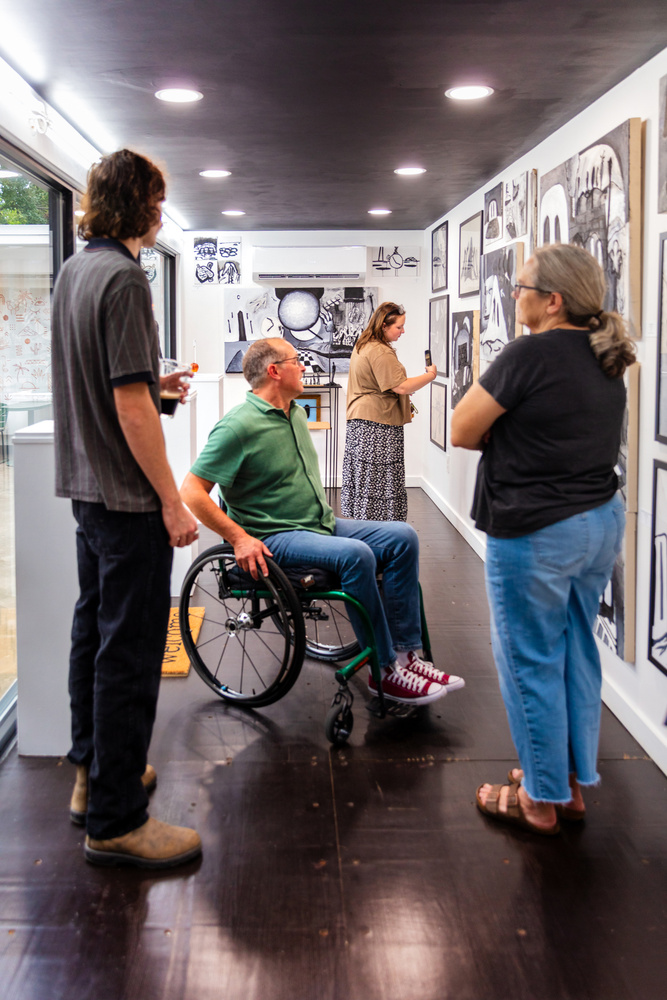
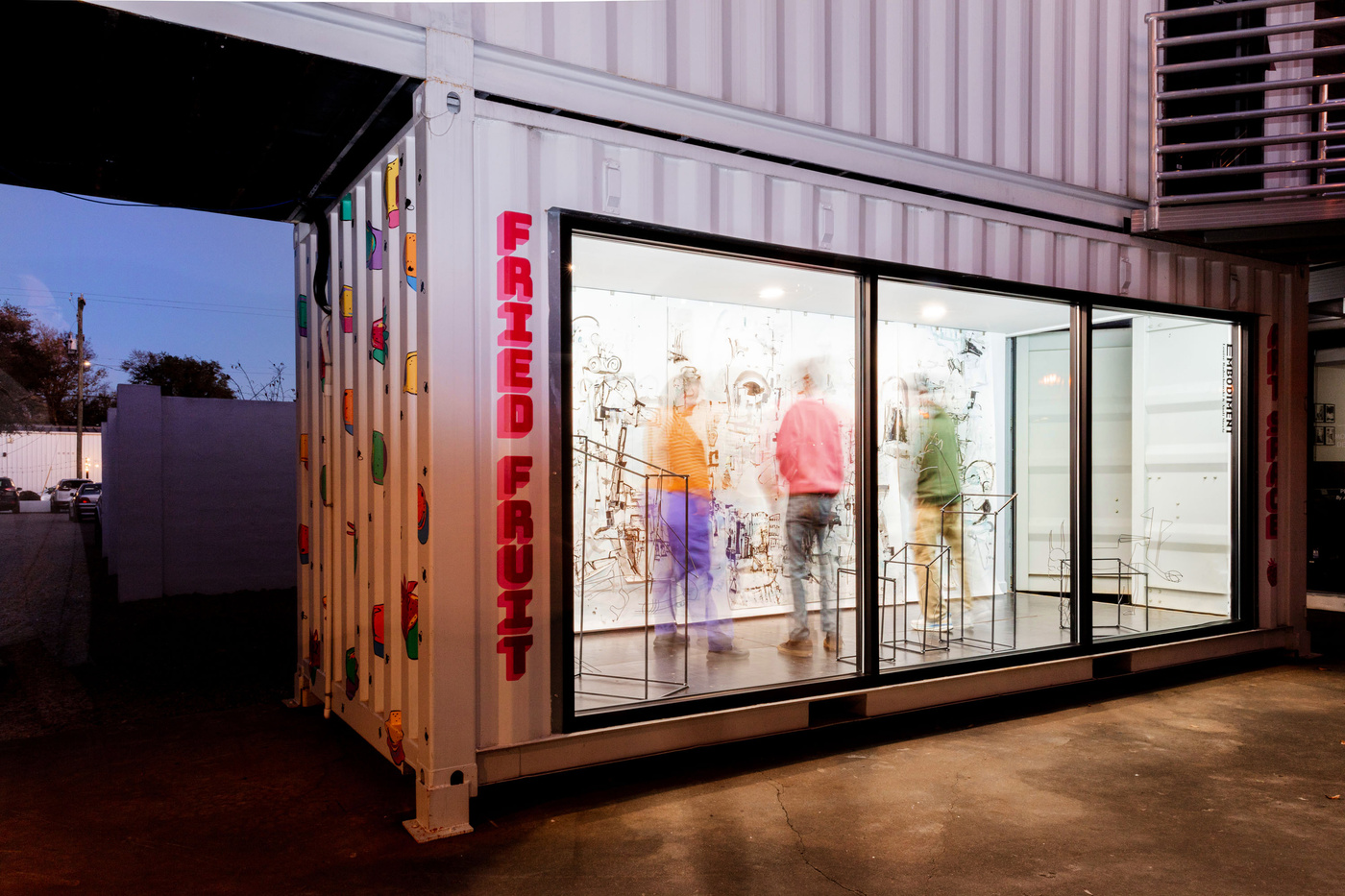
I wish the choice of the cargo container was intentional, but it really unfolded so organically. Matthew started working for Blue Cup Roastery, a coffeeshop also housed in a cargo container. As a barista, you are a hub for community information, and through that he met Will. Eventually, we moved into our own cargo container that was up a set of stairs, stacked on another container. Then finally, we were able to customize our current container, that lives accessibly on the ground floor, with one glass wall for ease of viewing each installation.
IMG: How does Wilmington’s Cargo District factor into the experience for visitors and artists alike? Does this area have a history of artists working within it or is it more recently become this hub? I also understand that the city itself is a port and I’m curious to know if that influences the work created by local artists or how you navigate the history of a cargo container in presenting exhibitions?
MMC: Wilmington has a long history of art communities, the most notable is Acme Studios in the Brooklyn Arts District, co-owned and founded by the same group of artists that started the annual No Boundaries artist residency on Bald Head Island. Unfortunately, that studio is closing and the building will sell very soon, but a new generation of artists losing their studio space have banded together to create Pulp Print Lab that opens at the end of this year. The biggest hole by far in Wilmington’s community is affordable and reliable studio space.
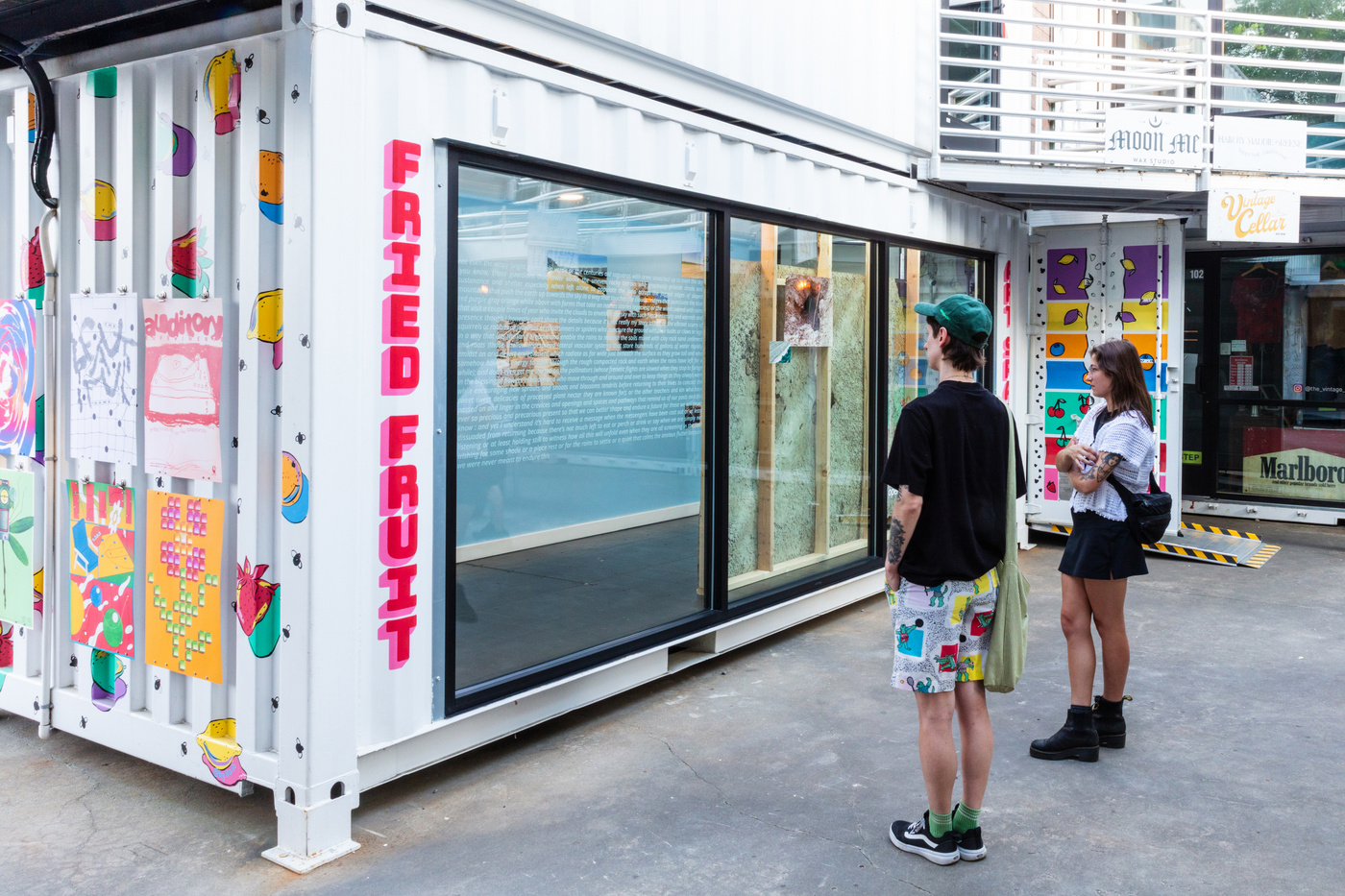
The Cargo District is a very young hub, with artists coming in and out of it from the beginning. Several shops sell local artwork and there are a few places where patrons can take art classes. Wilmington is a destination city, so many artists rely on tourism to support their practice. There are so many teeny individually owned and operated stores, salons, studios, food spots, and bars packed into the footprint of the Cargo District. A good chunk of our audience accidentally happens upon our space while they are getting a slice of pizza, before their hair appointment, or as a curious wanderer. In these interactions, sometimes we reach people who have never visited a gallery or art museum and that feels significant to us. It is hard to quantify how many people see the work, but there are always handprints and faceprints on the glass as evidence of a visit. One early morning we found out our gallery is a stop on bike tour!
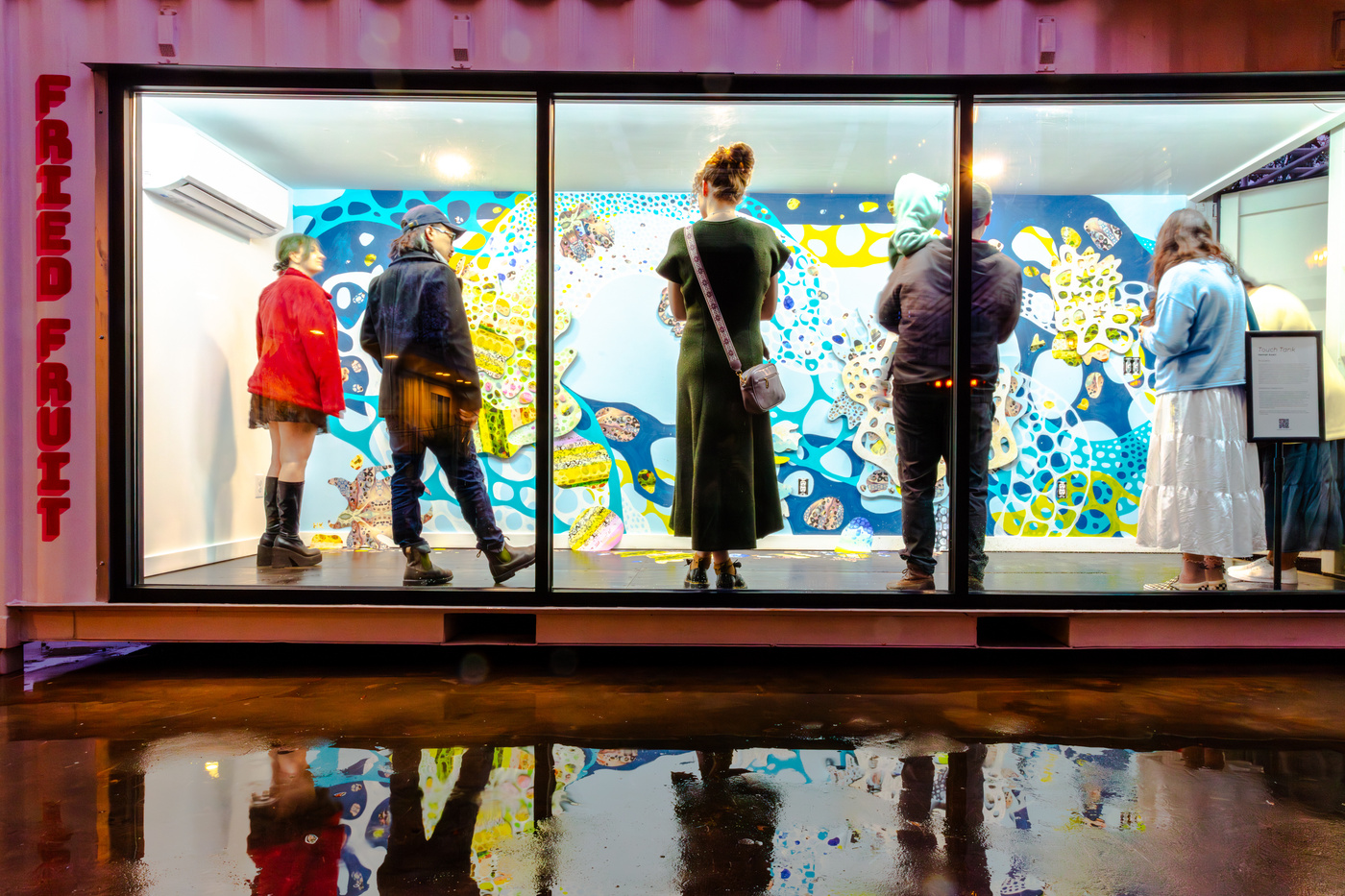
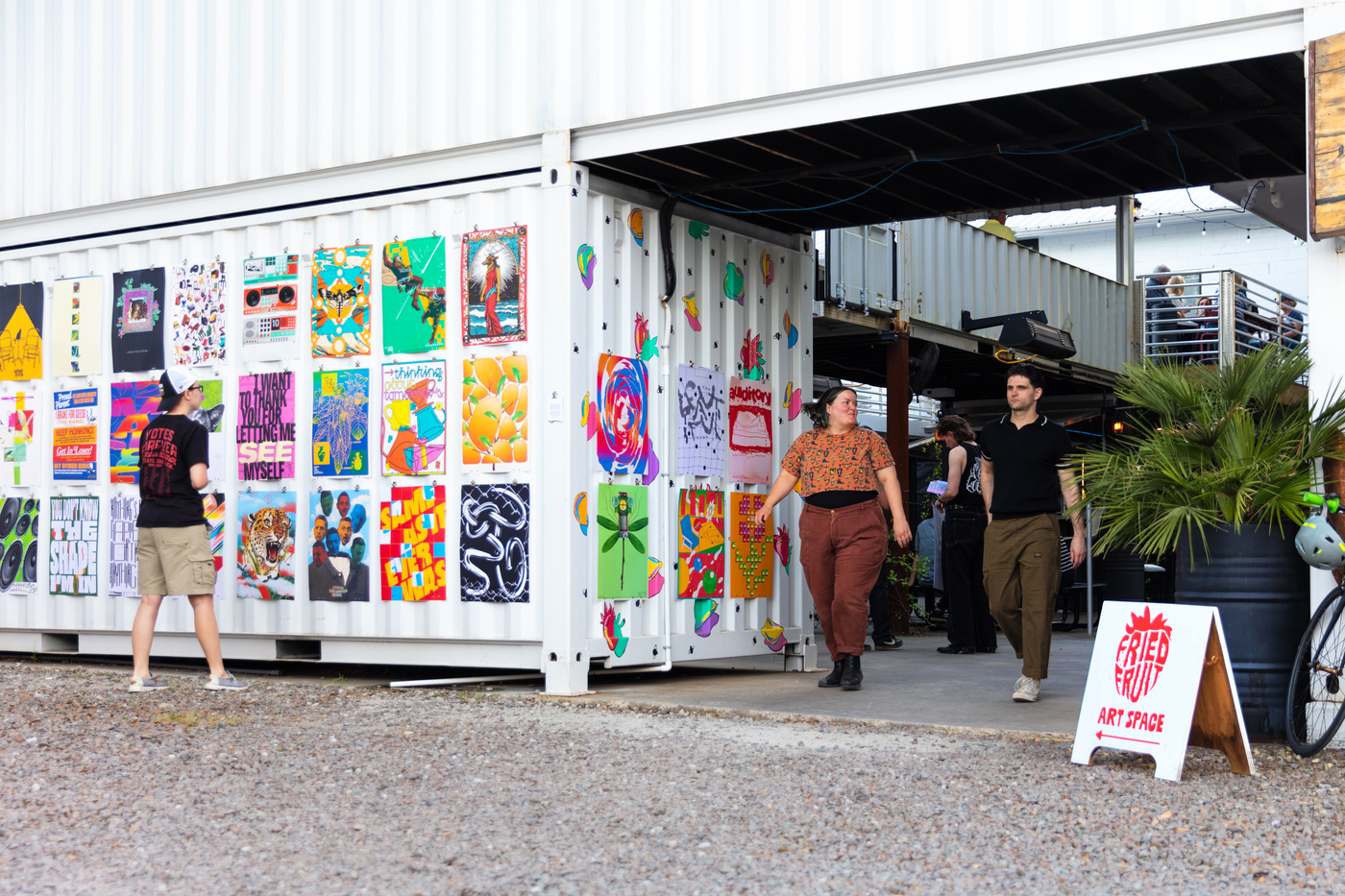
Being a port city, there is quick access to retired shipping containers as affordable building material. The developer often refers to them as Lego blocks, and you can see a lot of experimentation with construction in each area of the district. Our container still has functional cargo shipping doors. So, when they open, an entire wall of the gallery is gone; it also allows for LARGE work to fit into the space. Artists are often thinking about two perspectives when installing, the closed gallery and the open gallery. One of the recent artists alejandro t. acierto installed photographs in the gallery that were covered by a partial wall and just out of view when the gallery was closed. He talked about it like internet archives; the information is there but only comes into view when you go looking for it.
Many artists have thought about the cargo shipping container as a conceptual element. Hannah Keats thought of it as an aquarium, Henry Gepfer and Kit MacNeil used the glass as printing press in a performance about collaboration. Megan Young’s exhibition With What We Could Carry really considered the cargo container as a place of reflection on themes of migration, matriarchy, and the dreams of our elders. We would love to collaborate with a historian or internet sleuth to find more information about the specific travel log of our container, where it has been, and what it may have carried.
IMG: I particularly love how your mission statement includes the following: “The smallness is appealing and unintimidating, allowing exhibiting artists to conceptualize and execute an idea freely.” What have been the joys, blessings, challenges, and upsets along this journey of running Fried Fruit Art Space?
MMC: So many fears: Have we designed a space that exhibiting artists can see themselves within? Is the experience of exhibiting fruitful for artists? Have we made a space that warrants community care? Does the programming feel authentic? Is there room for others to influence gallery programming and feel a sense of ownership? Is the gallery accessible, is it safe? Have we done enough marketing to get the word out? Have we done too much marketing and are now destined for spam folders? Will people come?
Scale has been a big one for us. The trajectory of many other businesses in the Cargo District tend to hit a tipping point and need a bigger space to grow their capital. Compounded with social media’s hold on us to produce/share/reinvent as fast as possible to be visible, to make something that the algorithm will like, to chase those followers. In the early days those fears manifested as 11 exhibitions a year and we nearly burned out. At one point, we event occupied two spaces, thinking more shows, meant success. Now, we are in the mindset of finding ways to slow down and offer less and longer exhibitions, give artists more time to prepare, give us more time to find funding for artist honorariums, and more time to connect exhibitions to groups within the Wilmington community.
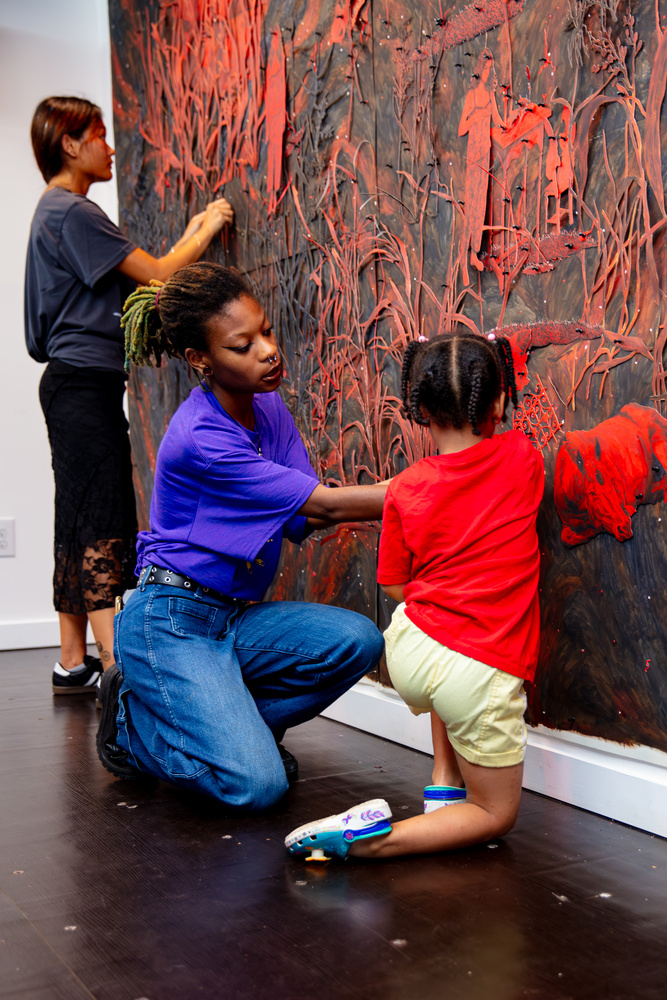
Our art space sort of sits at the intersection of artist-run and academia because of Madison’s role as a professor at the University of North Carolina Wilmington (UNCW). This connection allows us to get funding from UNCW’s internal grants as well as use the university’s 501(c)(3) non-profit status to apply for external grants for artist honorariums. Since our space is teeny, artists will give lectures on campus open to the public. Sometimes an artist with an expertise in RISO printing, textile design, etc, will give a workshop or demo using UNCW’s facilities, often generative for both artist and attendees.
We have also started offering one or two exhibitions a year to recent UNCW alums. It is a joy to take part in an artist’s first solo exhibition and to platform them alongside professional artists. These exhibitions are real community builders because they often bring part of North Carolina with them that we would not see otherwise. We had this incredible VR music pop-up DreamLounge by James Covial (aka Cov), where he invited several of his collaborators from True Productions Music Group to perform during the opening.
The connection to UNCW also has its downfalls. It took a while for the university to see value in our space. In fact, early on, we had to change our name from gallery to art space because there is a commercial connotation to the word gallery. It was hard to understand that our space is not a money-making venture and that great art could also be really hard to sell. And on top of that, our audience is broke, and we don’t take a cut if the work is sold. The artist honorarium is so important with performance, social and installation art.
IMG: Talk to me about the previous, present, and future exhibitions and programming. How does Fried Fruit Art Space go about selecting what artists to feature in the space and the programming that is brought to the community?
MMC: We are super excited for our 2027 exhibition calendar. Artist included are Martín Wannam, Meredith Starr, Sam Modder, Emma Quintana, Max Trumpower, Jack Estep, and Kaleena Stasiak.
Our main source for finding and selecting artists is through an annual spring open call. We want different perspectives selecting the artists beyond the cofounders’ point of view. In the past we’ve collaborated with paid interns as well as guests in the community to select exhibitors. Each round is tough to narrow down, and we often find ourselves reaching out to artists who were not selected and scheduling them two years in advance. On a few occasions, we have offered shows to folks who inquire by email prioritizing artists who have a connection to Wilmington. We have also offered exhibitions to local artists who may not be used the application process but have an incredible portfolio of work. We usually find out about these artists because they come to gallery programming, and they show a similar excitement for the type of exhibitions we host at Fried Fruit. It seems to be a natural organic dialogue that follows and eventually leads to an exhibition.
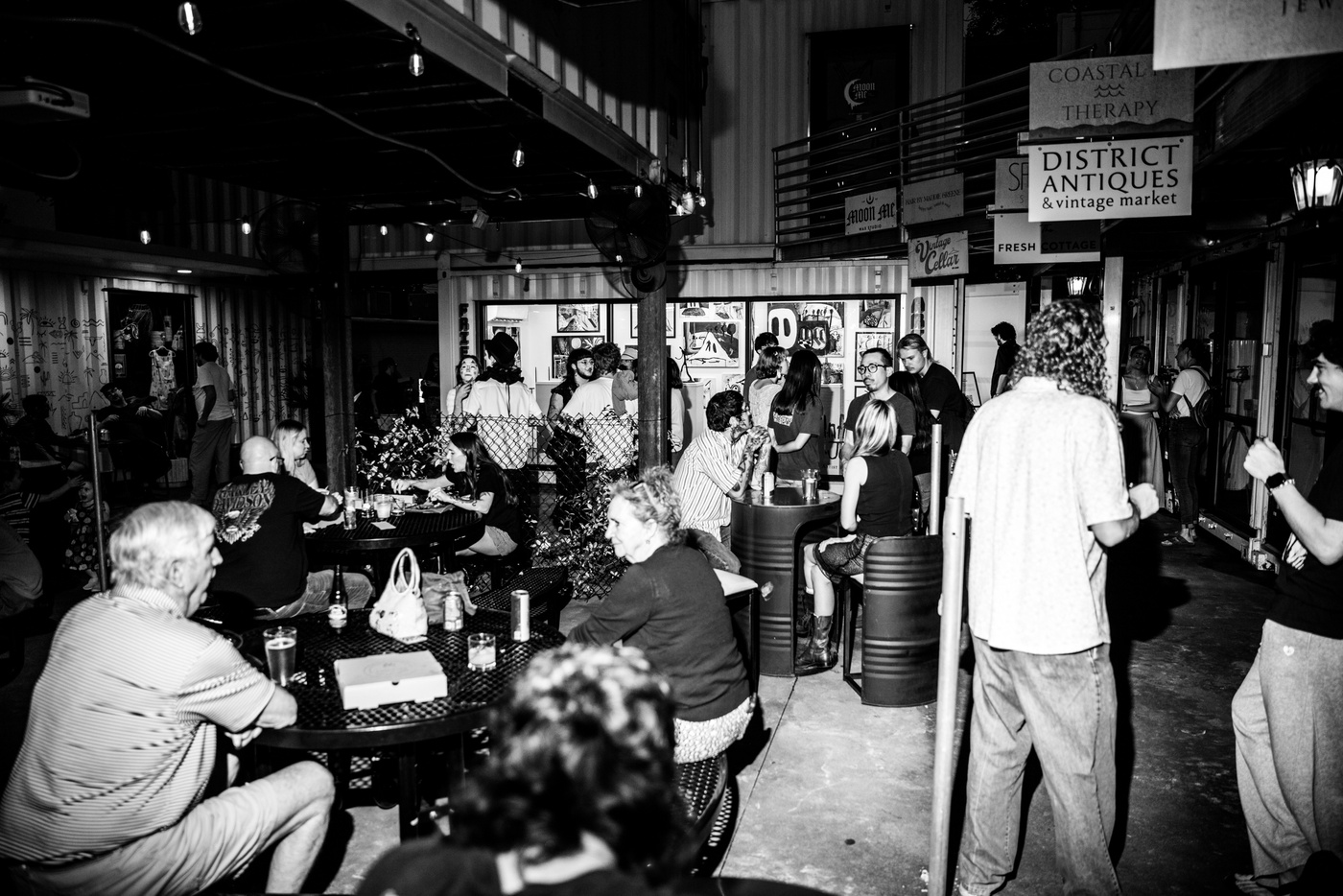
The gallery highlights a range of disciplines in hopes of expanding our community’s understanding of what art can be. Art is research, process, material, emotion, and storytelling. Beyond that, the work needs to be experienced from outside the glass. There is a lot of great work that we pass up, because it is too small, or solely projection, sound based, and performance based. The large windows for viewing the exhibitions, our limited hours of opening the gallery doors, and our shared courtyard space makes certain elements beyond our control.
Alongside each opening reception, we have been regularly including pop-ups in a parking spot behind our gallery. We found the ones that work best are un-polished work, experimental projections, VR projects, poster and design projects, and wild student ideas. One of our favorites was an Immersion Residency Pop-up, a collaboration between The School of Making Thinking and Cucalorus. There were readings, virtual reality projects, performances, and the Wilmington shuffle led by Remi Harris.
IMG: How do you hope to continue supporting local Wilmington artists in the upcoming year?
MMC: First and foremost, we’ll continue to make Fried Fruit a space that champions and celebrates weird unconventional art, supporting a culture that values experimentation within an arts practice. Our programming for 2027 includes a mix of local, state, and regional artists with diverse perspectives, materials and themes. Through representation of artists from all different cultures and identities will hope to be a beacon to budding Wilmington artists.
Secondly, we are happy to share that we extended an invitation to local artist, and RISO legend Jack Estep to install their very first solo exhibition in October 2027. This is two years in the making and has been a treat hearing how their ideas have shifted and grown within this extended period.
And finally, this may not be something achievable within one year, but we would also love to use our grant writing powers and network to aid in supporting affordable, accessible and reliable studio space for artists in Wilmington. Manifesting here, in case a curious ILM local reads this and wants to collaborate.