For photographer Alfonso Duran navigating housing as an adult felt provisional, something to endure rather than inhabit. By the time he moved into his Spring Garden apartment—a small, historic residential neighborhood tucked just northwest of Downtown Miami along the Miami River—in late 2022, the search was driven by survival: finding somewhere that didn’t make creativity feel like a liability. Crossing the bridge into the Spring Garden neighborhood, Duran felt the pace of the city shift. The streets narrowed, the canopy thickened, the river pressed closer. “It feels like you’re stepping into a different world,” Duran said.[1]
For the first time in years, he had an apartment that felt like his own, a space where he could invite people over, leave work on the walls, and return to the same geography day after day. That stability, rare for artists in a city defined by speculation and churn, set the stage for See It Like a Native: a photography exhibition, a book-in-progress, and a home turned gallery rooted in one of Miami’s oldest neighborhoods.[2]
See It Like a Native belongs to a long lineage of Miami artists who have turned their homes into exhibition spaces in response to housing precarity and institutional exclusion.[3] From 1980s domestic spaces like 381 and Real Wet Paint, through apartment galleries such as The House, to foreclosure-era projects like General Practice in the early 2010s, these spaces emerged when artists were priced out of commercial venues and forced to build their own infrastructure. Home-based exhibitions have functioned as sites of autonomy, allowing artists to show work, circulate value, and build community. Located in Spring Garden, where 100-year-old homes are being positioned for multimillion-dollar resale, Duran’s exhibition displays what steadiness makes possible: a tempo that is intimate, communal, and reverent. The photographs arise from presence, and in turn, honor the home that allowed them to exist.
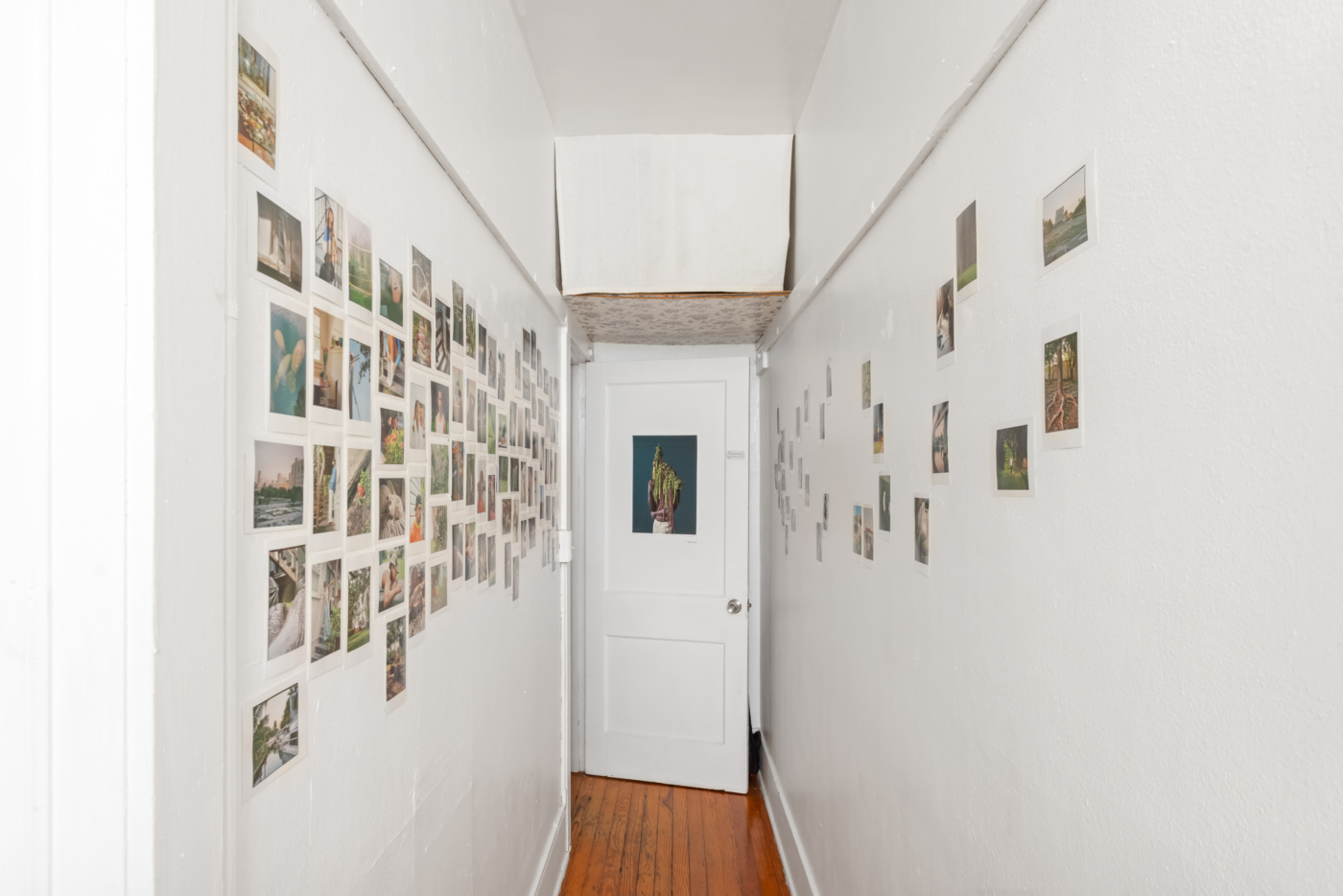
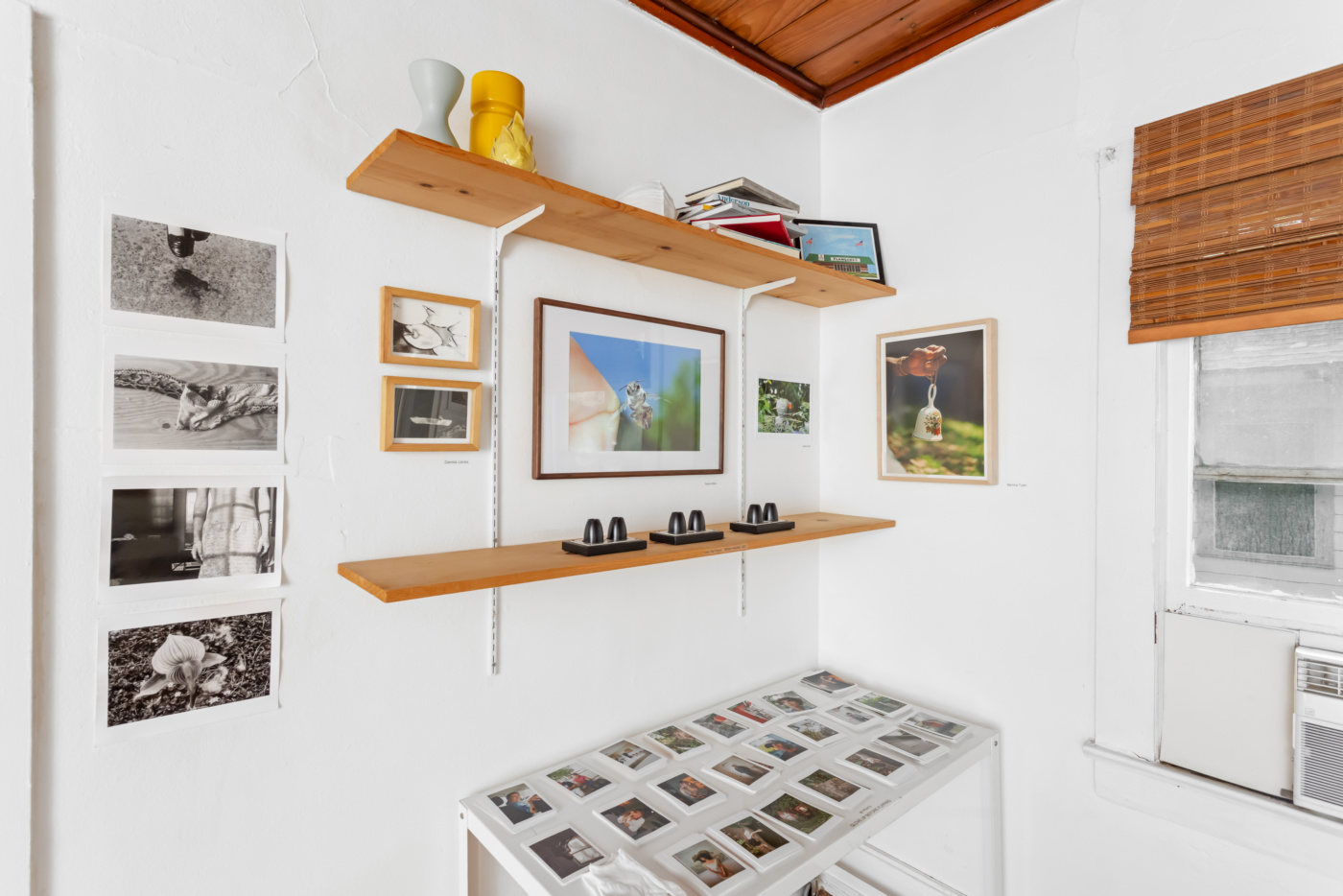
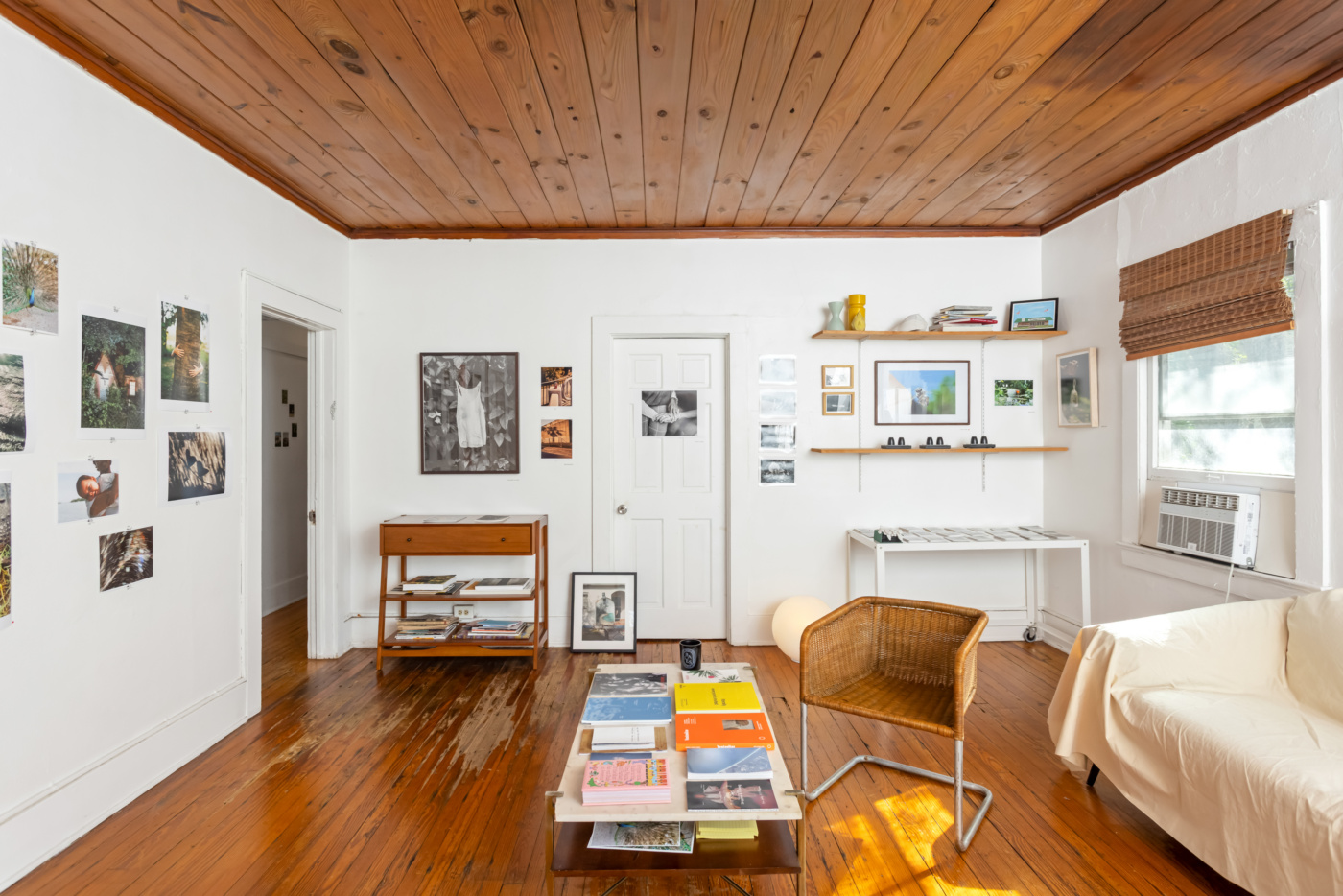
On a quiet block in Spring Garden, a narrow apartment hallway has become an archive. Photographs line the walls shoulder to shoulder: fragments of felled trees carried inside and preserved, traffic cones painted white topped with monochrome birds, offerings left along the Miami River, friends drifting in water and asleep on couches, a freshwater spring hidden behind a locked gate on private land. The work is intimate without being nostalgic, precise without flattening emotion. It is a living record of the neighborhood’s spirit through Duran’s patient eye.
See It Like a Native opened in early December as a one-week, open-house-style show during Art Week. After the opening, word spread. Visitors kept asking to come back. The show extended through January 4, turning Duran’s apartment, including its hallways, bedroom, and living room, into an exhibition space that felt temporary but carefully considered. The life Duran had built there over three years was apparent as friends and guests arrived with intention. While the group exhibition has since come down, Duran’s 4 x 6 photographs remain installed in the apartment hallway, part of an ongoing body of work that is also becoming a book-in-progress.
Curated by Madhavi Ghiotti, See It Like a Native foregrounded process. It asked visitors to move slowly through a lived-in space and to reckon with Spring Garden as a site of active erasure. As historic houses are demolished or gutted into minimalist white boxes, longtime residents are priced out and the neighborhood’s dense tree canopy is cut back—sometimes tree by tree.
Spring Garden is one of Miami’s earliest neighborhoods, shaped by Black land ownership, labor, and stewardship, and long overlooked in dominant narratives of the city.[4] Spring Garden’s history lives in its residents and their continuity. The neighborhood includes homes held by the same families for generations, including a two-story house built in 1916 that remained in the family of pianist and civil rights activist Ruth Greenfield for more than a century before listing for roughly $2.75 million earlier this year.[5]
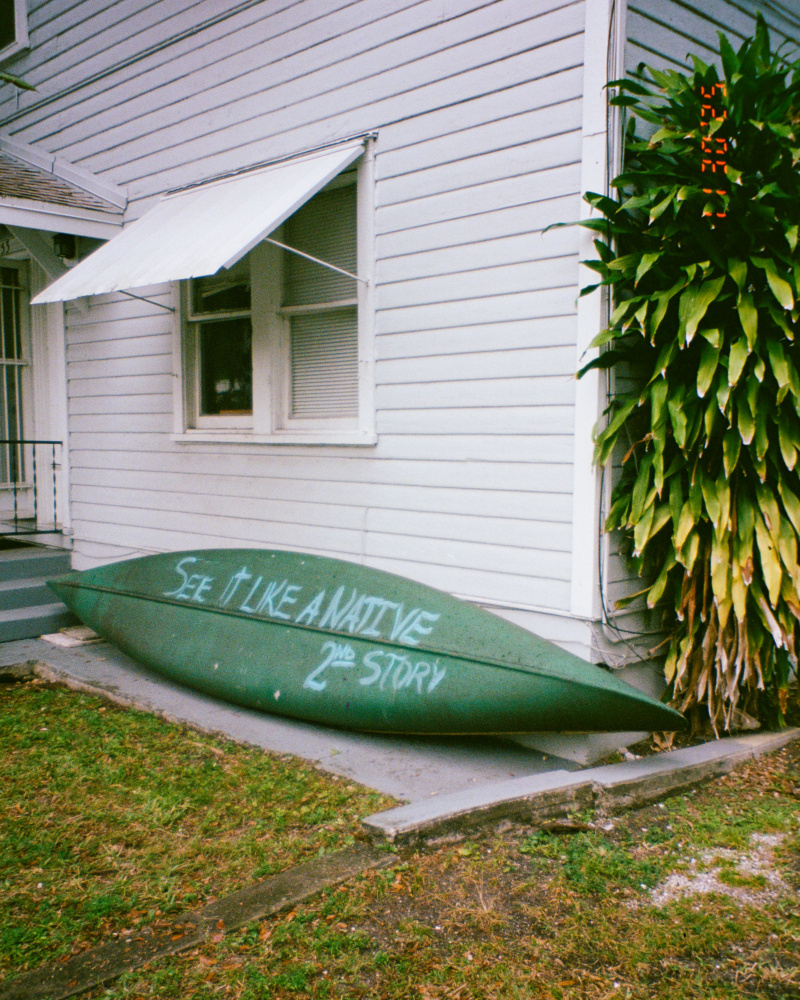
Outside, the exhibition’s title was painted onto a canoe that once belonged to Greenfield. After her death, her son offered it to Ghiotti, turning a neighborhood heirloom into a marker of the show’s preservationist stakes. For Ghiotti, making the work public—even unfinished—was a way of insisting that artistic labor be seen in real time, rather than deferred until institutional validation arrives, if it ever does. That insistence is inseparable from the exhibition’s setting. Learning the neighborhood’s history further reshaped the project.
One of the first people Duran met was his downstairs neighbor, artist William Keddell, who has lived in Spring Garden since the 1990s and shared archival maps and stories tracing the area’s origins.[6] Through him, Duran learned about the freshwater spring that gives the neighborhood its name—still flowing behind a locked gate on private land. When the group gained access to photograph it, the moment felt like a revelation. For Duran, the work operates as preservation and personal record—“the charm of this place and how historic it is,” he said, alongside “my own experiences just being here.”
If the work documents loss, the exhibition itself models an alternative infrastructure; one rooted in proximity, shared labor, and refusal of the white cube logic that dominates Miami’s art economy, particularly during Art Week. Ghiotti, who spent years working in commercial galleries before stepping away, was blunt about why this mattered. “Galleries are draining, and they don’t pay,” she said. “You have to eat. But that doesn’t mean you stop believing in showing work.”
Turning a home into a gallery was not romantic nostalgia; it was a pragmatic response to economic reality and institutional fatigue.
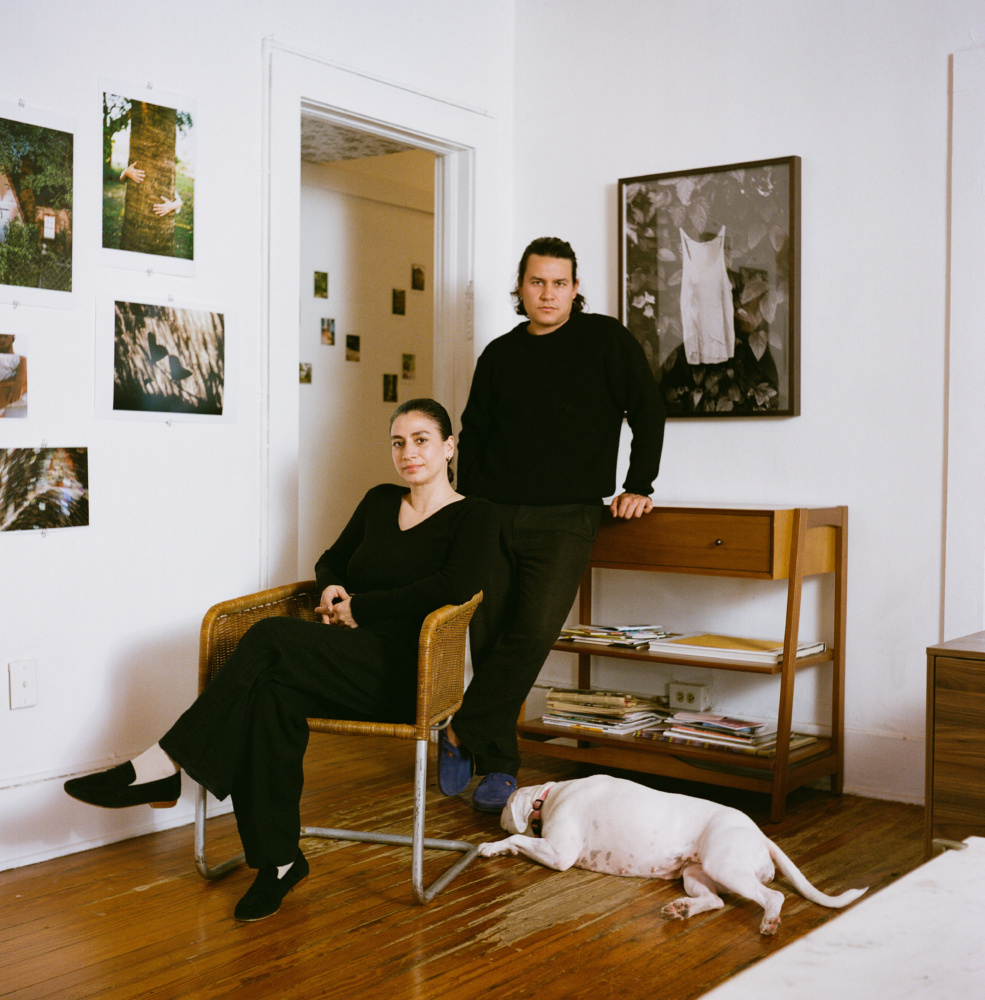
For Duran, making the show required moving furniture into Ghiotti’s apartment, relocating personal belongings to his parents’ house in Pembroke Pines, and temporarily boarding his dog. “I kind of moved everything to make the show happen,” he said. But the result was a rare intimacy: viewers could look at a photograph and realize it was taken just steps away.
From the 1980s through the present, domestic and improvised exhibition spaces have repeatedly emerged in Miami during moments of crisis. In the late 2000s and early 2010s, during the foreclosure crisis, artist-run space General Practice occupied a home in legal limbo, staging exhibitions and performances amid instability. The lack of formal permission created unexpected freedom. Artists took risks precisely because there was nothing left to protect.
Carlos Rigau, who lived and worked out of the General Practice house between 2010 and 2013, recalls the period as one of urgency and intensity.
“There was no funding, no safety net,” Rigau said. “So people just did things.”
House galleries emerge when artists and curators recognize that waiting—for funding, for permission, for recognition—is itself a form of erasure.
Earlier still, house galleries like The House in the 2000s offered similar conditions for experimentation, operating outside commercial pressure and institutional timelines. These spaces are rarely archived by museums, yet they live on in artists’ memories as formative sites—places where work could be seen and lived with.
As Duran prepared to transform his apartment into a gallery, he received guidance from Tadeo Reyes, an artist who lived in The House. Reyes helped Duran think through how to work with the constraints of a domestic space: how to pace photographs along narrow hallways, how to guide visitors through rooms without overpowering the architecture, and how to respect the fact that the exhibition was unfolding inside a home. The exchange underscored how Miami’s house-gallery tradition persists through peer transmission—artists passing down strategies across generations.
Rigau was explicit about why this history remains thinly documented. In his view, it is a structural disincentive. Artist-run house galleries, he argued, expose a contradiction at the center of the art economy: that artists can produce, exhibit, and circulate work without institutional mediation. Drawing from Marxist principles, Rigau described institutions as extractive structures that depend on artists’ labor while claiming authority over its value and visibility. To fully acknowledge spaces like General Practice or The House—where artists organized autonomously, sold work directly, and embedded exhibitions within everyday life—would be to admit that the institution is not the only future. “It doesn’t benefit them to promote this history,” Rigau said. “Because it proves that artists can do it themselves.”
For Duran, plans are already forming for what comes next. Duran and Ghiotti have named the project space Second Story, a nod to its literal location and its evolving ambitions. A Spring Garden–centered group exhibition is in the works, alongside a three-day photography show in New York this spring that will bring Miami-based photographers into a different geographical context. Long-term, Duran imagines something more permanent—perhaps purchasing the building, perhaps turning a unit into an artist residency.
As Miami continues to market itself as a global art destination, these small-scale, domestic interventions offer a counterpoint that prioritizes memory and care over accumulation. They insist that seeing like a native means staying long enough to notice what is disappearing—and choosing, collectively, to make it visible while there is still time.
[1] Alfonso Duran (photographer), in discussion with the author, 2026.
[2] Sophia Hernandez, “Historic Miami home up for sale for first time in more than 100 years,” NBC 6 South Flori-da, March 30, 2025, https://www.nbcmiami.com/news/local/historic-miami-home-up-for-sale-for-first-time-in-more-than-100-years/3559944/.
[3] Rob Goyanes, “General Practice,” The Miami Rail, March 1, 2013, https://miamirail.org/essays/general-practice/.
[4] Justin Alexander, “Demolishing Black History: Miami’s Historic Preservation Failure,” Race & Social Justice Law Review, October 13, 2023, https://race-and-social-justice-review.law.miami.edu/demolishing-black-history-miamis-historic-preservation-failure/.
[5] Hernandez, “Historic Miami home.”
[6] “Home,” William Keddell: Multi Media Visual Artist, accessed March 3, 2026, https://www.williamkeddell.com/.