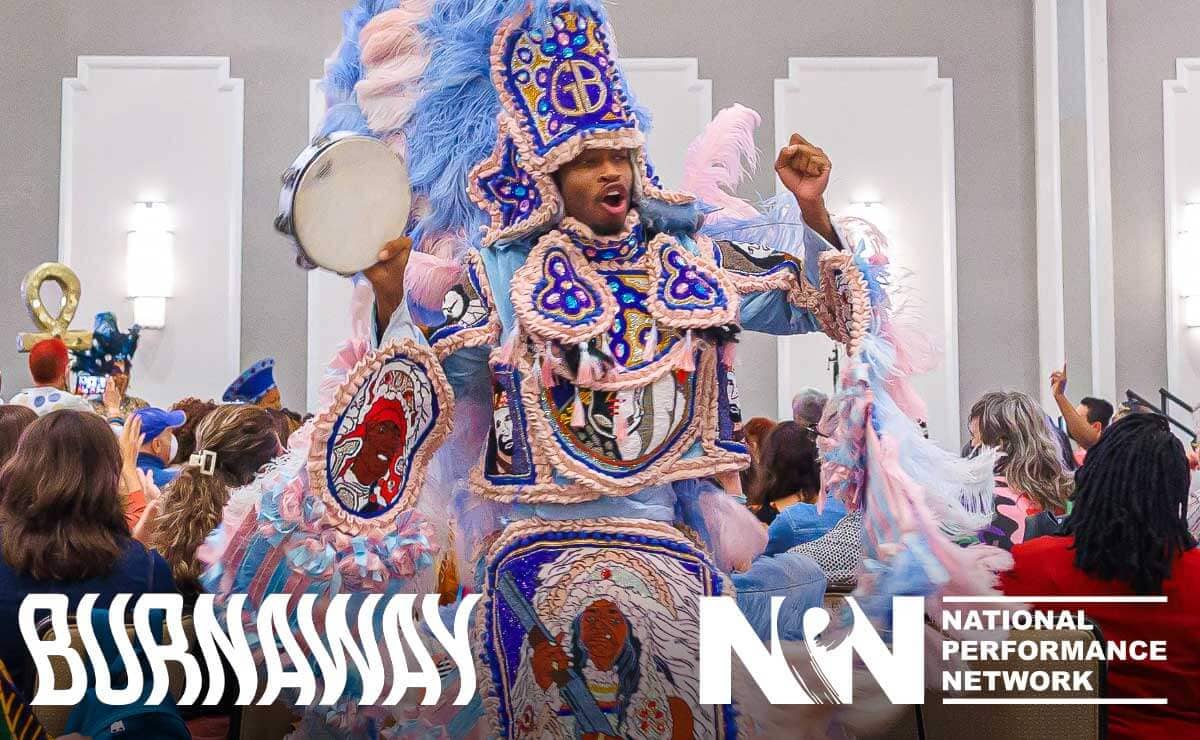
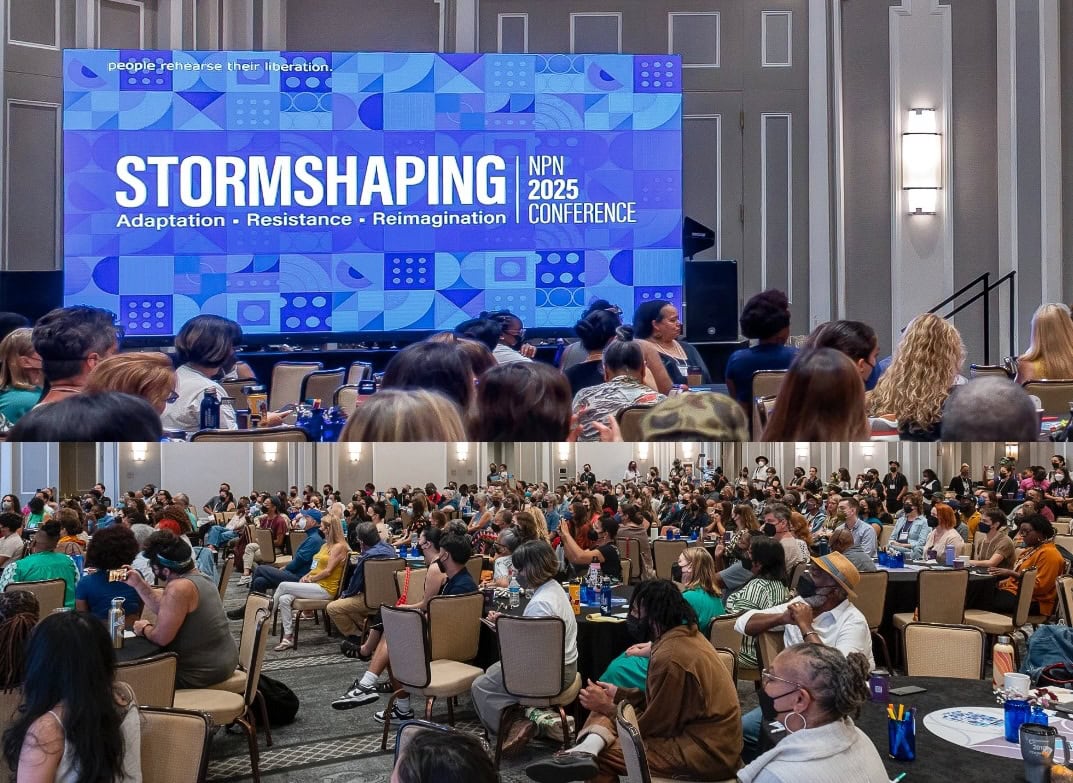
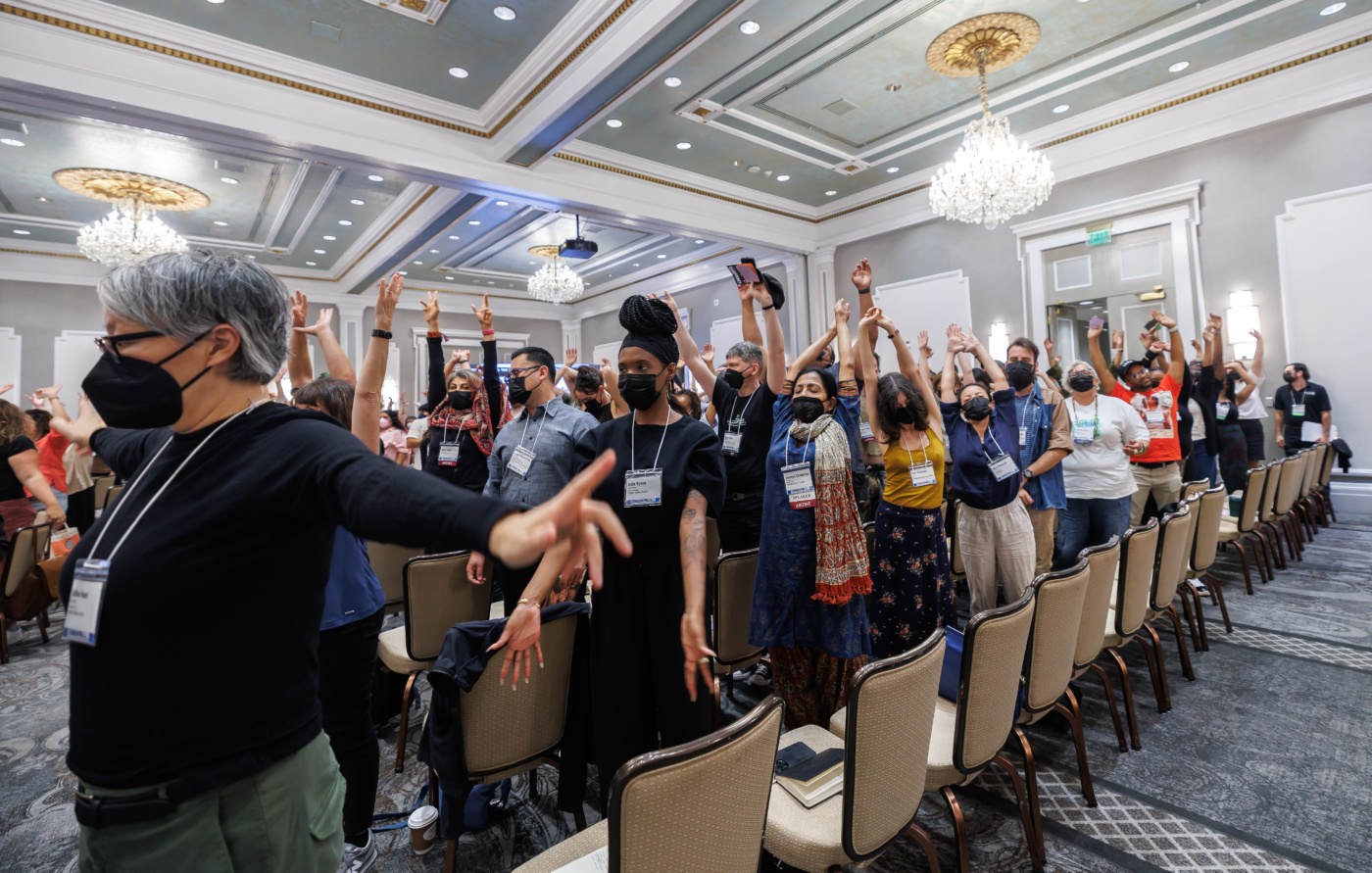
Presented at the National Performance Network’s (NPN) 40th anniversary conference entitled Stormshaping: Adaptation, Resistance, Reimagination, held in New Orleans, I attended the panel “New Tools for a New Terrain: Supporting Artists at the Intersections” moderated by Cézanne Charles, Partner at rootoftwo, with panelists Jes Allie, Co-Director at BULK Space; Judilee Reed, President & CEO of United States Artists; and Ama Rogan, Managing Director at A Studio in the Woods. Drawing on “Looking Back to Move Forward,” a participatory action research study of BIPOC artists and culture bearers in Detroit, MI, Memphis, TN, and New Orleans, LA, the panel considered problems of social transformation within the space of arts administration and the new, radical infrastructures required to financially and systemically uplift marginalized artists in these locales in meaningful and long-term ways.
While listening I asked myself: What does this mean for disenfranchised artists like me whose survival is dependent upon an already imperfect, predatory, and crumbling system? How do we honestly address and mitigate the violence of an arts economy that hoards the resources it has for artists and professionals already deemed legible and worth the return on investment? What economic histories are refused or unacknowledged when we ask these questions?
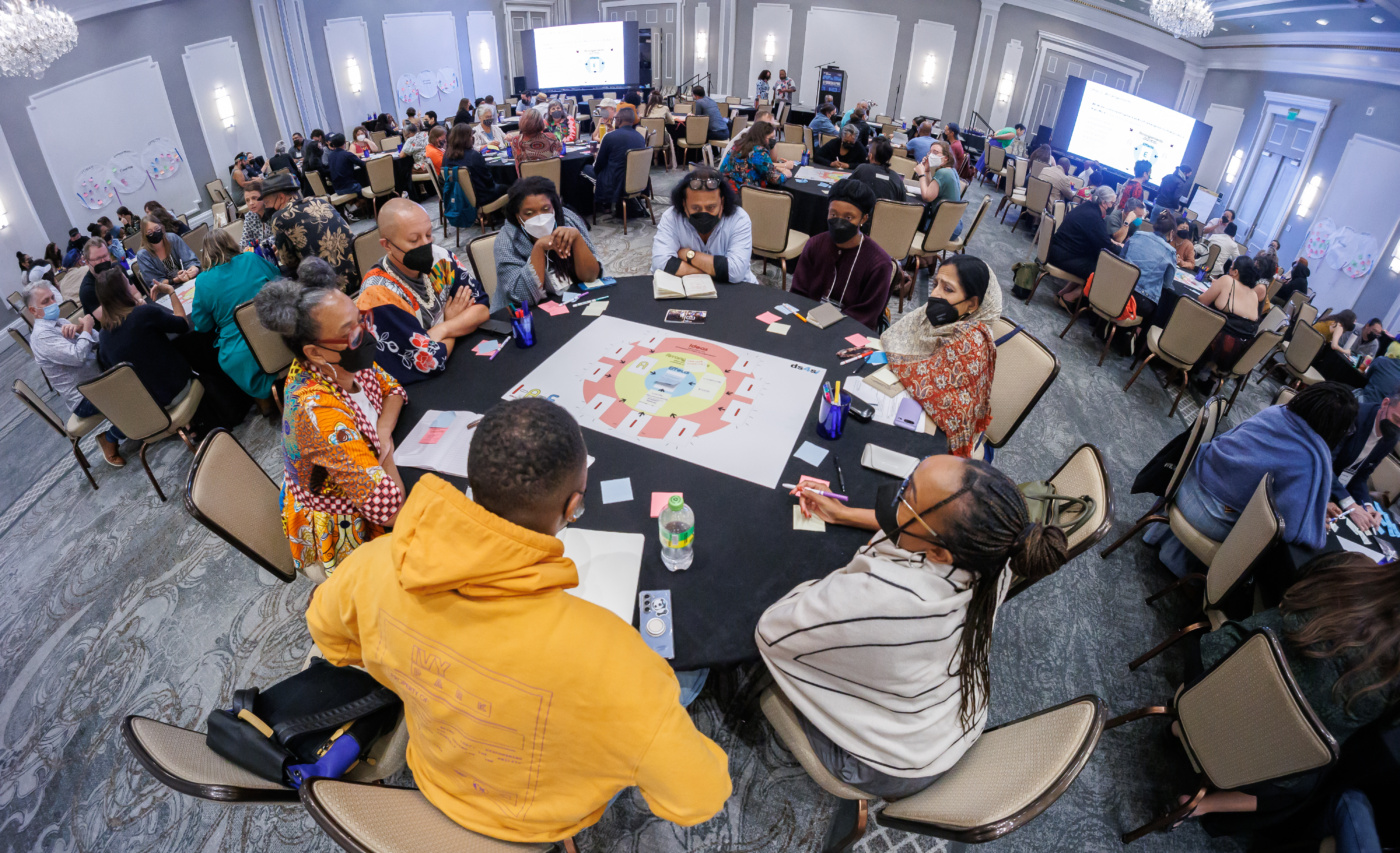
During the question and answer a microphone circulated. Participant after participant took turns sharing stories of their artistic and community driven work and the precarious nature surrounding it. One woman from New Orleans spoke of the dance troupe she ran from a makeshift studio in the back of her home due to lack of funding to rent a space. Another participant from the Indigenous Southwest spoke of their organization being mined for content by funders and then suddenly abandoned. As these stories continued, a constellation emerged in my mind, a constellation that linked my own histories of labor and artmaking to the violent fluctuations of back-to-back recessions, inconsistent employment, opportunity made available only as a gesture toward a vague and conditional act of solidarity. Finally in possession of the microphone, the last speaker in the queue, I began sharing my own story, taking the question of modern-day economic disenfranchisement back to mid-aughts.
If asked to pinpoint the moment of my awareness regarding the precarity of my existence in this country emerged I have to take us back to September 2005. I was just a few months shy of fourteen and had just started my freshman year of high school in the Southfield Public School district. News of Hurricane Katrina and its destructive aftermath filled the negative space of nearly every interaction. Spoken in, hushed voices of teenagers’ curious disbelief, we were horrified by the destructive strength of nature and the absolute indifference of so many official channels. I had never seen with my own eyes the lengths a government could and would go to abandon their own citizens. I had never watched the assemblage of racist and classist narrative be spun so quickly as means withhold aid and punish those suffering. Of course, this was nothing new for America and was in fact part of a long-standing tradition. Had I only previously known the shape of my oppressor, now I felt their weight. Should anything outside of my control happen, I realized, anything at all, this country will leave me to die.
I graduated high school in 2009, during the Great Recession’s “final” year.[1] In the United States, the recession ended the summer of 2009 but due to its expansiveness and intensity, the most vulnerable workers did not see their labor market prospects improve considerably until 2014.[2] Michigan was hit particularly hard, experiencing significant decreases in household median income and home ownership as well as an overall increase in poverty in just over half a decade.[3] Both of my parents, having lost their jobs, scrambled to find work. Barely able to afford the one year of college I did complete, it quickly became clear this was not a financially feasible option. At seventeen I began providing for myself, choosing part-time employment over the stress and anxiety of stringing together loan after loan for a degree I wasn’t sure would guarantee me the security of a career let alone pay off the debt I would surely accrue.
It was not a promising time to be thrust into adulthood. I knew what I wanted but every course of action available to me and previously assured had become insecure and confused. I spent the whole of my twenties working multiple jobs, moving up from physically demanding labor like cleaning and errand running to seemingly more stable roles as an arts administrator at various institutions across New York City. For a while it seems I had found myself on a forward trajectory of sorts. I had finally done what felt like an impossibility and cultivated a skillset that had turned into the reliability of a career that mostly met my basic needs while still allowing me some time to write poems. This lasted for only a short time of course, four and a half years.
Many practitioners of the arts in America are born of communities on the fringes of survival, of families who’ve exhausted themselves generation after generation for a way out of the systemic fate this nation constantly threatens. It is unlikely, rare even, for an artist of less resourced means to be able to live solely off of their creative work. Many of these artists work multiple jobs, often blue collar or entry level in nature, the kind of “unskilled” or background labor still held hostage by outdated minimum wage standards or cultures of logic-less professional hierarchies.
Across my own familial histories, labor manifests as a kind of Sisyphean doctrine. My mother, the youngest of five children, was born to a Mexican family in Peoria, IL, and worked odd jobs before becoming a housewife, a reality that was interrupted by divorce, more odd jobs, cancer, addiction, and disability. My father, the oldest of five, was born in the post-war Jim Crow South to a family of Black laborers hailing from Murfreesboro, TN, who settled in Nashville. My father’s life in particular is punctuated by work of all kinds: hard labor, blue collar, off-white—in jarring non-linear fashion. By the time I had come into his life he co-owned a small plastics plant that made parts for Ford before becoming a casualty of the 2008 automotive crisis. It was in my father’s plastics plant that I took my first job at the age of eight so that I might, in his words, “never have to work in a place like this ever again.”
In a stroke of irony, my father, seventy-six years old, currently works in a plant that makes computer parts. He tells me stories about his coworkers, mostly immigrants and the elderly, working into the early morning hours. He pleads with me to come up with a plan fearing that I will end up back in the factory he promised I would never have to return to. I don’t have the heart to challenge him with the honesty of my thoughts: Retirement and social security are likely pipe dreams for my generation and those to follow, that feels impossible to plan for the future in a burning house.
Across my own adulthood I have had several jobs, in nearly all of which I was abused. With every year, I’ve made, in one way or another, slightly more money than the last. And every year the cost of living rises and so my math unbalances itself. Precarity begets precarity. The rock slides down the hill.
As of August 2025, U.S. workers who have been jobless for at least twenty-seven weeks now make up more than a quarter (25.7%) of all unemployed people, a comparable number to early Great Recession figures.[4] Persons identifying as Black or Hispanic and younger workers generally experienced relatively high peaks in unemployment as well as steep declines in labor force participation over the course of the pandemic. Additionally, those with lower educational attainment generally experienced even higher unemployment rates and lower labor force participation.[5] Long-term unemployment whittles away at an individual’s confidence, pushing them to the fringes of professional displacement via skill erosion, résumé gaps, age discrimination, and general discouragement. This kind of abandonment isolates the most vulnerable, essentially creating and disappearing large swathes of demographically “unemployable” people. This subterranean class of the unemployable has only grown in the years since the Great Recession via the expansion and exploitation of the gig economy, which grew remarkably in response to COVID-19 lockdowns and furloughs, outsourcing creative and administrative roles with little to no job permanence, protection, or benefits.
Artists know best what kind of support they need.
I’ve heard these needs grow and echo across conversations with friends or colleagues and I heard them again during the “New Tools for a New Terrain: Supporting Artists at the Intersections” panel. Artists need local, long-term, no strings attached financial support. Artists need institutions to divest from the fickle and impenetrable pageantry logic of grant applications to a more sustainable model grounded in the distribution resources vs. the collector mentality of amassing a roster of well-known alumni. Resources need to be diverse and considerate of the survival of an individual and the longevity of their career. And, perhaps more importantly, they need to be grounded in honest dialogue with the economic histories from which many are still recovering. In an economy as unsettled, fragile, and marauding, throwing money at an artist solves only a fraction of their problems, acting as a tourniquet slowing the bleed-out but never stitching the wound. As I wander up and down the blocks of New Orleans, I see Detroit, the city I am from, reflected in the vacant lots, abandoned homes, and creeping gentrification. I, like the city I am from, like the city I now live in, am haunted by the blurred edges of displacement, disenfranchisement, vacancy, and futures stolen.
I pose a question that aligns with the NPN’s conference theme of Stormshaping, calling in what I believe to be an important act of reimagination and redistribution: How many working-class artists could you purchase a year’s worth of health insurance for with $800,000?[6]
[1] The Great Recession was a period of market decline in economies around the world that occurred from late 2007 to mid-2009, overlapping with the closely related 2008 financial crisis. “Great Recession,” Wikipedia, last modified February 11, 2026, at 22:59 (UTC), https://en.wikipedia.org/wiki/Great_Recession.
[2] Jay C. Shambaugh and Michael R. Strain, “The Recovery From The Great Recession: A Long, Evolving Expansion,” The ANNALS of the American Academy of Political and Social Science 695, no. 1 (August): 28-48.
[3] Josh Sanburn, “These 3 Maps Show Where the Great Recession Hit Hardest,” TIME, December 3, 2015, https://time.com/4133963/us-census-poverty-income-great-recession/.
[4] Niccolo Conte, “Charted: Long-Term Unemployment in the U.S. (2005-2025),” Visual Capitalist, October 24, 2025, https://www.visualcapitalist.com/charted-20-years-of-long-term-unemployment-in-the-u-s-2005-2025/.
[5] “Unemployment Rates During the COVID-19 Pandemic,” Congress.gov, published August 20, 2021, https://www.congress.gov/crs-product/R46554.
[6] $800,000 is the prize amount awarded an individual by the MacArthur Foundation Fellowships, also known as the Genius Grant. In 2025 they awarded 22 individual fellowships totaling $17,600,000.