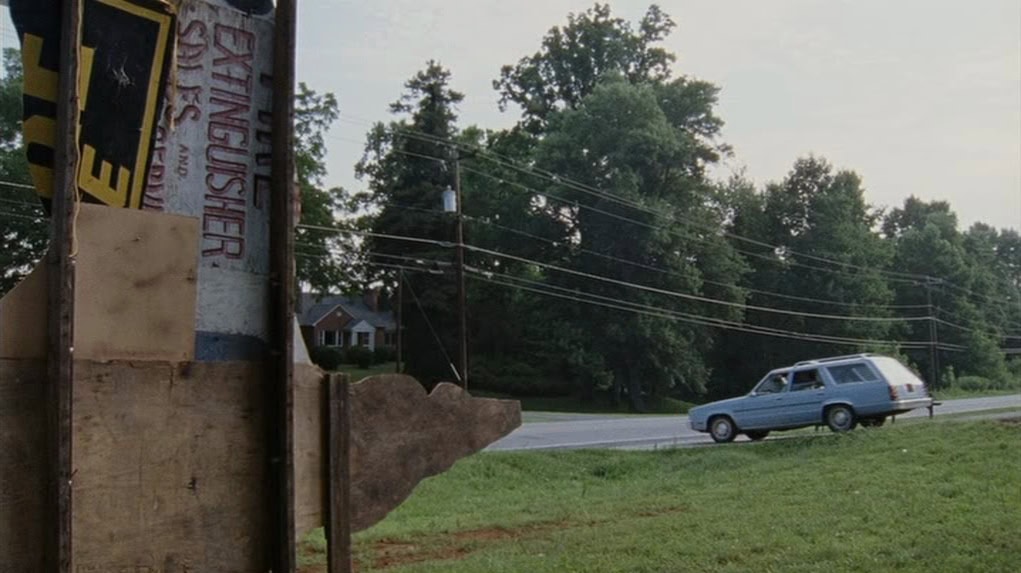
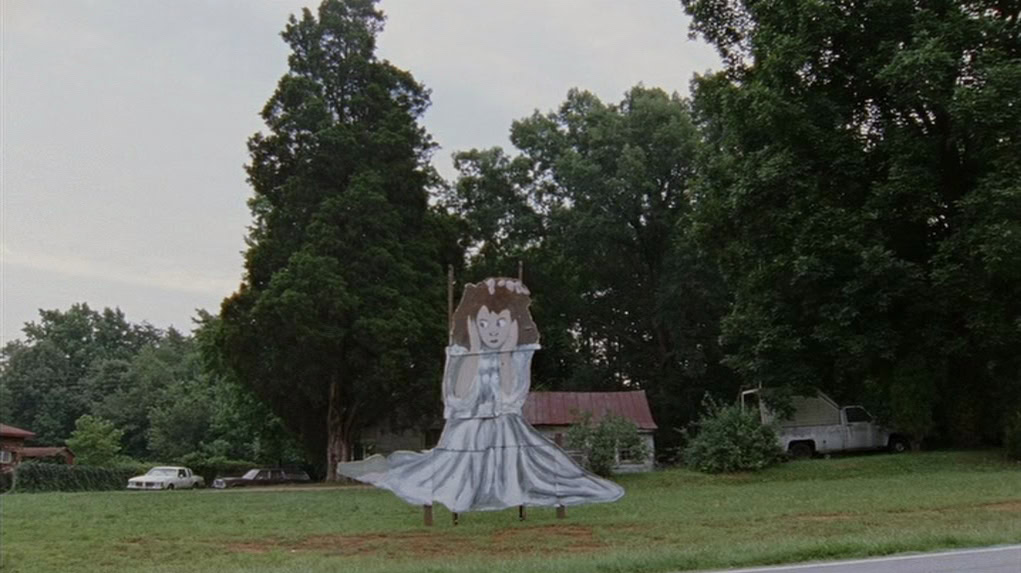
The first work on screen by Winston-Salem NC-based artist David Wark is a large painting of a young girl kneeling; her hands cover her ears, displayed in his front yard as if a billboard. She looks slightly down to the left, her expression between worry and annoyance. She wears a dramatic white dress, spread over an implied ground; her forearms the only other part of her body visible, rise from falling sleeves rendered in unremarkable grays. The supports of the work are visible from behind: weathered two by four beams of varying heights rising vertically from the ground. The next frame shows the reverse, a collection of repurposed plywood pieced together. From this angle, the depicted girl faces the actual road as a car pulls into the driveway, opening to reveal a group of artist types hoping to meet the painter.
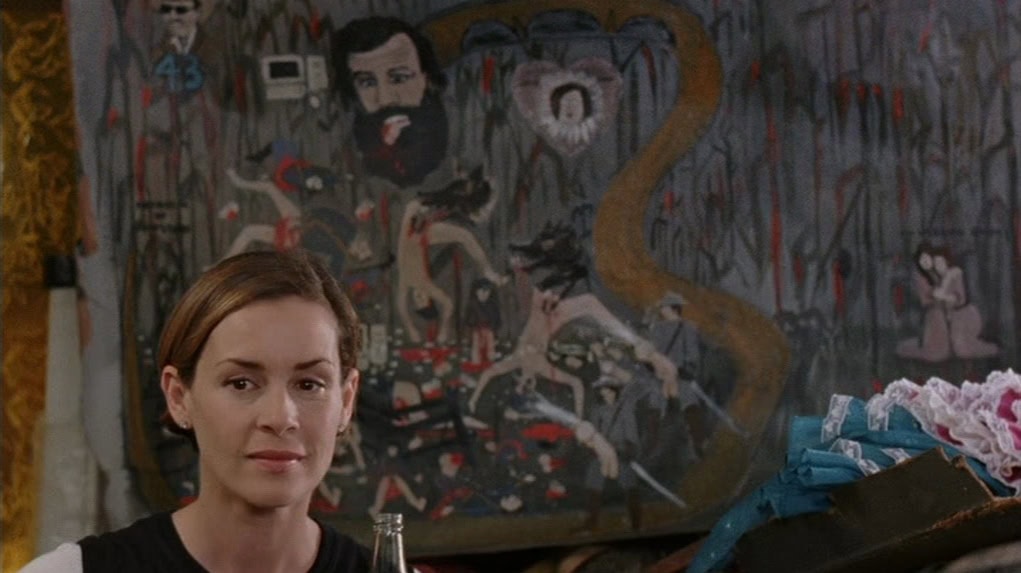
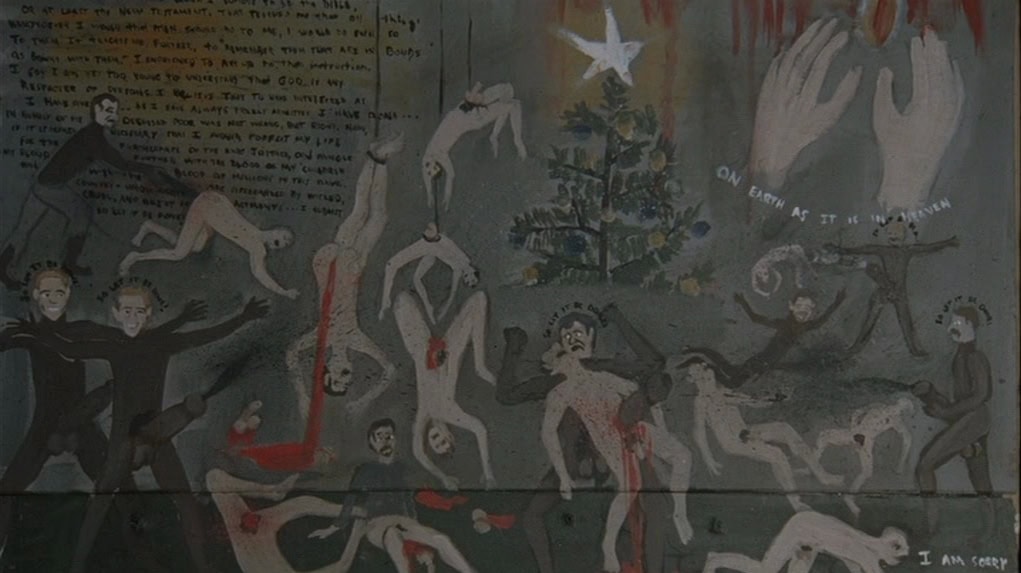
One of the scouts in this scene pulls out his cellphone to call Madeleine Johnsten, a leading art dealer at a Chicago gallery specializing in “visionary art.” He implores her to see the work in person, that the paintings are genius, that meeting the gallerist would make Wark much more comfortable signing a representation deal. And so she visits, and it is through Madeleine’s view that the audience accesses the interior of Wark’s home and his entire body of work. The languishing woman from the painting in his front yard appears in another painting as a small detail among flying bullets and a man bleeding from his ass. “I love the dog heads and computers,” Madeleine remarks while holding a glass bottle of Cheerwine. Each painting loosely correlates to events of the Civil War with soldiers in blue or gray uniforms. The paintings’ brief appearance on screen introduces curiosities about cultural difference that inform the film and linger in contemporary discussions regarding “outsider” artists, despite their status as film props.
Junebug (2005), directed by Phil Morrison, charts the early tensions of “folk art’s” cultural reappraisal, which has been integrated into larger, canonical art histories in the twenty years since release. In the film, Johnsten’s brief immersion into Winston-Salem through her new husband’s family commands most of the plot as the dealer of “visionary art” visits the American South for the first time. The paintings as props are also subject to their own complexity, created by artist Ann Wood under the direction of Morrison. Cultural differences are unveiled and challenged through narrative, yet the differences incite reverence and fascination. Madeleine champions the “raw” work of Wark; she adores the nuance of Huckleberry Finn while her brother-in-law begrudgingly writes an essay about the novel for his GED. She sees value and novelty in the South’s cultural exports, while the local characters take interest in her cosmopolitan lifestyle and British accent.
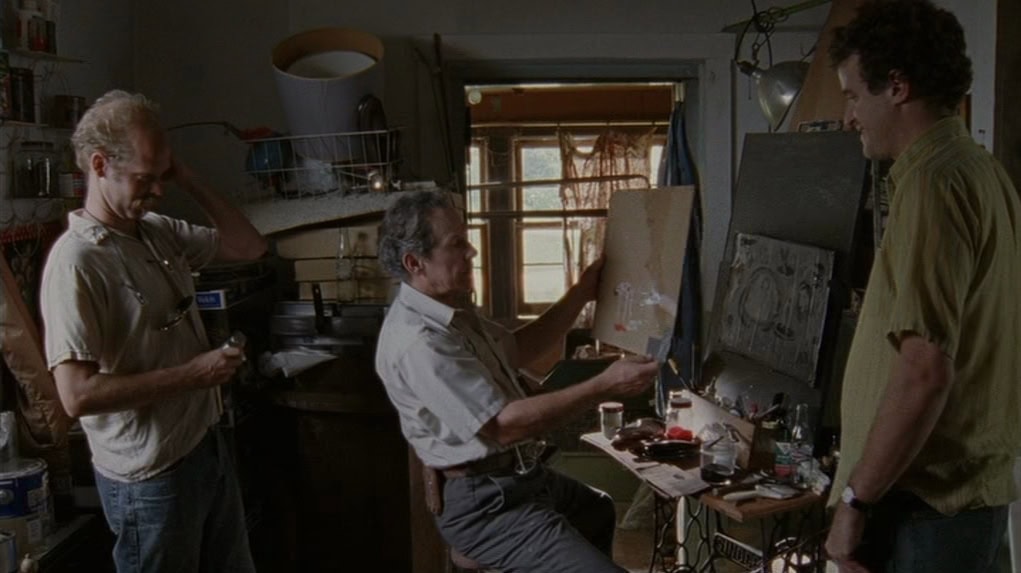
The Civil War makes for a convenient allusion to the domestic dramas that ensue while emphasizing the film’s Southern setting, though it also aligns Wark’s work within the tradition of “folk” history painting epitomized by Howard Finster. Like Finster, Wark is also compelled to paint his visions by a Christian God in order to spread his ideas. Though Finster favored historical figures from colonial America, both artists use history as a means of sharing fables, complete with didactic captions that obscure rather than clarify. Myths of humble Americana also manifest in their materials: common house paints on wooden substrates. The materials in turn inform the visual qualities of these paintings, the enamel and latex paints resistance to subtle blending facilitate the flattened perspectives of each painter.
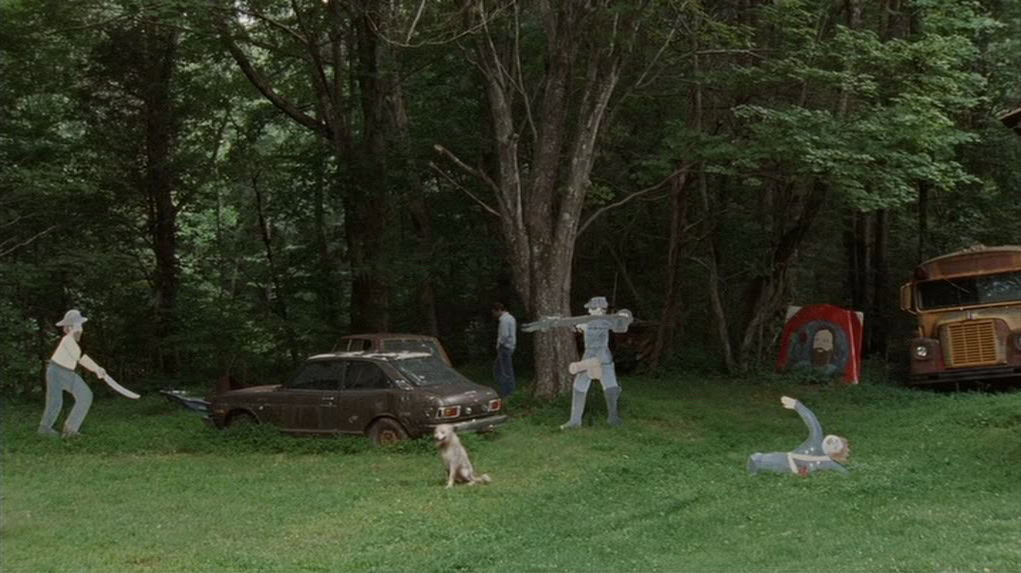
The artist’s limited material access lends itself to the populist approach of spreading a message; using durable materials associated with building homes, fictional Wark and real artist Finster utilized their outdoor spaces as extended sites of viewership. Beyond Wark’s young girl facing the street, his property has several sporadic sculptures of his Civil War soldiers among the old cars and his dog. To see these through the lens of a camera in service of a fictional narrative is a strange deja-vu, considering that most art existing in this tradition has dissipated and is only accessible through archival images and isolated museum acquisitions (A non-exhaustive list includes Finster along with Lonnie Holley, Nellie Mae Rowe, and Eddie Owen Martin/ St. OEM).
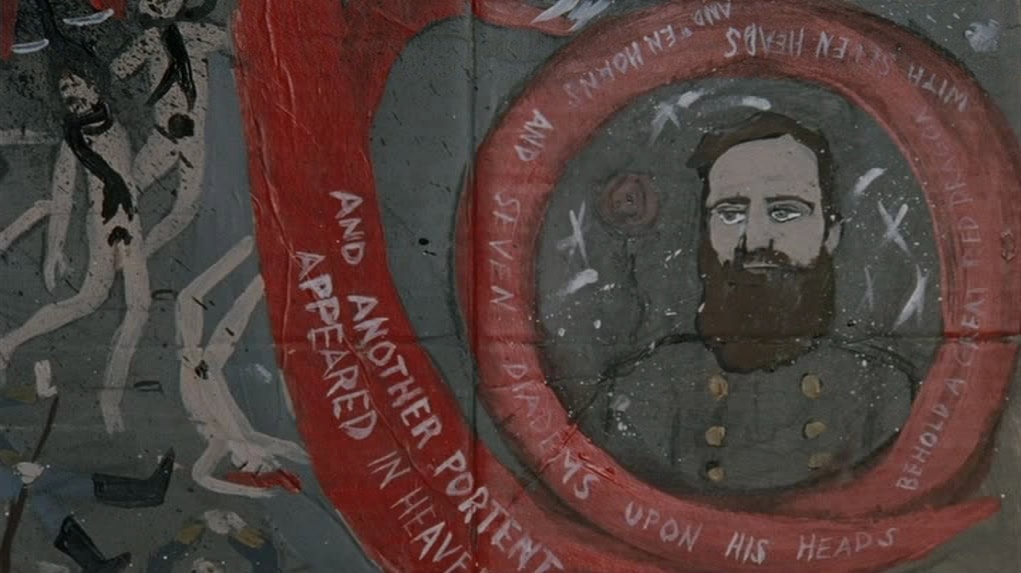
Wark’s subject of the Civil War also presents a surface for examining race relations largely absent from the film but intrinsic to the American South. Though his paintings resist neo-Confederate glory, with several men in grey uniforms clearly disemboweled, his depictions of slaves in these scenes are dehumanizing and obscuring: Wark paints Black bodies with white skin above their shoulders, each referencing the face of someone he knows. The pervasive white faces signal the insular nature of the place, Wark, and therefore the film. The hyperlocality of the painted faces ironically makes the work less familiar, further distancing him from the mild-mannered politeness performed by the locale.
The violence of such scenes becomes embedded in the painted landscapes: the ground of each a torched ashen green or gray, the remaining flora spare and rangy. In the absence of scenery, Wark uses the picture plane to imagine war in crowded detail. The landscape of Winston-Salem in late Spring feels expansive compared to these claustrophobic dramas, emphasized by Morrison in a number of leisurely shots looking out of a driving car, the front lawns and dappled sun passing to the familiar rhythm of being in the passenger seat.
Wark’s difference is cast in sharper relief via Madeleine’s in-laws with whom she is staying. Their home is neat and modest, middle class in a way that transcends the South. The few decorative flourishes are small and practical: illustrated floral wallpapers, lace curtains, and small ceramic birds. Madeleine’s brother-in-law Johnny works at Replacements, Ltd., the world’s largest producer of porcelain and crystal China dishware. The family does not understand why an art dealer in Chicago would travel to the South for art, their home filled with neoclassical and botanical motifs opposite of Wark’s gory tableaus.
Her search for an assumed Southern image ultimately obscures the diffuse reality of actually being present in the South.
Madeleine’s gallery contract is an interesting proposition, the white cube the audience briefly encounters in the film’s opening sequence entirely escaping the provisional dichotomy between Wark’s home and that of Madeleine’s in-laws. The film ends shortly after the signing of the contract, the curatorial considerations of working on an exhibition never addressed. Wark’s paintings therefore only exist in the context of his home, and by extension the film, with the blinds closed and the walls in various states of finish; outdoors, his sculptures are too precarious and embedded to remove. A similar dilemma lingers with the viewer: the work is ultimately ephemeral, existing as an archetype in service of a story rather than an art object.
Yet, it is Madeleine’s insistence of the value of Wark’s paintings as art objects that drives the plot both interpersonally and thematically: her search for an assumed Southern image ultimately obscures the diffuse reality of actually being present in the South. Wark’s visions of conflict are revealing beyond his personal consciousness, mapping fissures in both the protagonist of Madeleine and the social landscape which they occupy. Though his stated goal to “make the invisible visible” through painting is decidedly cliche, the work nevertheless succeeds in its mission to render differences beyond appearance.