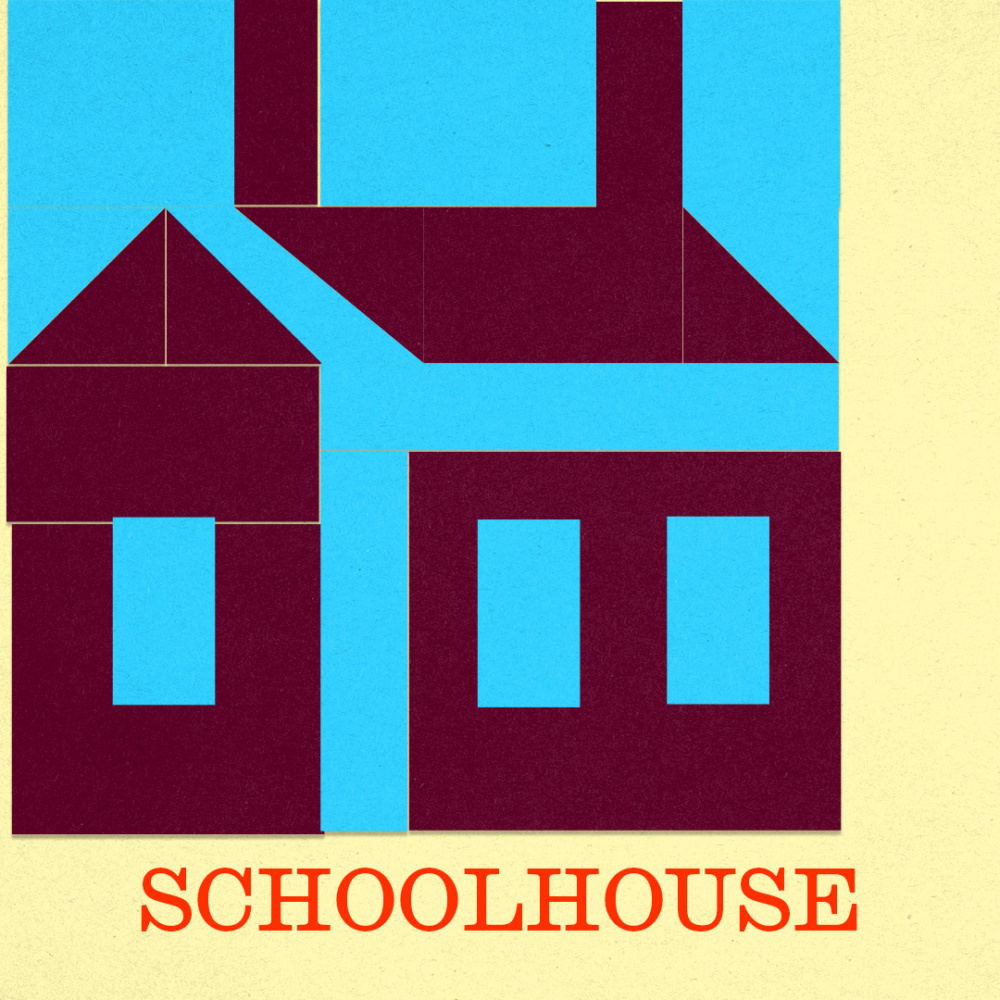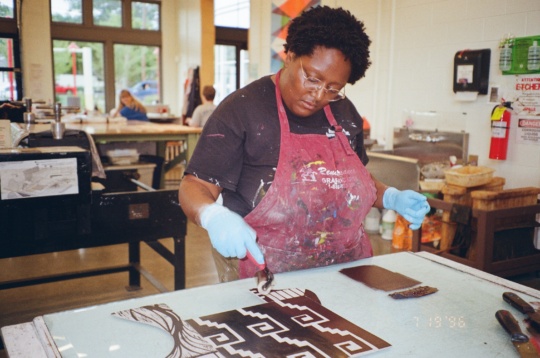
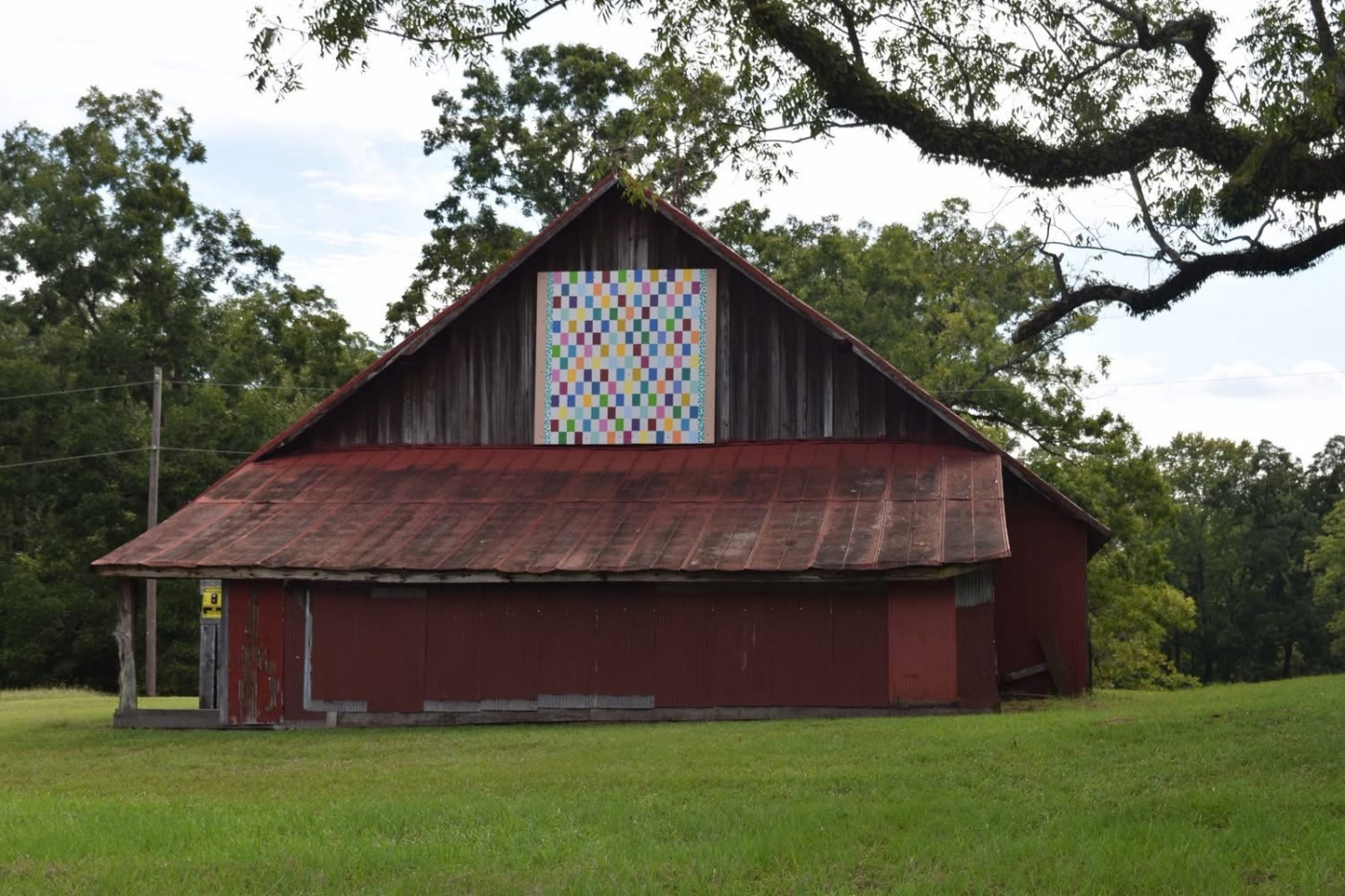
Alabama has a rich tradition of craft: the basket weavers of the Poarch Band of Creek Indians, the Tinglewood tree carvings in Montevallo, and of course the Gee’s Bend Quilters. Quilting is practiced across geographic and racial lines in Alabama. It is even honored across mediums. The Florence-based fashion brand Alabama Chanin hires local quilters to help assemble sustainable clothing, Huntsville artist Katie Baldwin translates her brilliant and dynamic quilt designs into screen prints, and barn quilts leap from covering a person to covering a building.
Barn quilts are traditional quilt square designs painted or hung onto barns. European immigrants brought the tradition to America in the eighteenth century. Occasionally referred to as “painted prayers,” the designs were thought to offer protection over livestock.[1]
The barn quilt tradition was revived in 2001 by Donna Sue Groves of Ohio, who put together the first Barn Quilt Trail, and Regina Painter started the Alabama Barn Quilt Trail in 2015.[2] Today, the Alabama nonprofit tracks more than 100 barn quilts across the state; the resulting database is easily accessible on Google Maps.
When I first went out to look for the barns, I suspected that I would feel the underlying tension that’s inherent in being a Black woman in rural Alabama. I’d hoped that art and craft could overcome it. I was wrong; that tension was baked into the entire project.

I’m an Alabamian, non-consecutively, I’ve lived in Alabama more than any other place. The math works out to nine years in Missouri, eight in Tennessee, and twenty-one in Alabama, mostly in the Huntsville area. But Alabama is big, not just in size but in experience. And I’ve lived in bubbles like Huntsville and Montevallo that are marked by their open-mindedness. Even in those bubbles, the experience of being a Black woman still comes with challenges. I’ve felt discrimination, my feelings dismissed, my potential ignored, but I’ve always had safe homes to return to.
I’d seen the quilts sporadically while on country drives, decorating barns like folksy graffiti. They’re quirky, and I love quirky. I found it especially charming to learn that they’re organized into a trail. These owners not only wanted to celebrate art, but connect to others through art. I planned to follow the trail in North Alabama to document the quilts, maybe interview the property owners if they were there, and write about how art is incorporated into rural communities, however, the experience quickly turned into something different.
Legend passed down through oral tradition and popular history says that during slavery, quilting took on a critical role as a communication system, with certain quilt square designs guiding travelers through the Underground Railroad.[3] To many Black Americans, quilting remains an important symbol of family and resilience. My mother has a quilt passed down from her Aunt Mae tucked in a closet away from everyday use. Its origins beyond Aunt Mae are unclear, but it’s precious because it’s been in our family for a while. It survived Jim Crow, the Great Migration, and more. But I am not sure where scholarship shakes out on how true these stories of quilts as maps are. If quilt squares have meaning, it’s unknown to me, but I desperately want to know, to feel a connection to a history that has likely been lost, but like many other Black Americans, all I might have is a quilt. This gap of knowledge turned my barn tour from an exercise in observation to one of deciphering.

Jackson County, Sunday, April 26
Jackson County is home to Unclaimed Baggage, a catch-all store for the contents of luggage lost or forgotten at the nation’s airports; Cathedral Caverns State Park, which features one of the largest stalagmites in the world; and the historic Scottsboro Boys case which highlighted Jim Crow’s brutal racism around the globe. This is where I would start my tour.
I followed a county road to a barn that is traditional in every sense of the word. An aged, red two-story barn behind a wire fence with the quilt square hanging from the top, and an American flag painted below. The square is painted in a yellow and black hourglass or bowtie motif. To travelers on the underground railroad, that design might communicate to be cautious of time or to disguise their identity.[4] I must decide how far down the driveway I want to go. And then I receive a crucial piece of information.
The “Stainless Banner” or “White Man’s Flag” is the second official flag of the confederacy; the traditional stars and bars of the confederate flag are set in the upper left corner of an all white flag.[5] The “Stainless Banner” was the one draped over the coffin of Stonewall Jackson. And one waved on the property of where the barn is located.
The quilt squares have meaning, all art does, and flags have meaning. I decide to not venture all the way down the driveway or knock on the door to talk to the owners. They’ve communicated enough.
Shaken but not deterred by my first barn, I continued on to Scottsboro. It’s nearing noon and the Baptists are still at church, pick-up trucks fill up parking lots. At the Johnson farm, I spotted a modified wagon wheel design on a gray single-story structure. It looks like a peppermint but orange and white instead of red with a blue center and pairs of blue and orange sunspokes along the perimeter. A Google search leads me to several quilting blogs that identify this as a wagon wheel design. The wagon wheel might indicate to restless travelers that one would need to prepare to move by wagon soon.
These blogs, with the aid of Google and Pinterest, prove crucial to deciphering the quilt squares meaning. The established veracity of these interpretations is limited, but I found it helpful to think of a deeper meaning behind the squares, like a link to history, even if it’s fantasy.

Highway 65 North, Friday, May 1
I planned to see some barns on the way back from Montgomery from a work trip. In Clanton, famous for its peaches; in Birmingham, a city I used to call home; in Cullman, a sundown town in the midst of an image reform effort.
My day job is communications for an advocacy nonprofit, and there was a conference on public interest communications in Montgomery that would hopefully provide insights on how to make our message of social change resonate with people over constant chatter. On the first day of the conference, I heard about the Supreme Court’s decision in Louisiana v. Callais, which allows states to ignore a crucial element, Section 2, of the Voting Rights Act that encouraged fair representation for communities of color. Sixty years of progress for inclusive democracy was erased that morning.
On the second day of the conference we heard from foot soldiers and strategists that birthed the Voting Rights Act like Doris Crenshaw, an acolyte of Rosa Parks who later worked for the Carter administration; Michelle Browder who leads a maternal health revolution (and whose aunt, Aurelia Browder, was the lead plaintiff in Browder v. Gayle, the federal case that concluded the Montgomery Bus Boycott and brought an end to discrimination on public transit); and Gee’s Bend quilter Mary Margaret Pettway. In Alabama in general, but Montgomery specifically, history constantly presses up against you. On the final day, the governor called a special session that would attempt to erase the Voting Rights Act from Alabama’s collective memory.
I pulled up the suggested route I’d assembled that would pull me off 65-North to see barns, then I checked the weather app. A storm was coming in. I skipped the barns that day.
Marshall County, Friday, May 8
The news continued to wear on me, so I took a mental health day off from work and headed Southeast with my mom. We followed the road South, shaded on either side by the densely forested foothills of the Appalachian Mountains.
When I was young, I did not rebel by staying out late or smoking, but by tiptoeing into spaces where I might not be welcome or protected: metal shows at abandoned warehouses, Shelby County dive bars, etc. For my mother, the barn trips also fall into this category. Despite calling North Alabama home for nearly thirty years, she recognizes that outside our (somewhat) progressive and diverse bubble of rocket scientists from around the world, especially in light of recent news, we’re never fully welcome everywhere. She is nervous for both of us. We implicitly understood that any fears we have are real without necessarily being calculable. We wind up the mountain, passing clusters of homes then nothing at all over and over again.
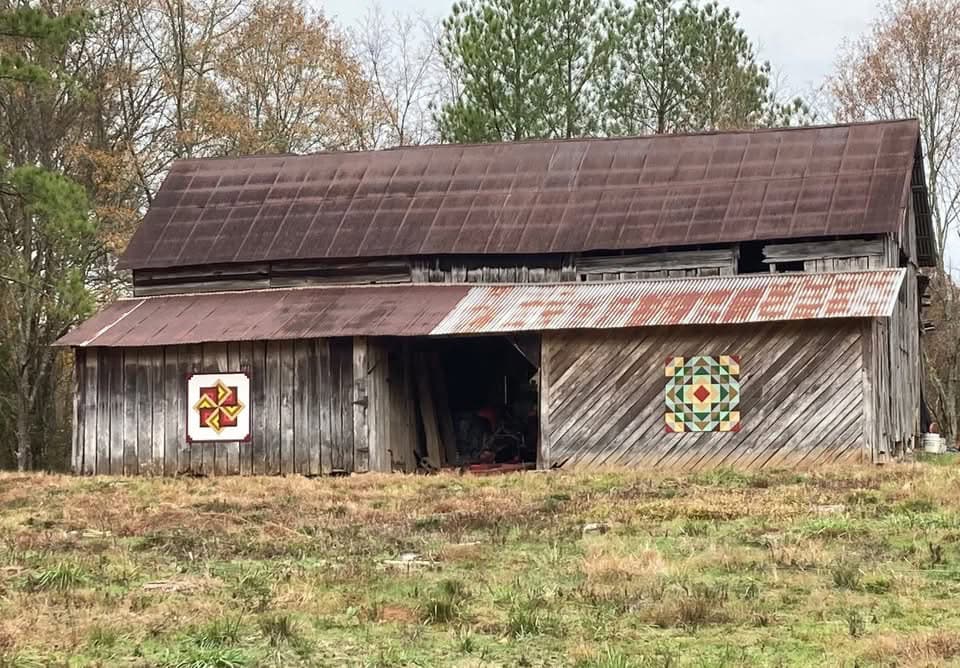
I reached a shed with a red, white, and blue Ohio star. The Ohio Star is allegedly named in honor of abolitionists.[6] The mailbox is decorated in a pinwheel pattern as well. This home in particular appeals to my mother. She wants me to drive further down the driveway, get out to take my pictures, but I resist. Not only are we away from home, but we’re on top of a mountain, which feels isolating and unfamiliar.
My mother is apprehensive as we move into Honeycomb Valley, a tiny lakeside hamlet in Grant. The first homes we see are trailers, some with chickens in the front behind a wire fence. As we progress, the houses shift to cottages and beachy bungalows; the property values shift as well.
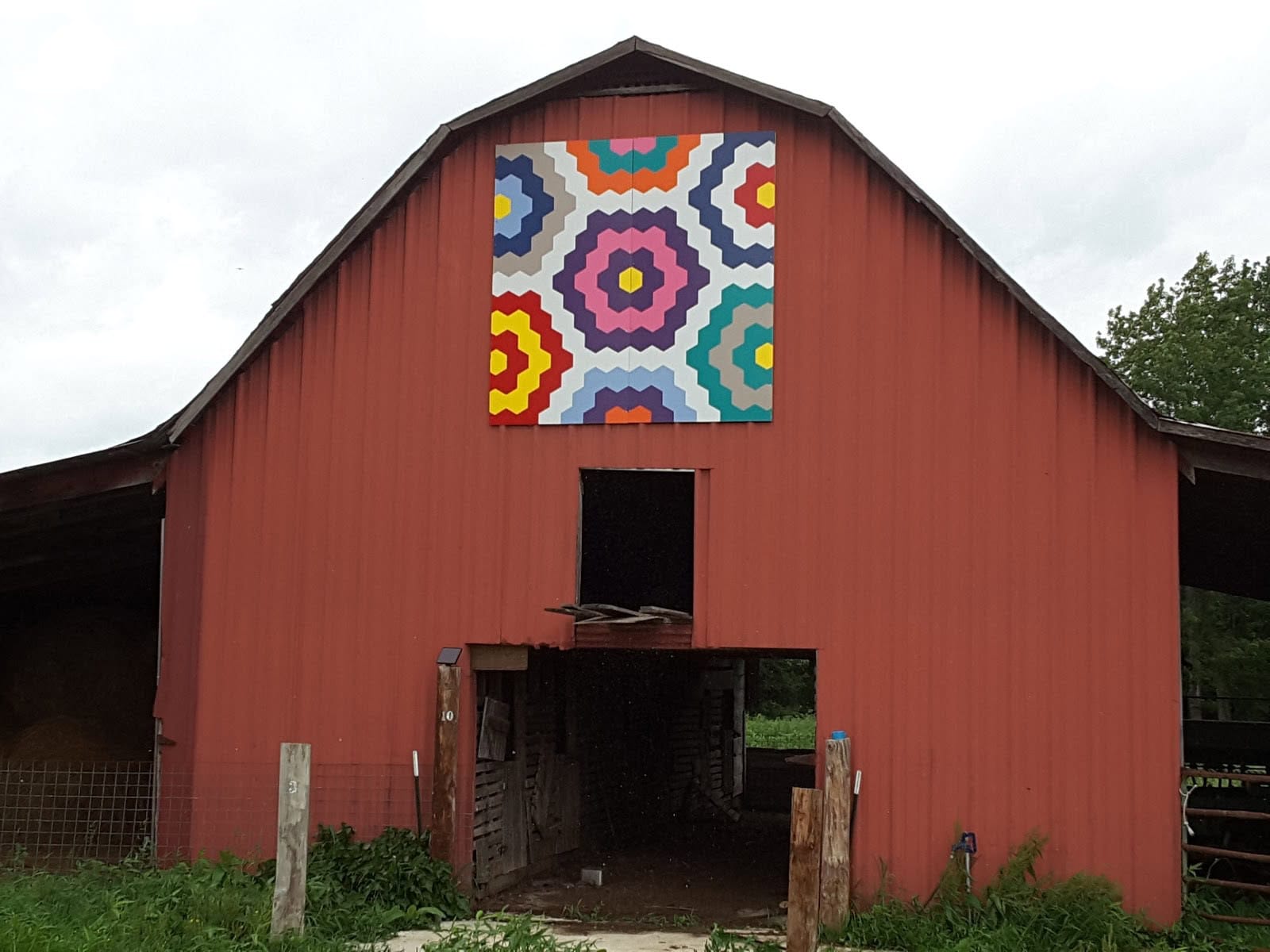
At the Zierbarth Barn we see a trifecta of quilt squares. A small outbuilding with a red, green, yellow, and blue garden star that resembles flower petals. On the side of a larger red building is a square with four flying geese going North, and four going South in green (turquoise) red, and purple on a marigold background. If used as a guide, the geese, triangles, would tell the viewer which direction they should travel.[7] On the front of the same building is a red, white, and blue Christmas star.
We are paused on the narrow road in front of the Zierbarth Barn when a black truck pulls up behind us. So I push forward hoping the driver will turn off behind us, but he keeps going, so we keep going until we pass a “No Trespassing” sign. I pull over and just let the truck pass us. As I’m doing a three-point-turn on a gravel driveway, a delivery truck pulls down the road; the driver is Black and gives us “the nod,” a somehow universal recognition of Black folks in predominantly white spaces. My mother acknowledged that she felt better after seeing him.
I found it helpful to think of a deeper meaning behind the squares, like a link to history, even if it’s fantasy.
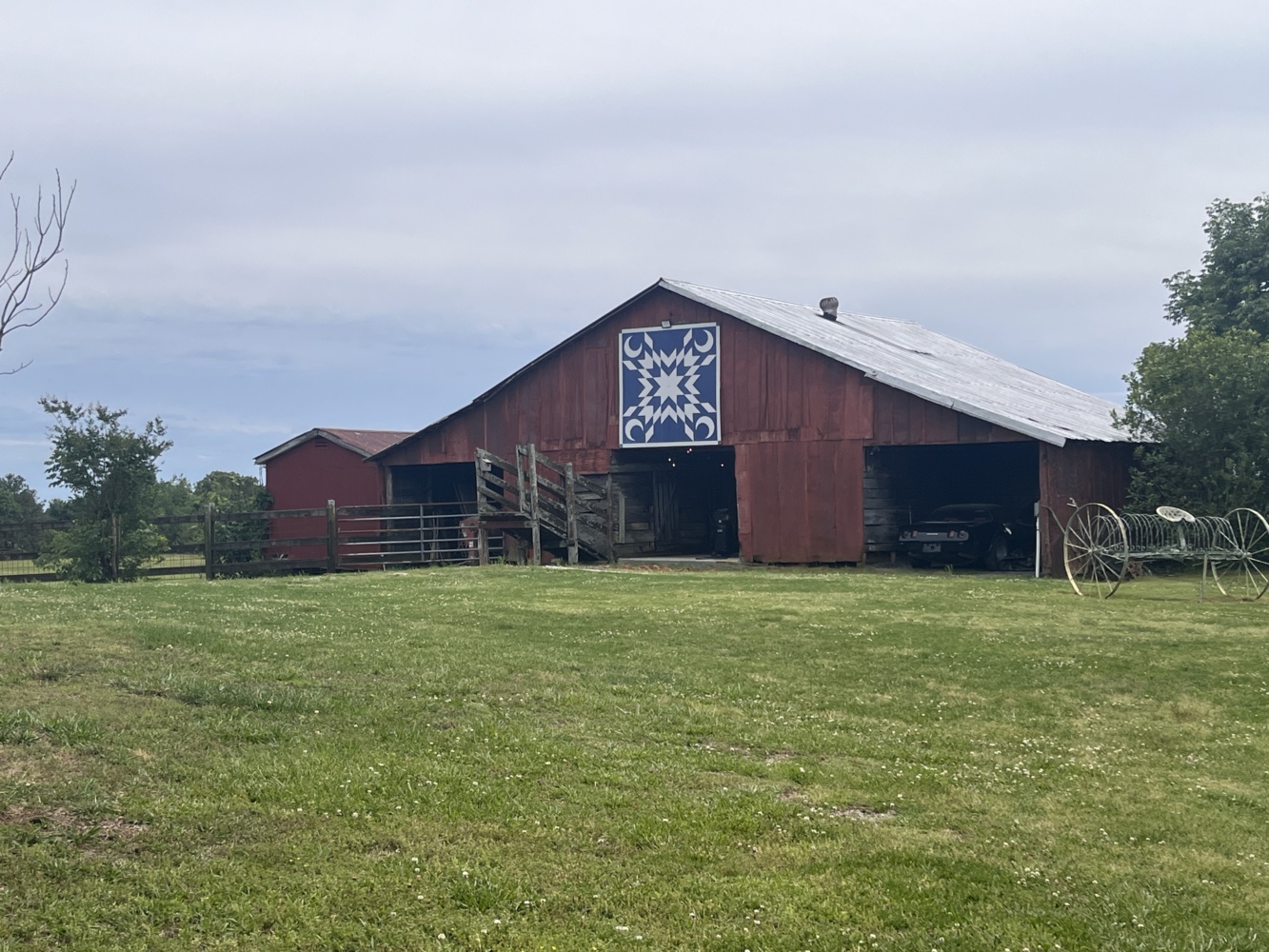
We moved up another section of deep hills. In front of a red barn with a tin roof is a staircase that leads to nowhere. Inside the barn is a black muscle car. In Wedgewood blue and white, I saw a design that I am unable to identify. In each corner is a crescent moon, and a white bursting star appears to ripple out from the center. Maybe it’s something new.
I saw a dozen barns in four counties (those were just the ones I could find, some eluded me), and I learned that behind every quilt square was symbolism and lore and, but their surroundings told its own story. I am the type of person who looks for meaning in everything: maybe the cardinal at the birdfeeder is my grandmother, maybe I didn’t get into a residency in Austria because I’m meant to spend next year in California. So the quilts present me with a meaning-seeker’s dream. There is the meaning behind the individual squares (Does the shoofly really indicate that help is nearby?), but there’s also meaning behind the trail itself. Hospitality and pride for sure, but also reverence for connection.
To join the trail, applicants are asked to share ‘the historical, community, or family importance of this location and the story you want to tell.” It doesn’t appear that the barns I visited had any additional context, most don’t. I wish that question was mandatory, because I’m curious about what the barn owners would say. Perhaps they cannot see the dichotomy of pairing a beacon of hope to runaway slaves with the battle flag of proud enslavers. Maybe they just think the squares look pretty.

[1] Zoe Spangler, “The Folk Art Legacy of Barn Quilts,” web log, Clark County Public Library Blog (blog), July 2, 2025, https://www.ccplohio.org/blogs/post/barn-quilts/.
[2] “What Are Barn Quilts?” n.d. Southern Living. https://www.southernliving.com/what-is-a-barn-quilt-7094251.; Matthews, Michelle . 2022. Review of 10 Things to Know about the Alabama Barn Quilt Trail. AL.com, July 22, 2022. https://www.al.com/life/2022/07/10-things-to-know-about-the-alabama-barn-quilt-trail.html.
[3] The Underground Railroad & the Legacy of Quilt Codes | B&O Railroad Museum.” 2026. B&O Railroad Museum. January 16, 2026. https://www.borail.org/the-underground-railroad-the-legacy-of-quilt-codes/.
[4] “Black History | Heritage | About Owen Sound | Owen Sound Tourism.” n.d. https://owensoundtourism.ca/uploads/documents/quilt-codes.pdf.
[5] Coski, John M. 2013. “The Birth of the ‘Stainless Banner.’” Opinionator. May 13, 2013. https://archive.nytimes.com/opinionator.blogs.nytimes.com/2013/05/13/the-birth-of-the-stainless-banner/.
[6] Williams, Suzy. 2016. Review of Everything You Need to Know about the Ohio Star Quilt Pattern. Suzy Quilts (blog). November 2016. https://suzyquilts.com/everything-need-know-ohio-star-quilt-pattern/?srsltid=AfmBOooExMAhtUWZ97f60FEfuztCRTb8Xv6jarTU5Kke8m5kQML7j322.
[7] “The Underground Railroad & the Legacy of Quilt Codes | B&O Railroad Museum.” 2026. B&O Railroad Museum. January 16, 2026. https://www.borail.org/the-underground-railroad-the-legacy-of-quilt-codes/.