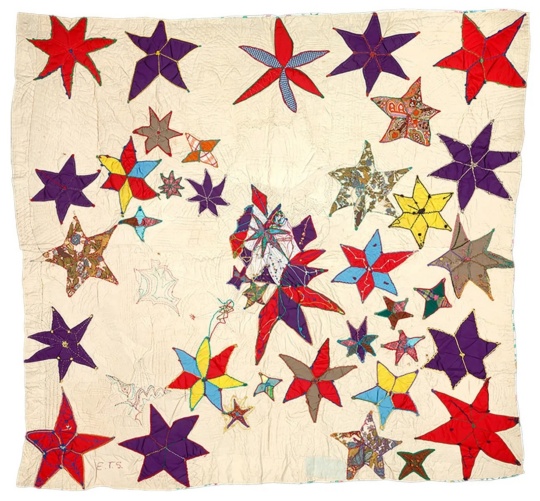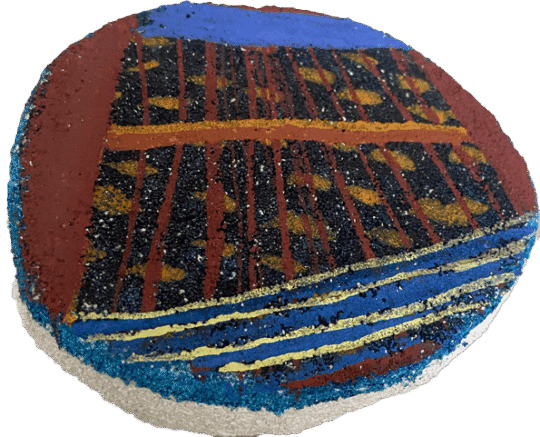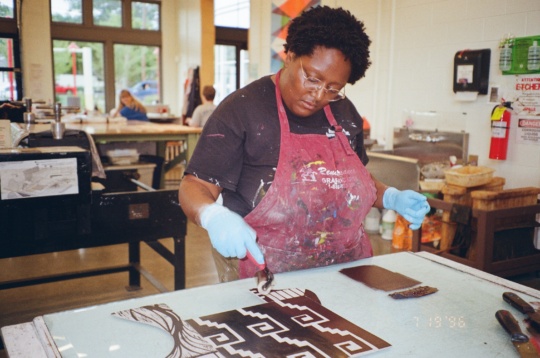
At the intersection of time, memory, and vulnerability lies the artwork of Treyvian Dowell. For Dowell, the past is a fluid medium where fragments of imagery, language, and color converge to shape identity and perception. His work quietly pressing against the boundaries of access and visibility within the art world.
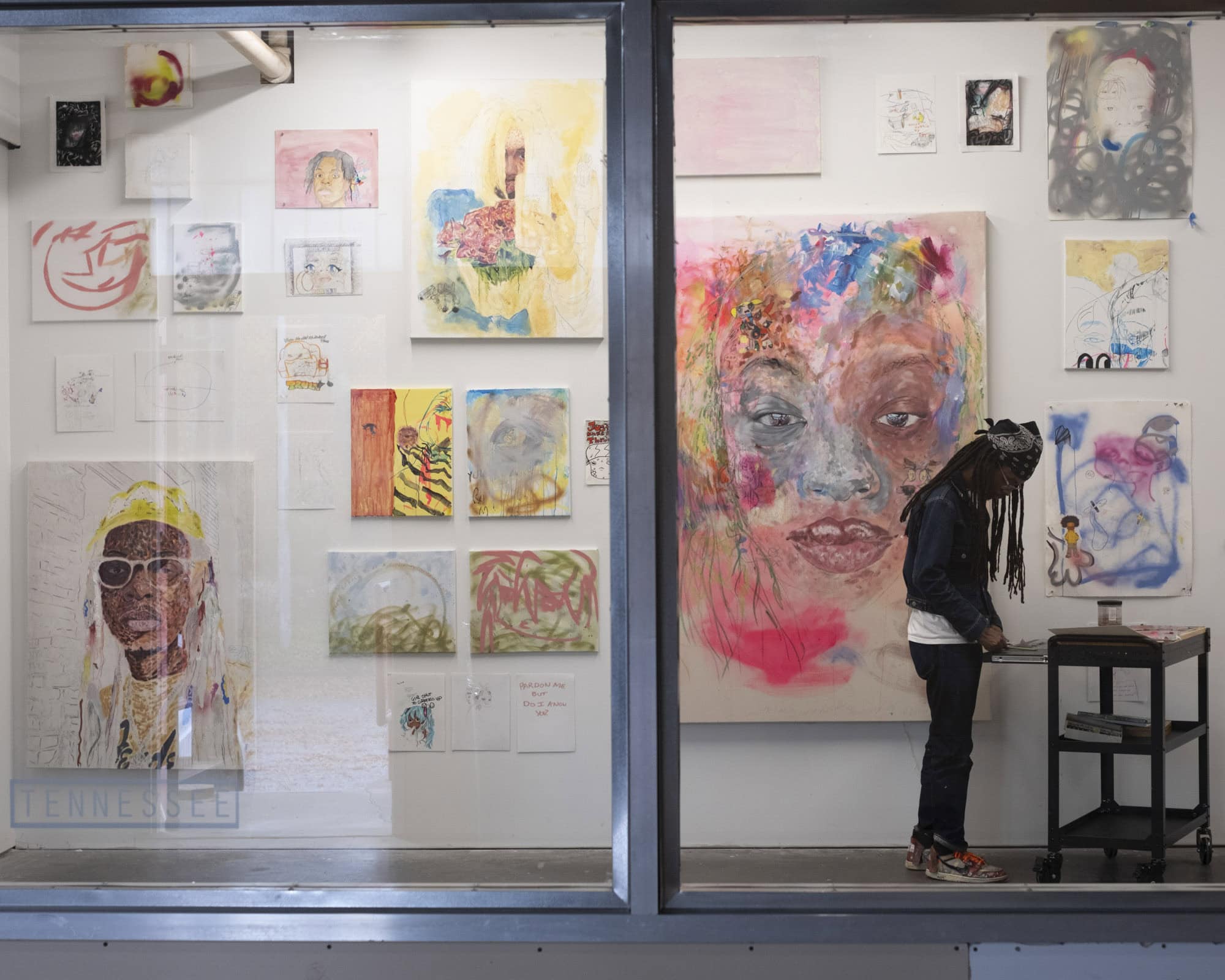
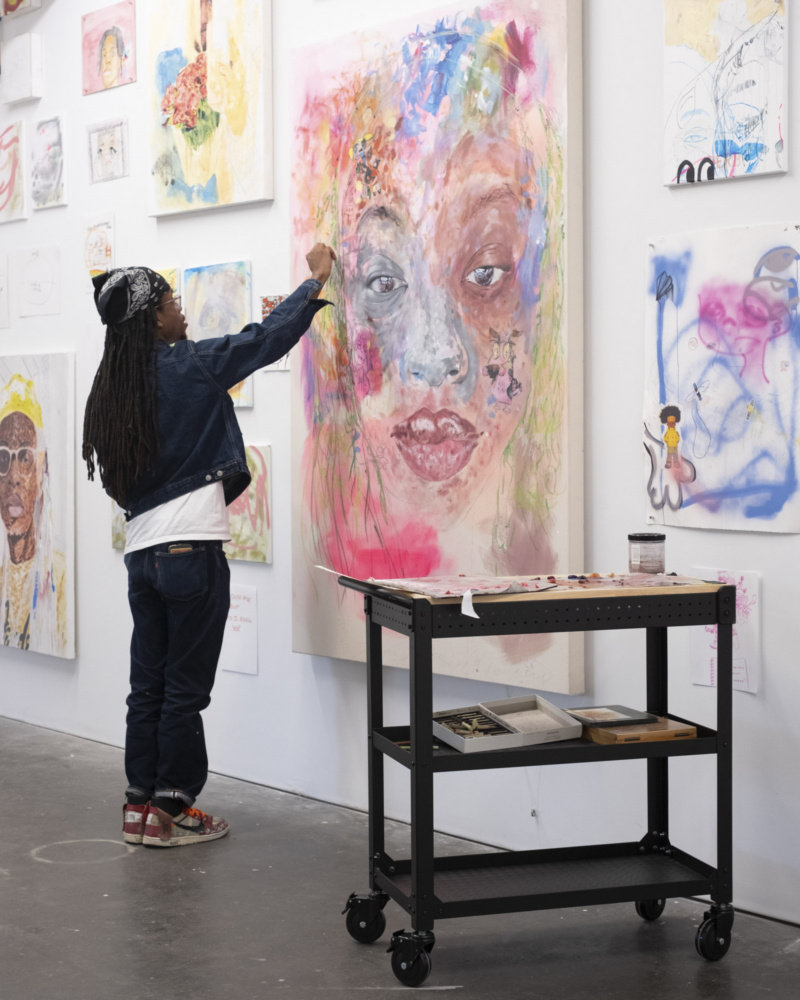
Dowell’s recent solo exhibition, In My Defense I Was Left Unsupervised at Tennessee Gallery in Atlanta, explores memory, politics, and vulnerability through a multilayered approach. The work is autobiographical and political in material and presentation. Rather than conforming to the white cube tradition of pristine frames and tightly controlled display systems, Dowell embraces a salon-style installation that reveals its own construction. Magnets, tape, and push pins secure works that feel less like finalized artifacts and more like pages torn from an open sketchbook—deliberately exposed, deliberately in process.
In his studio, Dowell engages a practice that activates memory and emotion as material. Words often anchor his pieces first—quotes saved in his notes app, song lyrics, or titles conceived before the image itself. These fragments guide him as he considers how language translates into feeling and what visual vocabulary can carry that charge.
The surface is initially mapped in pencil, pen, and marker, then sealed with gesso. Washes of watercolor or acrylic establish atmosphere and a psychological tone. He finishes with oil and spray paint, allowing the final layers to complicate or sharpen what lies beneath. The result is work that feels intimate yet unsettled—porous, layered, resistant to singular interpretation.
Embedded within this material choice is a critique of the unspoken value system that governs museums and galleries—a hierarchy that privileges certain materials and aesthetics while excluding others. Upheld by the cost of traditional fine art supplies and display hardware, raises a necessary question: what happens to artists who do not have access to these tools?
Dowell’s answer is not rhetorical. He creates regardless of access. By collapsing memory, reused materials, and digital saturation onto a single surface, he challenges the notion that legitimacy is dictated by polish or price. In doing so, he reclaims value as something rooted in imagination, inheritance, and lived experience.
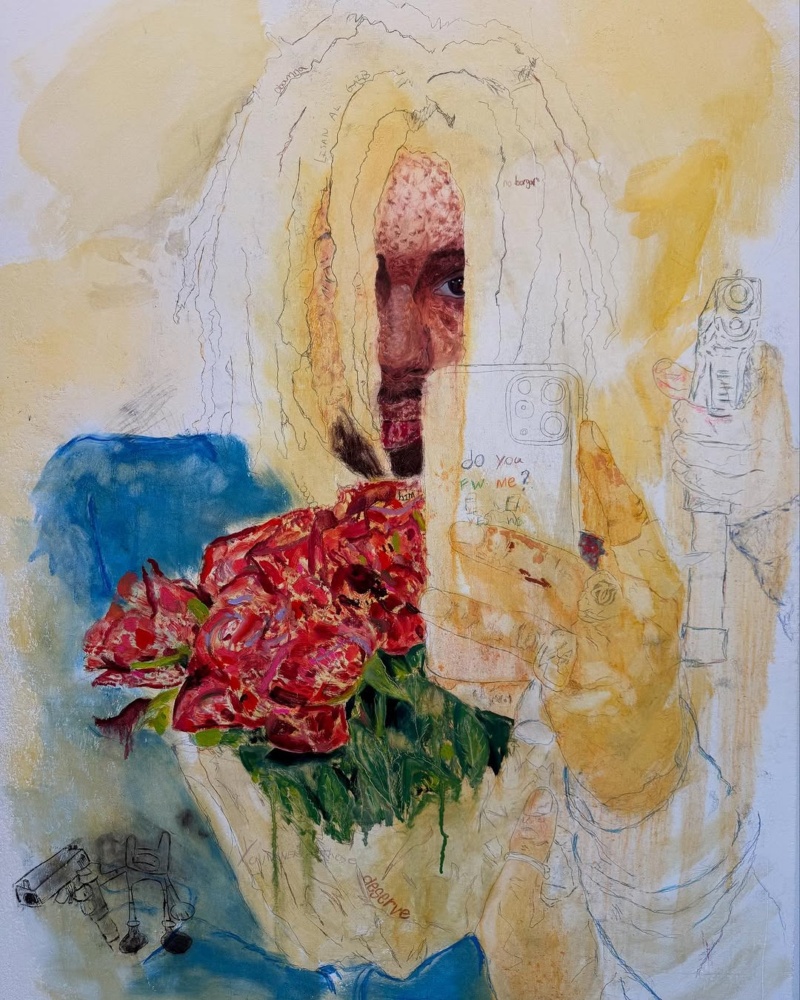
Through this approach, Dowell creates works such as protectingmyemotions (2025). The subject’s face is partially obscured by hair. One hand grips a bouquet of roses while the other lifts a cellphone in the familiar posture of a mirror selfie. From the edge of the paper, a hand enters the frame holding a gun aimed outward toward the viewer. In the lower corner appears Finn the Human from Adventure Time (2010), also poised in defense.
The piece captures a tension central to Dowell’s practice: tenderness coexisting with protection. The roses suggest softness and vulnerability; the weapon implies hyper-awareness and survival. A wash of blue and yellow hints at emotional contrast—introspection set against optimism. Finn, a character known for exaggerated toughness masking buried trauma, becomes a subtle emblem of performance as defense.
Dowell’s work emerges from contradiction, suspended between the quiet of nature and the relentless hum of the digital world. Raised within a Gen Z landscape of unrestricted internet access and cultural saturation, he absorbed humor, violence, tenderness, and spectacle in equal measure. His visual language reflects that fluency—where irony and sincerity coexist, and the unserious and the sobering occupy the same surface.
Yet, memory in Dowell’s practice is not singular. It is communal.

In Americus, Georgia, he grew up surrounded by the people who would quietly shape his visual grammar. His mother, a schoolteacher, kept a desk that doubled as his first supply station. No. 2 pencils, pens, markers, and broken crayons came long before oil paint. Printer paper became his earliest canvas. He often drew over discarded worksheets she saved from her students—unfinished assignments layered with his own marks, merging inherited narratives with emerging ones.
His great-uncle Haywood, whom he describes as more of a father figure, listened attentively to his fascination with superheroes and cartoons, nurturing imagination rather than correcting it. His grandmother lived nearby and offered steady wisdom. One proverb she often repeated—“once a man, twice a child”—lingers within his practice as both caution and invitation: a reminder to resist rigidity, to return to curiosity, to embrace the cyclical nature of becoming.
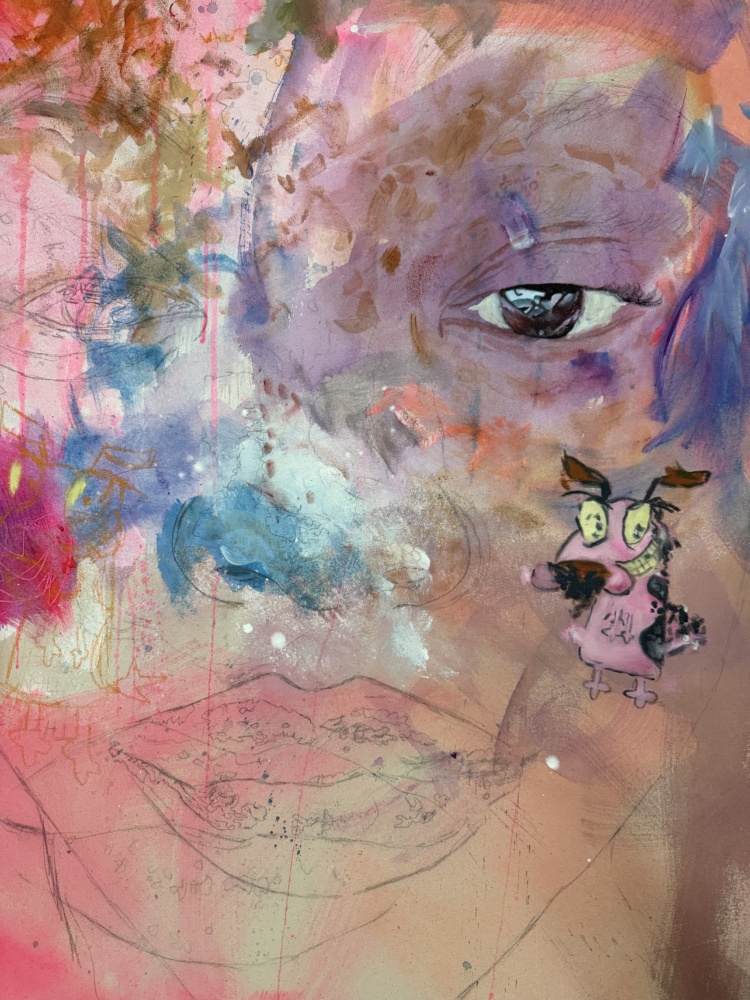
alloftheabove (2025) offers another striking example. A subject tilts their head upward, looking down toward the viewer. Their skin is stippled with browns, purples, grays, and gold tones, evoking sunlight across the face. Loose, childlike gestures coexist with hyper-realistic eyes. Innocence and composure share the same surface. Disorder and discipline remain in tension. Spray paint, colored pencil, and washes create a field of hyper-saturated, almost surreal color, visually echoing Coraline’s heightened world. In both the film and Dowell’s composition, chromatic intensity becomes a language of vulnerability—a hunger to be seen, to move fearlessly through uncertainty. A small rendering of Coraline rests in the corner.
The cartoons that populate his compositions are not ironic insertions; they are artifacts of a childhood protected enough to imagine freely. The wisdom layered beneath them is not decorative; it is structural. In this way, memory becomes inheritance rather than nostalgia—an accumulation of voices shaping the present.