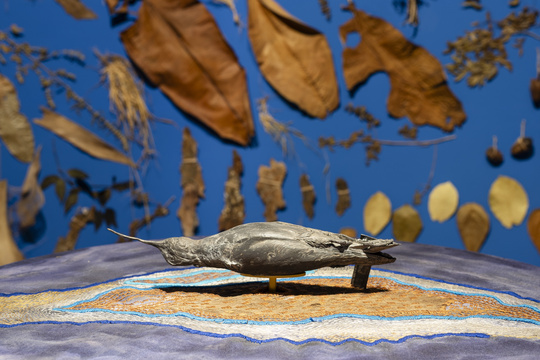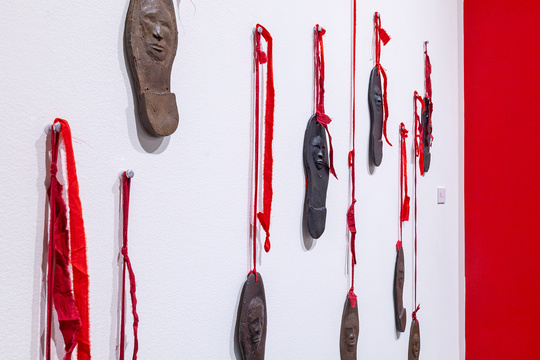
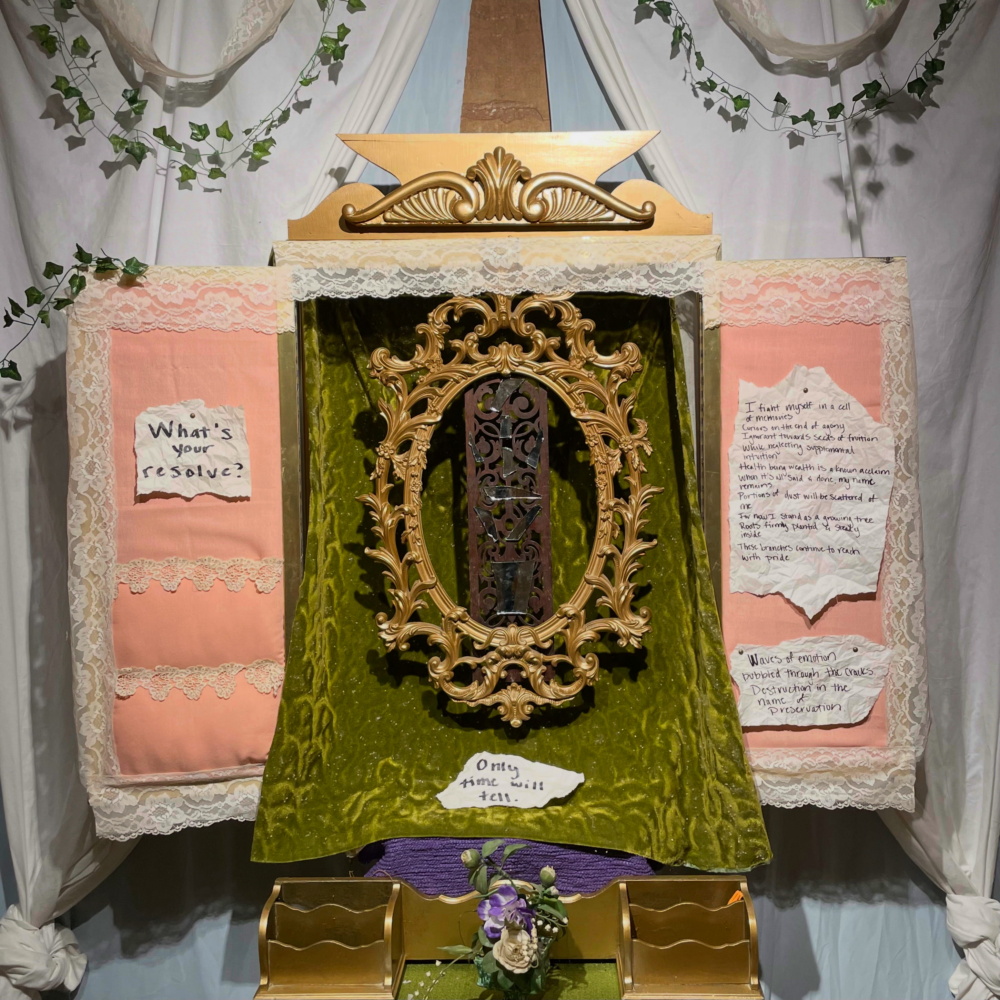
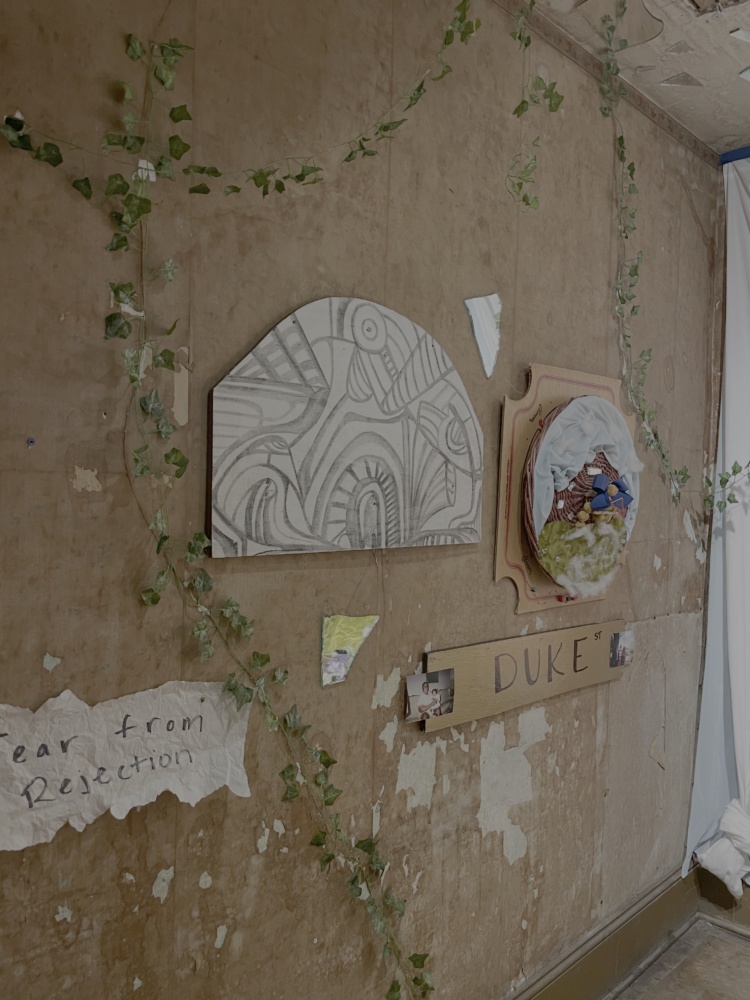
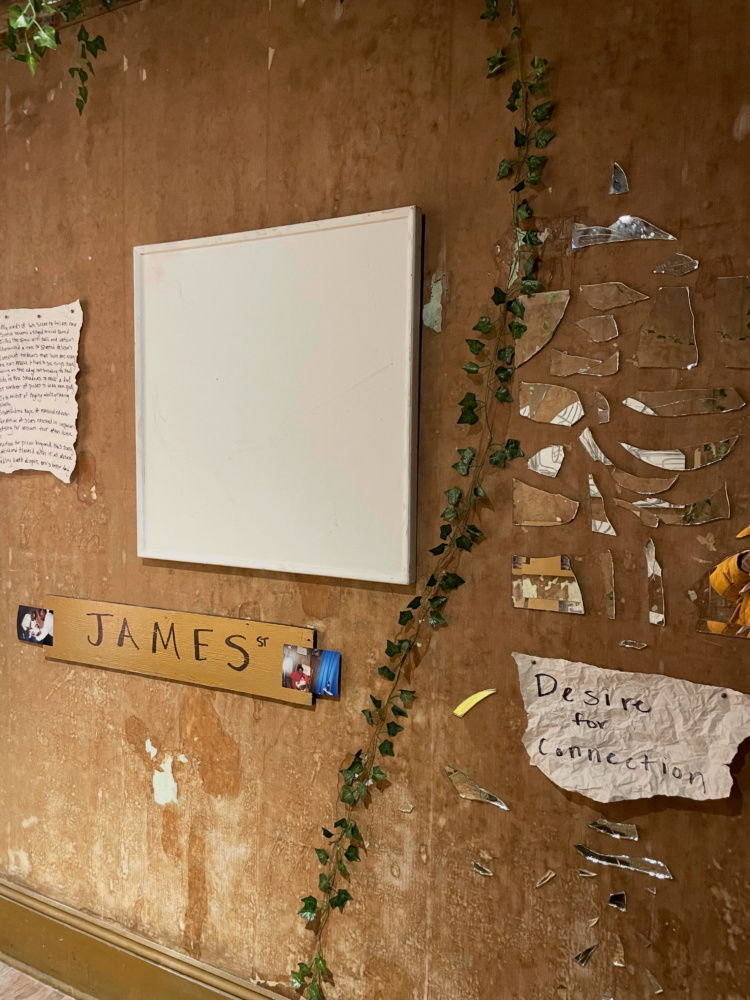
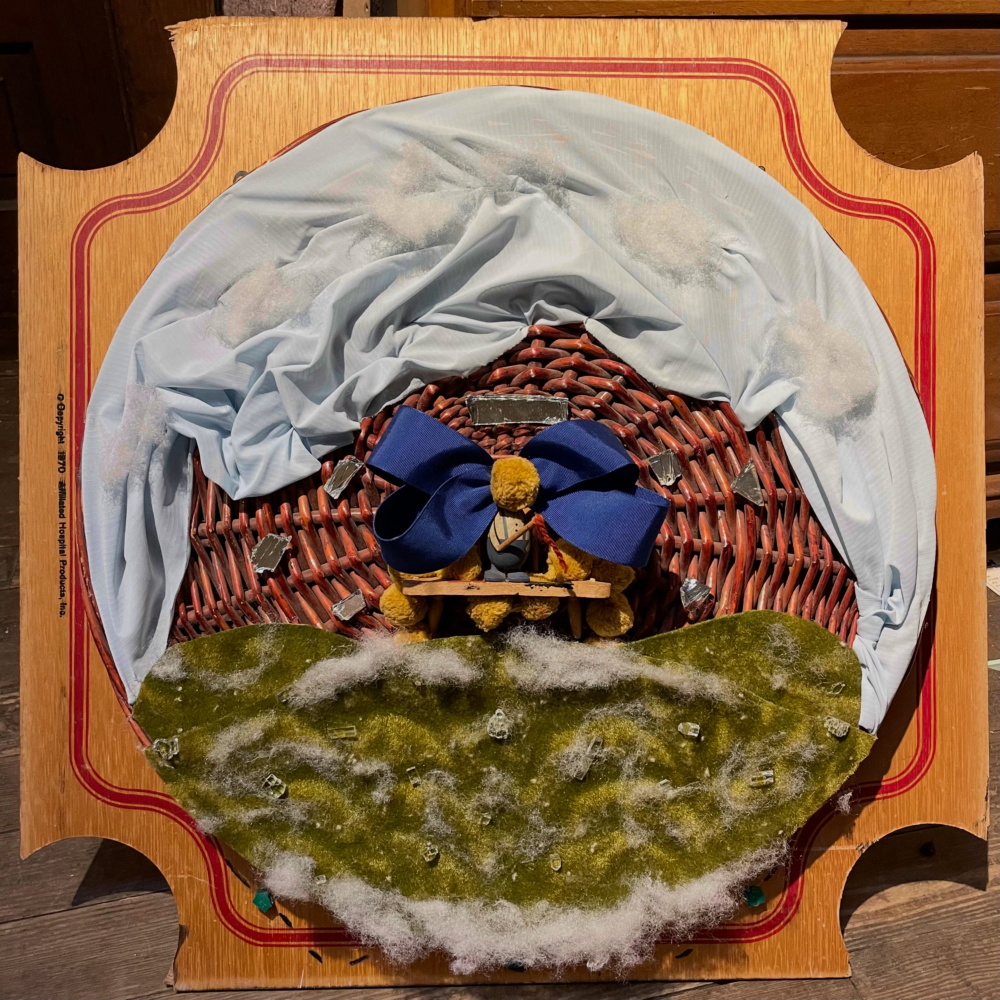
Michaela Baldwin described the Greensboro, NC, site of her 2023 work PROCLIVITY as a dilapidated jewelry box. Overhead, broken mirrors caught the light in fragments and rusted box springs hung from the ceiling. An old toilet and sink remained bolted, unmoved, as if the building had simply grown around them. Poems fixed to the walls— including one called “Treaty of Silence” (2022)—explored “the contradictions of effort, the struggle of trying while grieving, and the quiet negotiations we make with ourselves in order to move forward.”[1] On the floor, small objects left by visitors amassed into a collection of reminiscence and transience.
The distorted mirrors offer unstable reflection, while the removal of sound, which Baldwin originally planned for the installation, leaves viewers in a silence that feels intentional rather than incomplete. Described later in an artist statement, Baldwin writes that “Proclivity is about what is left unspoken yet still shapes the atmosphere,” reinforcing the work’s focus on silence and omission. The installation’s power comes from that withholding. Rather than directing interpretation, it asks viewers to sit with gaps and traces, allowing the sorrow of erasure embedded in the city to echo through the space.
The installation was made at Elsewhere, a residency and “living museum.” Elsewhere operates under an unusual constraint: “nothing goes in, nothing goes out,” meaning materials are altered and reused by incoming residents and nothing is sold. During her research into Greensboro’s history, she became interested in the zoning decisions and housing developments that displaced Black communities from the city’s limits. PROCLIVITY expands Baldwin’s interest in grief beyond the body, treating civic rupture and its aftermath as parallel to rupture within the self.
Baldwin, a multidisciplinary artist, writer, and communications designer, was born and raised in West Point, Mississippi. She began making art formally in 2019, though the instinct began much earlier through jewelry-making, crocheting, and sewing. Today, she works across painting, drawing, installation, and digital illustration. The artist said working in these mediums is “integral in my evolution as a person” and an attempt to document “the taboo: grief, rage, softness, surrender.”[2]
Her background in craft deepens that approach. Sewing and crochet are relational practices, built on tension and the slow accumulation of small gestures into something larger. They are also practices historically associated with Black women’s domestic labor—skills passed down through generations, often undervalued precisely because they belonged to the interior life of the home rather than the public world of the gallery. She describes slipping into a flow state and “figuring out to sew alongside Project Runway reruns and studying my great-grandmother’s crochet projects.”[3] That same attention to the interior—to what is made slowly, intentionally and by hand—carries through her paintings, which treat cultural memory and emotional instability as intertwined subjects worthy of sustained attention.
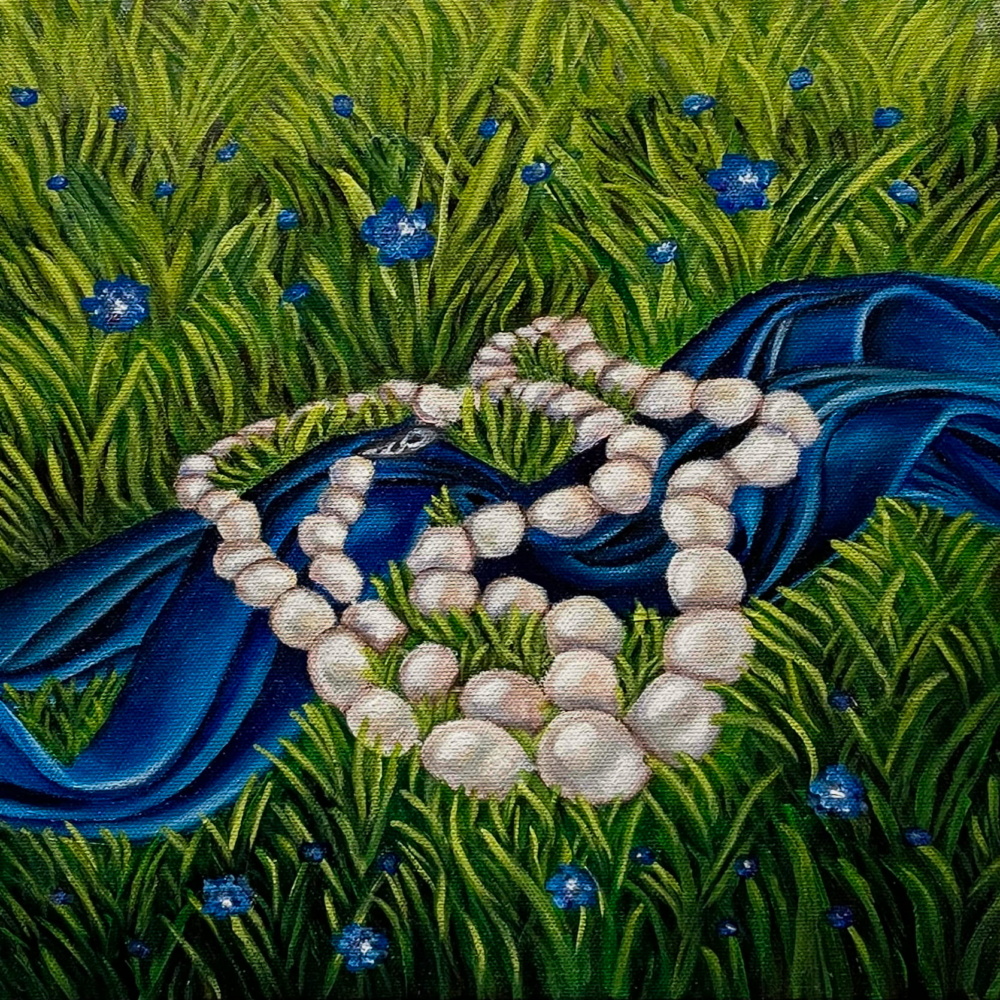
Her paintings extend layering into color and form. Limbo (2020), with its fragmented objects rendered through repetition and color, captures the in-between states that recur throughout her work. Granny’s Pearls (2021), an acrylic on canvas depicting pearl jewelry draped over a scarf amid grass and flowers, treats an inherited object with the same relevance she brings to memory and domestic history in her drawings.
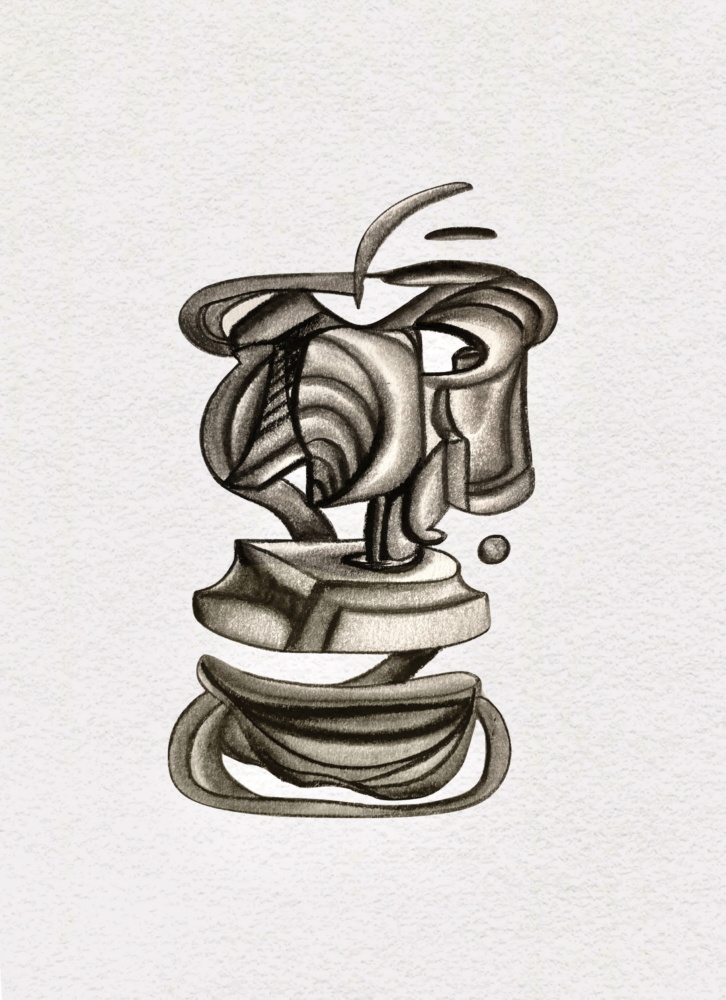
Sensitive, emotional layering is especially visible in AFTERSHOCK (2022), Baldwin’s earlier body of charcoal and graphite drawings. The series moves through grief without trying to resolve it. Titles like Granny’s Prayer, Masquerade, Grenade, Prolapse, and Lovely move sharply between tenderness, concealment, violence, and intimacy. The shifts feel abrupt, reflecting how grief itself rarely settles into a single emotional register. Throughout the series, Baldwin uses contrast—heavy shadow against exposed light and soft sketches beside violent marks—to trace what she describes as “the profound emotional shifts of this transformation.”[4]
What distinguishes Baldwin’s work is the seriousness with which she treats experiences that are often expected to be glossed over, overcome, or easily consumable. She describes herself as “a collector of remnants, memories, objects, gestures—of the almost-intangible moments that leave imprints without explanation.”[5] Whether working in charcoal on paper or building installations from abandoned objects, Baldwin approaches art as a record of what remains unresolved. The result is a practice that asks viewers not to search for resolution, but to pay closer attention to the traces left behind.
[1] “Proclivity | Elsewhere Museum,” Michaela Baldwin, accessed May 20, 2026, https://mikaywa.com/portfolio/proclivity-elsewhere-museum/.
[2] “About,” Michaela Baldwin, accessed May 20, 2026, https://mikaywa.com/about.
[3] Michaela Baldwin, interview with the author, June 1, 2026.
[4] Baldwin, interview with the author.
[5] “Proclivity | Elsewhere Museum.”