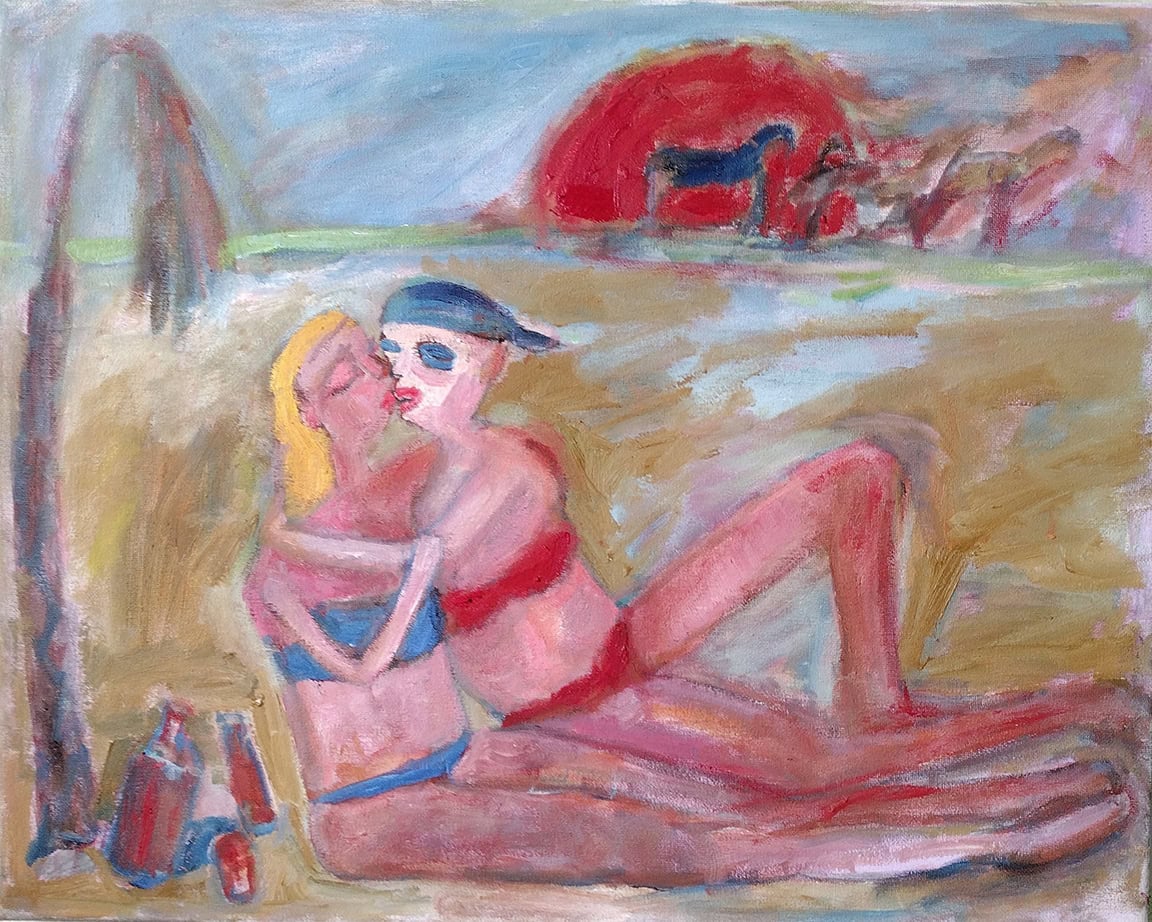
Susan “Sue” Bowers’ Wild Horses in the Sunset (2025) centers two lesbians making out at Nembutal Beach. The femme is blonde, and her beau wears a baseball cap turned towards the back. Sunscreen blanches his face. Both sport blue and red bikinis; their bodies are burned pink from the sun’s ultraviolet rays. It sets in the background, a ruby red orb, while three horses run the day’s last races along the horizon. A palm tree has been blown over by the breeze and glass bottles lie forgotten at its base. The canvas rests in a handmade frame built and painted cornflower blue by the artist.
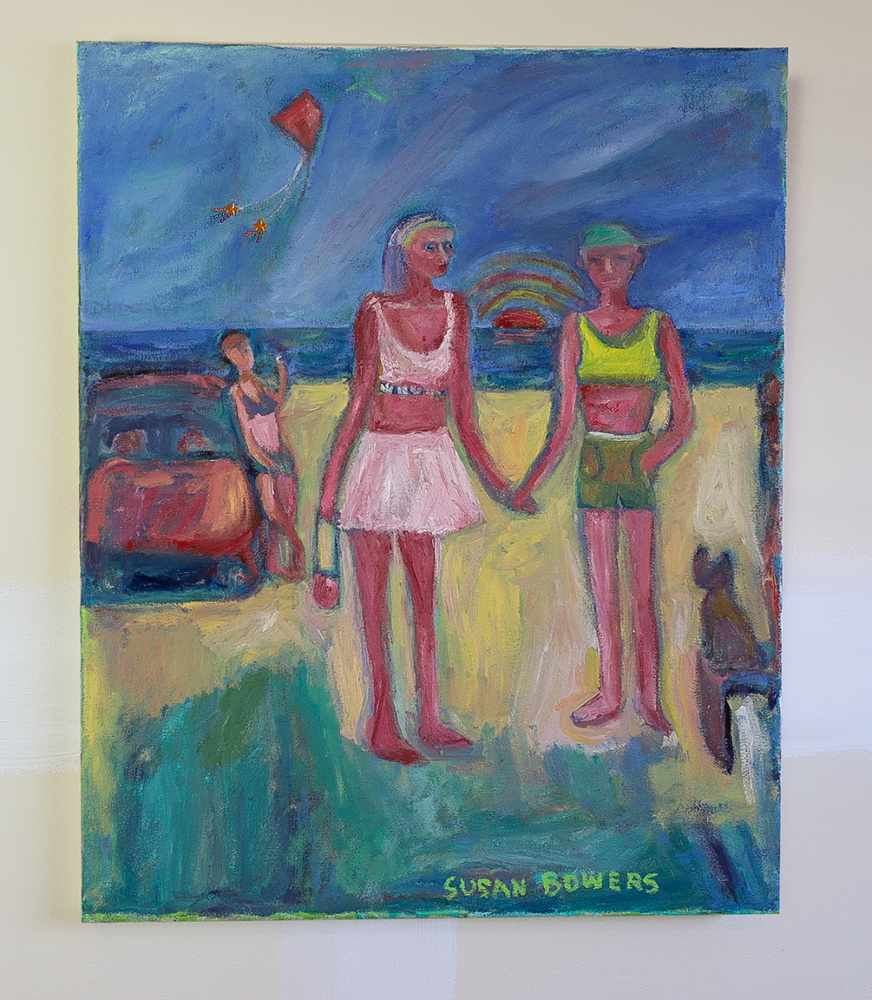
It is the most subversive painting I own. Purchased this January, the work belongs to the series Life’s a Beach, a show I saw at Studio Phizz, the artist’s home studio in uptown New Orleans in winter, painted in the latter half of the previous calendar year. Plentiful accumulations of beach camp abounded (body builders, guitar players, and kiddie pool swimmers were among the parties pictured) and glyphs of whimsy embellished them (including cartoon stickers and painted hearts, after a sheet of glittery smiley faces I mailed the artist in the fall). A broad-ranging schema of rainbow-colored pigments in oil illustrated the series, while beach towels with painted references to the book Flowers for Algernon were draped on the backs of her shotgun’s doors.
Sue is a product of twentieth-century New Orleans. In high school, she describes herself as both a cheerleader and a prom queen (“I was desperate for this kind of love and attention,” Sue says); she has evolved into an ageless eccentric. She was closeted until recently, although she met her life partner, the artist Genevieve McKeown, at Charlene’s, a since-shuttered lesbian bar in the Marigny, in the 1990s. Over time, she became well-known in local circles for the ceramics she made in the basement at Tulane, which include lipsticks, urinals, rotary phones, and pets, and are prolific, and which she has since abandoned after they overshadowed her preferred medium of painting.
This interview has been edited for length and clarity.
Susan Bowers: I thought my legacy was going to be ceramics. I have now disavowed ceramics. I was like, that’s all they wanted to see—the patriarchy. It was this total oppressive situation. And the thing is, when I had the show TRIPTIX at May Gallery, I was doing the security guards. What more horrible thing can you do? The security guards: it’s this whole idea of certain people are going to have a wonderful death and the rest of us are going to be squished. So, I had this squished head and security… But I never put my name on any of that work. No one ever said, “Susan, put your name on this work.” Never, never, never mattered that it was me. It was always about the collector. Even Charles [Whited], he went up to the curator, “Keene, can you pick out the piece I should get?”
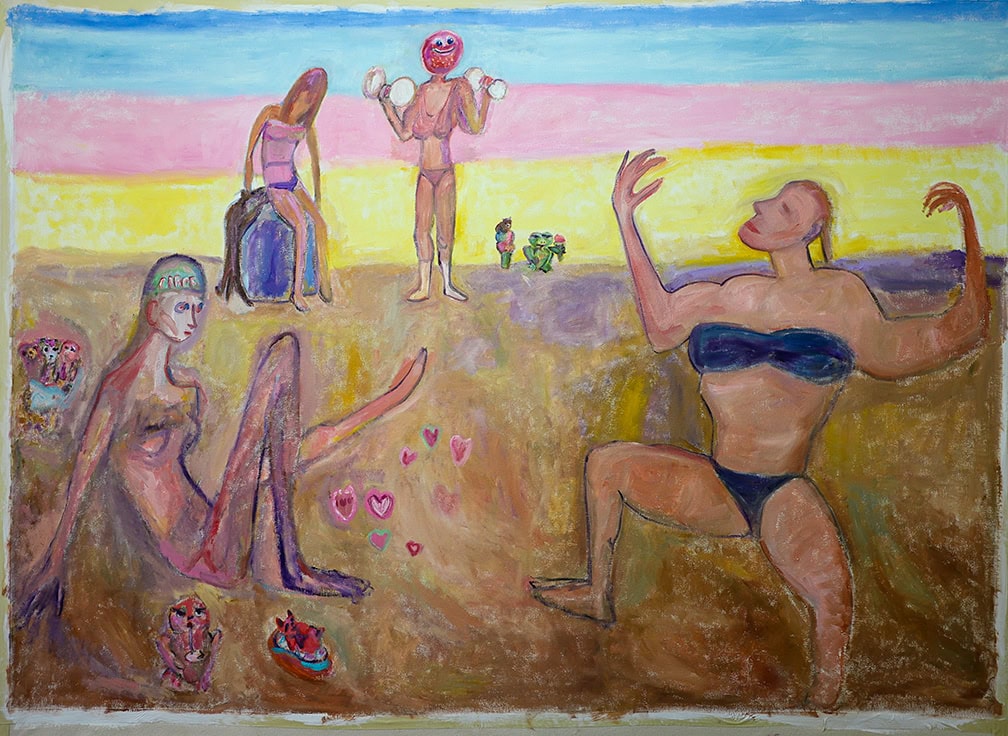
Lauren Stroh: In May, after years of ballooning personal and professional defeats, Studio Phizz moved to a shotgun at 1167 Eagle. A first wedding anniversary gift from Genevieve, the couple will sell paintings and books out of the showroom, following in the tradition of Genevieve’s sister, Margaret “Maggie” McKeown, who owned the used bookstore McKeown’s Books and Difficult Music on Tchoupitoulas.
Genevieve McKeown: People still come up to me and go, “Well, how’s Margaret doing? Is she ever going to open the store again?” So, we’re carrying on the tradition.
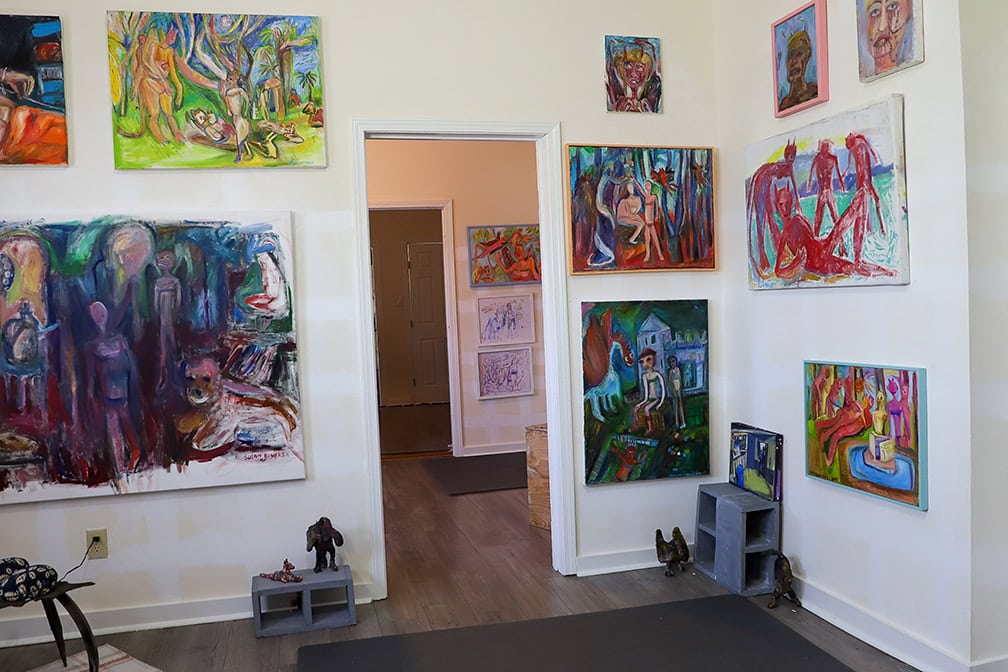
SB: I’m like, this gallery—it’s here. I’m liberated!
LS: The new Gallery Phizz’s first show, The Devil’s Picnic, advances from the cheery paintings of last year’s focus. Its centerpiece, Artist Painting in Paradise Garden After Wildfire (2026), is a self-portrait of Sue at work, surrounded by soot. The central figure, wrapped in a straight-jacket and sitting on a bright green bolster, is painting what appears to be a demon, while other possessed figures fly above and alongside her. The work is accompanied by paintings of a fictionalized version of Jeffrey Epstein’s prison epic wherein the financier becomes a character called Jeffrey Demon and is murdered with a garrote; these were drawn on an iPad, printed, and then embellished with acrylic paint to uncanny effect. Too appear various depictions of other devils, dragons, beasts, and creatures of myth throughout the gallery’s shotgun showrooms. They are all positively deranged, hideous in their muddied palette, and rather unfortunate to look at. They carry with them a condemnation, for there is no sin graver than to take Eden and do to it what we have done. The artist has begun signing the fronts of her work.
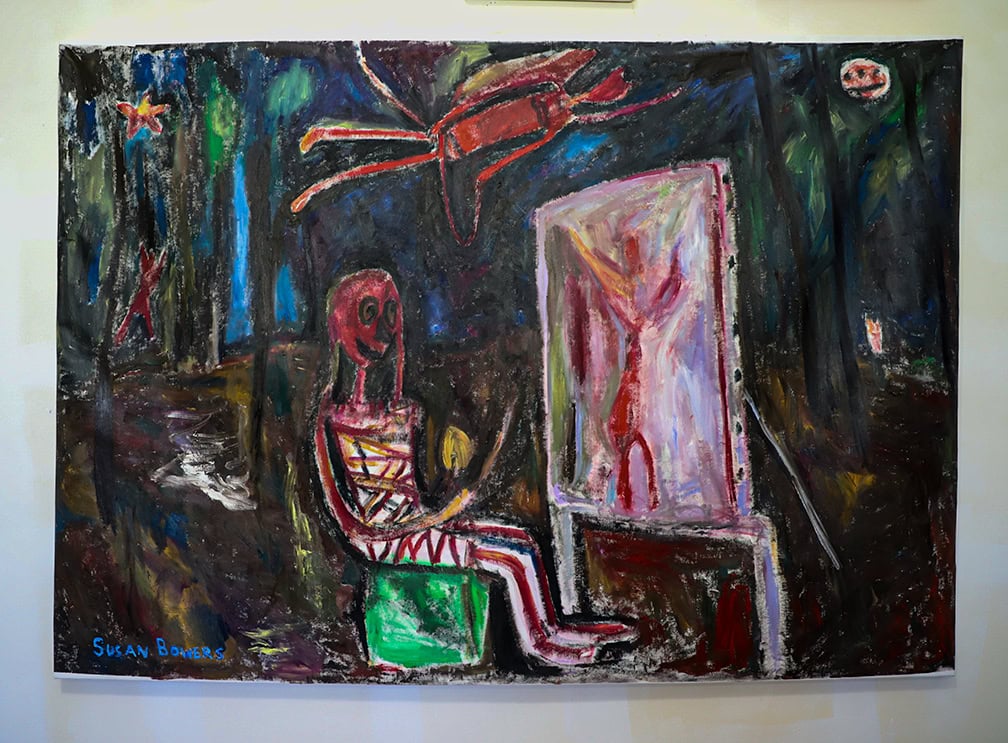
SB: I’m channeling Michelangelo [in] The Devil’s Picnic. I’m surrounded. It’s like that one note, you know: the irony. And then I was thinking, ok I’m going to say this to Lauren—If you look up Hegel, what he said about women. He said women are the everlasting irony of the community. So, this whole thing, I’m channeling Michelangelo, The Last Judgement, filled with demons and the garden. This is kind of my self-portrait in the garden.
And I was thinking you could also call the work, “The Fifteen Faces of Eve.” Eve was the person who ate the apple. If you look at Michelangelo’s work, it wasn’t an apple; it was actually a fig tree. She brought on death to the world, the entire epistemology of death. That’s sort of what I’m dealing with—I guess my own internalized misogyny, too. And then I included Epstein in there because it’s this whole idea that the person is finally going to get their due. Supposedly the garrote in prison would take him out—whether that’s true or not, whether he self-suicided or not. I like to deal with this idea of the imagination. When you read [the investigation into his death], you kind of get fixed. It’s like that idea; it’s like the Greeks. They always believed if you were a bad person, you were going to get your due. That’s part of the deep thing. I’m kind of embracing that. The demon are going to get their due. He’s not going to be allowed to just bump himself off.
GM: Someone who can manufacture their own death has had a good life.
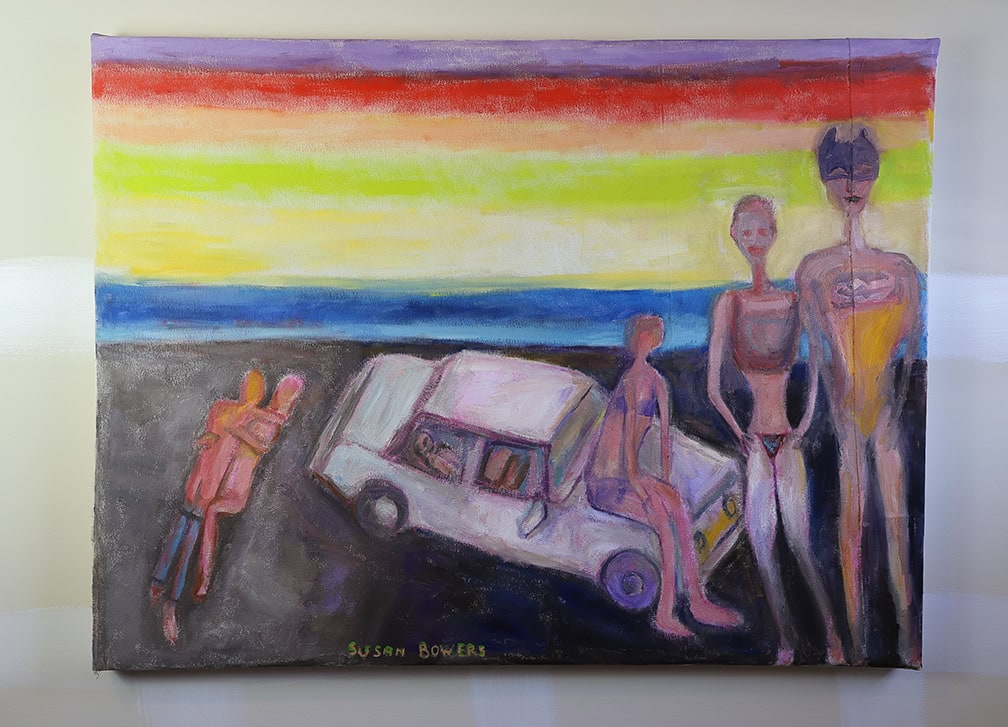
LS: Ghosts Along the Mississippi (2026) technically excluded from this show, exists as a bridge between Life’s a Beach and The Devil’s Picnic. Named for the Clarence John Laughlin book of photographs of Louisiana plantations, the work sees the romance devolve into degeneracy before we reach the garden of despondency and ruin. A couple, fucking on the beach, has lost their individual attributes; they are now blurred, faceless bodies—one is nude, the other has their jeans pulled only part-of-the-way down, squandered in mid-coital abandon. A car idles along a black sand beach; a sunset crests above the water in stripey neons. Batman loiters nearby, along with an anonymous masked companion with a boxy build, and a figure sits on the hood of the car with its low beams turned on. All of a sudden, one recalls that in certain places, nothing good happens at night.
Talking about the work together after Sue pulls it out from a forgotten corner.
GM: “It’s that feeling you have: it’s the late evening setting, and you’re leaving the beach. It’s this last lingering imagery that’s so desolate and depressing. And you’re so ready to go home.”
SB: “It’s two demons who didn’t make the cut.”