Louise Mouton Johnson and Diana Antohe are New Orleans-based textile artists. Mouton Johnson was born and raised in the city. Antohe was born in Romania; her family relocated to Texas when she was a child. I am interested in where the lines between the work of Louise Mouton Johnson and that of Diana Antohe meet or become more apparent.
Louise Mouton Johnson’s textiles remind me of time—parallel, computational objects, that were also, marked, enveloping, constant. Mouton Johnson characterizes her work as being grounded in family. I’m certain they garner favor with the ancestors. They hold access to the temporal loop of history. A quieting of the mind, they are a framework for sensing the unknown, for the encountering of selves, for the long journey home. These are deeply metaphysical objects. They alter us. In an instant, the work can read like a shadow play behind the eyes. Her textiles are demonstrative.
Diana Antohe’s recent work suggests the gap between looking and forgetting, repetition and the dreamed—powerfully capturing the material presence of Louise Mouton Johnson’s quilting. They could be paintings. Or montages. Allusions to care. So many stars—excerpts of the heart at rest, of love and its grandeur. Despite appearances, they’re at the beginning of ritual cues, in companion. The stitch is a way forward, a symbol of hope. I spent a few hours with Louise Mouton Johnson and Diana Antohe in their studios—discussing form, beauty, portraiture, the African-ness of certain gestures, translation and opacity. The following are fragments of our conversation, which, for me, started to feel like something akin to meditation.
This interview was edited for length and clarity.
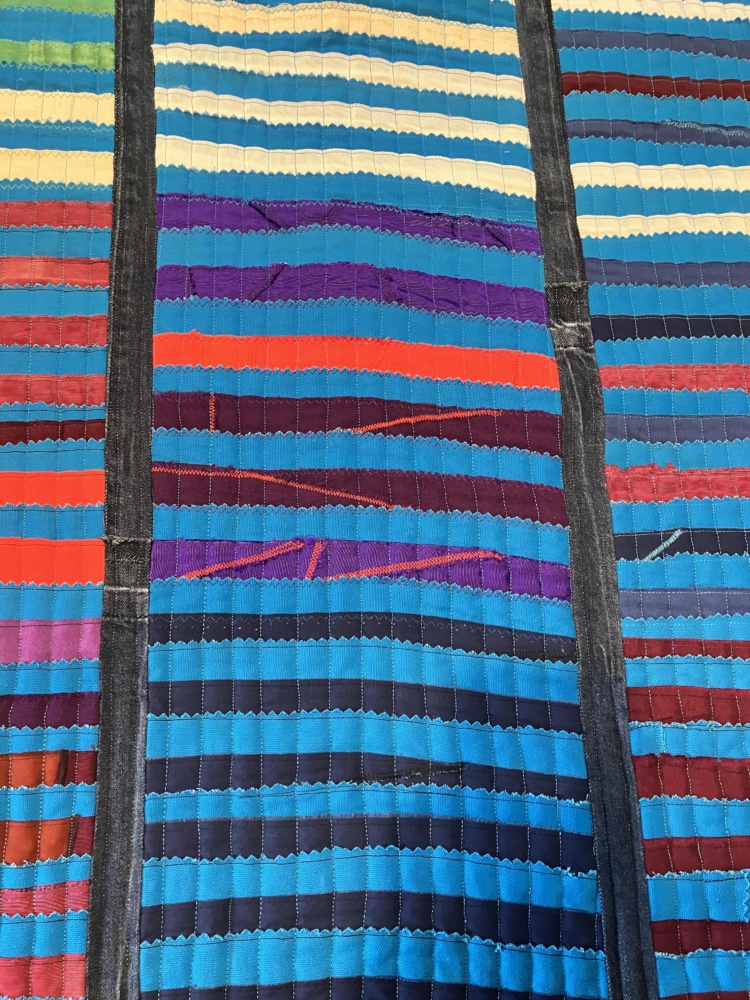
Louise Mouton Johnson: This is denim. That’s from one of Charlie’s old shirts. All cotton. I like indigo. I learned to like stripes. These are scraps that just came like that. When I would weave things I would just do it by hand. But mostly I use a sewing machine.
Sherae Rimpsey: This might be a silly question, or too personal, but do you title everything? And if so, do you find yourself actively thinking about a title while you’re making, or when you’re thinking about the idea for what piece you want to do next, or is the title always after the work is finished?
LMJ: All of those. Like with this piece, for example, this is a combination of paper and very little fabric. It started off as a series of pieces called Unfinished Business (2005). What inspired it was using paper to make a quilt. I grew up learning how to make a quilt where you used scraps of something. My mom taught me how to sew. We never went out and bought fabric to make a quilt, you just used leftover pieces from when you made something.
SR: Does family inform a lot of your thinking?
LMJ: It does, but it might not come out as literal.
SR: This one reminds me of those illuminated paintings, religious paintings. I know that this part isn’t recessed, it’s all on the same plane, but it implies that it is.
LMJ: That was from a series called Offertory (1997). I was doing something where I was inspired by a West African sculpture, a female figure holding a bowl. Then thinking about some of the imagery that I saw in the Egyptian Book of the Dead. Also, I grew up Catholic. The arch is the dotted shape. It was also showing a connection with plants.
SR: This almost looks like it’s penetrating flesh, it’s so close.
LMJ: The material difference, this is made from a woodcut.
SR: When you’re working from a woodcut, there’s still a way of disrupting the figure.
LMJ: A little bit hidden.
SR: We get to think about it. This is a durational piece. I’m back at time again, or an imagined thing.
LMJ: We had indigo plantations here in Louisiana. This African fabric is from a piece I really love. I gave this to my mom when we came back from Senegal.
SR: Do you always start off with a sketch?
LMJ: Sometimes I just start off with how is this gonna look? I like the back and forth, it’s almost like looking through blinds. Did I do this first and then put this down and then cut it out, or is this first and then cut, then put. I did all of the embroidery first. Then I carefully it cut out. Then I put down the little stitches. This one is made of scraps.
SR: Do you spend a lot of time just handling the surface before you even do anything?
LMJ: Yes, just touching it, feeling it you know? Even with some things, knowing how it looks before it’s actually sewn together, or if it has a gloss or glaze on it. My mom and I used to do sequins. This is so Black, a sequin.
SR: What does it say here?
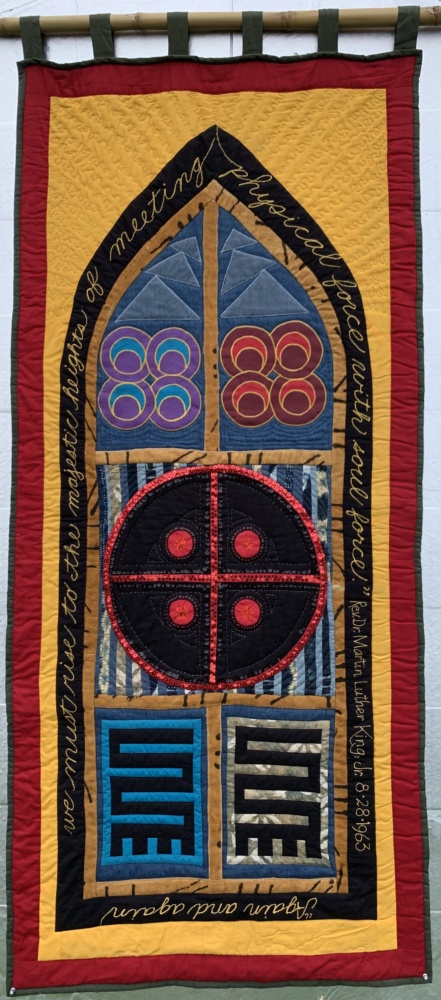
LMJ: We must rise to the majestic heights of meeting physical force with soul force.
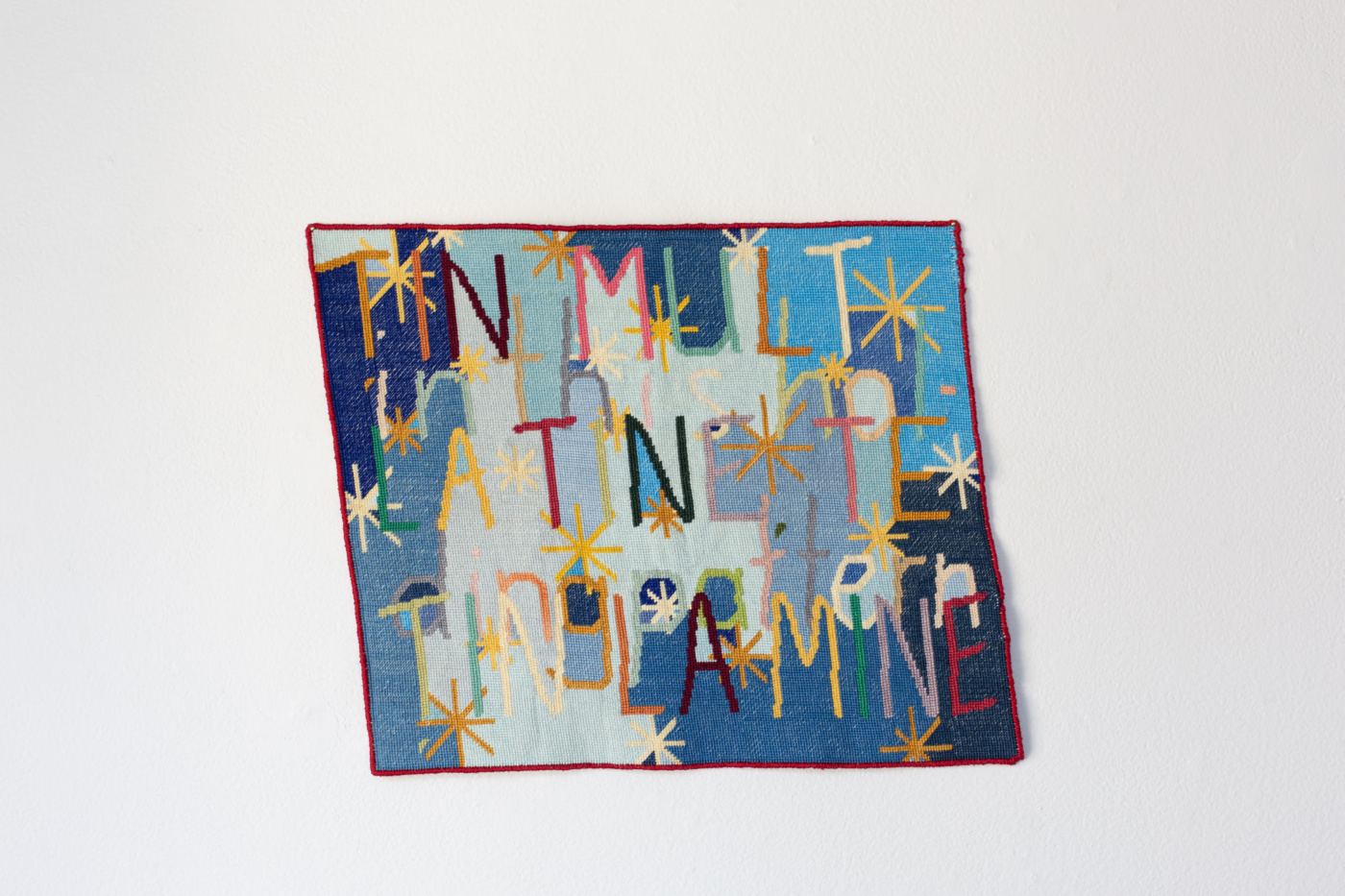
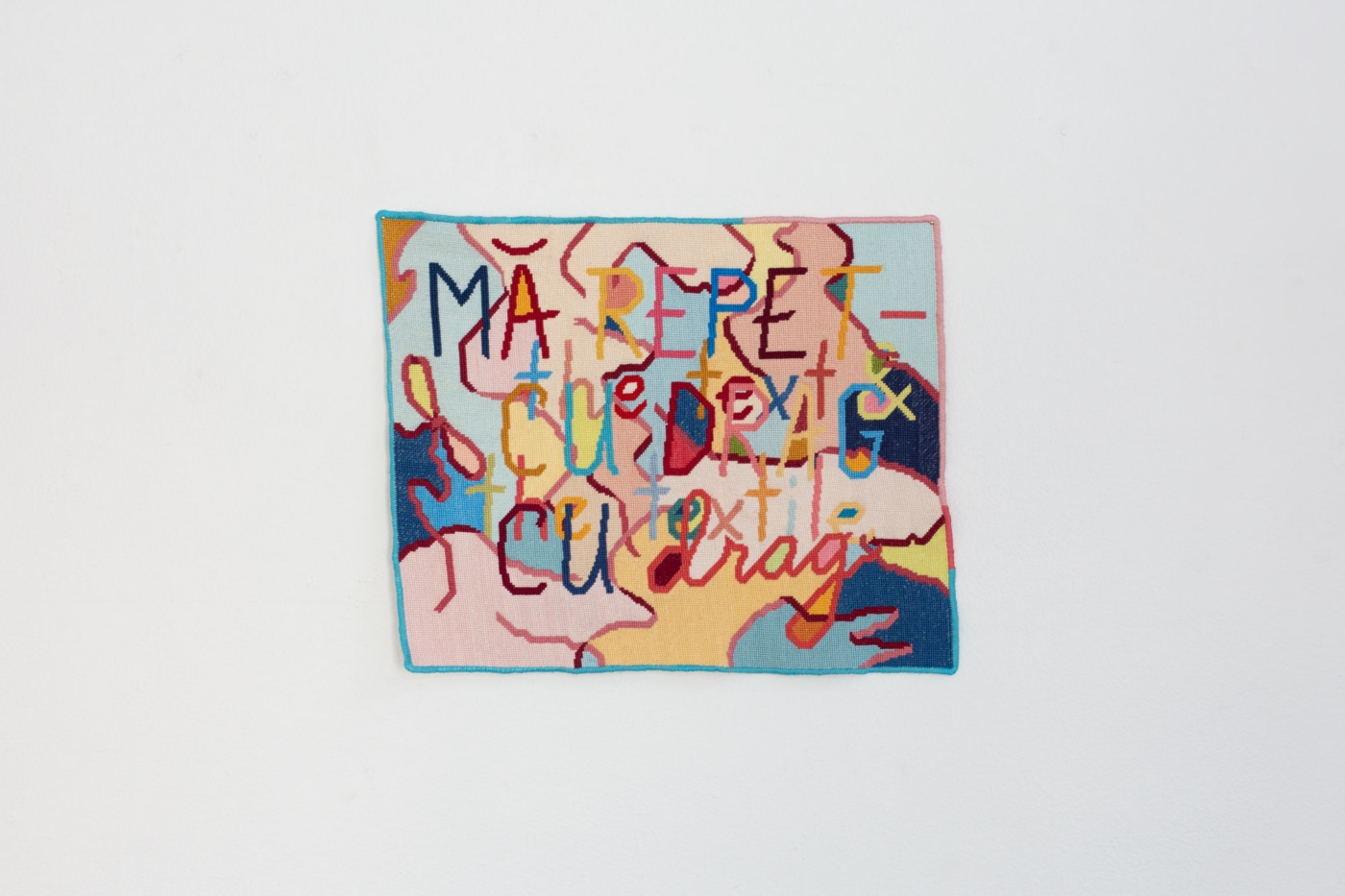
Diana Antohe: One really active part of working on these was trying to slow things down. Cloud things. Especially in this first one. Introducing text in my work, I don’t want them to be straightforward or too legible.
SR: The overlapping is really interesting. The works feel like there could be a thousand more of these. I know you’re not a machine, but I feel like you’ve opened something. They’re not explicitly narrative in the way that one would normally think of narrative, but there’s so much here. They’re poetic. They’re painterly. They’re textile. They’re cinematic. They’re objects, there’s so much happening, they feel generative.
DA: I wrote the text out first, in Romanian. English. Then I tried to bury it a little bit. And so I was burying it in patterns that I was pulling from like my grandmother’s apartment, or my childhood sheets, or an apron, or embroideries, and I got really excited about this bearing of text.
SR: So is there the original cloth and then your surface covering them?
DA: This is the cloth. It’s called Aida cross stitch fabric, so it’s woven to have these gaps. I did a cross stitch for the letters and then the backgrounds, like a single stitch. That’s what gives it its trapezoidal shape.
SR: All that movement. I’m wondering, are you moving things away to reveal things or is it accretion? Are things being stacked?
DA: I love that question. I’ve talked about revealing and concealing in terms of my obsession with translucency, like when I’m painting, or when I create veils or stains of color. Revealing and concealing feels pretty apt.
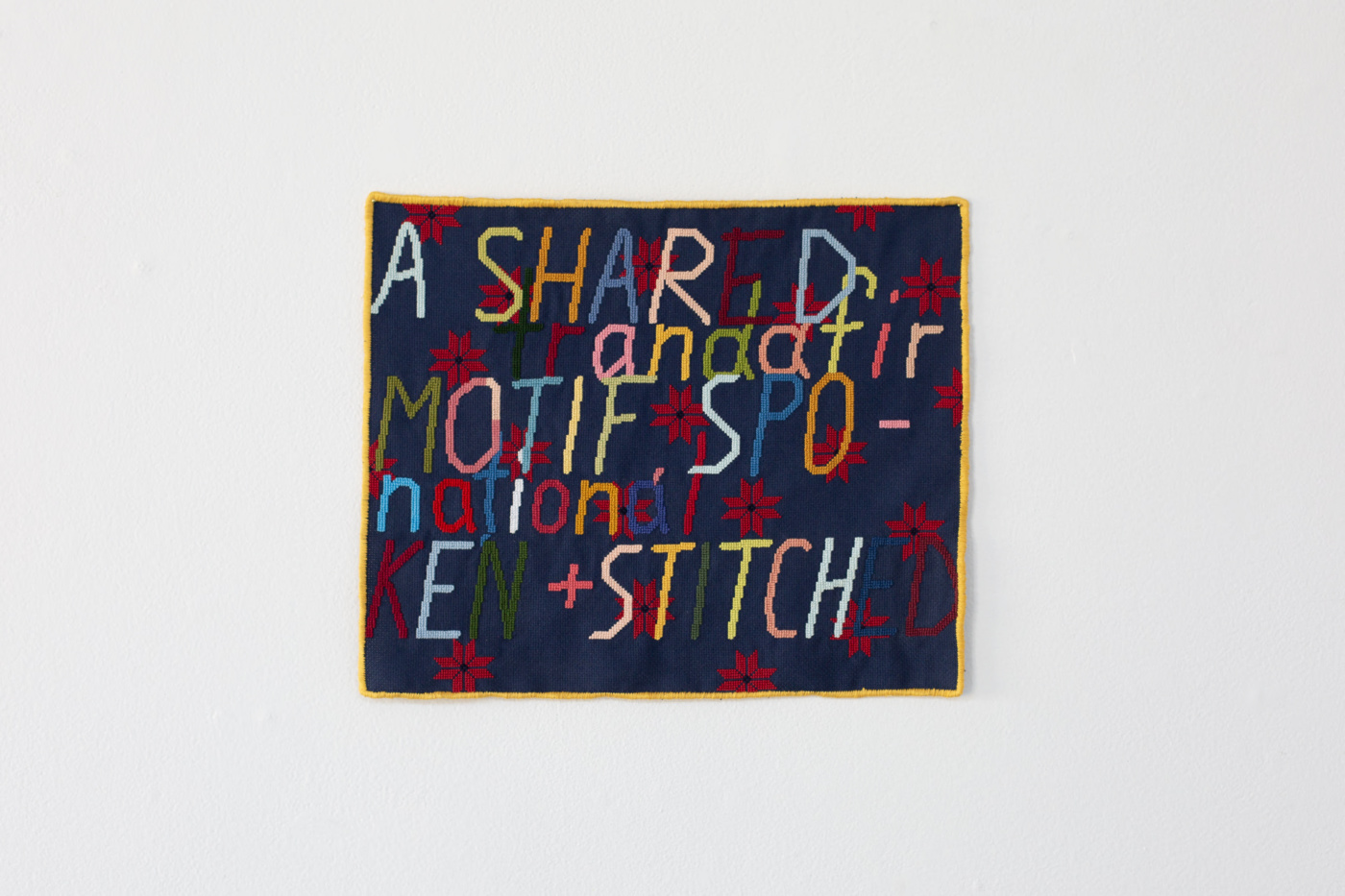
SR: There’s a whole world here being mapped or coded. Or like, coming into being. We’re reading the text as you’re writing, or like, stitching it. Have you ever made a film?
DA: No. Do you see them as kind of flickering or animated?
SR: They feel cinematic. This does not dictate scale for me. I know that I can touch them and that this is my encounter with them, but they also feel larger than the building I’m in. The only other thing I know that has the capacity to do that is cinema. Your visual sense and understanding of space, even from here to here, feels like film. All the implied detail outside of this framing that can infer something else.
DA: I’ve had different responses to titling and translations. If I can ask, what do you think about translating this work?
SR: Well, I feel like translation is never the source material, it’s its own thing, its own separate text.
DA: Yes!
SR: I kind of relish when things aren’t translated.
DA: Me too.
SR: There’s something to be said for us, the viewers, navigating language on our own terms. I don’t feel like you’re shutting me out by not translating the Romanian.
DA: I appreciate that. Let me let people sit with it. It’s kind of a bigger conversation.
SR: Obviously, I can’t speak for all viewers, but I do feel like it’s a tremendous act of generosity to trust the viewer to make their own decisions.
DA: I think of these things in iterations sometimes. What does this iteration need if I’m showing it this way and just experimenting. I’ve been enjoying using both English and Romanian. If I’m reaching for this other language, there’s a reason why I’m saying it in that language right?
SR: Right.
DA: We have to unravel.