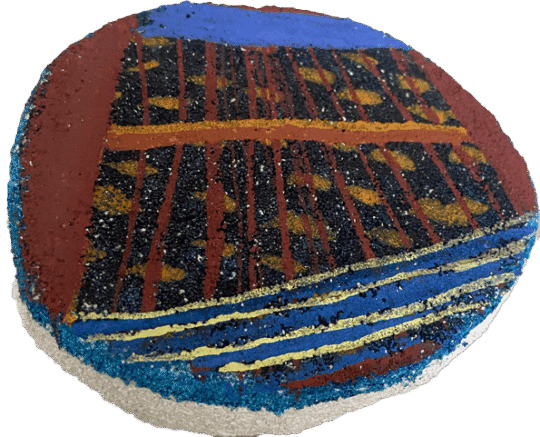
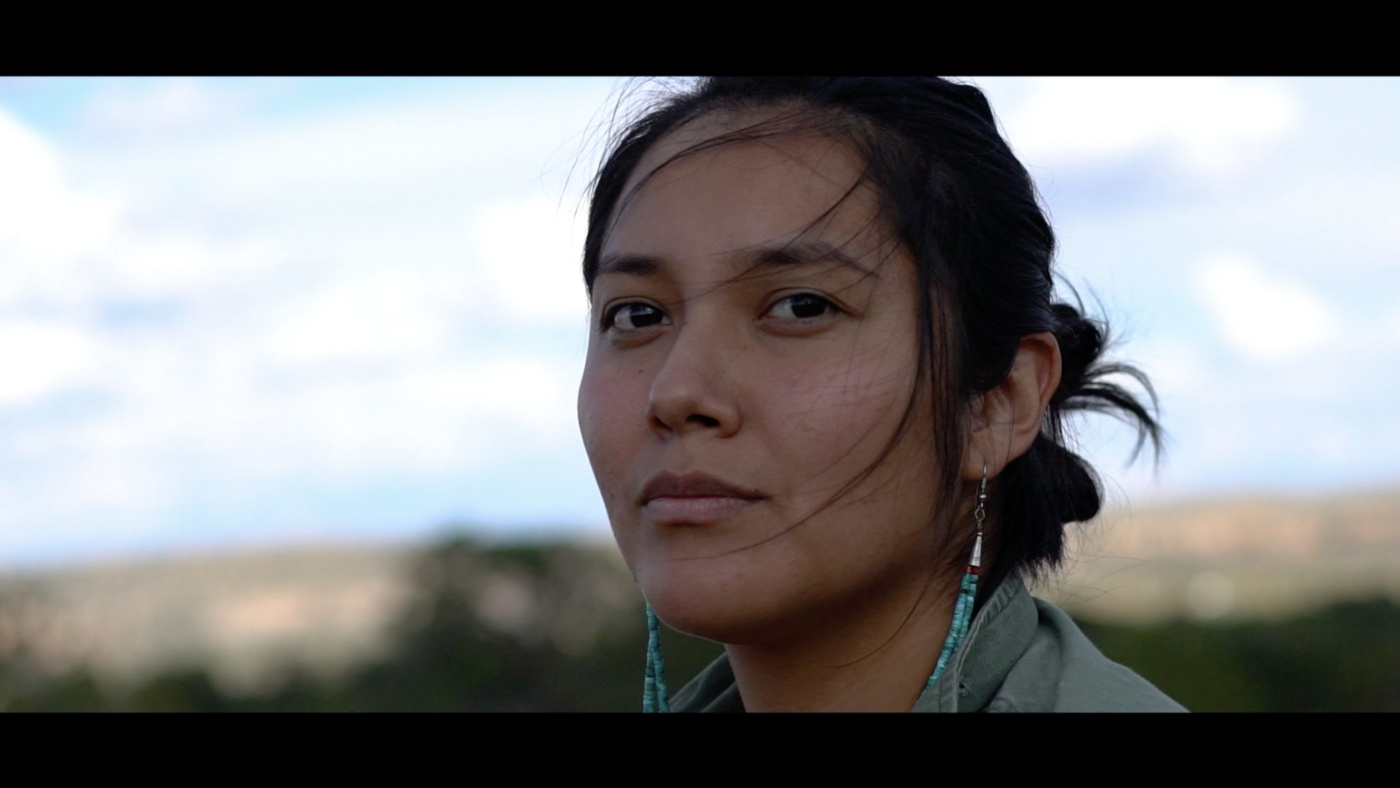
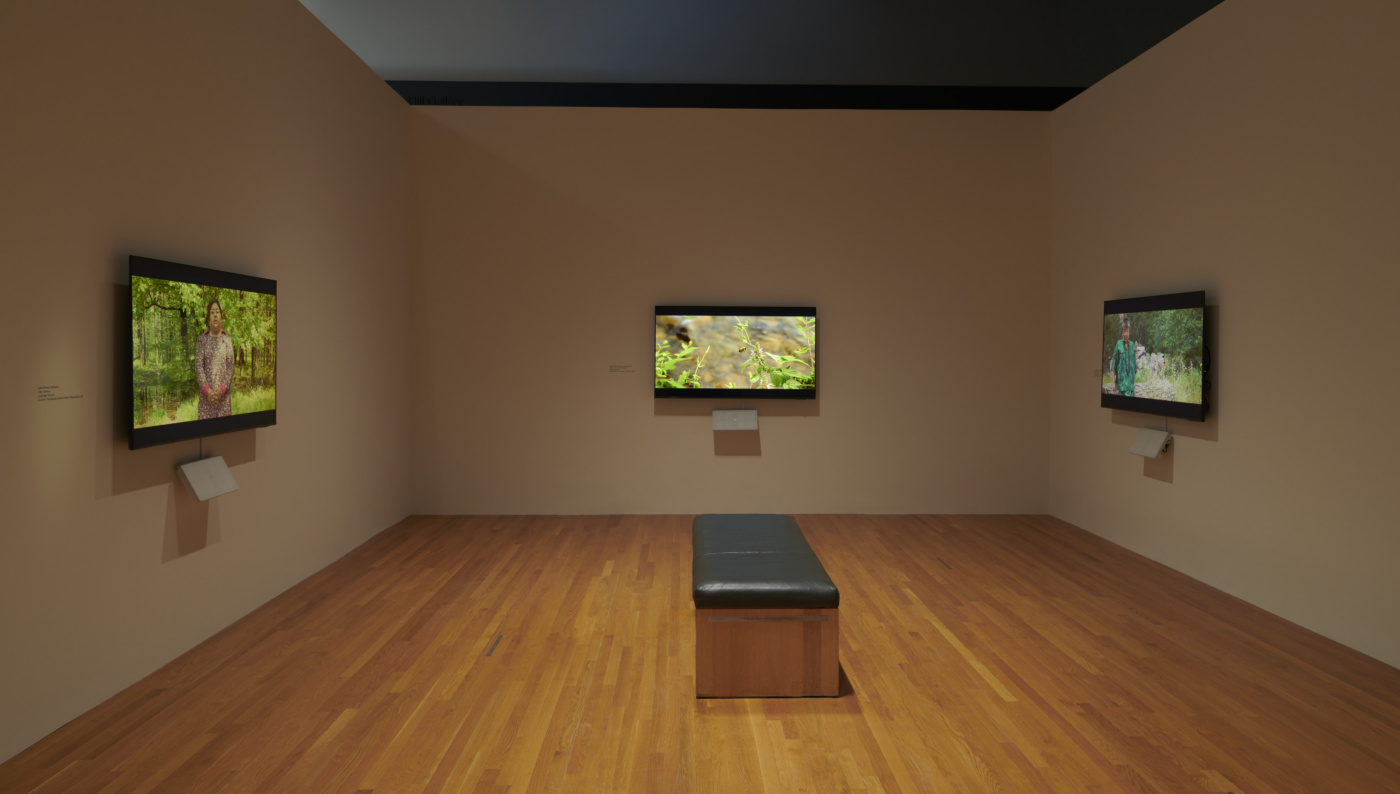
In LISTEN (2020–ongoing), an eight-channel video installation with directional sound by Dyani White Hawk (Sičánǧu Lakota), each screen plays simultaneously, featuring a different Indigenous woman speaking in her language on her tribal homeland, filmed on location. Across the five-minute videos, imagery of the surrounding land is layered with ambient sounds of those environments: in the soundtracks, water laps, wind rustles foliage, and bugs beat their wings.
White Hawk’s installation at the Nasher Museum of Art at Duke University offers minimal explanatory context, especially for an unfamiliar viewer. Beyond each speaker’s name, tribal affiliation, language, and location, there are no subtitles or extra information. The exhibition statement broadly summarizes linguistic context—the women speak about prayers, personal and tribal stories, language practice, boarding school experiences, and relationships to land—making the specifics of each narrative opaque to some viewers while opening more immediate forms of recognition for others.
Arranged on three walls, the monitors and directional sound encourage visitors to drift from one voice to another and back again; moving through the gallery becomes an act of tuning oneself to each speaker and their surrounding world. Approaching a screen brings its speaker and their voice into focus; step away, and the language dissolves again into a distant murmur. The installation makes the body part of the listening process. To hear, one must choose to move closer.
At first, for viewers without fluency in the languages presented, there may be an instinctive effort to decode the words themselves by grasping a phrase, recognizing a familiar structure, or locating a foothold of linguistic understanding. Other viewers may encounter the work differently, potentially understanding one voice and not the next, or identifying numerous entry points shaped by experience across multiple languages. Few viewers are likely to understand all of the languages, and for many, the method of comprehension may gradually shift from vocabulary to rhythm and translation to tone, both forms of connection that exceed linguistic divisions.
The faces on the screens make that connection tangible, carrying much of its resonance. In several videos, the footage lingers in close-up as the speaker’s gaze remains steady and direct between monologues. The effect is disarming. Rather than observing from a distance, the viewer feels addressed, placed in the position of listener within an intimate exchange. Facial expressions register emotion with striking precision: curiosity, gravity, humor, reflection, and consternation. Even without knowing Ojibwe, Hocąk, Diné, or the other languages represented, meaning accumulates through emphasis, intonation, and countenance.
Such meaning is especially vivid in the video of Leiha Peters (Seneca) on the Tonawanda Seneca Nation Reservation in New York. As she speaks in Seneca, the deep croak of a bullfrog punctuates the footage, rising at steady intervals, both in and outside the frame. The sound anchors Peters to the forested landscape, the cadence of her speech mingling with the frog’s call. Their intentional interplay illuminates how language is not isolated from its surroundings, but situated with them, shaped by a living environment that continues to speak alongside it.
A different articulation of this relationship appears in the video of Lucinda Polk (Quechan/Kwatsáan) on the Yuma Quechan Reservation in California. Palm trees frame the landscape as Polk speaks in Kivasäan, her image layered transparently over the land itself. The muted tones of the dull brush sit beneath the vivid red of her traditional clothing, visually merging them together as if they sustain, or at least reflect, one another.
At times, the surrounding landscape is subtly subversive as well—an adept cinematographic achievement in the installation. In the video of Lorraine Ryan German (Sisseton Whapeton Dakota), the movement of a dragonfly causes the camera to lift and dip in small, playful motions. The moment introduces a slight disorientation, echoing the effort to follow speech whose words remain unknown. The effect of this mirrors the labor of listening: leaning in, adjusting focus, identifying meaning beyond vocabulary.

This specific presentation of LISTEN at the Nasher asks a deceptively simple question: “How many languages can you identify by sound?” As the exhibition statement contemplates how the average American can identify a paltry number of languages indigenous to their own land base, compared to those originating from other continents, a vast absence is revealed. Due to the enduring forces of colonization, this gap in recognition has rarely been acknowledged, much less confronted.
Within the gallery, the experience differs for each viewer, unfolding across varying linguistic and cultural positions: some may be faced not merely with unfamiliar languages but with the limits of their own recognition, while others may move between familiarity, partial understanding, and the shifting boundaries of recognition itself.
Without accusation or explanation, LISTEN creates space for reckoning with how these languages are preserved, why they may feel foreign to many, and what histories have concealed them from greater familiarity. The installation resists an offer of resolution, inviting introspection as a form of remedial action because understanding requires patience, presence, and a willingness to be uncertain and uncomfortable.
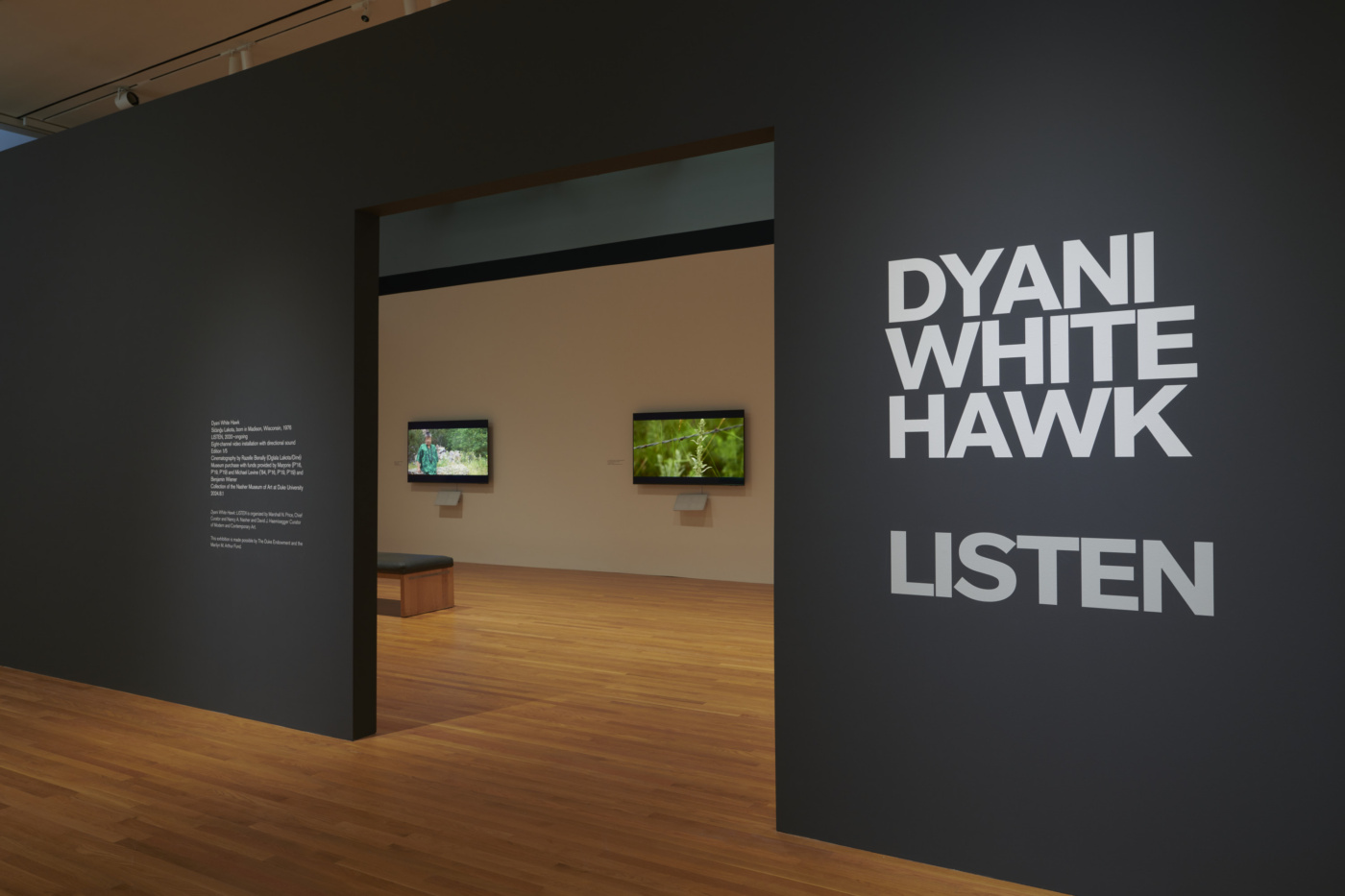
Dyani White Hawk: LISTEN is on view at the Nasher Museum of Art at Duke University through July 5, 2026.