By William Shakespeare Craig Drennen
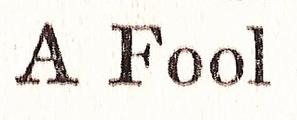






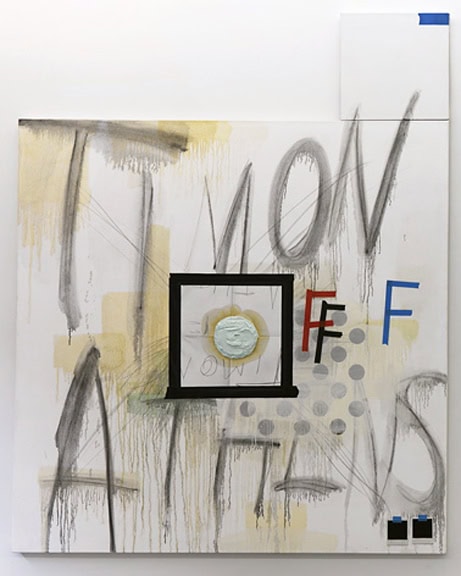
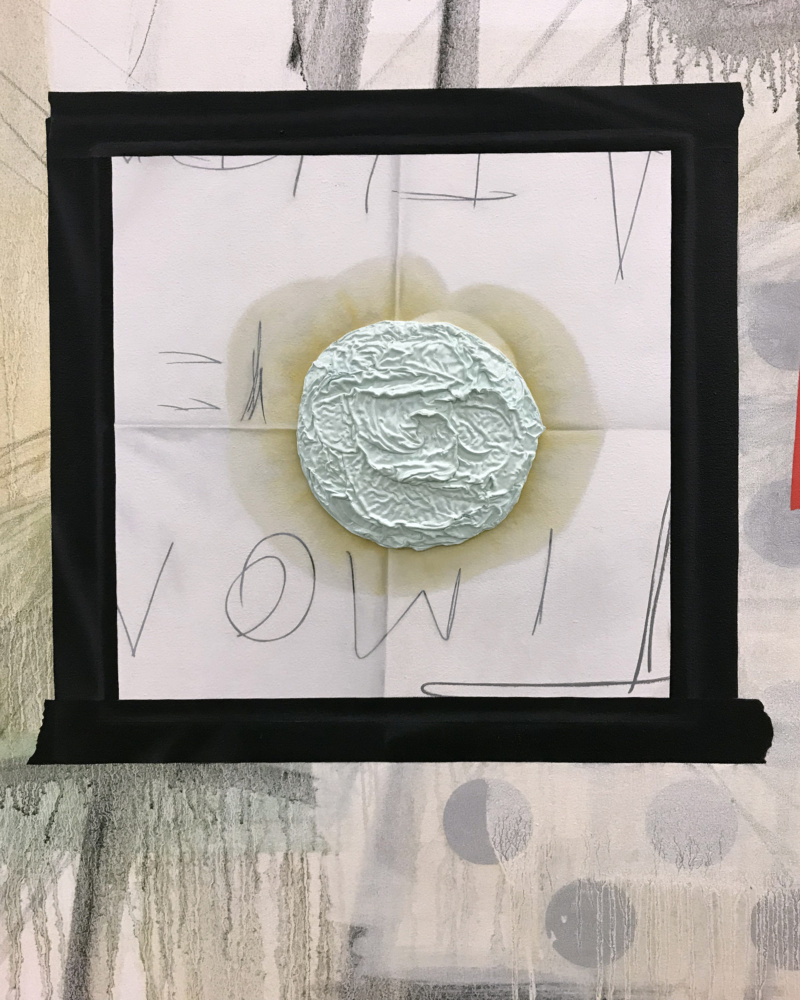
*This piece is interactive; please hover over the individual names in the image to activate the accompanying images.
For this iteration of the Annotations column, Craig Drennen presents an interactive guide to his Timon of Athens project that he has worked on continuously since 2008. Timon of Athens is the only play by Shakespeare not performed in his lifetime, and it may have been unfinished, abandoned, or simply too weak. Drennen has made a separate body of work for each character in this play, and any characters can be exhibited together in any combination. The decision to use an obscure 400-year-old play to structure a thoroughly contemporary painting practice seemed unusual when he began eighteen years ago. Now, with each passing year, the project looks increasingly prescient. In simplest terms, Drennen has taken a bad thing and turned it into unexpected good things. As a natural shapeshifter, he found a way to create a diverse group of paintings under the canopy of one guiding idea. As of summer 2026, there has been no exhibition or monograph that have surveyed the entire span of these works. This Burnaway Annotations column is the first full public presentation of every character in Drennen’s Timon of Athens project.
Drennen showed early pieces from this project in 2008 at the Samsøñ booth at the NEXT Art Fair in Chicago and at Degree Zero Gallery in Beijing. The first characters Drennen addressed, the infamous Mistresses and Masquers, foregrounded their criticality. The more recent characters, like Merchant, became less compartmentalized and moved imperceptibly toward autobiography. Any of the sixteen characters thus far serve as an entry point into the project, but no single character reveals the project’s full scope. As the T-shaped paintings shown recently at the Hunter Museum in Chattanooga or the guillotine-shaped pieces slated for his September exhibition at Brigitte Mulholland Gallery in Paris clearly indicate, Drennen’s Timon of Athens works are always about the present.
There are very few living painters who are committed to ongoing, multi-decade projects. That is partly what makes Drennen’s work such a useful counter-model. In a time when there is urgency for art to be made quickly for a speed-obsessed market, Drennen’s work moves at a measured pace and reveals itself more slowly. At a moment when young artists are pressured to settle into recognizable, algorithm-friendly brands, Drennen’s refractive practice sidesteps the repeated, signature style. Perhaps Drennen aligns with the poet Victoria Chang who notes that when culture requires an artist to be everything to everyone, it can inadvertently teach them to be themselves in many ways.[1] Drennen found a way to bypass entrenched layers of cultural gatekeeping to quietly inhabit a territory at the edge of the Western canon.
Burnaway plans to add character updates to Drennen’s Annotations piece as he moves the Timon of Athens project toward completion.
All images courtesy of the artist and Brigitte Mulholland Gallery.
[1] Chang, Victoria. “Victoria Chang: Dear Memory.” Between the Covers podcast. Jan 1, 2022

Timon of Athens refers to the play in entirety, and not the single lead character. Timon of Athens pieces speak for the project and performs the role that broadsheets or posters would historically serve. The Timon of Athens works are made to inform and clarity all of the other paintings.
Image Caption: Timon of Athens 1, oil & alkyd on canvas (2 sections), 90 x 72 inches, 2009. Exhibited at Timon of Athens solo exhibition at Samsøñ, Boston, MA, 2010; First Acts solo exhibition at Atlanta Contemporary, Atlanta, GA, 2022; First Acts Part 2 solo exhibition at the Moss Art Center, Virginia Tech, Blacksburg, VA; and T Is For Timon solo exhibition at the Marietta-Cobb Museum of Art, Marietta, GA, 2025.

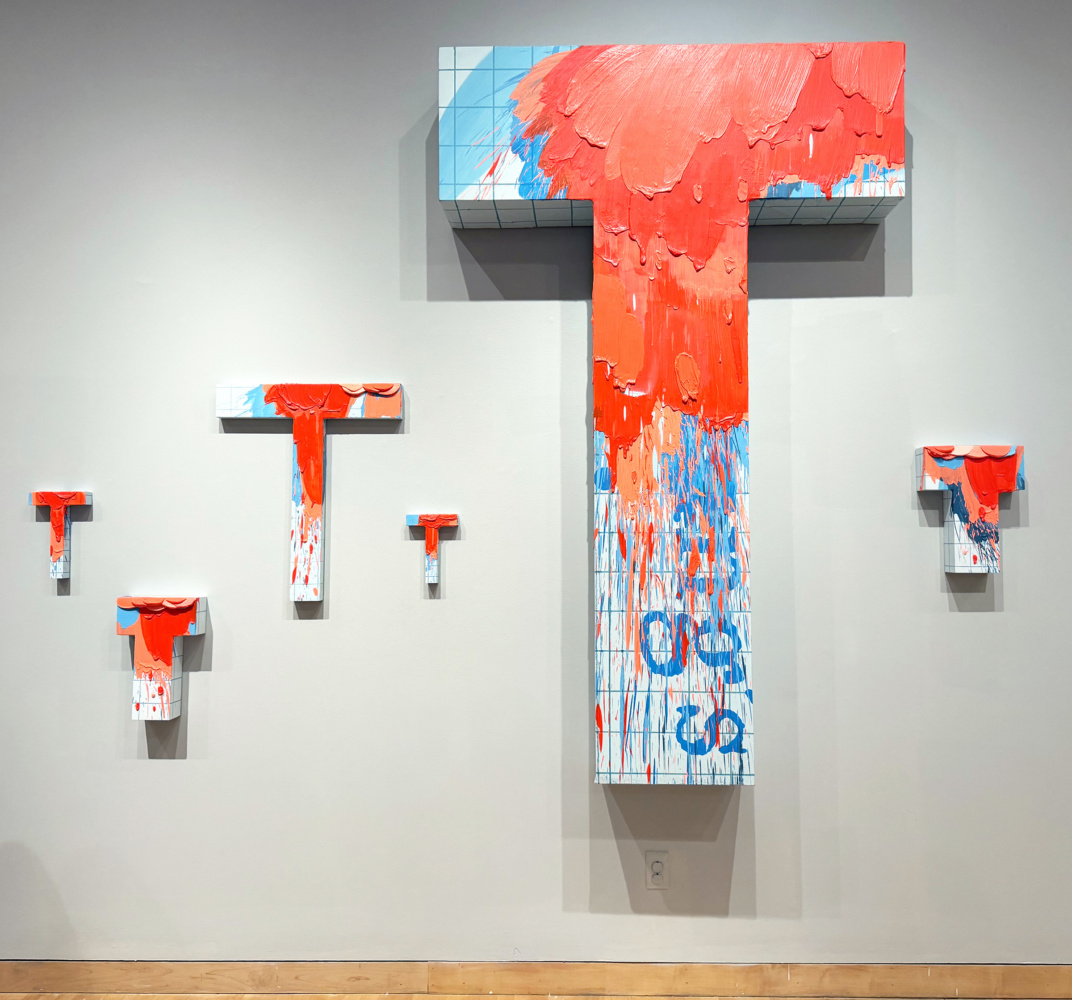
Timon begins with wealthy naivety and ends with misanthropic despair. Much is asked of him by his community, but little is given in return. Timon is on shaped supports that form a capitalized, sans-serif T. This shape is also three quarters of a crucifix, common imagery in Western art. Timon’s fluorescent orange paint has fewer art historical associations, but the method with which it’s applied comes from abstract expressionism, which has its own thorny connection to anguish.
Image Caption: T40 (Each Thing’s A Thief), 2026, oil & alkyd on canvas over panel, 96 x 60 x 10 1/2 inches. Note: This piece is surrounded by an assortment of smaller T pieces. Exhibited in the Hunter Invitational V, Hunter Museum, Chattanooga, TN, 2026.
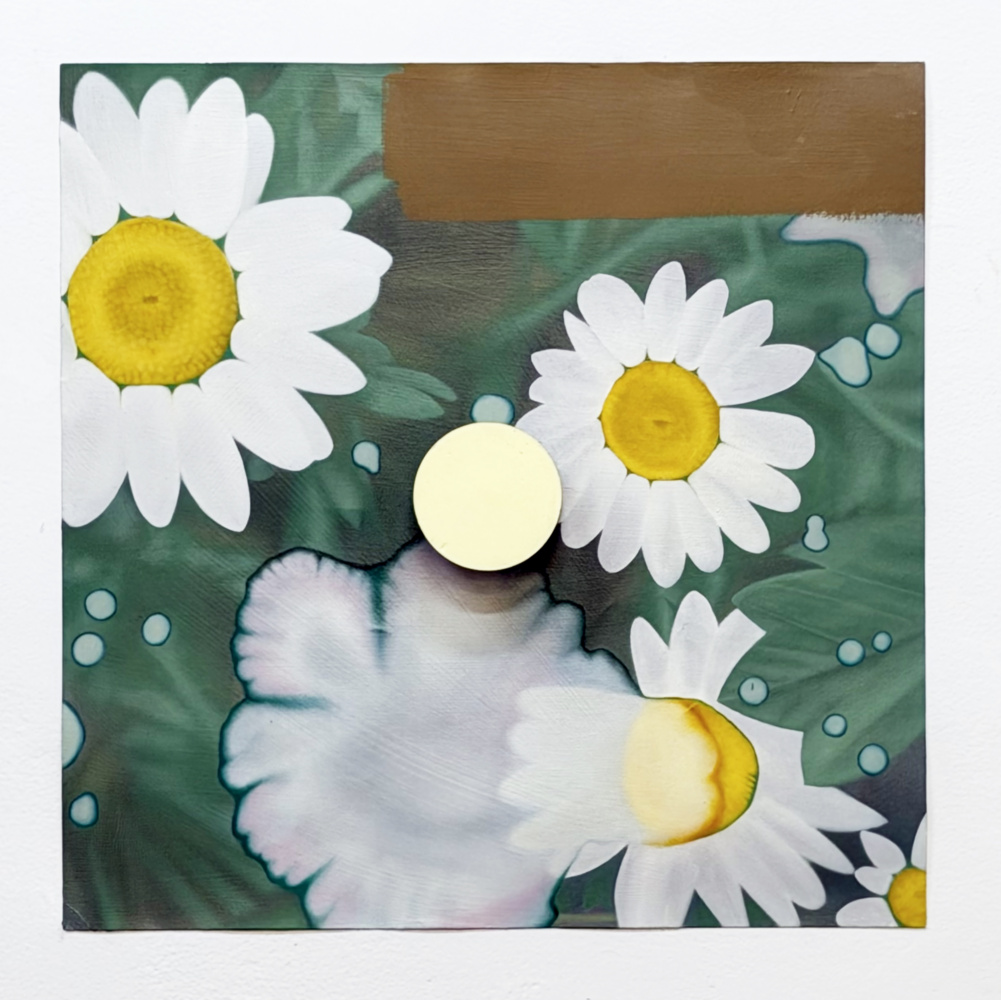
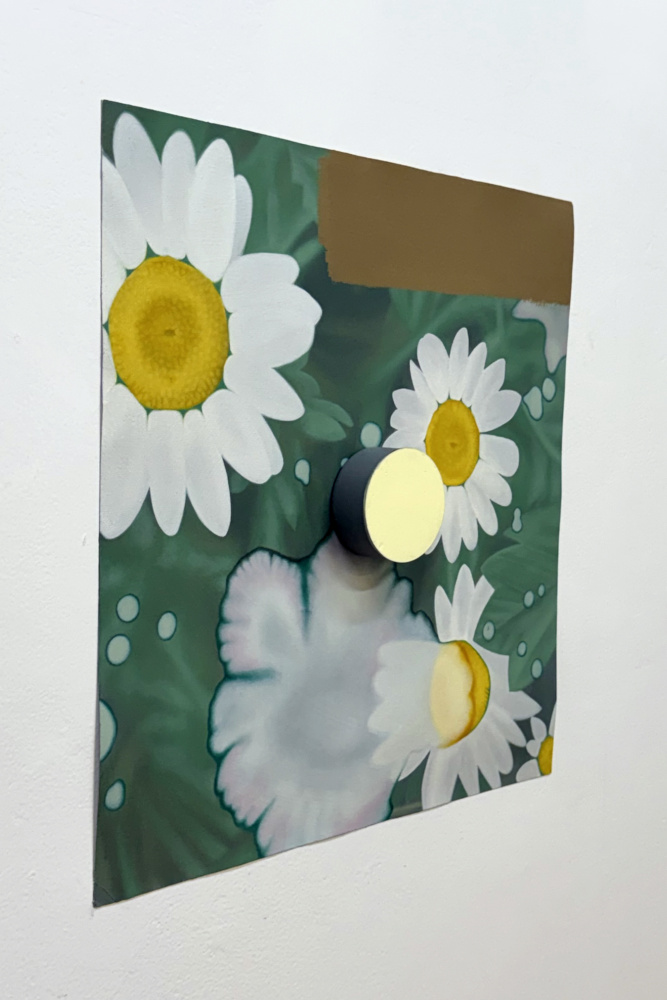
Flattering Lords react to the tradition of landscape painting. They are made using traditional oil paint on prepared paper to depict inkjet prints of daisies. The original inkjet prints included water stains because the printed daisies received a literal watering. A circle of pigmented Hydrocal is attached to the center of the image.
Image Captions: Flattering Lords 1, oil on paper + metal can with pigmented Hydrocal, 2008. Exhibited in Yueqi Zhang & Craig Drennen, 2-person exhibition, Degree Zero Gallery, Beijing, China, 2008 & Flattering Lords 1, oil on paper + metal can with pigmented Hydrocal, 2008, DETAIL.
Ventidius is forthcoming. Stay tuned.
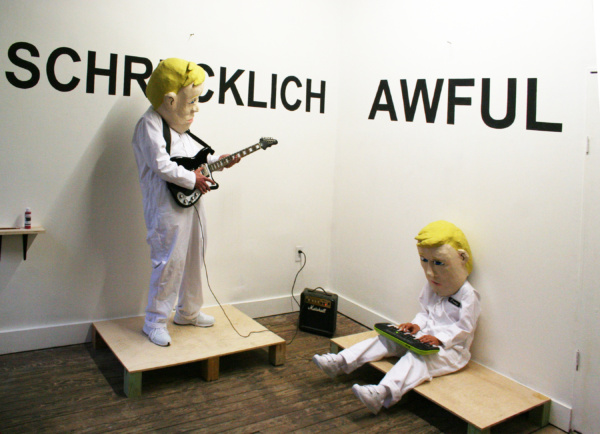
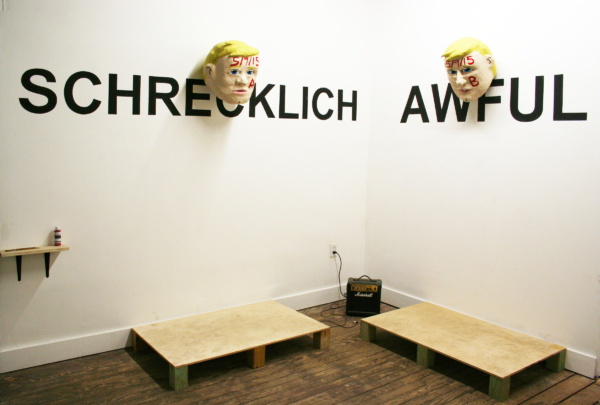
Apemantus utilizes performance art. The artist performs the song Awful (1998) by Hole in public while wearing an oversized paper mâché head, a caricature of his own appearance. The prosthetic heads continue on as an eccentric form of painting, with the performance date written on each forehead. This character starts as an absurdist performance but ends as severed heads on the wall.
Image Captions: AWFUL Inside Helper, 2-person performance, 1 hour 15min, May 9th, 2015. Exhibited as part of the Craig Drennen Is AWFUL solo exhibition at Helper Projects, Brooklyn, NY, 2015 & AWFUL Inside Helper, installation with performance ephemera, dimensions variable, 2015. Exhibited as part of the Craig Drennen Is AWFUL solo exhibition at Helper Projects, Brooklyn, NY, 2015.
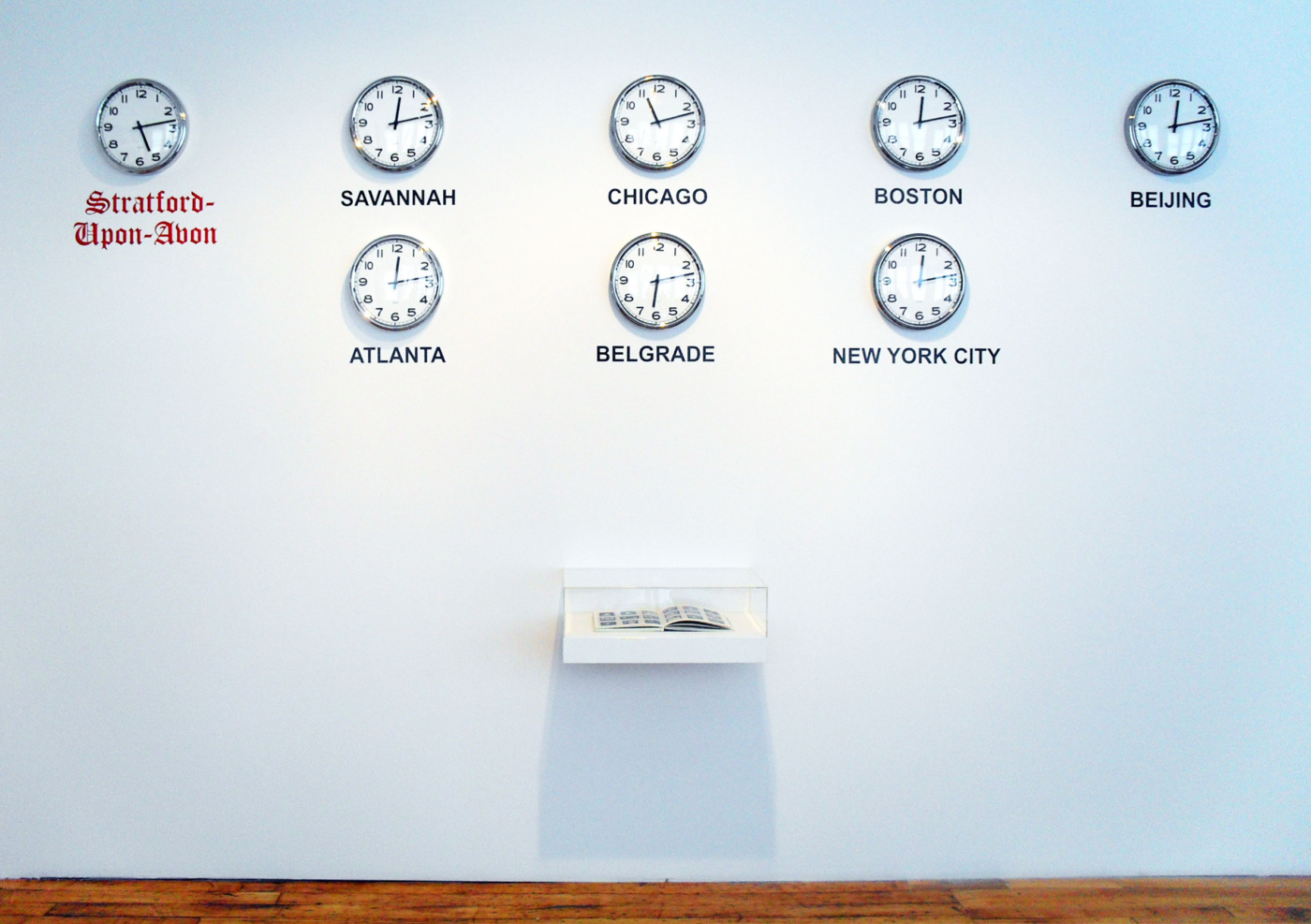
Alcibiades is an assortment of real or depicted clocks as a response to painting’s ability to capture moments of time. The multiple instances gathered form an imaginary chorus, therefore the word “chorus” can appear in the titles for Alcibiades. When real clocks are used, they are set to the current time in Stratford-upon-Avon. In painted versions of the clocks, the time is set at 10:10, since the hands of the clock at that time resemble an upturned smile and therefore “happy” times. The works underscore painting’s unique relationship to time, specifically the speed of production, circulation, and viewer experience.
Image Caption: Chorus, clocks & vinyl lettering on wall, dimensions variable, 2010. Exhibited in New Curators, New Ideas, PPOW gallery, New York City, 2010, curated by Erin Dziedzic.
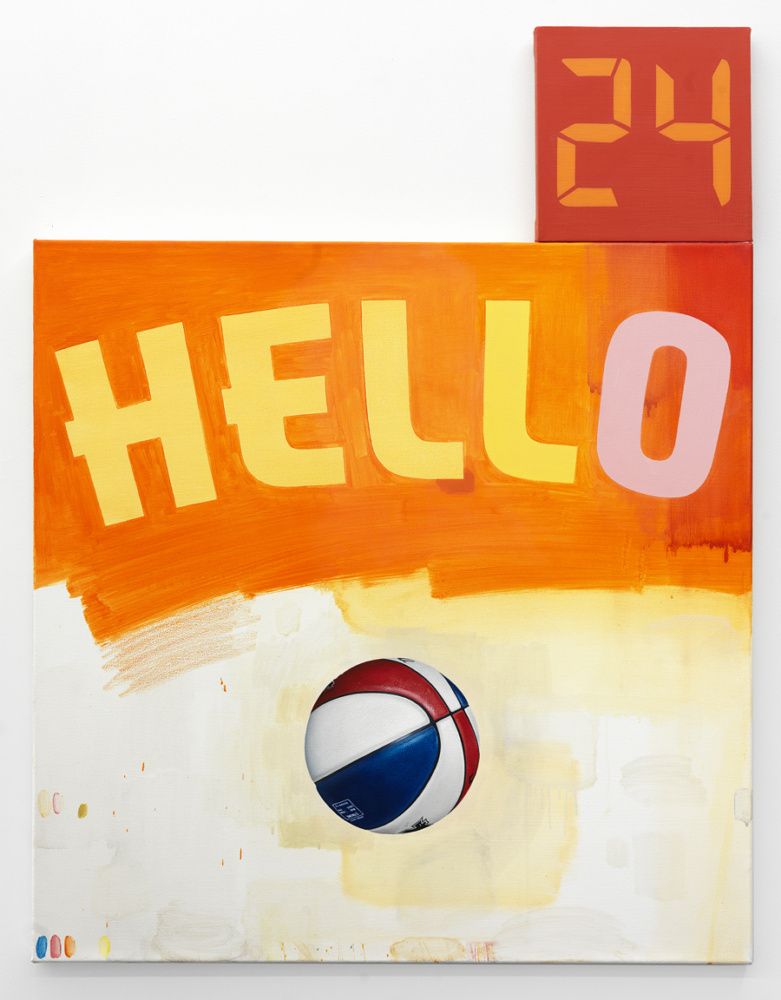
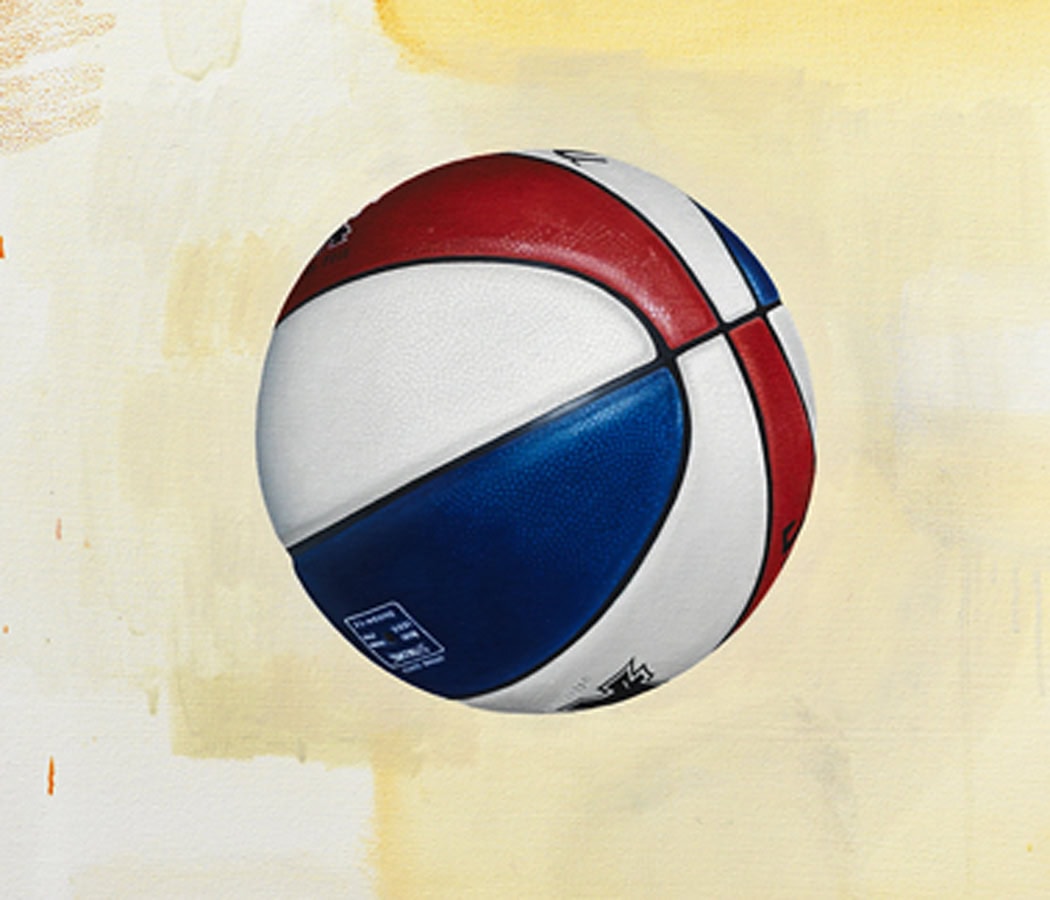
Poet uses images of basketballs to conflate technical achievement in painting with the meritocracy present in contemporary sports. The heightened presentation of the basketballs also references school trophy cases as a form of valorized public archive unequaled by contemporary museums. Poet has the first lines in the play, so Poet offers a continual “hello.”
Image Caption: HELLO ABA, oil on canvas (2 sections), 52 x 40 inches, 2014. Exhibited in Poet & AWFUL solo exhibition, Samsøñ, Boston, MA 2014 & HELLO ABA, oil on canvas (2 sections), 52 x 40 inches, 2014, DETAIL.

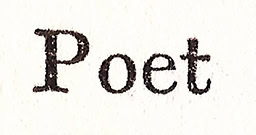
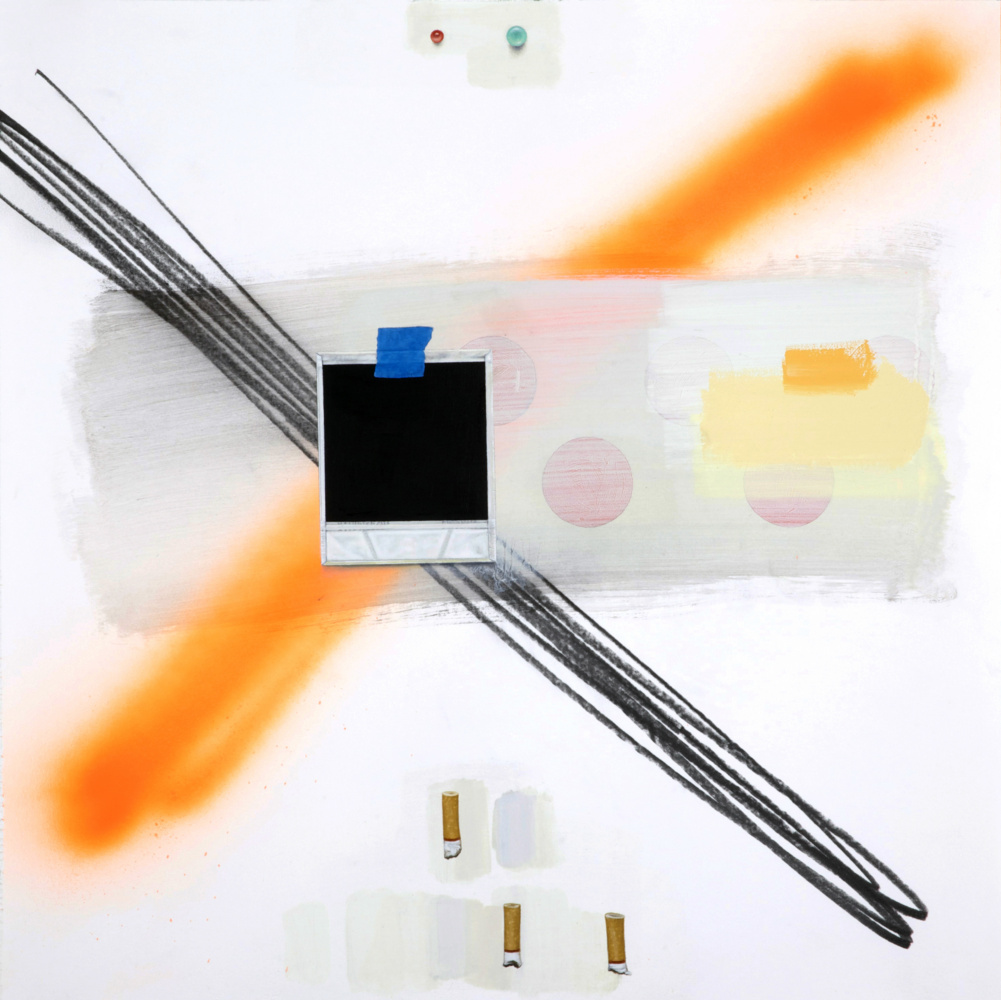
Painter provides a condensed history of drawing and painting where graphite, acrylic, oil, and spray paint all coexist on the same surface. Painter begins with a large X, to emphasize the recurring predictions of painting’s “death.” The center of the X contains a painted depiction of a Polaroid photograph, a painted letter P, or a physical lump of paint. These choices indicate that at the “center” of painting there is a relationship to photography, language, and its own material history.
Image Caption: Painter 13c; graphite, acrylic, oil, alkyd, spray paint on paper; 20 x 20 inches; 2013.
Jeweler elevates one of jewelry’s lower forms, the ankle bracelet. The ankle bracelet structure for the painting suggests an alternative version of display were the bracelet’s chain or string replaces the gallery center line. Jeweler positions three-dimensional shapes onto a black line of latex paint applied directly on the wall. The shapes mimic all prior works featured in the Timon of Athens project, to creating a mini retrospective for the wall (or foot).
Image Caption: Ankle Bracelet (Guillotine), latex paint on wall + cast Hydrocal & enamel, variable dimensions, 2025.
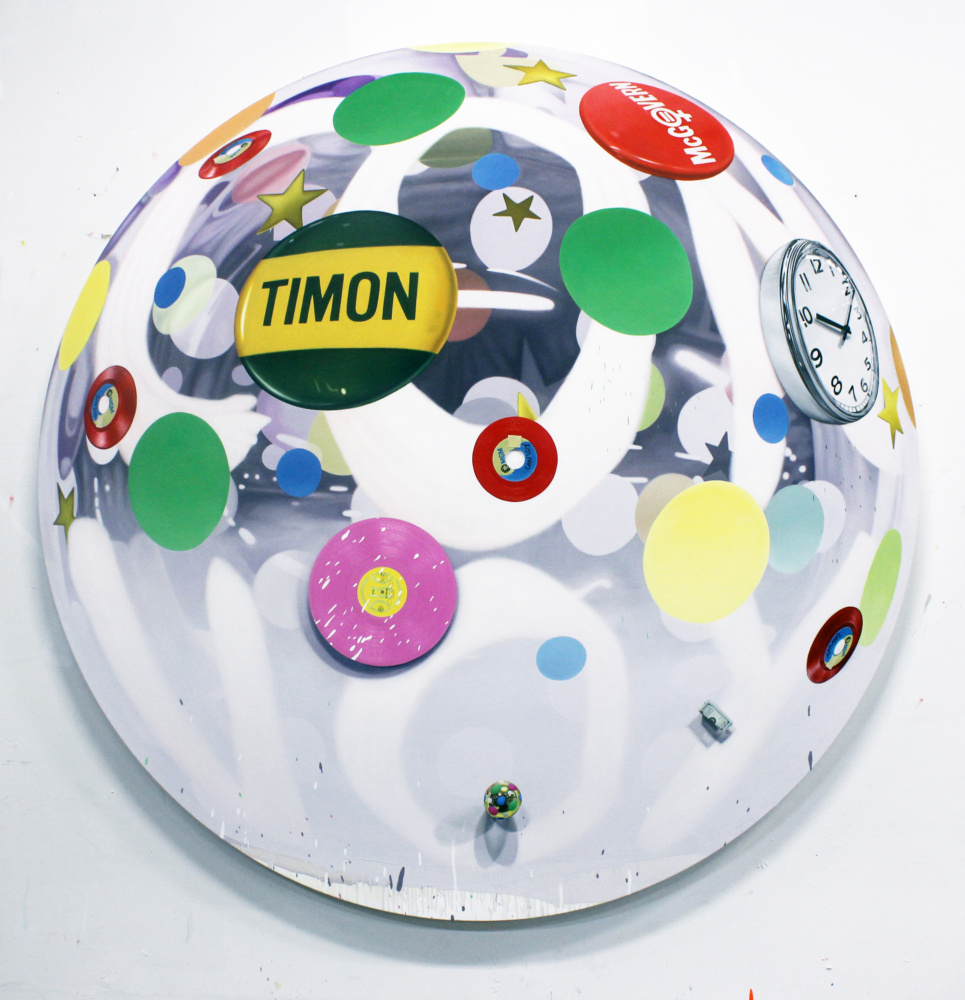
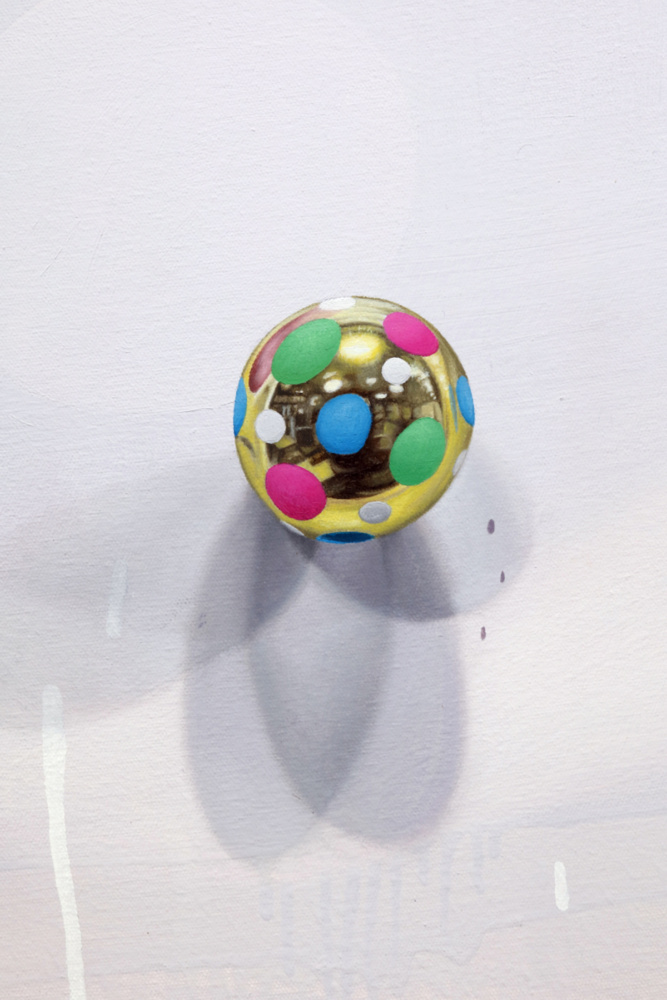
Merchant is circular to reinforce the connection to coinage. The series, started during the COVID-19 pandemic, begins with compositions that mimic the widely circulated illustration of the virus. The titles for Merchant are always in parentheses, to reemphasize roundness. These works include depictions of vinyl records from a 1970’s jukebox in a central West Virginia laundromat. Imagery from Several Servants or Certain Senators frequently encroach on this character.
Image Captions: (Convoy LeFreak), oil on canvas over panel, 72 inches diameter, 2022. Exhibited in the Merchant, Mistress, and T solo exhibition at Freight + Volume, New York, NY, 2022. Private collection & (Convoy LeFreak), oil on canvas over panel, 72 inches diameter, 2022, DETAIL.

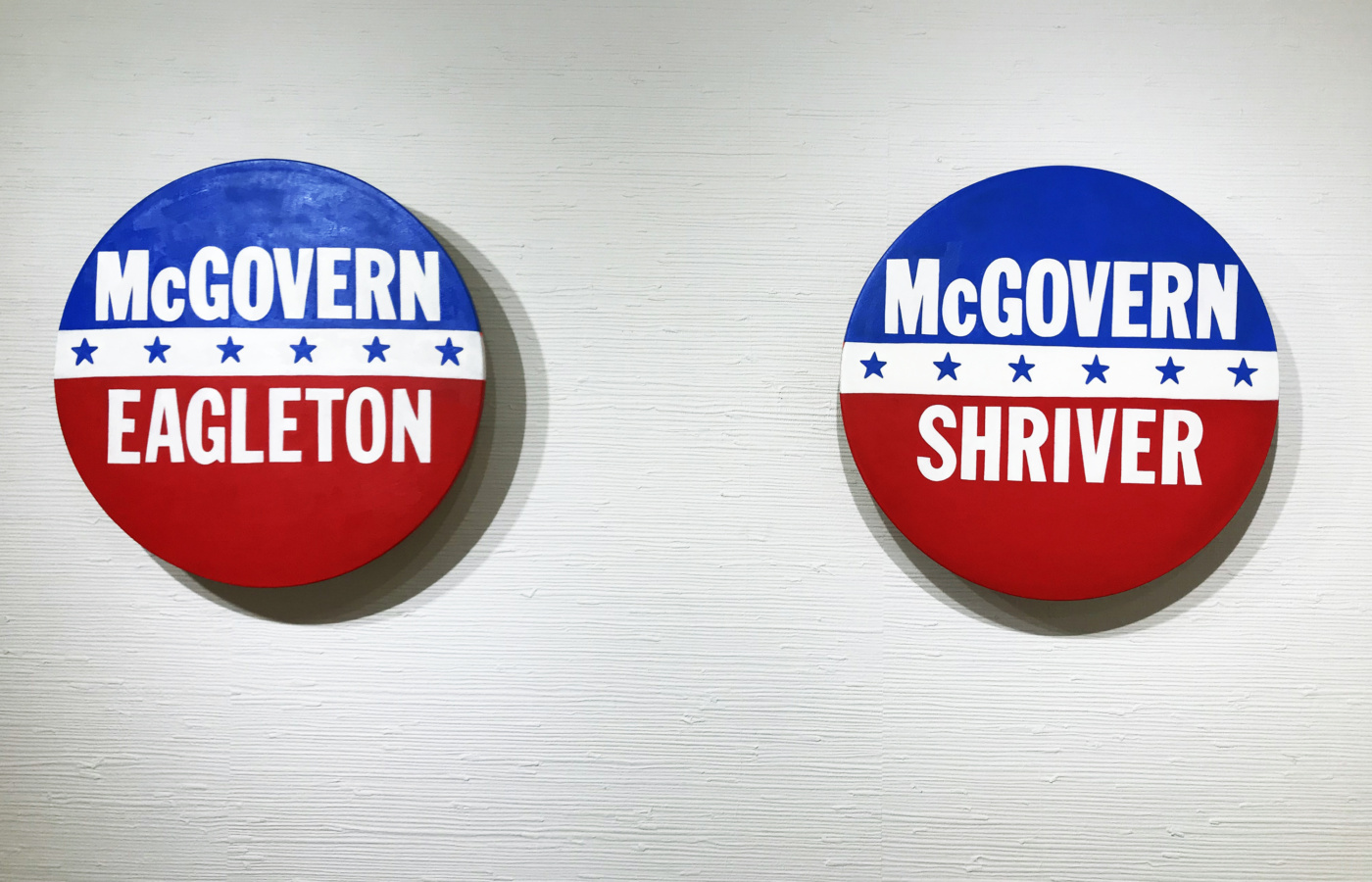
Certain Senators use text and imagery from political buttons made during George McGovern’s 1972 presidential campaign. Although McGovern lost in a landslide to Richard Nixon, the McGovern campaign introduced many issues new to presidential politics, such as support for second-wave feminism and early discussions of PTSD and mental health. The imagery for Certain Senators frequently migrates into the Merchant’s works.
Image Caption: L. Certain Senators (McGorvern Eagleton), oil on canvas, 20 inches diameter, 2021. R. Certain Senators (McGovern Shriver), oil on canvas, 20 inches diameter, 2021. Exhibited in Merchants, Bandits, & Certain Senators solo exhibition, Laney Contemporary, Savannah, GA, 2021.

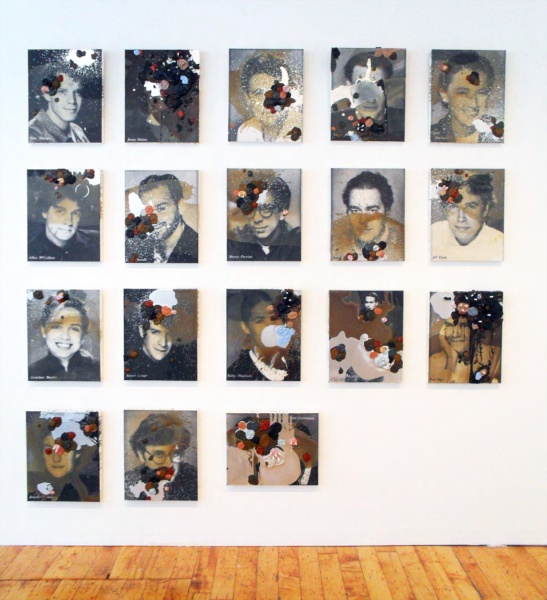
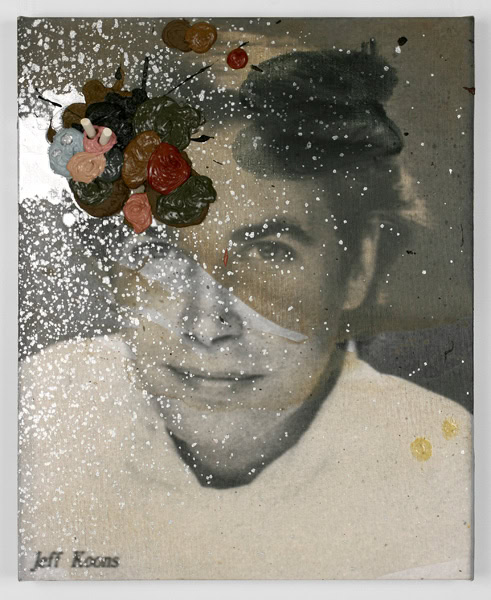
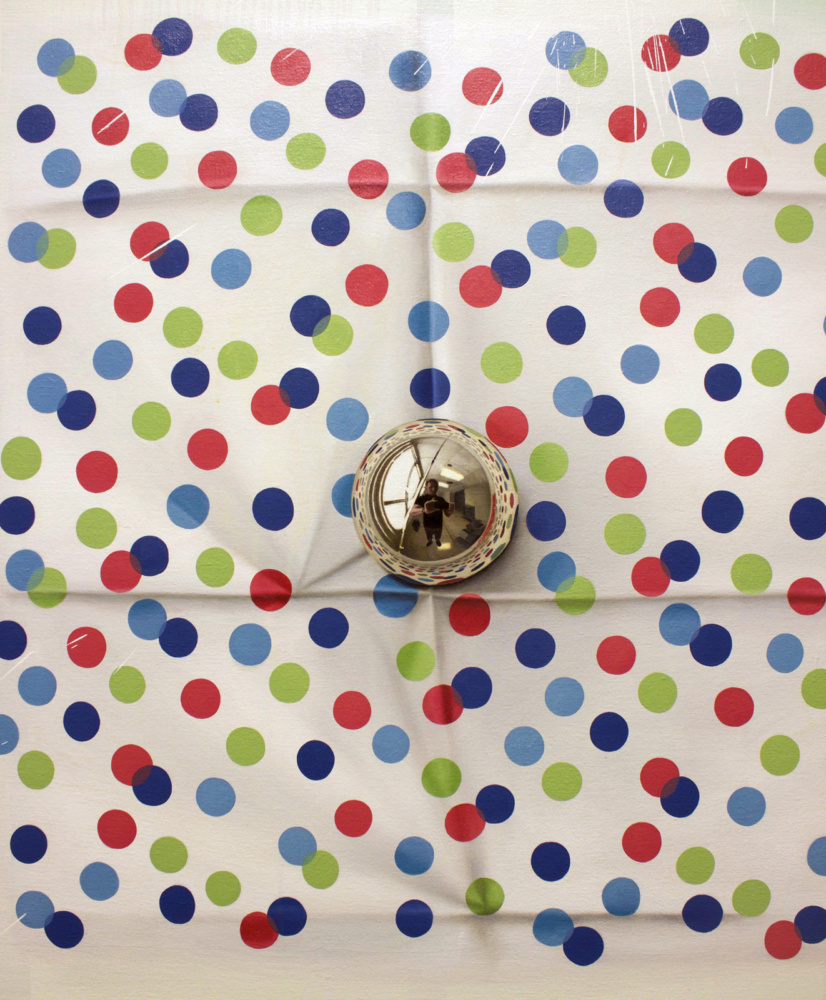
Certain Masquers includes a series of eighteen artist headshots portrayed in David Robbin’s piece Talent (1986) that are scanned from an exhibition catalog and printed directly onto canvases. The canvases are treated as if they were serving plates at a festive banquet. The paint acts as simulated dessert frosting onto which decorative aluminum foil and extinguished cigarettes are added. All the artists depicted in the original Talent are theory-savvy practitioners from the Pictures Generation and are therefore fully aware of appropriation’s guiding principles. Viewer anxiety about depictions of human beings being acted upon only proves that belief in voodoo continues into the current age.
Image Caption: Masquers, inkjet on canvas with oil, enamel, aluminum foil, cigarette butts, cigar butts, 18 units (each unit 20 x 16 inches), 2010. Exhibited in New Curators, New Ideas, PPOW gallery, New York City, curated by Erin Dziedzic, 2010.

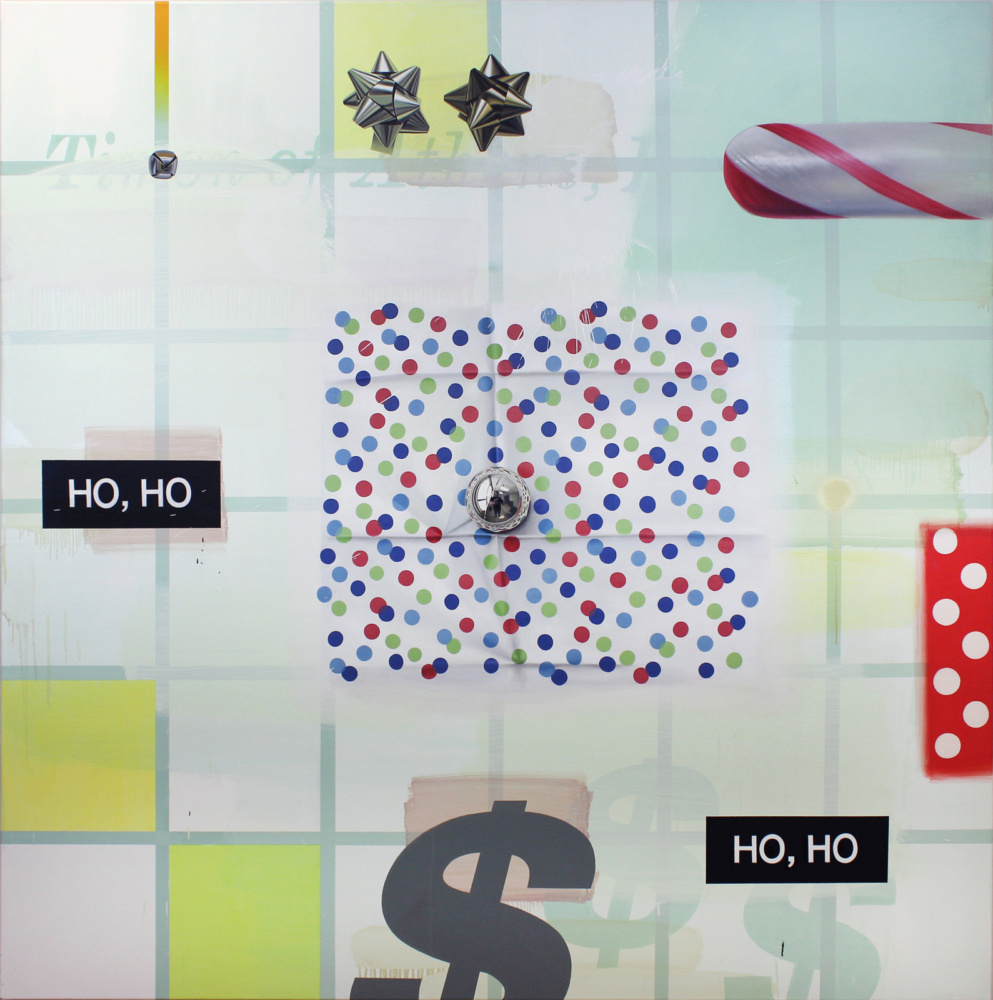
Certain Thieves changes from “thieves” in the dramatis personae to “bandits” within the text of the play. The attributes of Bandit (née Thieves) are shifted away from stealing and instead embrace mythic, eternal giving in the form of Santa Claus. If citizens encountered a gray-haired man in their house at night with a bag of items, it may be difficult to immediately ascertain his purpose. The line between taking and giving is sometimes thin. Because of this mutability, Bandit is the most varied character.
Image Captions: BANDIT 4, oil on canvas, 72 x 72 inches, 2017. Exhibited in the BANDIT Working Artist Project solo exhibition, MOCA GA, 2017. Collection of Tim & Lauren Shrager & BANDIT 4, oil on canvas, 72 x 72 inches, 2017, DETAIL.
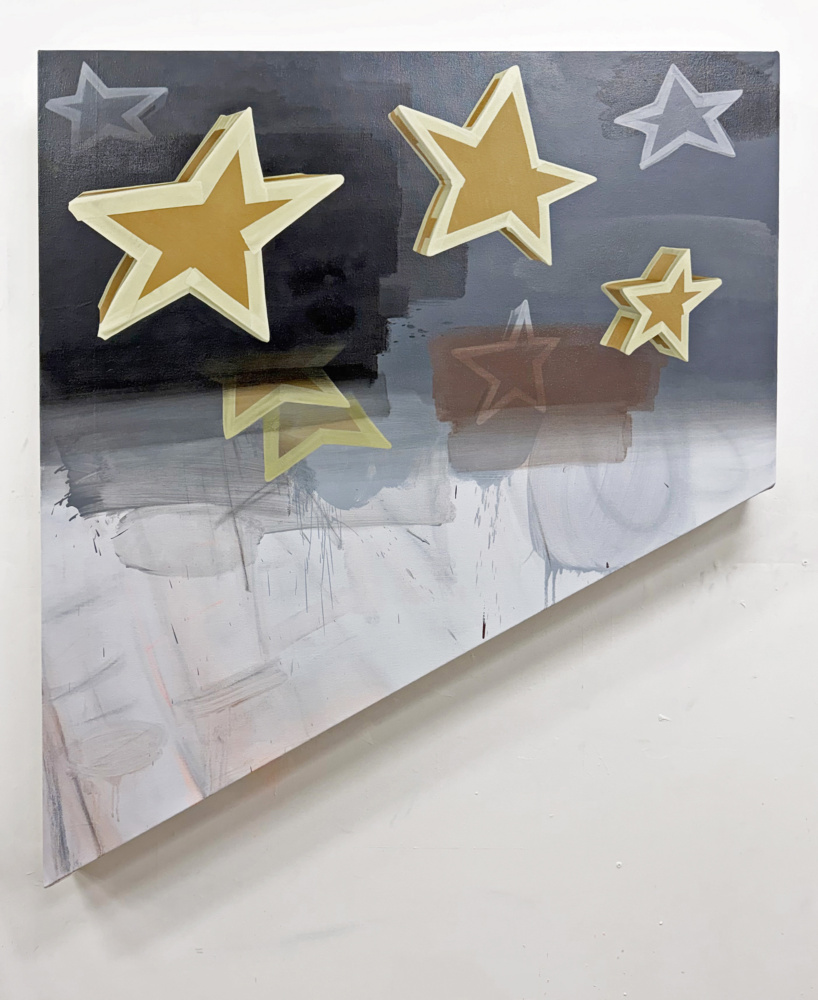
Flavius exists on custom made supports in the shape of a guillotine blade. The blade silhouette returns painting to the position of public spectacle, with the distant echo of revolution. The images within these shaped surfaces include skies populated with constellations of handmade stars.
Image Caption: Blade (Stars), oil and alkyd on canvas, 54 x 48 inches, 2026.

Servants to Timon is forthcoming. Stay tuned.

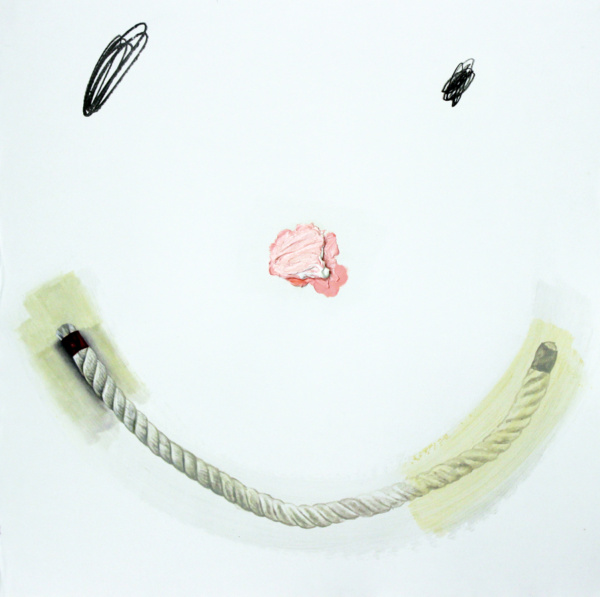
Several Servants are designed to be made quickly with technical simplicity. They form a pastiche portrait of the perfect servant, with hodgepodge features and the eternal smiles of servitude. The smiles are indicated with a short length of rope—long enough to form a smile but not long enough to form a noose.
Image Caption: Servant 3, 2012, graphite, acrylic, oil, alkyd, spray paint on paper; 20 x 20 inches, Private Collection.
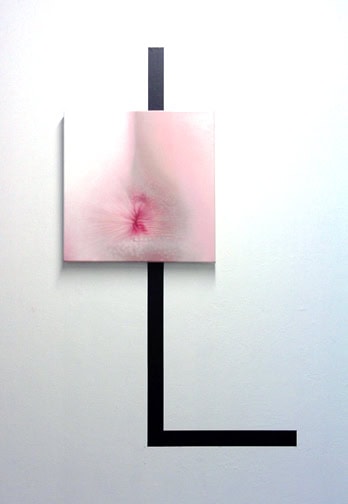
Mistresses, the characters in the Timon of Athens project, marked a desire for new figure painting. Both intimate and genderless, using oil on canvas to convey jpeg images submitted by anonymous adults, are displayed over a latex stripe painted directly on the wall. Mistresses became blank surfaces onto which viewer preferences are instinctively projected. The black stripes on the wall further complicate the paintings making them appear medical or procedural.
Image Caption: First Mistress, oil on canvas + latex paint on wall, 18 x 18 canvas + 2 inches wide latex paint line, 2008. Exhibited in the Samsøñ booth at Art Fair, Chicago, IL, 2008 and in the First Acts solo exhibition at Atlanta Contemporary, Atlanta, GA in 2022. Collection of Nick Cave.
Cupid is forthcoming. Stay tuned.

Three Strangers is forthcoming. Stay tuned.

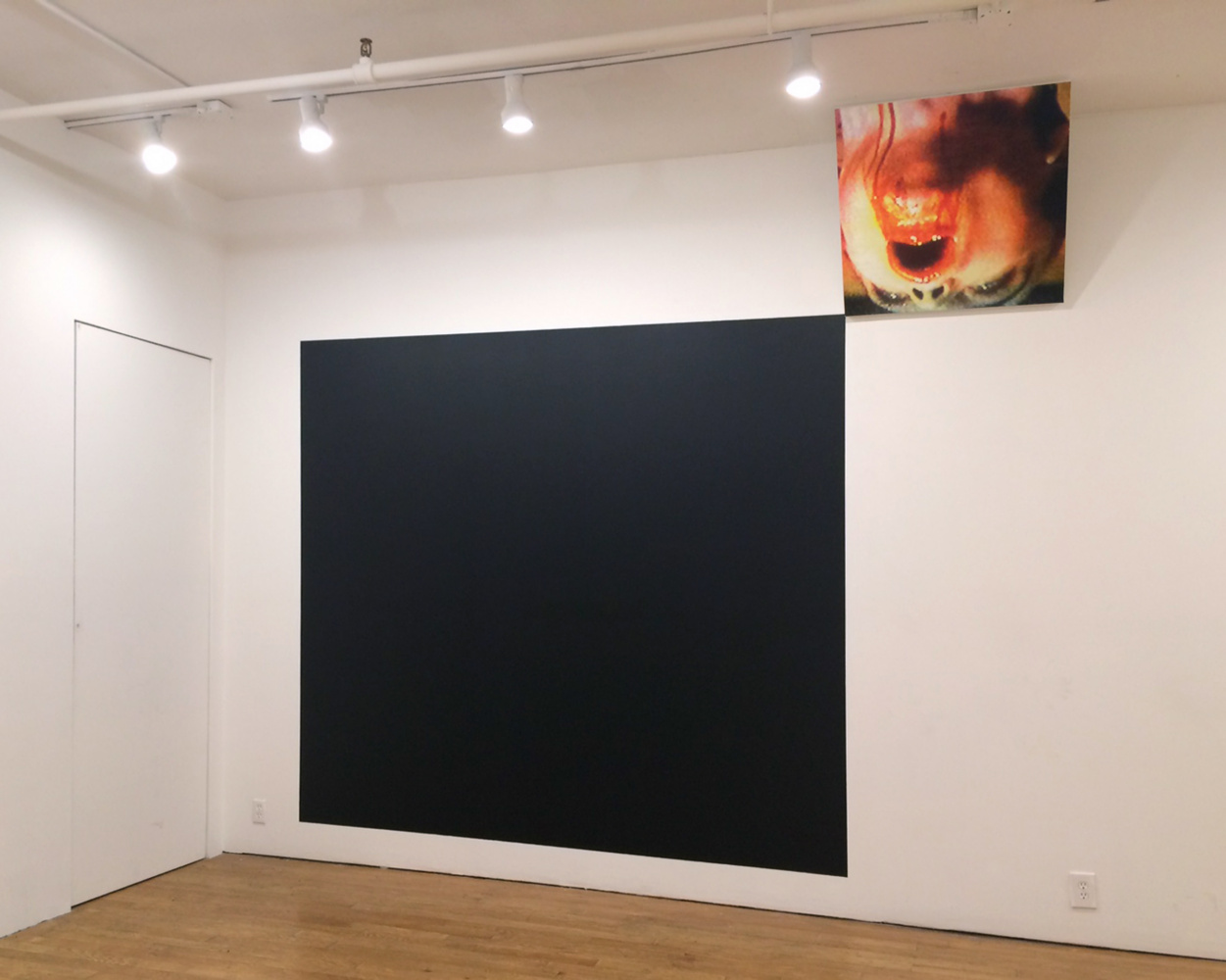
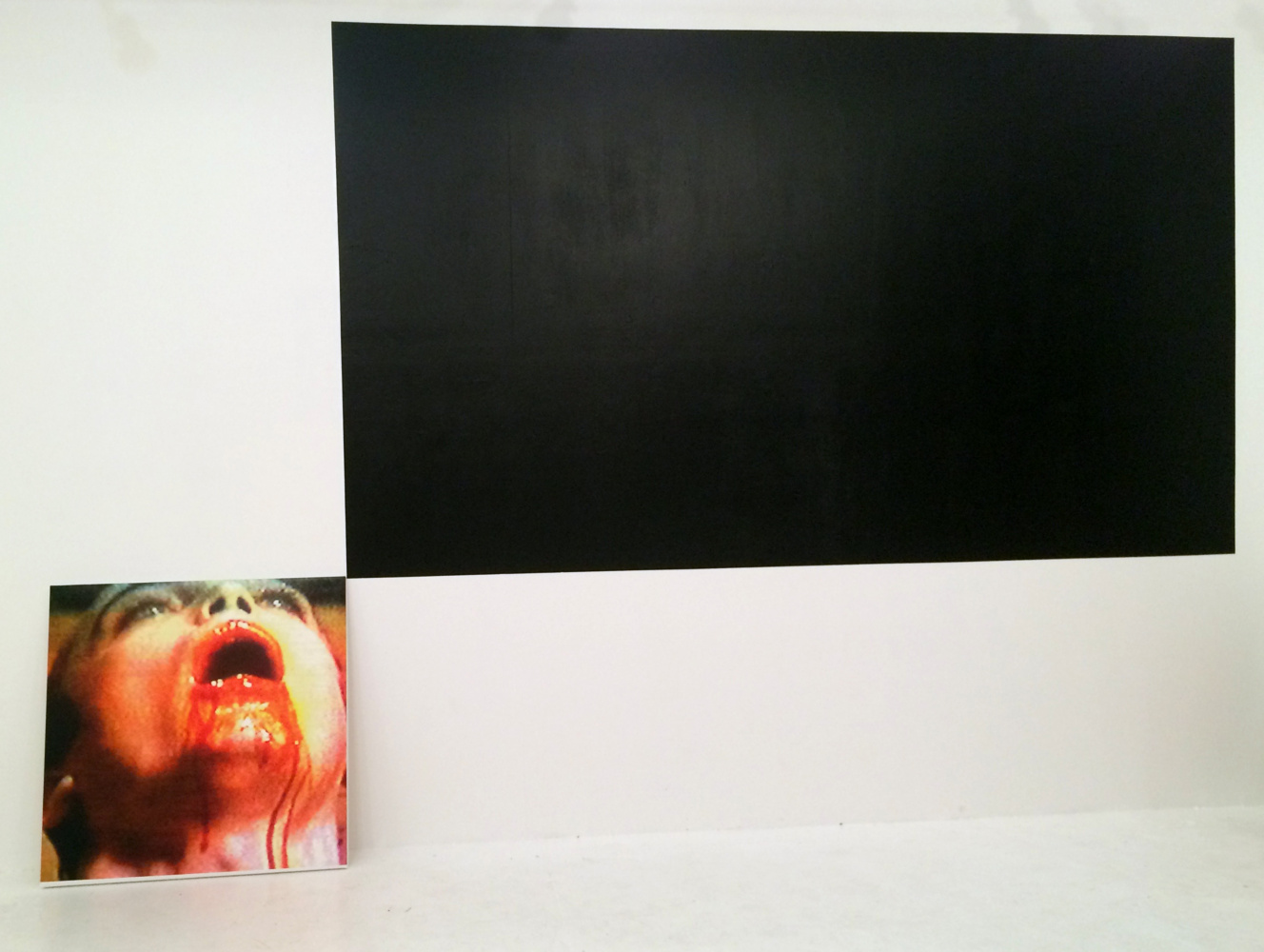
An Old Athenian includes an inkjet print on a canvas of Udo Kier from the 1974 film Blood for Dracula along with a monochrome square painted directly onto the wall that can expand to fill the remaining wall space. The base of the vampire canvas must touch the floor or ceiling, and the monochrome must begin at the top right corner of the canvas in each orientation. The black monochrome touches the vampire canvas in the manner of Michelangelo’s The Creation of Adam. On some level, the world “old” in An Old Athenian conjures two things that are old and very difficult to kill: vampires and monochrome painting.
Image Captions: Old Athenian, inkjet on canvas + latex paint on wall, dimensions variable, 2015. Exhibited in Old Athenians vs. New Mistress solo exhibition at Brooklyn Fire Proof gallery, Brooklyn, NY, 2015 & Old Athenian, inkjet on canvas + latex paint on wall, dimensions variable, 2016. Exhibited in group exhibition This Strange Game, curated by Brigitte Mulholland and Michael Woody, Chelsea Landmark Arts Building, New York, NY, 2016.
A Page is forthcoming. Stay tuned.
The works for Fool are forthcoming. Stay tuned.
Disclaimer: Craig Drennen is a member of Burnaway’s board. Editorial decisions are made independently of partnership, advertising, or board relationships.