When people write about Minnie Evans, they often start with the miracles. The voice that told her, “draw or die.” The visions that rattled her awake as a child. The colors that seemed to pour out of her hands in spirals, arches, and faces staring through leaves. For decades, Evans has been comfortably filed under “visionary,” the kind of artist who sounds like she floated above the world rather than lived firmly inside it.
But the High Museum of Art’s new exhibition suggests something different, something far more grounded. Seen together, Evans’s drawings argue that her art didn’t come from escape, but from a deep, complicated engagement with the land she lived on and the history running through it. The work feels visionary, yes, but rooted in: Wilmington, NC’s violent past, the labor of Southern gardens, in the experience of being watched, and in her own role as the woman stationed day after day at the gate of a white-owned paradise.
Evans wasn’t outside the world. She was looking straight at it.
Born in 1892 in coastal NC, she was just a month shy of her sixth birthday when Wilmington became the site of the only successful coup in US history—a day when white supremacists burned the offices of the city’s Black newspaper, murdered Black residents, and forced thousands to flee into the surrounding forests.[1]
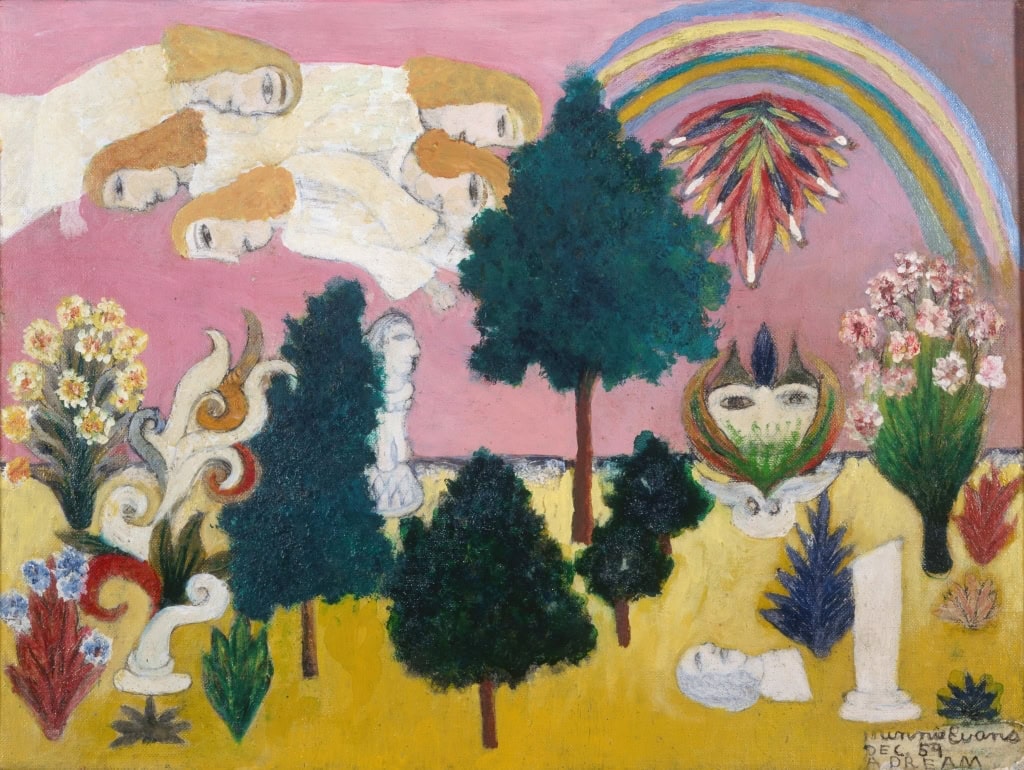
That image appears again and again in her drawings: wide, unblinking eyes tucked in flowers, buried under vines, hovering above bursts of color. In Untitled (Tower of Angels) (1962), eyes multiply across the surface, nestled in wings, embedded in curling forms, watching from places one wouldn’t expect, as if the landscape itself has learned how to look back. Scholars have tied this to Evans’s spirituality, but there’s another way to read it. When you grow up in the aftermath of racial terror, the landscape doesn’t just hold trees. It holds memory. It holds witnesses. Evans’s eyes aren’t ornaments. They’re reminders.
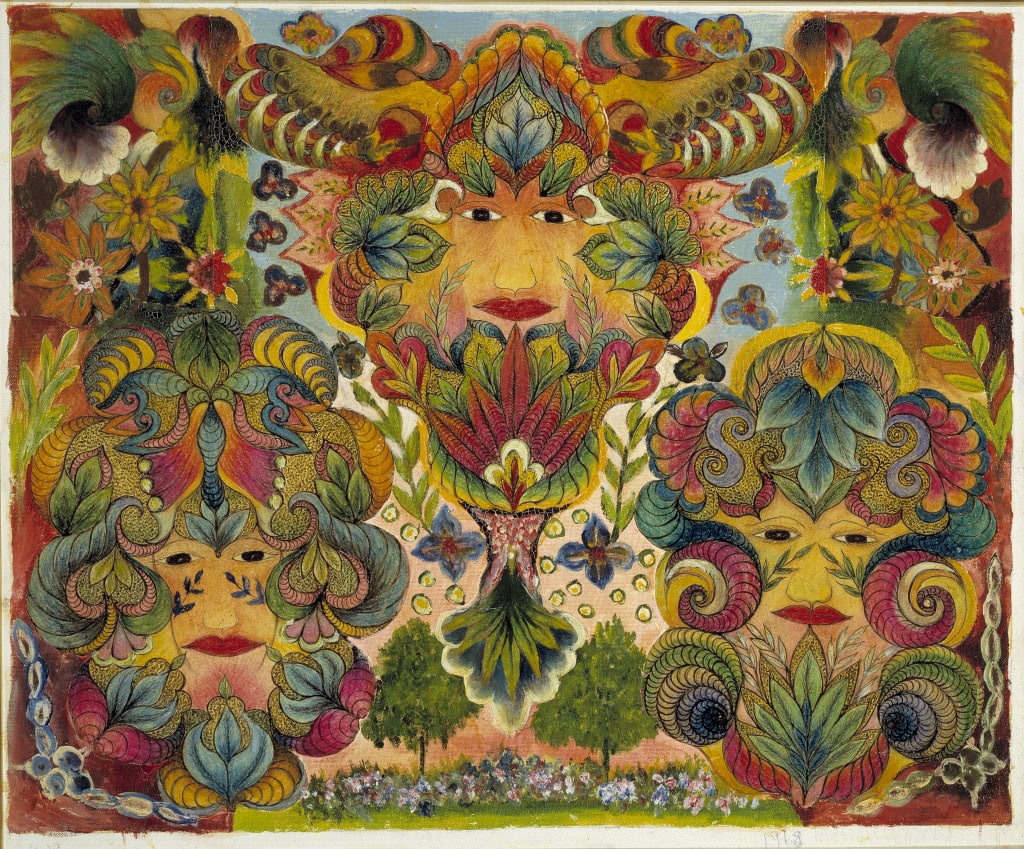
When I stand in front of her drawings, I feel abundance.
Before she became the humming presence at the entrance to Airlie Gardens, Evans worked as a domestic servant for the wealthy white families who owned that land. She dusted their rooms, walked their halls, carried the weight of their gaze. Eventually, she was moved outdoors, to the gate, where she collected money from visitors and, during quiet stretches, drew.
If the gardens were known for their breathtaking azaleas and camellias, Evans knew the other side of that beauty. She knew who kept the paths trimmed, who tended the greenhouses, who labored behind the scenes to maintain the illusion of effortless splendor. Many readings of her work describe her as inspired by Airlie’s plants. But inspiration is too gentle a word. She was living inside the system that maintained those gardens, racially, socially, and economically. The flowers were not neutral.
So, when she layered the page with petals and creatures and faces blooming from leaves, she wasn’t simply celebrating nature. She was building a world where the people who made the garden possible were finally at its center.
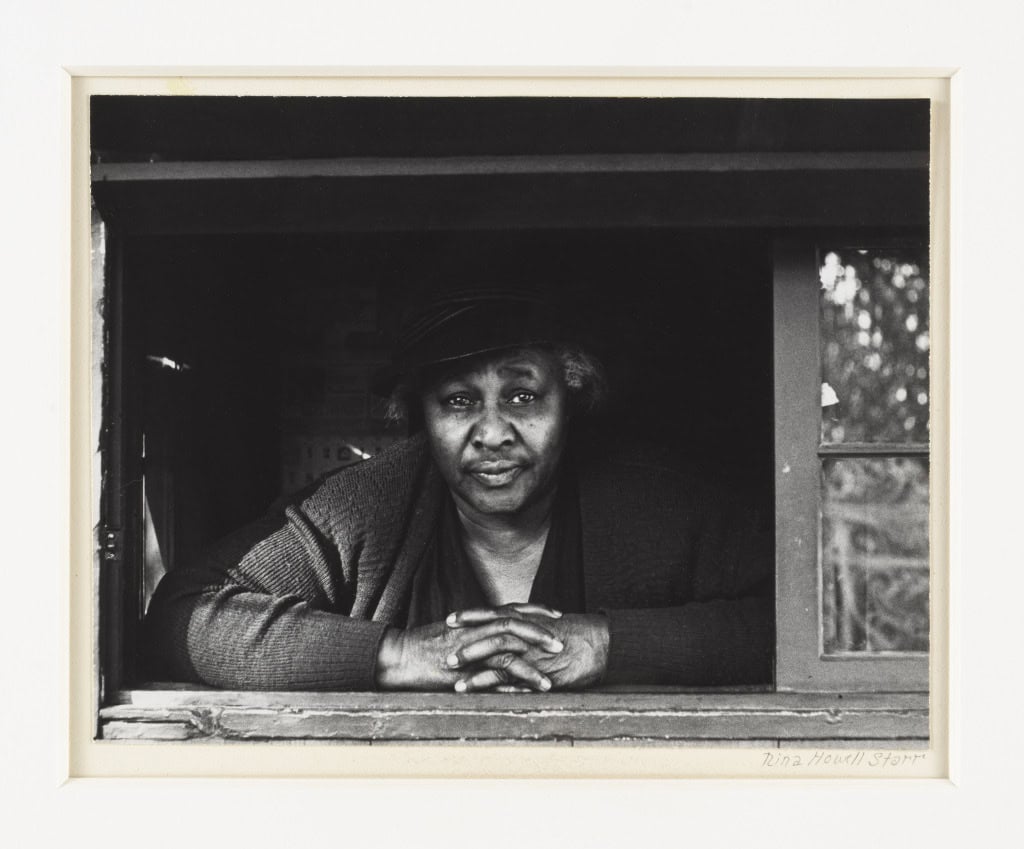
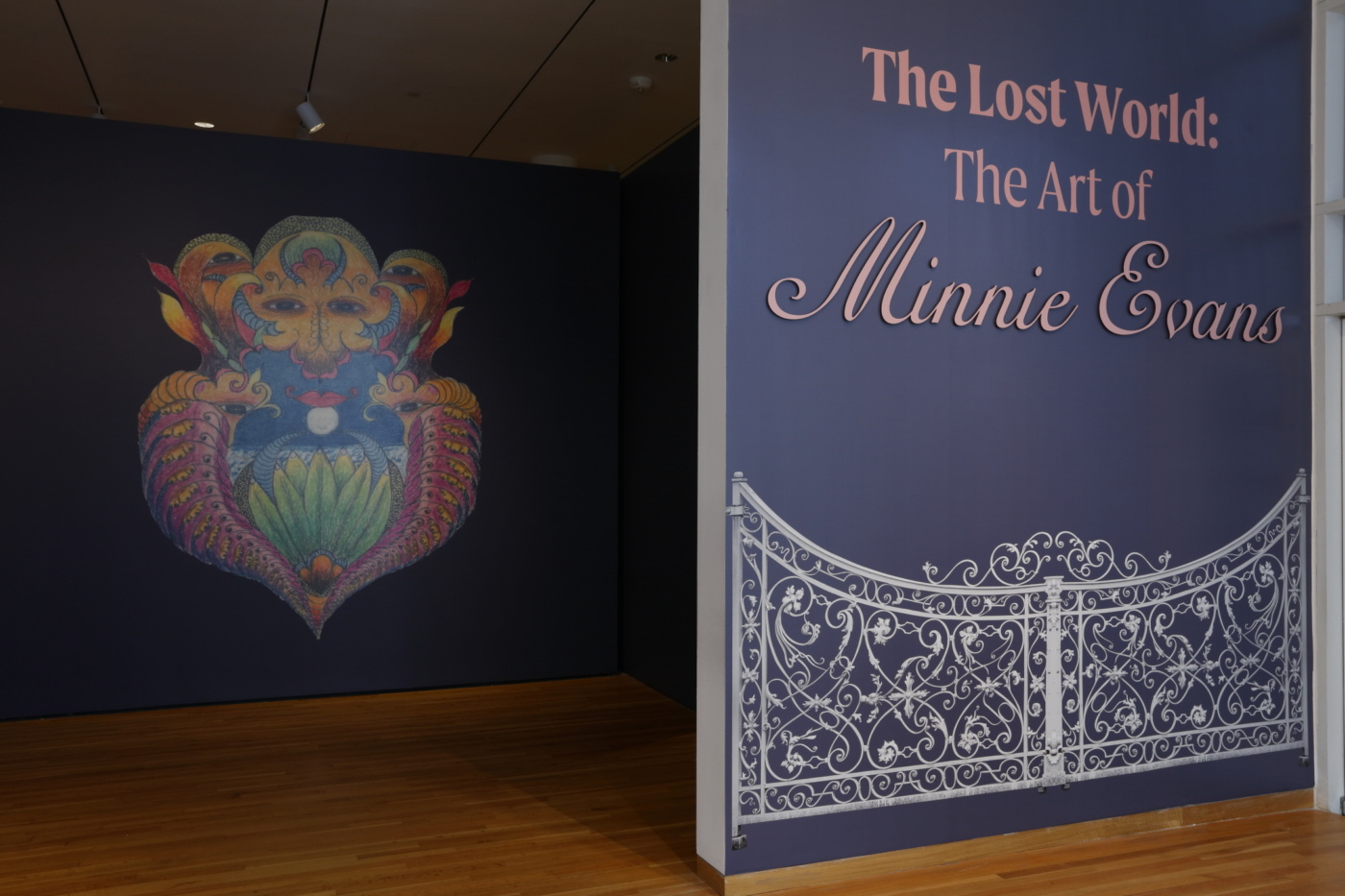
For more than twenty years, Evans sat at the gate of Airlie Gardens.[2] The literal gate: a wrought-iron structure with looping vines and mirrored scrolls. She passed tickets through the window, pulled a basket on a long pole to make change, watched who came in, who paused, who noticed her drawings taped to the gatehouse wall.
It’s easy to romanticize this, Minnie at the gate, Minnie in communion with the garden. But imagine the reality of that threshold. She wasn’t strolling through the estate; she was guarding the entrance to it. Every day, she occupied the line between public and private, between Black Wilmington and white Wilmington, between the world outside and the carefully curated dream inside.
And her drawings look like someone who spent her life thinking about thresholds. In Untitled (Pembroke Park Gate) (1940), a small wooden gate sits closed between two overgrown posts, the world beyond it visible but softened into haze. So many of her drawings begin with a kind of portal: a symmetrical frame, an enclosing arch, a pair of faces flanking a central figure. They feel like invitations but also warnings. Something is happening behind the gate, but one enters on her terms.
In this sense, Evans wasn’t just a gatekeeper on paper. She was a gate theorist, building visual languages around who can pass, what gets through, and how the world changes when you cross that line. When I stand in front of her drawings, I feel abundance. Everything multiplies. Leaves press against other leaves. Colors melt into new colors. Faces emerge from petals so gently they are almost missed.
But that lushness has nothing to do with escapism. The world inside her compositions feels tight, energetic, too full, as if the drawing itself is trying to hold more than it reasonably can. For someone whose life was shaped by racial violence, domestic labor, and spiritual visitation, the garden becomes a place to rebuild a universe large enough to contain what reality refused to hold. It’s telling that she often said the images came to her whole. She didn’t sketch ideas; she recorded realms. The garden was not a metaphor. It was a map to another way of being.
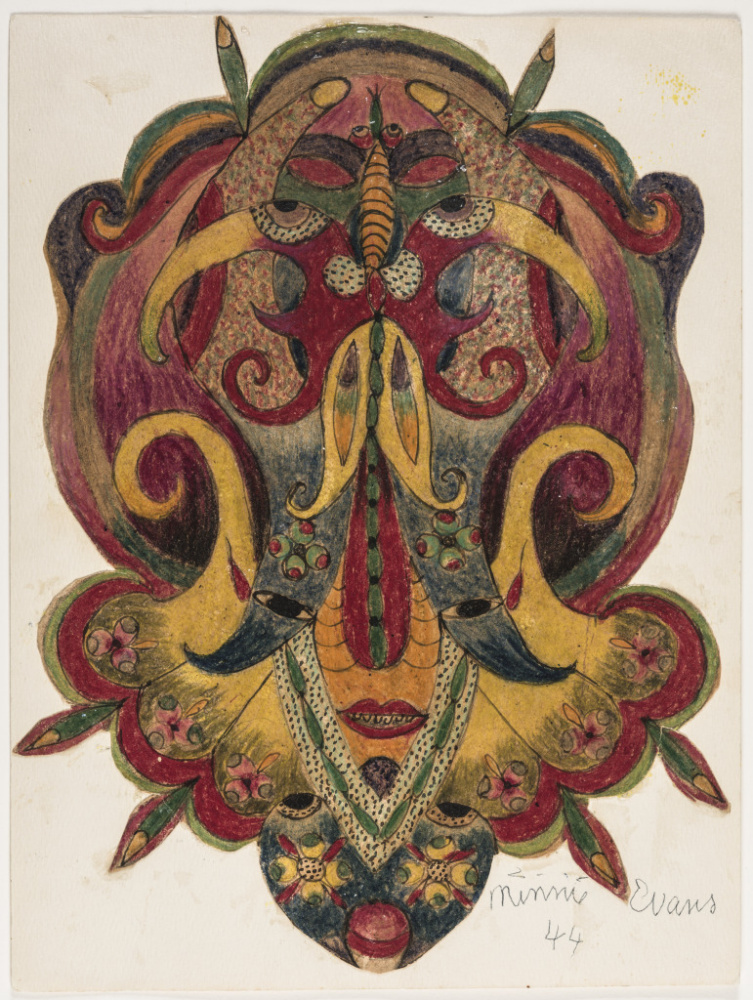
Evans lived in an environment where land meant survival. Enslaved ancestors grew gardens when nothing else belonged to them. Her grandmother kept a plot that fed the family, body, and spirit.[3] The forest around Wilmington sheltered her community during the massacre. Airlie Gardens, lush as it was, represented a different kind of inheritance, land shaped by wealth, tended by Black hands but claimed by white ones.
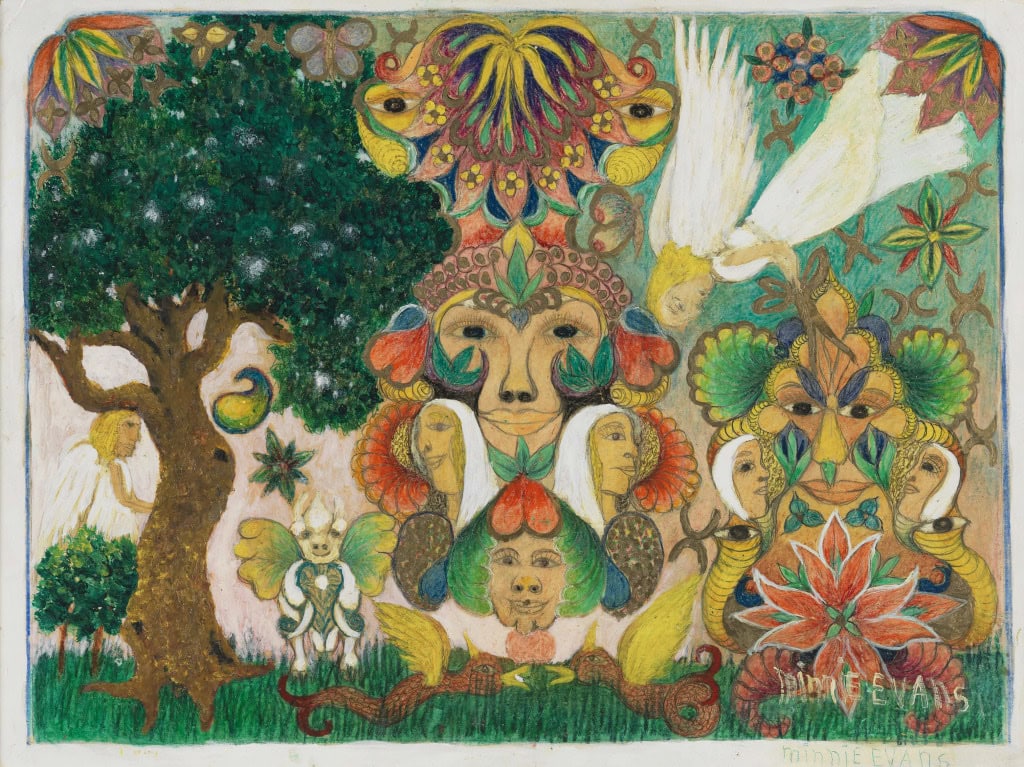
Her work sits at the crossing of these histories. Her compositions are part myth, part environmental memory. They point back to the woods where Black families hid in 1898 and forward to a world in which those families are not hiding anymore. When she draws a face emerging from leaves, such as Untitled (Airlie Oak, Angels, Faces, Serpents) (1966) where faces seem to grow from the trunk and foliage of a sprawling oak, she addressing who belongs to the land, and who the land remembers.
In a moment when the American South is reexamining and repressing its landscapes, its plantations, gardens, waterfronts, its buried histories, Evans’s drawings feel uncannily contemporary. They show how beauty and violence can grow from the same soil, and how art can become a form of tending: weeding, pruning, replanting.
Evans has long been labeled an “outsider,” but she wasn’t outside anything. She was inside everything: the aftermath of 1898, the systems of domestic labor, the Southern landscape’s fraught beauty, her own family’s history of survival and displacement. To call her visionary is not wrong, but it misses the point. Evans wasn’t escaping the world around her. She was remaking it, piece by piece, petal by petal, gate by gate.
[1] Daniel R. Biddle, “The Wilmington Massacre of 1898,” Equal Justice Initiative, Special Feature, November 10, 2025, https://eji.org/news/wilmington-massacre-of-1898/.
[2] Lisa Slominski, Nonconformers: A New History of Self-Taught Artists (New York: DelMonico Books/Prestel, 2022), 338.
[3] Michelle D. Williams, Minnie Evans: Art of the Gatekeeper (M.A. thesis, University of Memphis, 2010), 35, https://digitalcommons.memphis.edu/etd/100.