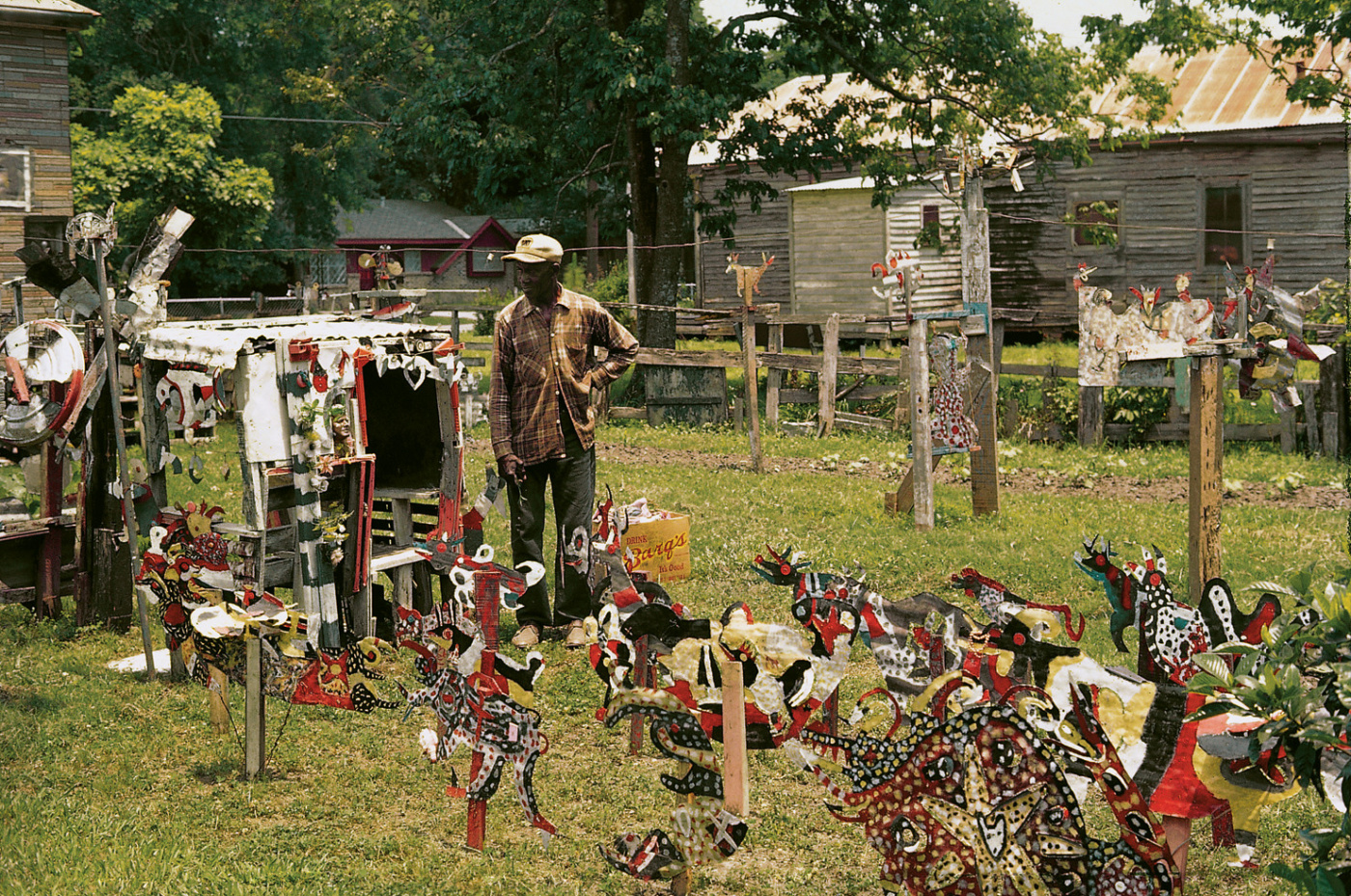
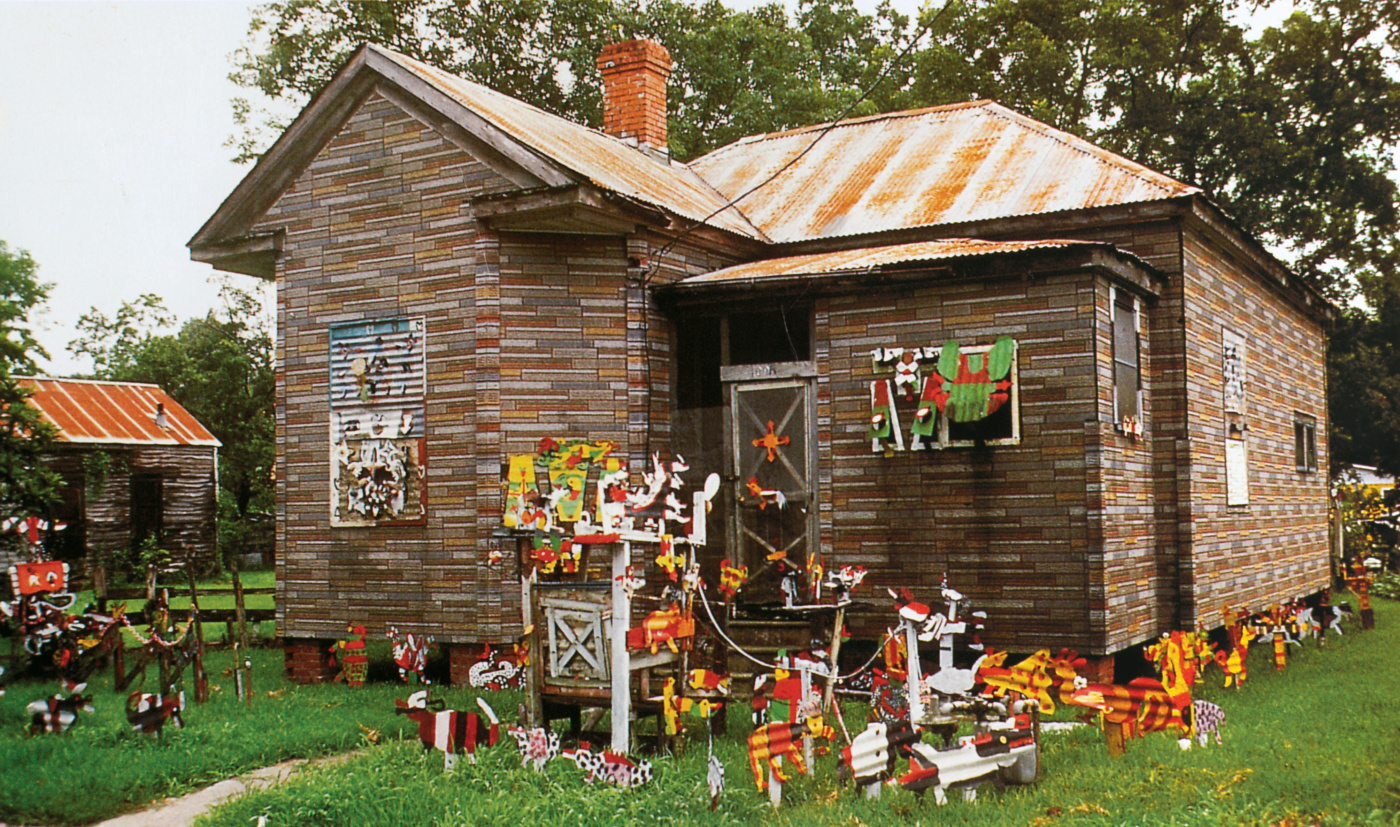
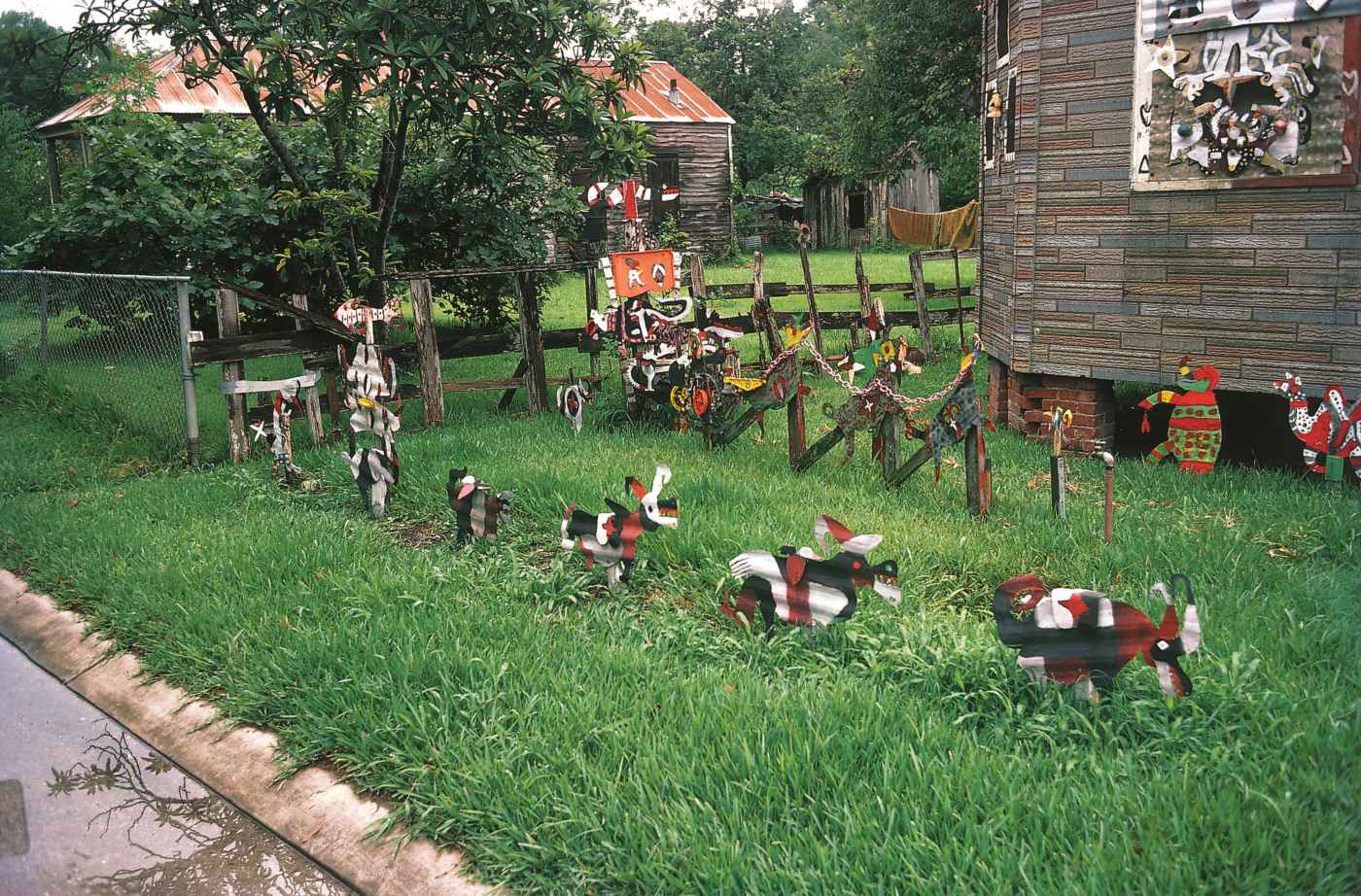
A yard in Patterson, Louisiana, once blushed with whirligigs, colorful toys, and painted metal figurines. Crowds of animals gathered in the greenery, and tin dolls kept watch, glowing red beneath the Southern sun. In the grass, mermaids, snakes, and seabirds mingled. Crosses and pinwheels waited, metal growing hot. When wind shifted the day’s breath, their blades churned, delivering life to the congregation. Together, these creatures formed an animated barrier around David Butler’s home. His house sat at the center of the tangle, windows boarded with roofing tin. The space was chaos, but closer inspection revealed recurring patterns. Among the peculiar implements, one image appeared again and again: the star. Butler scattered these shapes about his dream world, positioning them on boots and tails, tracing crucifixes, and hanging above lovers. Long before he became a celebrated artist, stars created his sanctuary. The celebrity he later achieved would dismantle it.
Born in Good Hope, Louisiana, in 1898, Butler was the eldest of his family’s eight children. His father had worked as a carpenter, and his mother pursued life as a missionary until her untimely death. At a young age, he dropped out of school to care for his siblings, and later found work. Butler spent his free time observing his town and recording the workful goings-on of the world around him.[1] He drew what he saw: trains, shrimp boats, cane, and cotton fields. His adulthood was equally marked by labor, and he spent most of his life doing physically demanding jobs. He cut grass, built roads, worked a dragline, and loaded lumber for shipment on railroad cars.
When Butler first began modifying his home, in the 1960s, he was seeking spiritual refuge after a period of loss. In 1962, while toiling in a sawmill, he had suffered a severe head injury at sixty-four years old. The impact had left him disabled and unable to continue the labor that made up so much of his life. Following the accident, his beloved wife passed. These rapidly succeeding losses altered Butler’s relationship to the world around him, deeply affecting his sense of safety. In the years that followed, he devoted himself to creating the environment he felt would best protect him.[2] A star-filled landscape began to emerge.
The symbol of a star has long functioned as a protective device within Christianity. Among the notable stars is the Star of Bethlehem, whose light guided the Magi to Jesus’s birth. Historically, five and six-pointed stars were carved into churches and other buildings to ward off or entrap demons. It was thought that malevolent entities would enter and become ensnared within the shapes.[3]
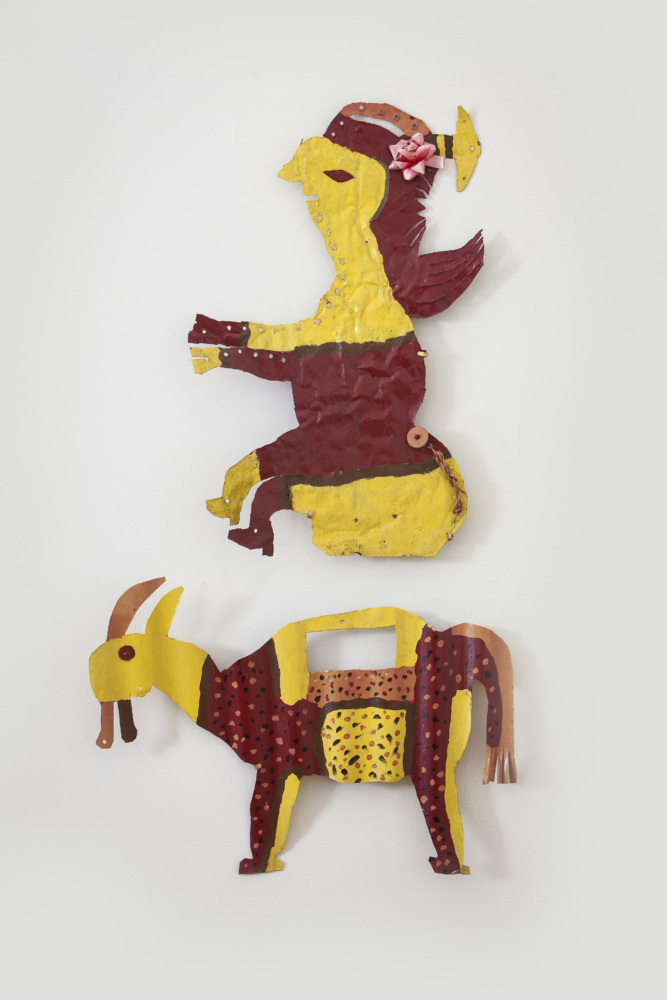
Butler called the most explicitly protective devices he created spirit shields. He began creating them immediately after becoming “sick and nervous,” with the intent of warding off evil spirits that could prey on his vulnerability.[4] He mounted the spirit shields, metal barricades that were painted and perforated with designs, over the windows of his home. Like the sculptures he had arrayed in his yard, the shields were made from recycled roofing tin and worked with common tools. He used chalk to trace the outlines, tin snips to cut out the shapes, and nails to puncture the metal. As light passed through the shields’ apertures, they cast shifting images across the inside of his home, animating the space.[5] Scholars have connected Butler’s penchant for movement and light to the common belief that flickering light was contact between the earthly and heavenly realms.[6] Butler was a devoutly religious man, and his shields often depict biblical imagery, especially nativity scenes.[7] In one such scene, a couple tends to a rocking baby; three stars sit in the sky, and another large star is positioned between the figures. In others, animals form pairings of their own, unions punctuated by stars. The shape’s consistent appearance on Butler’s spirit shields reflects their active contribution to his sense of safety and protection.
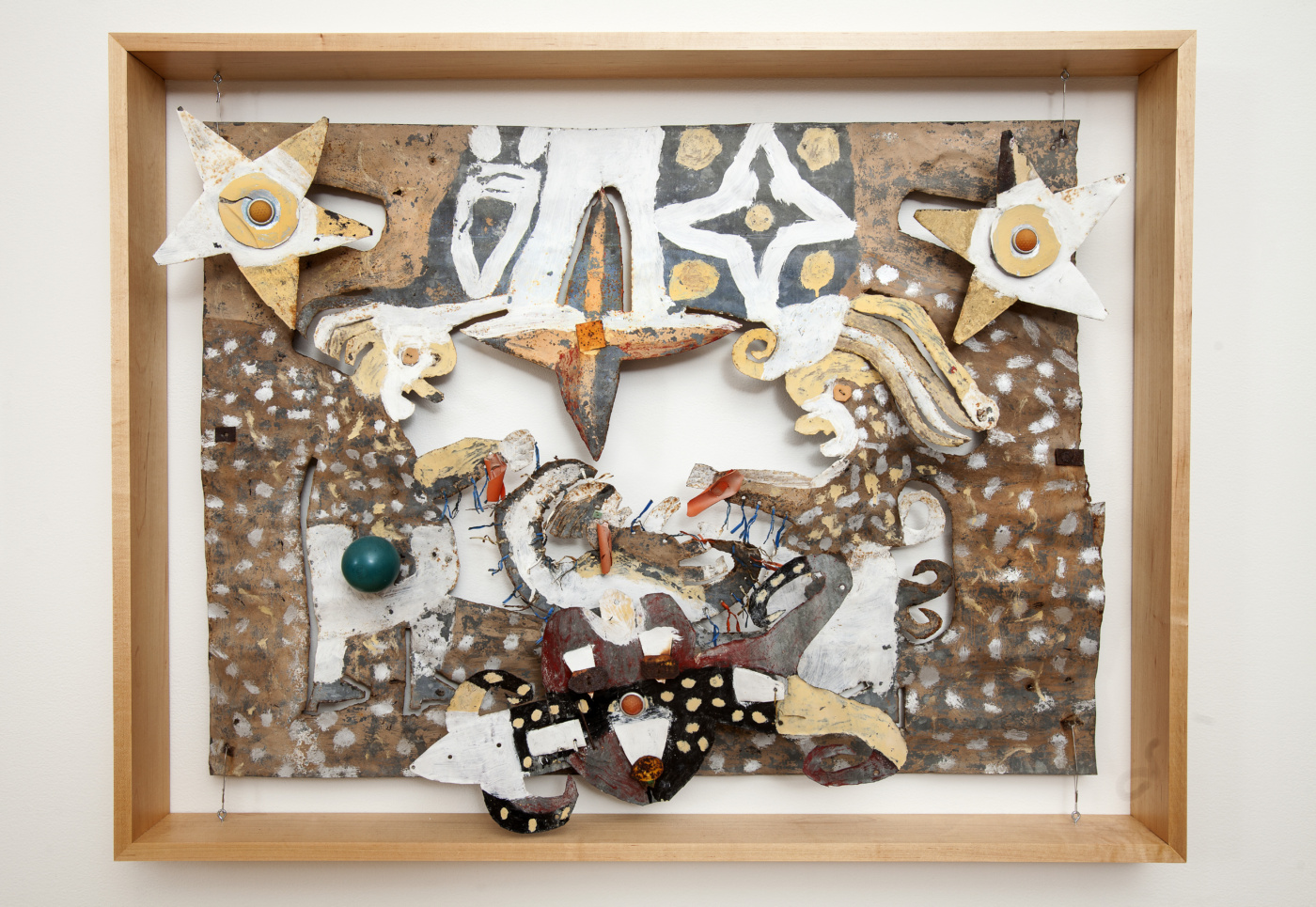
David Butler, untitled, c. 1968; paint, steel, and mixed media, 29 1/4 x 41 1/2 x 4 3/4 in. John Michael Kohler Arts Center Collection, gift of Kohler Foundation Inc. Photograph courtesy John Michael Kohler Arts Center.
Butler was not alone in endeavoring to transform his home into a defensive space. His efforts are connected to a broader legacy within Black Southern culture known as the yard show. After Emancipation, newly acquired property offered formerly enslaved people a place to express cultural practices that had previously been sidelined to spaces like grave sites. Many began to adorn domestic lawns with repurposed materials and handmade objects that functioned as apotropaic devices, or objects to repel evil. While the form of these implements could be particular to each household, one commonly recreated device was the bottle tree. In this convention, bottles are placed upside down on the branches of a tree. Curious spirits were meant to find their way into the enclosure and would be unable to escape.[8] Butler’s understanding of his domestic space as a place that could be altered to offer him protection was likely grounded in the apotropaic devices of the South’s yard show tradition.
Butler knew that the remedy to his pain was not to shrink away but to radiate outward, expanding into the world with force.
Seen within this context, Butler’s star acquires spiritual utility and becomes one of the primary visual indicators of his intent to protect himself. His belief in stars’ spiritual agency is evident in particular in one of his spirit shields, in which the star appears as the tip of a magic wand. Positioned as an active agent rather than a passive embellishment, this star suggests a supernatural force capable of action in the world.
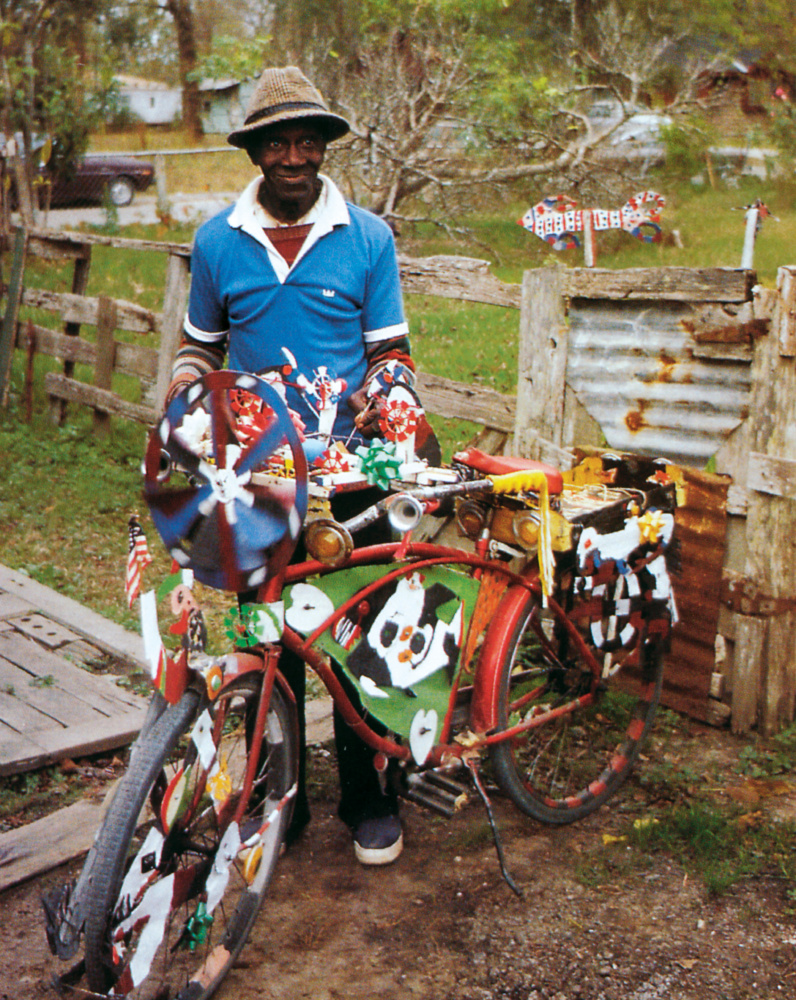
On the first of each month, Butler collected his pension check. On these days, he celebrated by pushing his embellished bike around Patterson and delivering candy to the neighbors. It was during a ride like this in the late 1960s that he met William Fagaly, the curator of the New Orleans Museum of Art.[9] Following a friend’s suggestion, Fagaly had ventured two hours west to find “Mr. David” and see his remarkable yard. Soon after this encounter, Butler received a solo show at NOMA and shot to another kind of stardom. The attention he garnered, however, was unwelcome, and Butler had no interest in acclaim. The collectors who swarmed Patterson treated the artist’s sacred space as a place to source objects, filling truckload after truckload of sculptures from his lawn. Family members and collectors bought and sold pieces from his yard without his permission. Work was stolen. Eventually the art world attention denuded the protective environment Butler had created; his stars were stripped away. After his death, in 1997, the site was completely dismantled.[10]
A house still stands in Patterson, baking in the sun. All of its curious implements have vanished. Louisiana wind now pours through the grass with little resistance. Brightness floods into the windows with nothing to mold it. The spinning machines are gone, the spirit shields are gone, and the stars are all gone. Some remnants reside in museums, private collections, and auction houses, scattered far from the land they once helped protect.
It is this notable absence that evinces the strength of Butler’s now-gone creation. The space he crafted was a manifestation of personal power, of the determination to act during circumstances of grief, loss, and injury. Butler knew that the remedy to his pain was not to shrink away but to radiate outward, expanding into the world with force. Repeated across his yard, the star was a mark of that instinct, guarding his sanctuary but also drawing the attention that dismantled it. Long before the art world made Butler a star, he knew how to harness its power.
[1] Corcoran Gallery of Art, “Black Folk Art in America, 1930–1980: Corcoran Gallery of Art,” Internet Archive, January 15, 1982, accessed June 1, 2026, https://archive.org/details/cor5_0_s06_ss01_boxrg5_0_2008_017_16/page/n67/mode/2up; Maude Southwell Wahlman, “David Butler,” Souls Grown Deep, accessed June 1, 2026, https://www.soulsgrowndeep.org/artist/david-butler.
[2] John Michael Kohler Arts Center, “David Butler,” September 14, 2021, accessed June 1, 2026, https://research.jmkac.org/artist/david-butler/.
[3] Charles Fairey, “Protective Devices, Apotropaic Symbols and Witch Marks,” Charles Fairey – Historian -, n.d., https://sites.google.com/site/charlesfaireyhistorian/publications/protective-devices-apotropaic-symbols-and-witch-marks.
[4] William Fagaly, David Butler (New Orleans Museum of Art, 1976), NOMA Archives, New Orleans, Louisiana.
[5] Southwell Wahlman,“David Butler.”
[6] Randall Morris and Valérie Rousseau, “OHP Morris | MULTITUDES,” Folk Art Museum, November 4, 2024, accessed June 1, 2026, https://www.folkartmuseum-multitudes.org/oral-history-project-morris.
[7] Southwell Wahlman, “David Butler.”
[8] Morris and Rousseau, “OHP Morris | MULTITUDES.”
[9] Southwell Wahlman,“ David Butler.”
[10] Michael Adno, “At Home With William Fagaly, the Curator Who Helped Bring African Art to New Orleans,” Artsy, March 15, 2019, accessed June 1, 2026, https://www.artsy.net/article/artsy-editorial-the-nightcrawler-king-man-helped-bring-african-art-new-orleans.