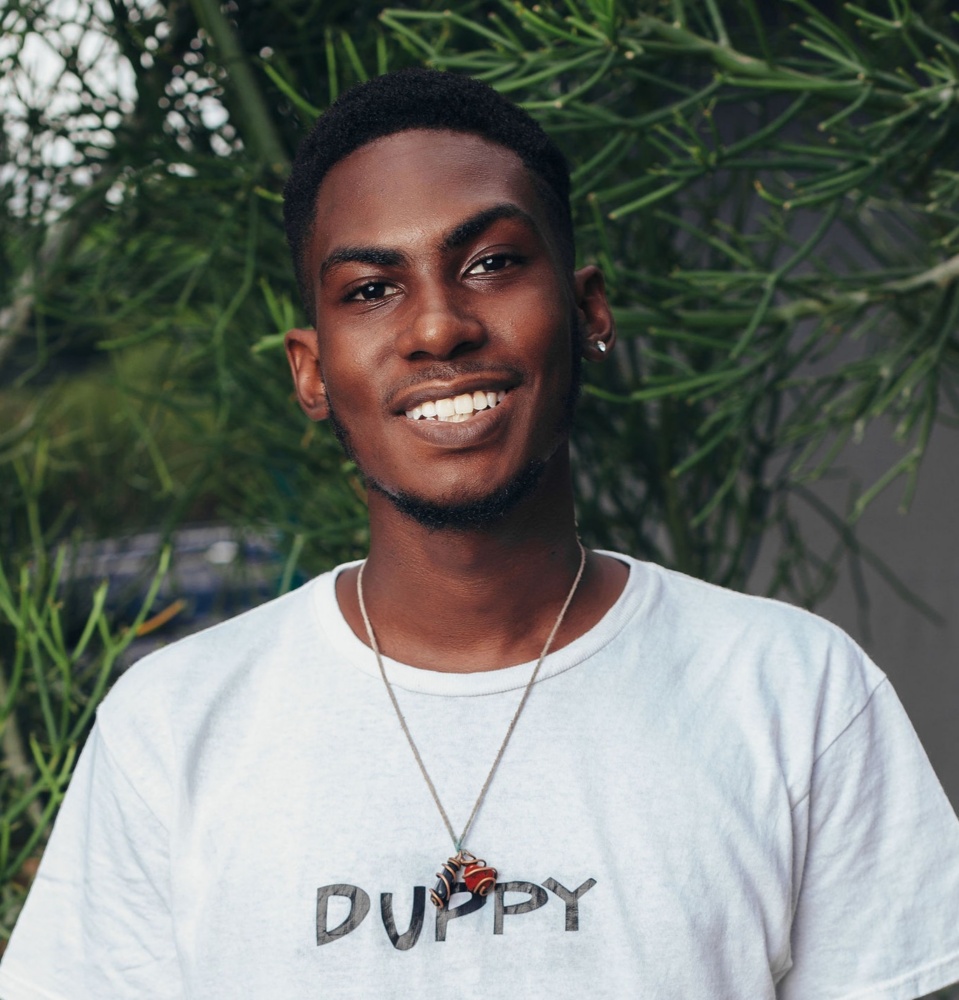
“Just like how living carbon-based lifeforms are birthed, then grow and change, evolving, so too do stories,” says artist Sonn Ngai.[1] Ngai’s work sits at the intersection of imagined futures and reconstructed pasts. Ngai creates collage, handmade paper, paintings, and mixed media works in order to explore questions of materiality and sustainability as a means to preserve ancestral technologies. He investigates Caribbean Blackness through surreal, dreamlike narratives that intersect memory, mythology, and lived experience.
Assemblage serves as a visual language for navigating fragmentation and inherited memory. The resulting form depends on what he collects. In his handmade paper works, he reshapes locally sourced plants into new surfaces. In his digital collages, he pulls archival and open-source images from their educational contexts and recombines them. Across both processes, Ngai does not erase the past, but alters it, letting older images and spiritual presences have new life.
This practice of gathering speaks to Ngai’s connection to land. The artist treats nature as a character itself: as an ancestor, participant, keeper of histories that exceed written or spoken language. Among the plants foraged from places of personal significance are cattails from the edge of Yallah’s Pond in St. Thomas, Jamaica, and nearby scrubland; corn husks sourced from local farmers; and banana fibres from his backyard. He transforms this flora into handmade paper through processes of boiling, retting, pulping, and pressing. Each plant requires different preparation, leading to differences in texture, color, and density. As Ngai explains, materials trace the environments and conditions from which they were sourced.
Ngai describes his papermaking as an alchemical transformation, one that allows him to remain in dialogue with his surroundings. Through gathering and reshaping what is often considered waste, he seeks reciprocity with the natural world, turning overlooked materials into vessels of memory and meaning: “I think reproducing the knowledge of our ancestors means working within the environments and methodologies they once used.” In this intention, his work expands past preservation; the artist maintains an active relationship with the land.
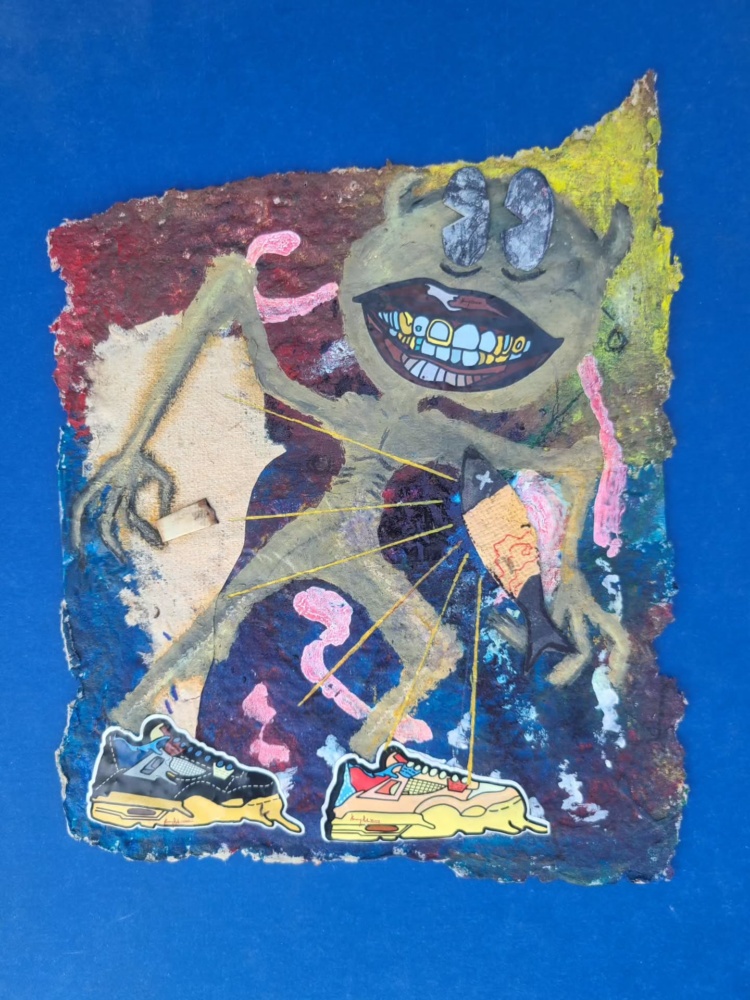
This alchemy surfaces in Black Heart Man (2025), a work made with oil, ink, collage, spliff, and handmade paper. Its frayed edges, uneven density, and fibrous texture make the support feel bodily, as though the image has grown out of the paper rather than having been placed on top of it. Across the plane, a green, cartoonlike figure stretches through saturated fields of red, blue, yellow, and black. Its exaggerated teeth and swollen eyes create a mood that is both humorous and unsettling, while a dark, heart-shaped form at the chest sends thin yellow lines outward toward the surrounding shards. Collaged cutouts, painted marks, and found elements persist together, but are never blended.
Ngai’s digital works operate differently but follow the same logic of collection, metamorphosis, and recombination. Rather than with plant fibers and salvaged objects, he works with imagery from archives and public collections, cutting them from their original contexts and intuitively reassembling them into new compositions.
"My work created a space that ended up being a way to make connections."
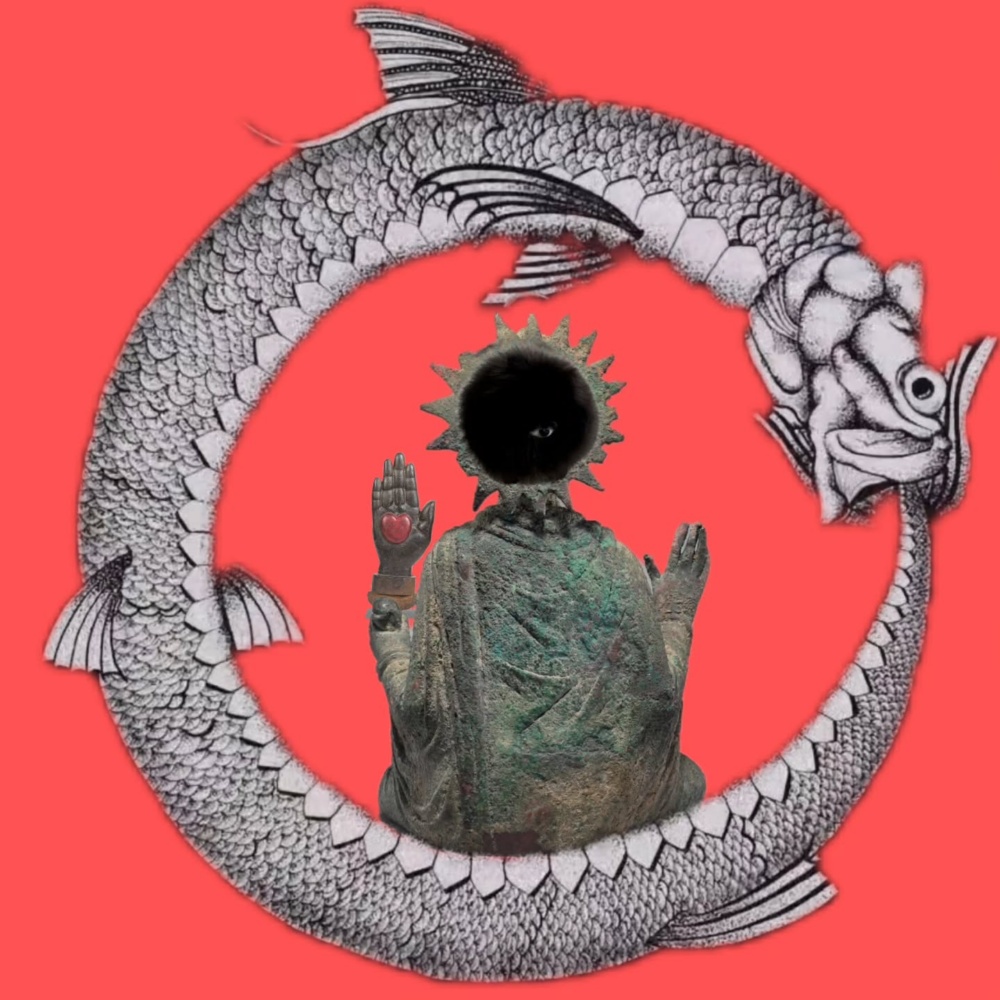
Where Black Heart Man makes remnants tactile through handmade paper, found objects, and uneven surfaces, Ob Takes the Form of a Hierophant to Save the Princess from Her Arrogance (2026) translates that same method into a digital and archival register. Ngai layers different eras and histories into a single composition. An ouroboros offers no entry point and no end, its scaled body closing the composition into an endless loop. Inside it, the same disunity plays out at the level of form: a weathered, statue-like body meets a head of dark, unruly texture, while a separately rendered hand, painted with a red heart at its center, extends outward. No one body, era, or material logic governs the image; the parts hold together without dissolving into a seamless whole.
This movement away from fixed origins is also central to Ngai’s spiritual practice, in which inherited symbols, forgotten gods, and personal experience coexist without being forced into a single belief system. Even when drawing on private spirituality, Ngai’s work emphasizes the way stories are shared, inherited, and reworked across generations and between people. His assemblages do not seek to restore an original narrative, but to create relationships between what endures. “We are only able to tell our stories for as long as we are alive,” Ngai reflects. “After we have parted, even if our stories continue, we will not be the ones writing them. They will also become narratives with their own will, and like us, they will coexist alongside those who can help develop them and develop others in return.”
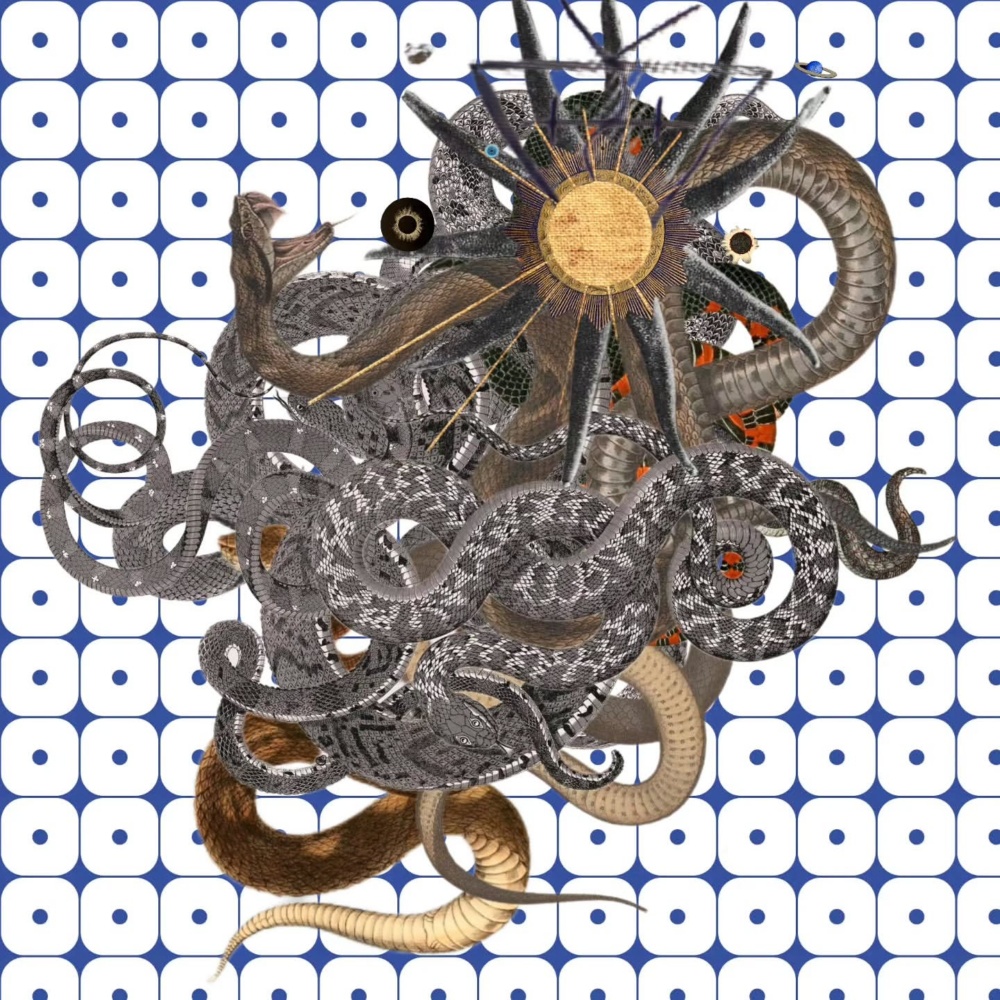
The God of Third Choices (Detained) (2026) renders this cosmology directly, through serpentine forms that intertwine around a radiant celestial body. Set against a stark white ground, the composition appears suspended in space, untethered to any stable horizon. Snakes of varying scales, colors, and patterns coil over and through one another, none dominant, none subordinate. Together, they create a dense, knotted mass that expands outward and folds back into itself. At its center, a gold disc radiates sharp, starlike projections, whose geometric precision contrasts with the fluid movement of the surrounding bodies. This interplay produces a visual tension between order and continual restructuring. Nestled among the coils, a ringed planet, a small moon, and a solitary eye pull the composition outward into watchful registers.
The snake imagery invokes transformation, a recurring concern throughout Ngai’s practice, while also echoing the Hoodoo concept of Simbi, an ancestral water spirit. The work refuses binary structures: the fragments never fuse; they coil without resolve. The third space is relational as much as spiritual—a way of forming connection where social structures have produced alienation. “As someone who has always felt very alienated from my social surroundings, my work created a space that ended up being a way to make connections,” explains the artist.
Across paper, archive, and forgotten belief, Ngai’s method holds: He never asks the pieces to merge. The plant fibers keep their textures, the eras stay unblended, and the serpents coil without a need for an end. Assemblage is how that which remains finds new form and relations, in the open hands of whoever gathers them next.
[1] All quotations from Sonn Ngai are from an interview with the author, March 10, 2026.