
L.V. Hull’s work does not ease into a room quietly. It arrives all at once. Loud color. Hand-painted declarations. Television sets transformed into sculptural warnings, prophecies, jokes, sermons, and arguments. Found objects covered edge to edge in phrases and thick acrylic brushstrokes.
At the Mississippi Museum of Art, Love Is a Sensation carries that same immediacy. Born in McAdams, Mississippi, in 1942, Hull spent much of her life transforming not only objects but the landscape around her. The exhibition is inseparable from the home she left behind in nearby Kosciusko, now being restored, once a sprawling environment of painted signs, dangling beads, altered appliances, sculptures, toys, and messages layered across porches, fences, and trees. The boundaries between artwork, decoration, architecture, spirituality, warning, humor, and daily life eventually collapsed entirely. Visitors often described the property as immersive or overwhelming, but what becomes striking is how direct the works are. The things she wanted to say, she said plainly.
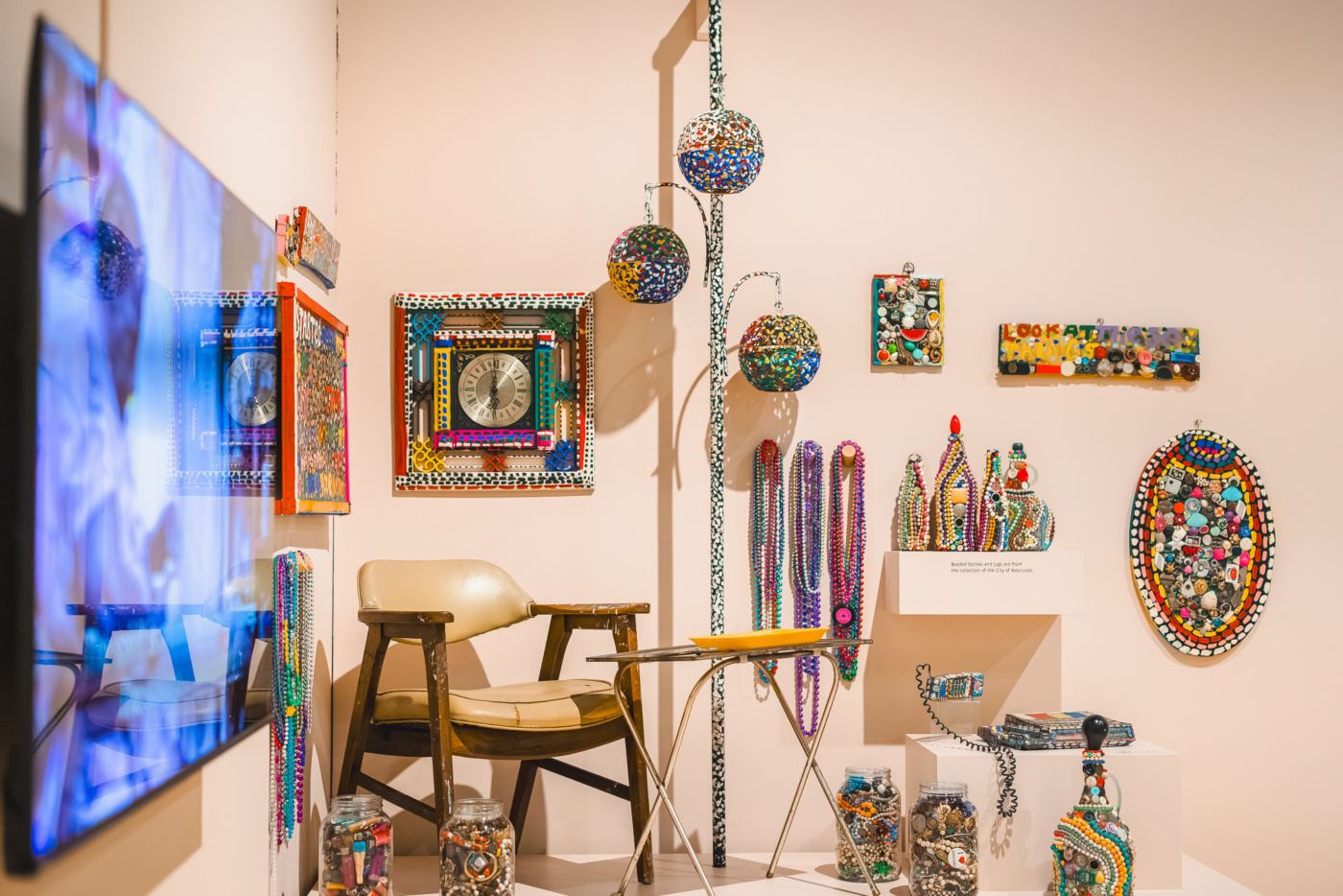
The exhibition wisely avoids isolating Hull’s objects into overly precious singular masterpieces. Instead, the galleries retain some sense of accumulation and visual overload. An old chair sits behind a TV tray beside jars filled with watches, costume jewelry, lighters, and buttons. Walls are crowded with signs, assemblages, toys, and discarded domestic objects. The installation understands that Hull’s work gained power through density. Her objects were never meant to exist alone.
The show opens with one of Hull’s most memorable signs: “THIS IS A SHOW OFF PLACE NOT A RIP OFF PLACE.” The message is funny, protective, welcoming, and confrontational all at once. Hull invites viewers in, but she also establishes terms. “ASK NO FAVORS…GET NO FAVORS,” the sign continues. “IF YOU WANT TO BUY—GO TO WAL-MART.” Even before entering the galleries, the exhibition makes clear that Hull understood the complicated dynamics of spectatorship surrounding her home and work. She welcomed many visitors, but she refused to let herself become a spectacle.

One of the exhibition’s strongest works is Jesus Is Coming to Kosciusko, Mississippi, 39090, Mind Your Business (2000), a painted television transformed into its own kind of sculptural broadcast system. Across the screen, Hull hand-lettered the phrase: “HONESTY IS THE FIRST CHAPTER OF THE BOOK OF WISDOM.” The sentence sits within a dense field of multicolored dots that resemble confetti, static, stars, or serve as visual noise. Hull repurposes a machine built to deliver information into something stranger and more personal, a device for revelation rather than entertainment.
Walking around the piece reveals even more text:
“IT TAKE BOTH RAIN AND SUNSHINE TO MAKE A RAINBOW.”
“WHAT A FRIEND WE HAVE IN JESUS.”
“JESUS IS ALL OUR FRIENDS CUT IT OUT THANK YOU PEOPLES.”
Hull does not disguise the television’s original identity. The dials remain visible. The speaker grill stays intact. The buttons now live beneath thick layers of paint. The television becomes both relic and critique. A machine once meant to transmit authority now delivers handmade truths instead.
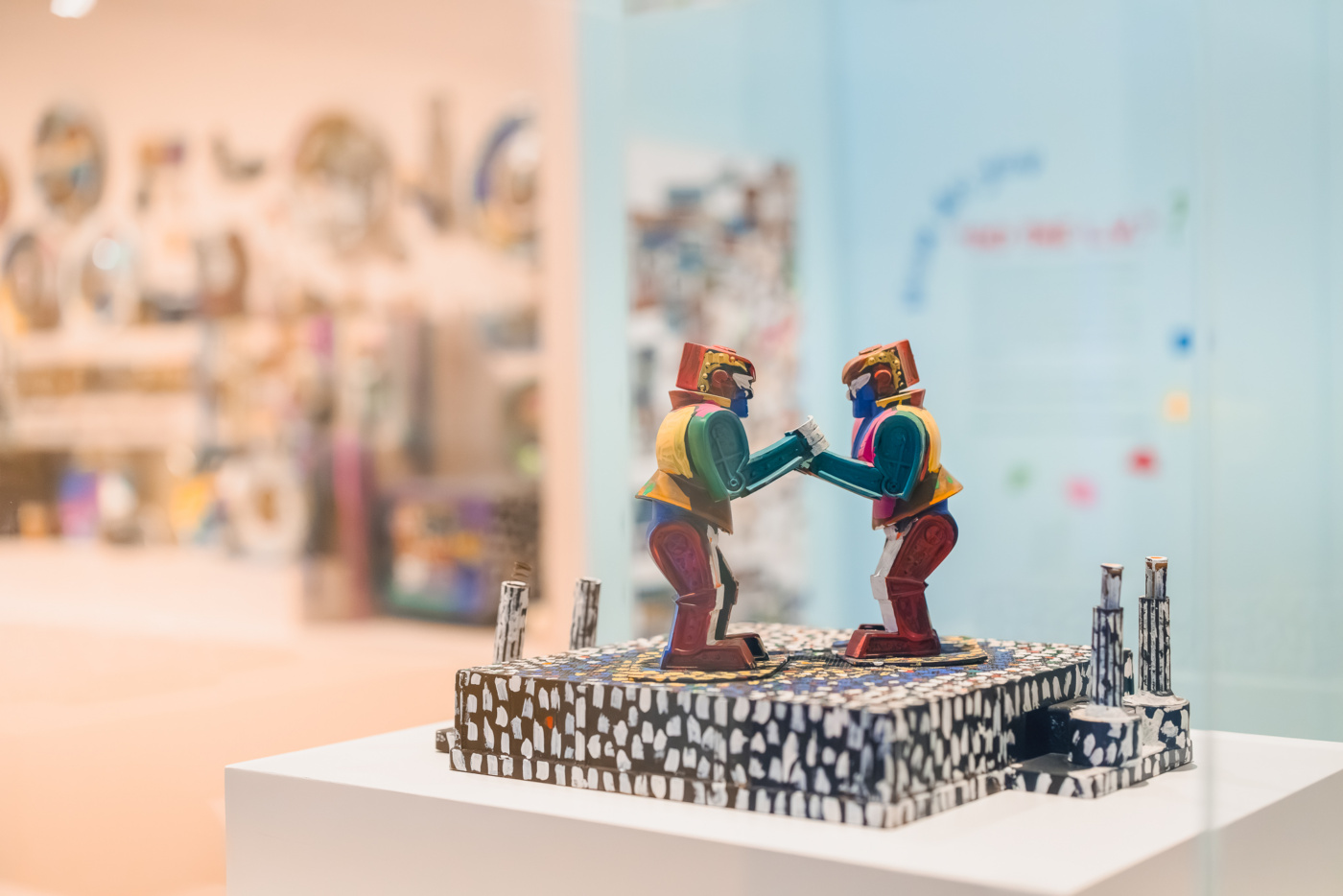
Elsewhere in the exhibition, Hull transforms a battered Rock ’Em Sock ’Em Robots toy (Untitled, no date) into a strangely moving sculpture. At first, the piece appears playful: two brightly painted plastic boxers, frozen mid-fight, atop a hand-painted platform. But after spending time with it, the imbalance becomes impossible to ignore. One fighter still functions. The other’s controls are broken, its left punch button missing entirely, its right punch reduced to an exposed spring. The game is physically rigged. Hull leaves the damage visible. What initially reads as comic nostalgia slowly turns into something darker and sharper, a portrait of unequal struggle hidden inside a children’s toy.
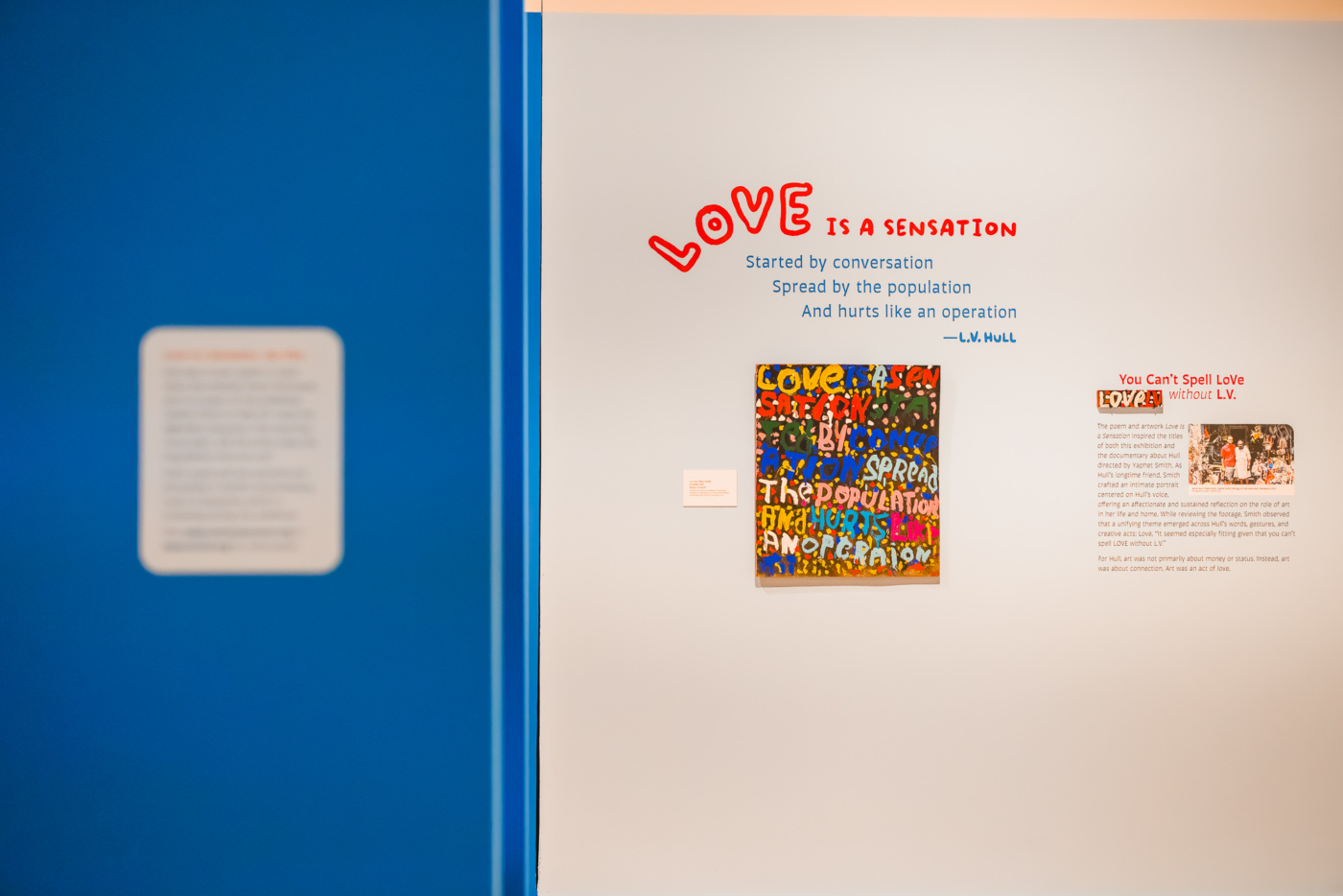
One of the exhibition’s emotional anchors is Untitled (2007), a painting whose text gives Love Is a Sensation its exhibition title. Across the dark surface, Hull painted: “LOVE IS A SENSATION / STARTED BY CONVERSATION / SPREAD BY THE POPULATION / AND HURTS LIKE AN OPERATION.”
"Making art was not separate from living. It was living."
The words expand unevenly across the surface in bursts of color and shifting scale. Love, for Hull, is not private or sentimental. It spreads socially. It moves through conversation. It alters the body.
After spending time with the exhibition, I drove to Kosciusko to visit Hull’s house.
For years, the property existed as one of the great artistic environments in the American South, covered almost entirely with her work. Sculptures hung from the porch. Painted signs covered the exterior. Beads dangled from ceilings and windows. The property appeared less like a home than an ecosystem of making.
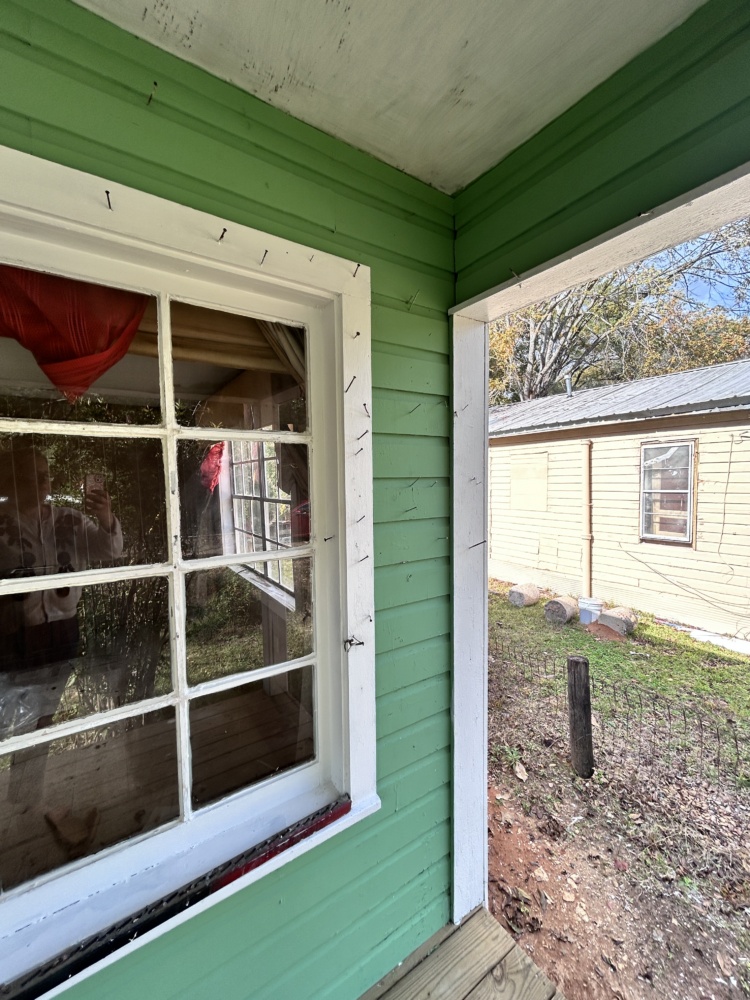
Now, much of it is gone, as the house is currently in the process of repair and preservation as part of the new L.V. Hull Legacy Center coming later this summer. Fresh white siding wraps portions of the exterior. The porch sits mostly empty. The rooms inside have been cleared. Hundreds of nails still cover the porch columns and walls in seemingly random patterns, jutting outward at every angle. Once noticed, they become impossible to ignore. These nails previously held sculptures, strings of beads, signs, objects, and paintings. They are the physical residue of density, ghost outlines of composition.
Elsewhere, faint streaks of spray paint remain visible on the steps. A “Private Property” sign near the fence still carries traces of Hull’s paint. Through a screen door, a small square of color can still be seen hanging deeper inside the house. Near the entrance, her name remains barely visible beside the doorway.
Standing there, the overwhelming feeling is absence. What became apparent was years of labor: hammering nails into porch beams, painting objects continuously, and rearranging things endlessly. The house was not simply decorated. It was built through accumulation. Subsequently, the traces feel so powerful. They preserve process more than finished product. The nails are evidence of decisions. The paint drips record movement. The faint marks on the walls show where objects once leaned or hung.
Hull’s work has often been described as joyful, and certainly it is. The colors remain exuberant. The language still sings. But what lingered with me most after visiting Kosciusko was persistence. The sense that Hull transformed every available surface because making art was not separate from living. It was living. Even now, after the objects have been removed and the rooms emptied, the work continues speaking in fragments: a streak of paint, a faint name beside a doorway, hundreds of nails waiting for something to return.