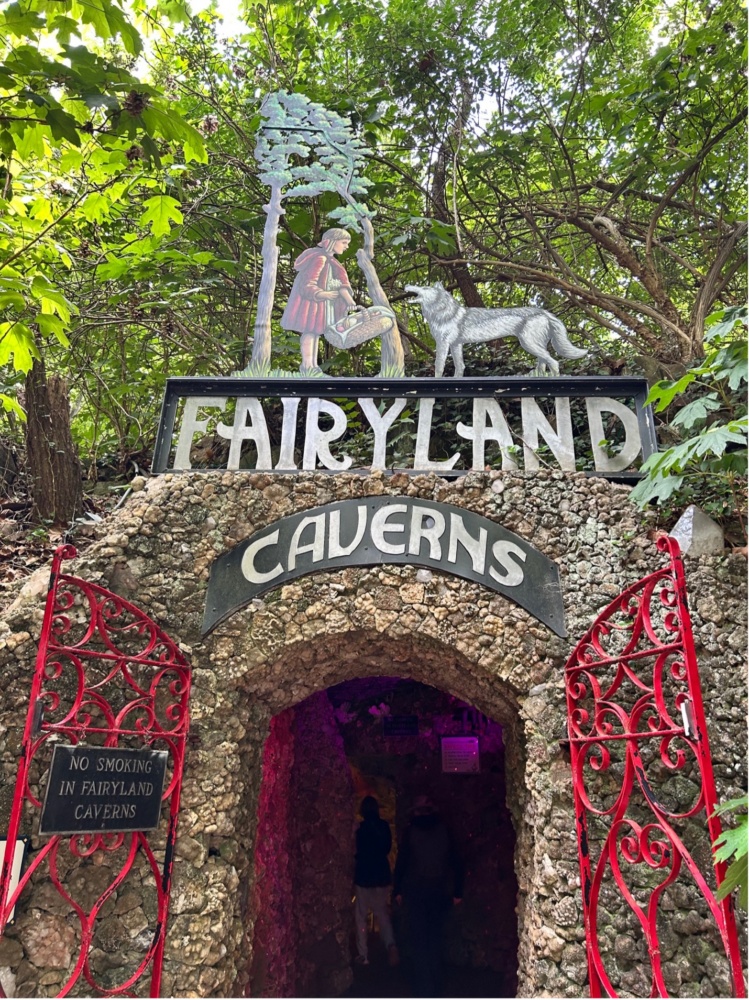
“Snow White currently has a brain injury,” Pepper Raper, the Public Relations and Media Manager for Rock City, said cheerfully as she peered into the cavern’s mouth.[1]
Snow White looked okay to me, more or less, but I trusted Pepper on this one. The “brain injury,” with which Rock City’s Innovations Team were tasked with repairing, was not an easy job. According to Pepper, moving the figure would put it at great risk of falling apart entirely.
Snow White did seem a little jaundiced, her yellowed skin glowing brightly with the blacklights. Wearing a flowing blue and pink gown, she lounged on a rock surrounded by purple flowers, her flower crown being adjusted by the prince, who knelt faceless beside her. A stream flowed nearby with butterflies and dragonflies filling the air. Early fall in the scene, trees dropped an array of sunset-colored leaves. In the background, dwarves carried on their daily tasks, a rising sun just visible. “Snow White,” written in blue curvy letters, hung from the branch of a tree.
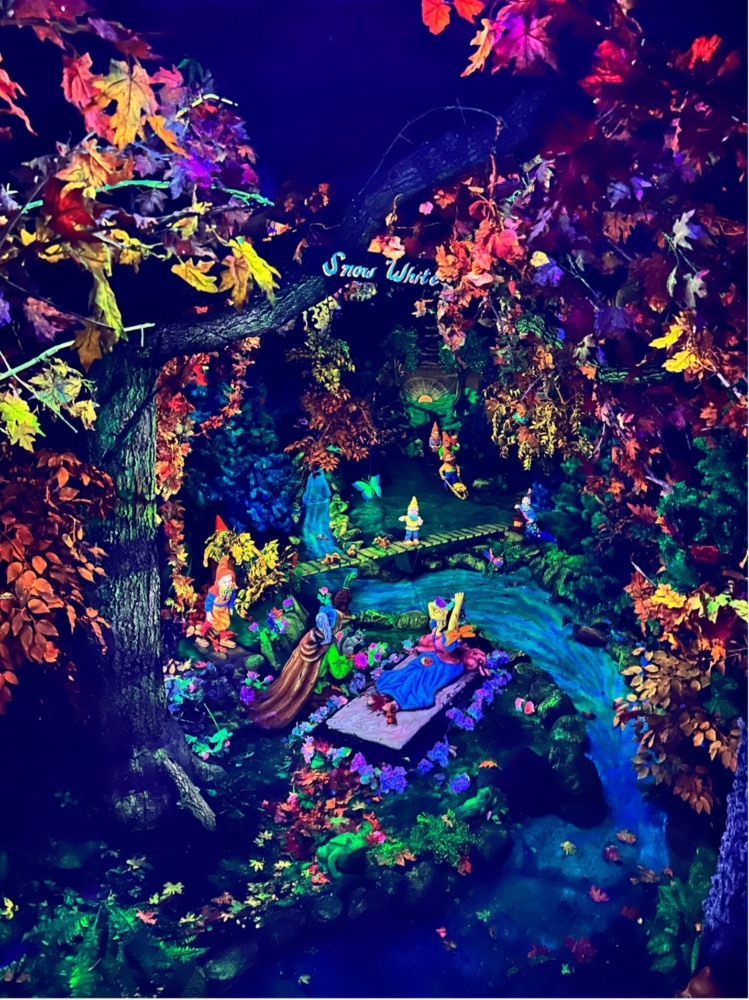
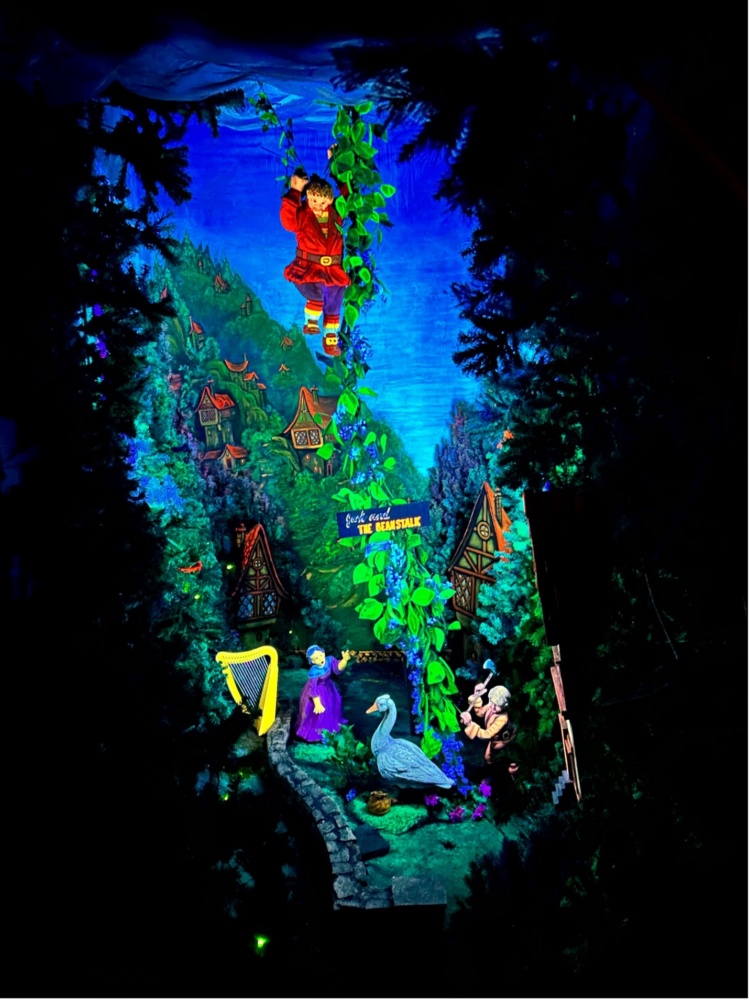
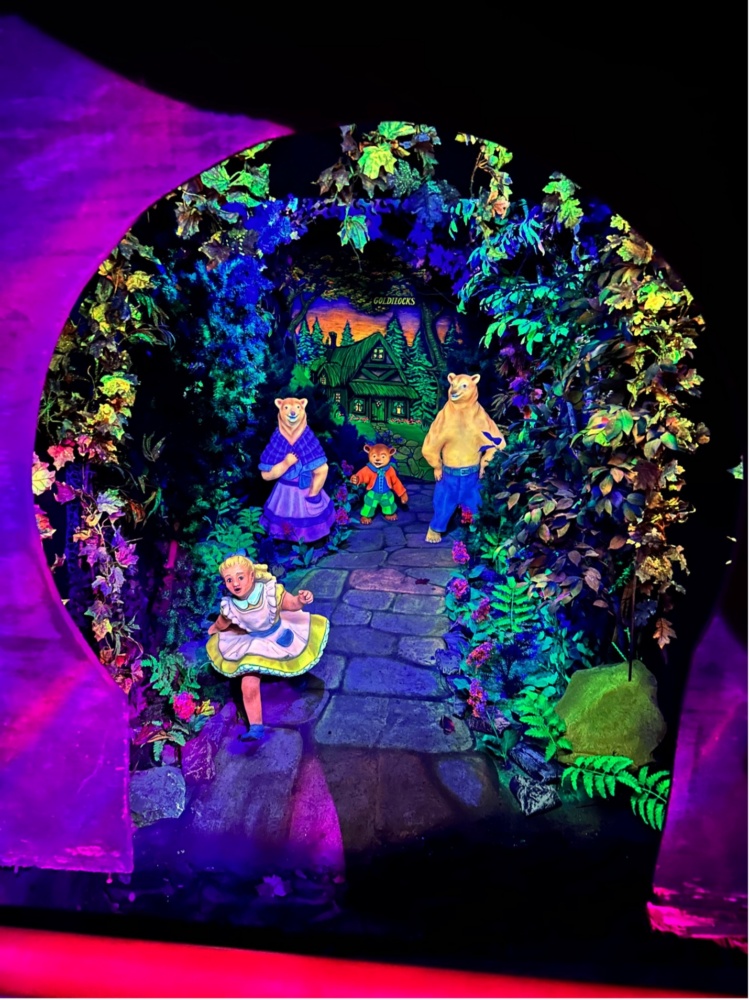
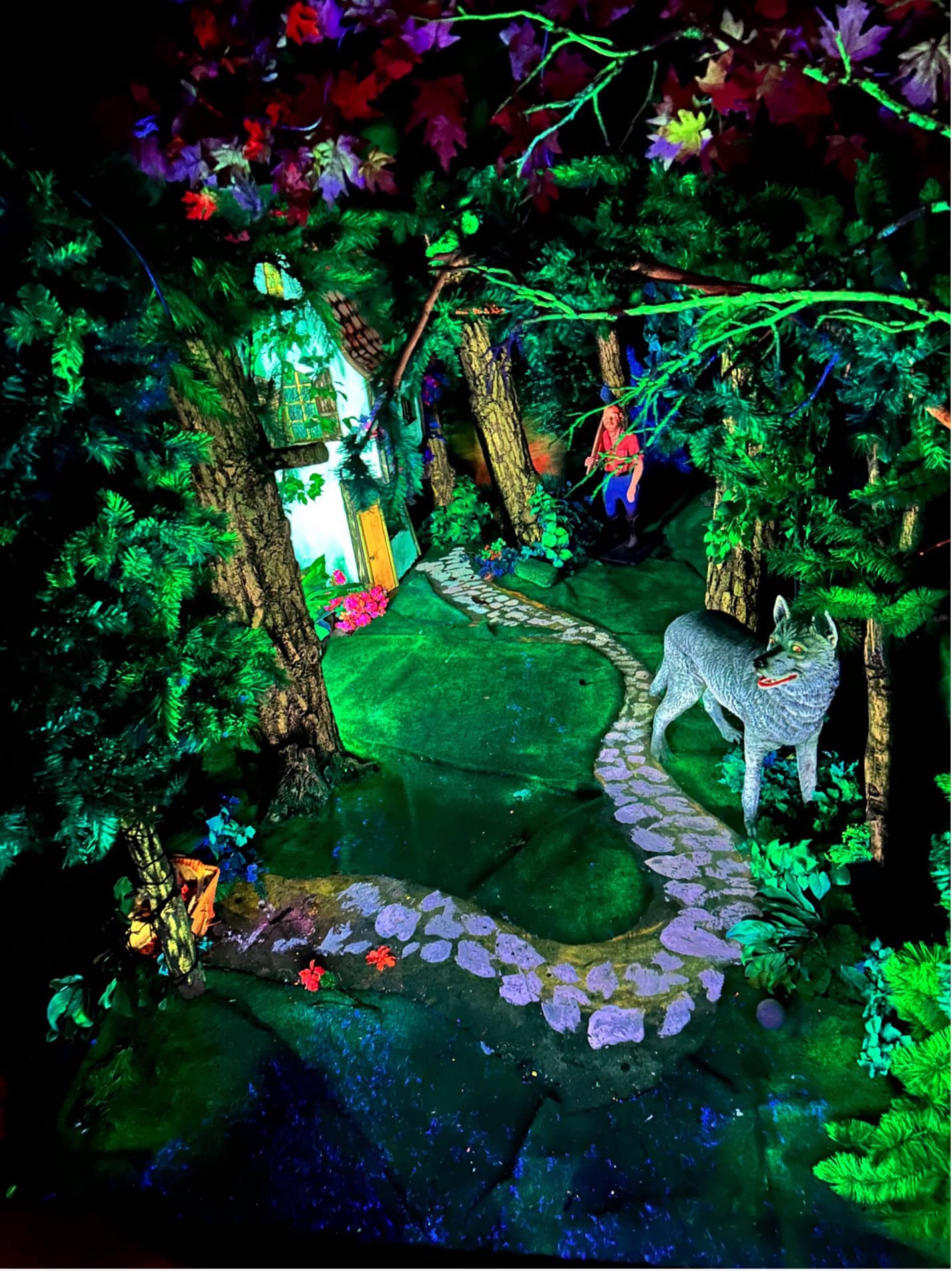
It was one of nearly two dozen hand-crafted storybook scenes on view in Rock City’s Fairyland Caverns near Chattanooga, Tennessee. Created in the 1940s by Atlanta-born artist Jessie Sanders, Fairyland Caverns—which Pepper pronounced Ferrah-linds—is a strange tour-de-force among the many natural and artist-created attractions of Rock City. The fantastical dioramas, inspired by traditional Germanic folk tales and nestled within caverns in Rock City’s limestone caves, employ black lights and were created decades before the trippy effect met mainstream popularity, and back when black light was used primarily in medical diagnostics rather than art. Every scene is impossibly detailed. The figures are expressive and active, their mouths open in surprise or fear, their bodies mid-action. Her dioramas are packed, spilling over with movement and greenery, every detail considered. Seen from the perspective of a viewer peering downward and the lighting distorted, the sense of distance creates the illusion that the figures are life-sized, though they probably aren’t more than a couple feet tall.
Like many Southerners, I grew up seeing images of the painted barn advertisements for Rock City. I remember more than one neighbor mounting a Rock City birdhouse in their yard, a take-home souvenir duplicating the See Rock City slogan in white lettering painted by Clark Byers. While advertised as “genuine highway Americana,” most of the original barns have long since been repainted or deteriorated, but the iconography lingers on.[2]
Also like many Southerners, I never actually knew what Rock City was. While schoolkids in Tennessee may visit Rock City on a field trip, my interest, long dormant, was activated after meeting artist Ollie Goss at Stoveworks, a residency and art space in Chattanooga. Ollie, who specializes in multi-media installations and puppetry, had planned a trip to Rock City specifically to speak with the caretakers of the cavern animatronics, figures animated by motors or other mechanical devices.
A year later, I found myself in the sprawling conglomerate of winding gardens and cave systems that is Rock City. The attraction was created and maintained by Frieda and Garnet Carter in the 1930s as a tourist attraction, with great emphasis on Frieda’s rare gnome collection, European folklore, and local artistry supplied largely by Jessie Sanders. The natural rock and cave systems of Lookout Mountain are blended with man-made elements, with an unrelenting focus on whimsy.
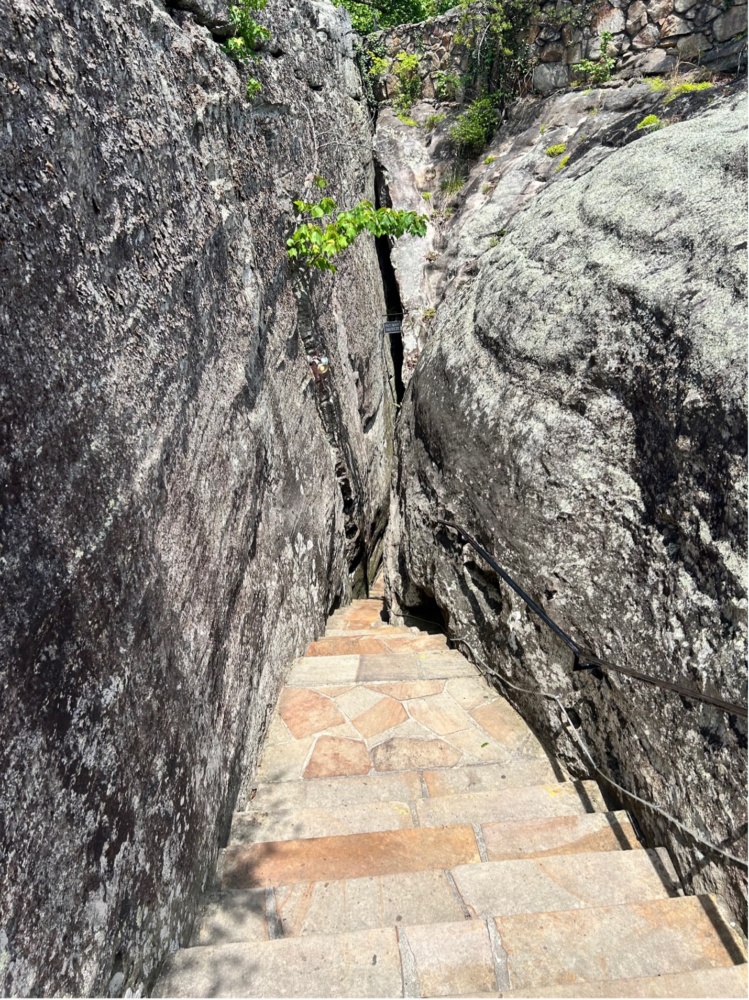
I went on an exhaustive tour. We rushed through the newly updated Hall of the Mountain King, though Pepper was disappointed that the speakers weren’t working and insisted I missed out on the full effect of Edvard Grieg, I assured her I was familiar with the song and could use my imagination. We bounded through the Rainbow Hall, a small, cavernous bridgeway illuminated with rainbow-colored stained glass. “When the light is right, it’s stunning,” Pepper declared, unhappy that at 1:30pm we had just missed the best of the sun. The Swing-A-Long Bridge tested my fear of heights and rowdy children, and the perhaps tactlessly named Fat Man’s Squeeze attested my fear of tight spaces. Occasionally, Pepper would point out various gnomes atop boulders or peeking out from bushes, which the Innovations Team were prone to moving around without warning. The trails were winding and the caves and trees obscured site lines; in our frenzy, I found myself disoriented.
Once again, Pepper was unsurprised. “If you try to control where you go, you’ll never find your way,” she mused as she marched confidently ahead and I tried not to trip over my feet. “We’ve tried maps, we’ve tried wayfinding…”
There was a map at the start of the trails, though its effectiveness was questionable. Created by artist Alex DeHeart, the map accurately displayed the impossibilities of the park’s layout, with the various trails crisscrossing over one another in a jumbled pile. It was, according to my enthusiastic guide, “one of the hardest projects [Alex] has ever done.” I could believe it.
By far, the main attraction of Rock City was Fairyland Caverns. The dreamlike caverns contained fairytale figurines posed mid-scene made primarily of Hydrocal, a material similar to plaster. There was Hansel and Gretel, poised to enter a gingerbread house. A precarious Jack hung from a neon green beanstalk. A busty Cinderella, led by a team of mice, ran away from her prince. One of the two animatronics—gnomes on a Ferris wheel—was out for repairs with the Innovations Team, a damp cave was not ideal for animatronic electronic systems.
“I couldn’t really find photos online,” I said as Pepper and I wandered the caverns. This was not entirely true. In my pre-visit research, I had found photos online, just not photos that I felt accurately captured what I was looking at now.
Pepper nodded like she had heard this before. “It’s hard to photograph. Honestly, iPhone photos work best.” However, my iPhone photos missed a few key elements. Like the photos I had found in a quick Google search, they warped the scenes, rendering them flatter and larger than in person. Photographs also failed to capture the environment—the darkness, the dampness, the sound of water mixed with the cheerful tinkling of instrumentals piped in via a speaker system. It was surreal and far too weird to be translated successfully into digital. But perhaps all roadside attractions thrive off a little mystery. Some things you just need to see in person.
Fairyland Caverns culminated in the Mother Goose Village, Jessie Sanders’ masterpiece. Housed in the largest part of the caverns, the Mother Goose Village was a vast island of figurines acting out vignettes while old carnival ride music played. It was here that Pepper casually mentioned she was reading Neil Gaiman’s American Gods (2001), in which Rock City features prominently. In the otherworldly glow of Jessie’s Mother Goose Village, I could see how the setting could take on a mythical quality.
There is very little information on Jessie, who died in the 1990s. She was hired by Frieda Carter in the 1940s, and she worked on the cavern scenes for her most of her life.[3] In a picture of Jessie posted to the Rock City Facebook in 2022, she adjusts a miniature carriage, perhaps a prototype for the larger version in the Mother Goose Village. Her dark hair is short and curled, and she wears 1950s style horn-rimmed glasses. Jessie‘s dioramas, housed as they are in a highway attraction, run the risk of being categorized as kitsch. They are, after all, sentimental, emotional, and over-the-top, and displayed in an undeniably tourist environment. But ultimately, the artistry, humor, and pure strangeness of it all push the installations into a category all their own.
The Innovation Team responsible for maintaining all artistic aspects of the park are the caretakers of Jessie’s creations. Comprising eleven full-time artists, the team touches up the paint on the gnomes and figures, adjusts them if they fall out of place, maintains the lighting, sound design, and surrounding greenery. On the day I visited, Christopher Rhyne, one of the young Innovation Art Specialists with a side hobby of action figure customization, was working on a mural near the visitor’s entrance. When asked about the challenges of the work, he joked the hardest part was “keeping paint off clothes.”[4] He went on to say, “You have to be a jack of all trades with this job,” a sentiment I heard echoed throughout the Innovations Team. The artists were part-art handlers, part-maintenance crew, part-sculptors, part-installers, and part-set designers.
The challenges are apparent: these are outdoor sculptures in Southern humidity, on a mountainside and throughout damp rock formations. “We’re really battling the elements of nature,” said Ren Langston, a muralist and the Project Coordinator for the team.[5] Every part of Rock City—the cavern figures, the gnomes, the various bits of artistry embedded in the landscape—contend with the environment. Gnome limbs break down, and off. Animatronics rust to a halt. The Hydrocal figures are slightly porous, constantly pulling in moisture. Paint bubbles up. As we walked the park, Pepper frequently pointed out that which wasn’t there: an intricate door taken in for repairs, Red Riding Hood missing from her scene, a gnome that was there, right there, until it wasn’t.
I had been following Pepper without question, keeping up with her lightning pace, and was surprised to realize we were back at the entrance of the park. My time was up. After giving me a nearby restaurant recommendation—The Purple Daisy Picnic Cafe—Pepper disappeared as quickly as she had arrived, swallowed up by the slew of gift shops and welcome signs.
Every part of Rock City—the cavern figures, the gnomes, the various bits of artistry embedded in the landscape—contend with the environment.
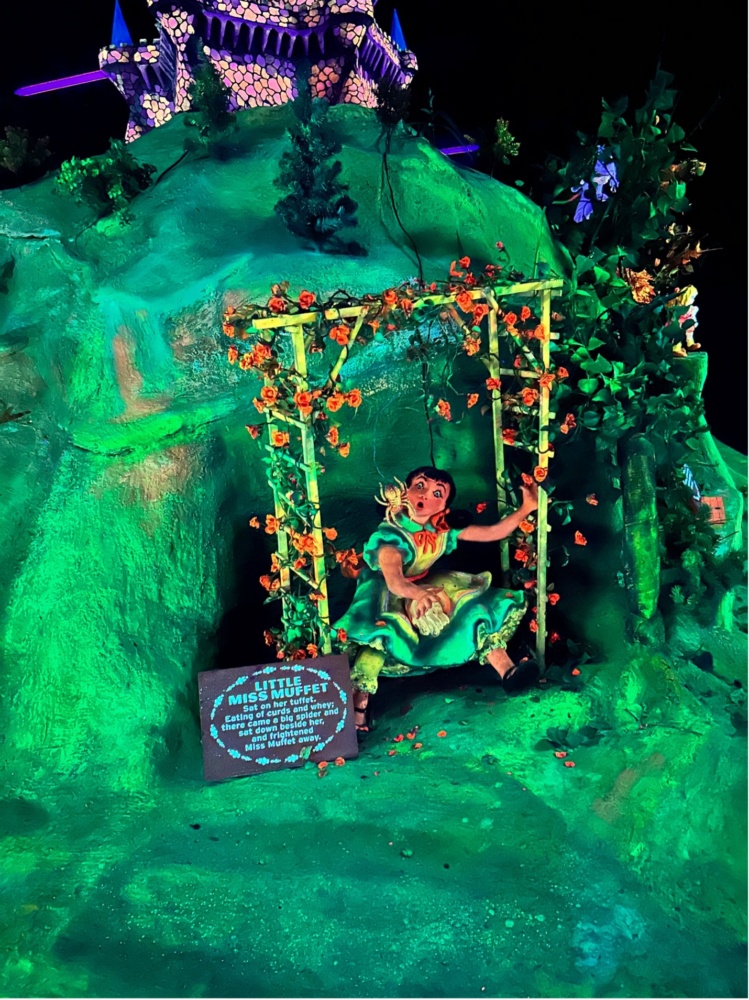
It would be easy to draw a parallel between this self-described Americana attraction and the precarious state of the arts today. Or, conversely, Rock City could be viewed as an allegory for the futility of the maintenance of the American dream, but irony is everywhere, and earnestness is rare. There’s something devotional, steadfast in Rock City’s commitment to maintenance, like the seven dwarves and their daily, cheerful tending of the cottage when it’s so much easier to let it all fall apart. Devotion requires care and time. The payoff is fulfillment and deep connection, whether to a place, person, or mythology. I want to envision Jessie in her studio, pushing her glasses up her nose, carefully molding Little Miss Muffet’s mouth into a perfect “O.” I want to think about the young artists, eighty years later, carefully touching up the tiny orange flowers that surround her, arranging the petals on the ground, getting paint on their clothes.
[1] Pepper Raper, interview with the author, Lookout Mountain, Georgia, May 11, 2026.
[2] Rock City, “Barn History,” accessed May 12, 2026, https://www.seerockcity.com/barn-history.
[3] Pepper Raper, interview with the author, Lookout Mountain, Georgia, May 11, 2026.
[4] Christopher Rhyne, interview with the author, Lookout Mountain, Georgia, May 11, 2026.
[5] Ren Langston, interview with the author, Lookout Mountain, Georgia, May 11, 2026.