“As they say, sometimes it’s easier to see things from far away,” said Clare Hu from her Tribeca studio during the last year of her Master of Fine Arts program at Hunter College in New York, NY.[1] Born in Norcross, GA, right outside of Atlanta, Hu spent her formative years working in her parents’ antique store in Dublin, GA, and hanging out on Buford Highway, an area north of Atlanta and one of the most diverse parts of America, which is home to many immigrant-owned businesses. Hu’s practice centers legibility and the Chinese American experience in the American South through traditional forms of weaving. The resulting large-scale works serve as evidence of transition, a record of place, and an analog to digital go-between.
“I always describe myself as a weaver who wishes they were a photographer,” says Hu.[2] Receiving a BFA in Fiber and Material Studies at School of the Art Institute of Chicago (SAIC), she balances legacy with intervention, sharing a particular interest in overshot weaving from Appalachia, which involves two shuttles creating a plain weave and a pattern. The artist’s investment in weaving was driven by a desire for connection—to people as much as textile. Communal in nature, Hu learned from her friend and mentor Liz Ensz to dress the loom and weave as a group. Her relationships extend to people not present at the loom with her, because the overshot pattern makes her feel tethered to the labor of women from centuries past.
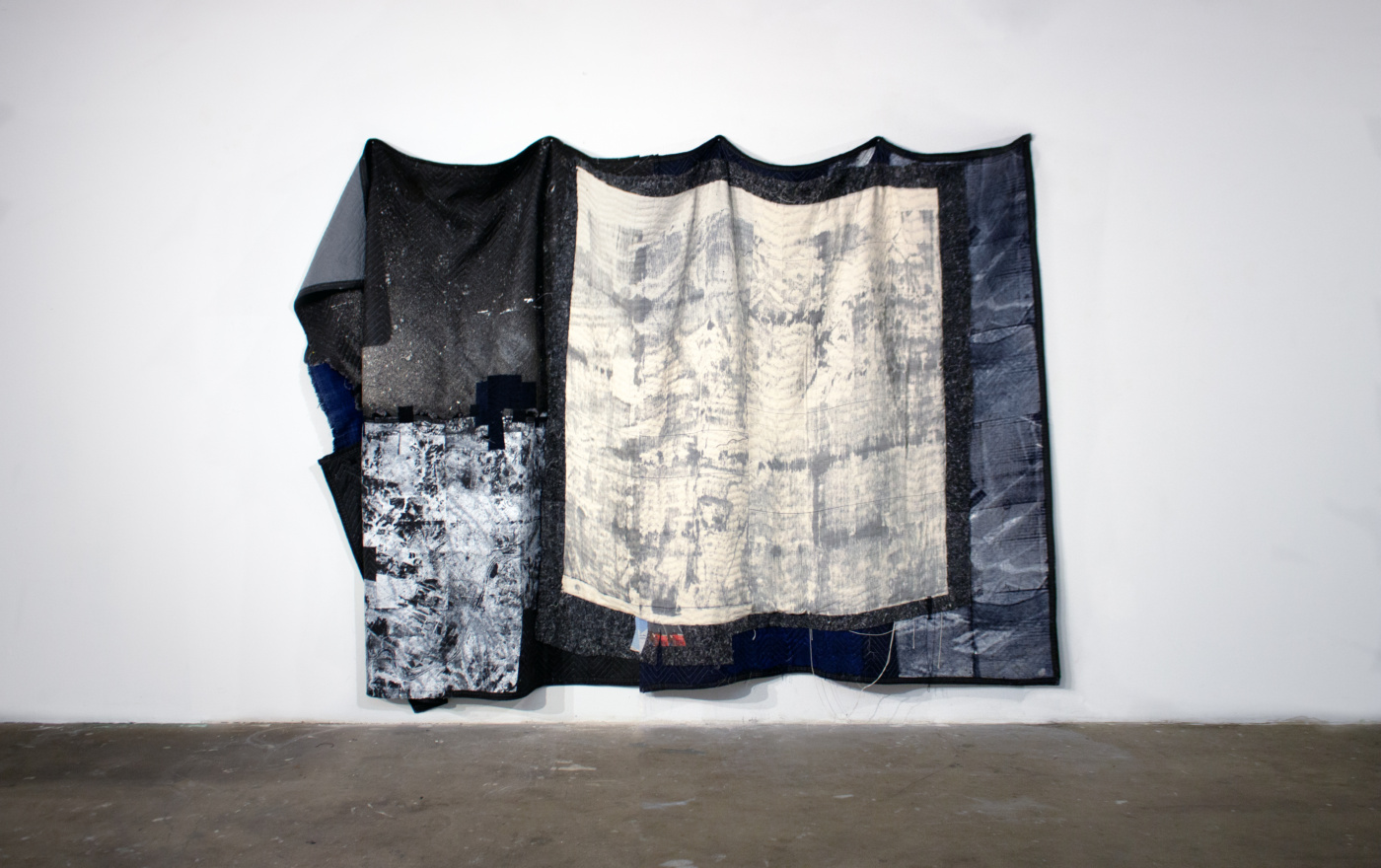
From 2022 to 2024, Hu’s Tarps series engaged materiality as a means to investigate site. Weighty, thick, crumpled, and paradoxically soft yet industrial, these works forced two dimensional planes to become three dimensional compositions. One such example, 2300 Pleasant Hill (2022), invokes a window, or in this case, a window upon windows. White panes are woven and stretched atop the shellacked surface of a muted but familiar vinyl tarp. Miniature squares are layered, much like a computer screen, revealing paper maps and photographs, alongside a red nettled absence on the surface of the textile. Grommets negotiate the boundary where textile meets the wall but also provide a hanging apparatus. Buford Highway is depicted alongside the scaffolding of Stone Mountain, a granite dome just outside of Atlanta that is known for the massive relief carving of Confederate generals. The tension between contrast and coexistence is made visible but only through tattered thin ties.
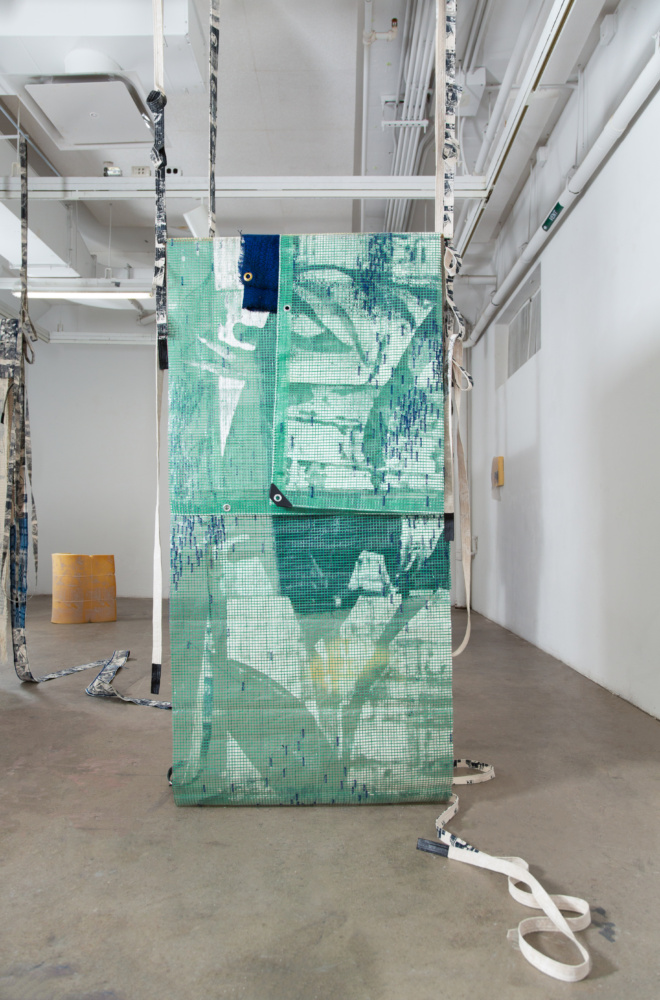
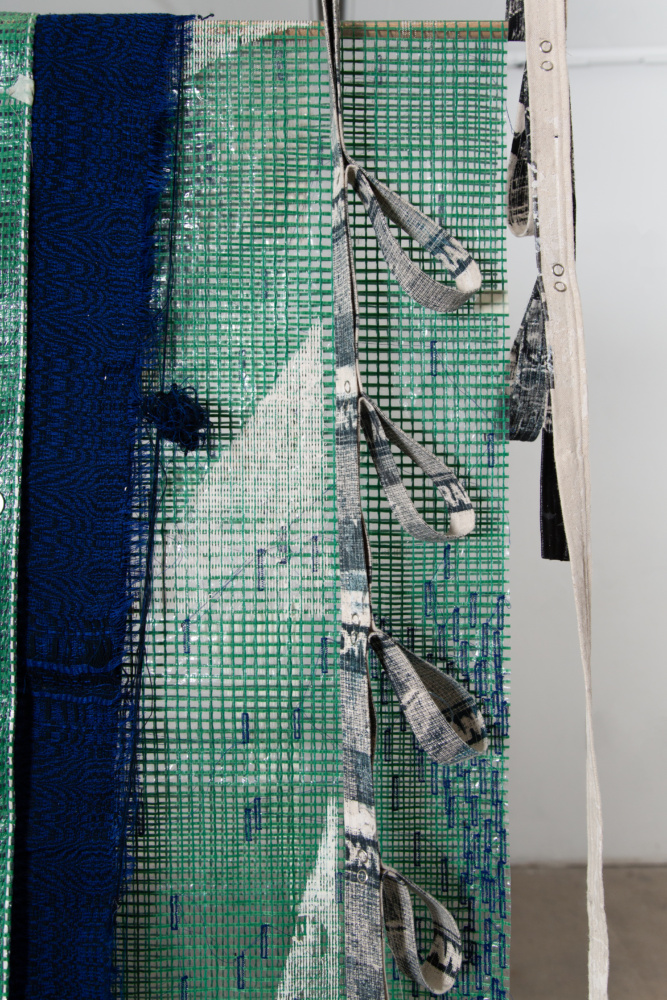
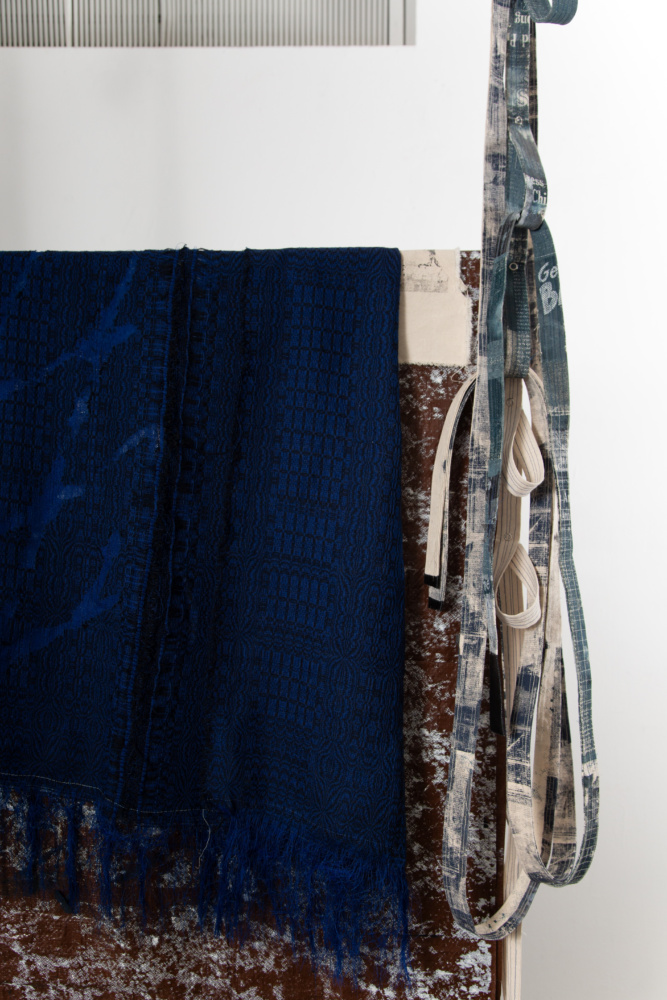
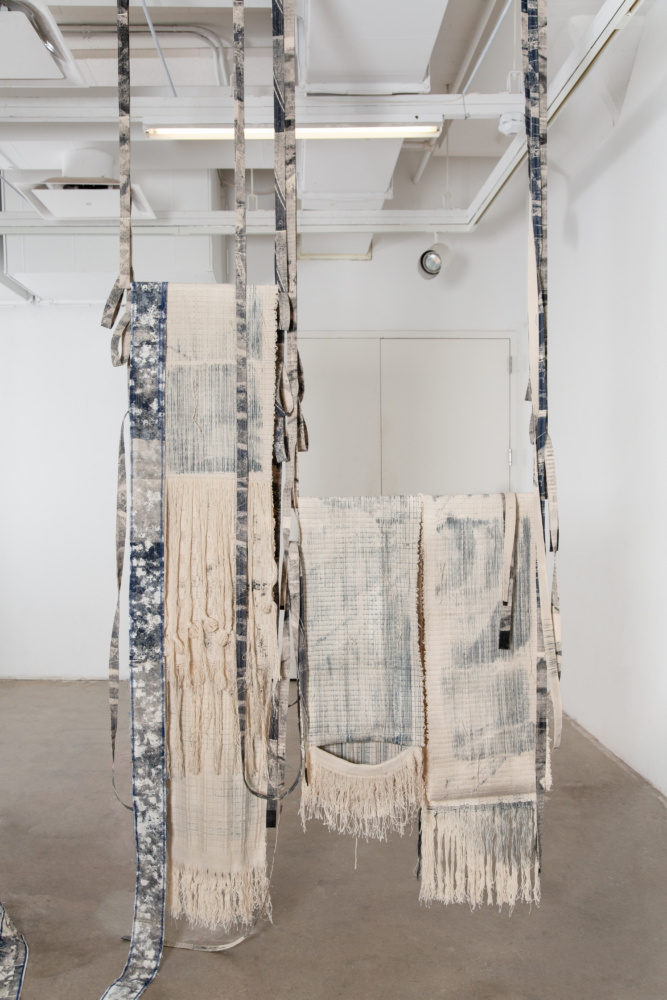
Another tarp, 5010 variation 1 (2024), incorporates screenprinting with woven textile and printed fabric. Hung from the ceiling like a trapeze, the surfaces are draped; the window is no longer wall-bound and grommets puncture rather than outline. A bitmap, a digitized grid, invokes a newspaper—a dying or dead print form of image reproduction—but also its Photoshop usurper. Loops of images, recalling 35mm negatives, ribbon onto the floor, interrupting any perceived flatness. Layering up to four weaves, the bulky constructions test the capacity and ultimately the failure of the loom on which they are made. According to Hu, “The more planes of cloth, or the more yarn that you’re putting in the warp, the more things start to kind of get sticky, the more things break. I am really interested in the entropy of the woven thing itself.”[3] The Tarps series incorporated moving blankets Hu collected from her parent’s now closed store. Modular in nature and responding to the space they were mounted; the installations created were on the move themselves.
“How can you make the optic haptic?”
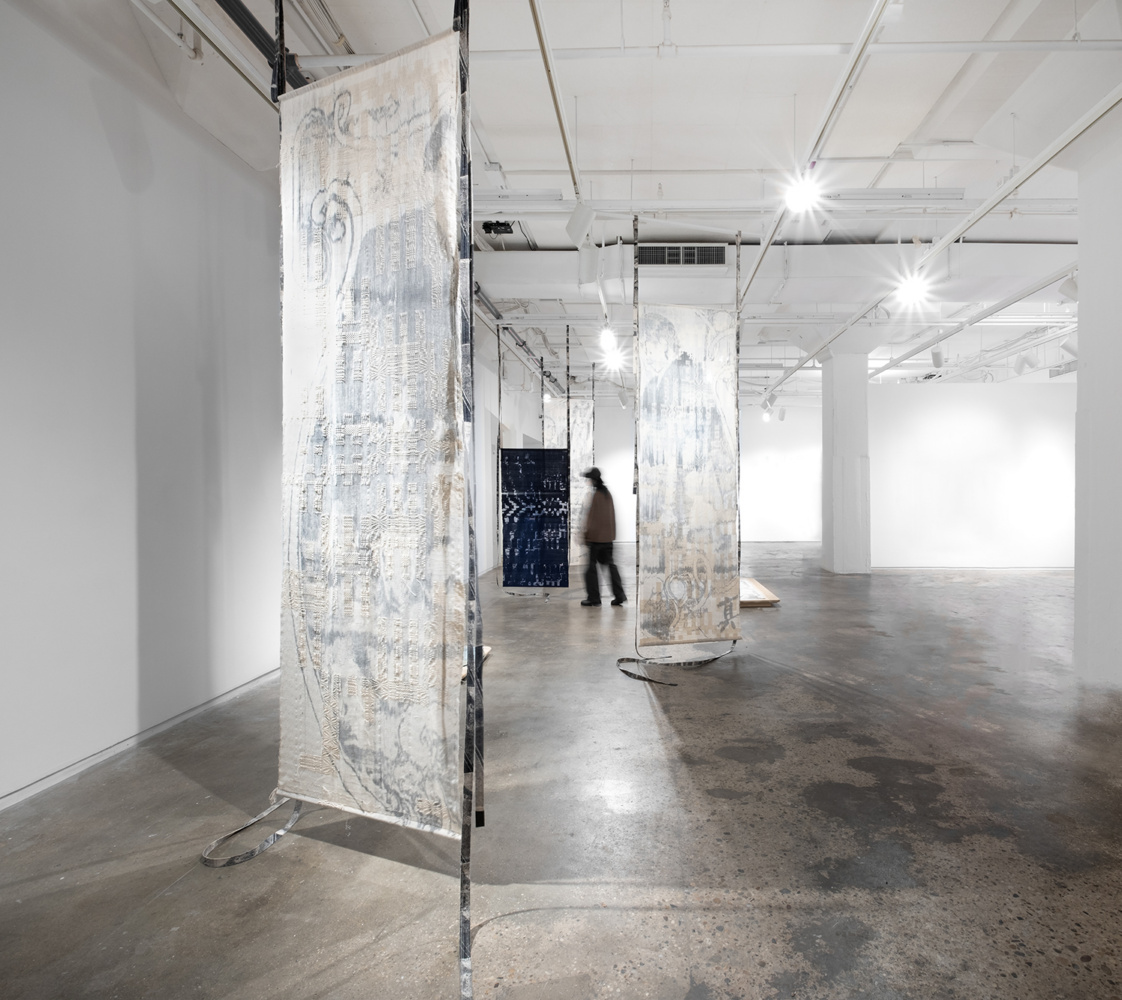
More recently, Hu created Debris (2025), a triptych of ceiling-hung overshot weavings that source images of the Chinese American community in Augusta, GA from the Vanishing Georgia Photographic Collection on the Georgia Archives website. With interest in a digitized collection from the 1890s-1980s, Hu was drawn in by how sparsely the community was documented. Brought to Augusta as laborers contracted to widen the Augusta canal in the 1870-1890s, the images record a public narrative and decontextualize events, leaving the private story unknown. A delicacy to the resulting panels, pixelation, rendered on the loom, is evident—yet faces, hands, and identities are obscured.
Hu’s works foreground legibility, what can be seen, perceived, and understood. Utilizing scanned images, which offer the possibility to zoom in, Hu questions how closeness actually provides cover. Through a translation of mediums, both access and remove are offered: the lived experience becomes a print photograph that becomes a digital scan that then becomes tangible weaving. With attention, reproduction becomes transformation. Hu is interested in inviting chance through the stroke of a key or the movement of a shuttle so that an image becomes something else entirely. She asks, “How can you make the optic haptic?”[4]
Subsequently, Hu’s weavings feel expertly made, even sturdy, but still intervened upon. The physicality of form is grounding. Interested in the life of images and materials before they reach her hands, Hu considered, “What I really love is when you see a scratch, or a fold, because then you can really start thinking about its life. If it’s a fold, it’s not like someone just had it in a photo album. They probably took it out, folded it, maybe put it in their pocket, maybe lived with it.”[5]
For future work, Hu is invoking another means for clarification and obfuscation: language. She is exploring how naming and cataloging systems influence access to information and community for Chinese Americans in the American South. She continues to find ways to connect the desire for present and past belonging. “I am doing this research and learning more about how people create communities, especially in a landscape that might not want them,” stated Hu.[6] She also finds connection in quieter moments, like at her loom or when she talks to her mother on the phone while she is in her garden in Dublin, GA.
[1] Interview with the author, April 5, 2026.
[2] Interview, April 5, 2026.
[3] Interview, April 5, 2026.
[4] Interview, April 5, 2026.
[5] Interview, April 5, 2026.
[6] Interview, April 5, 2026.