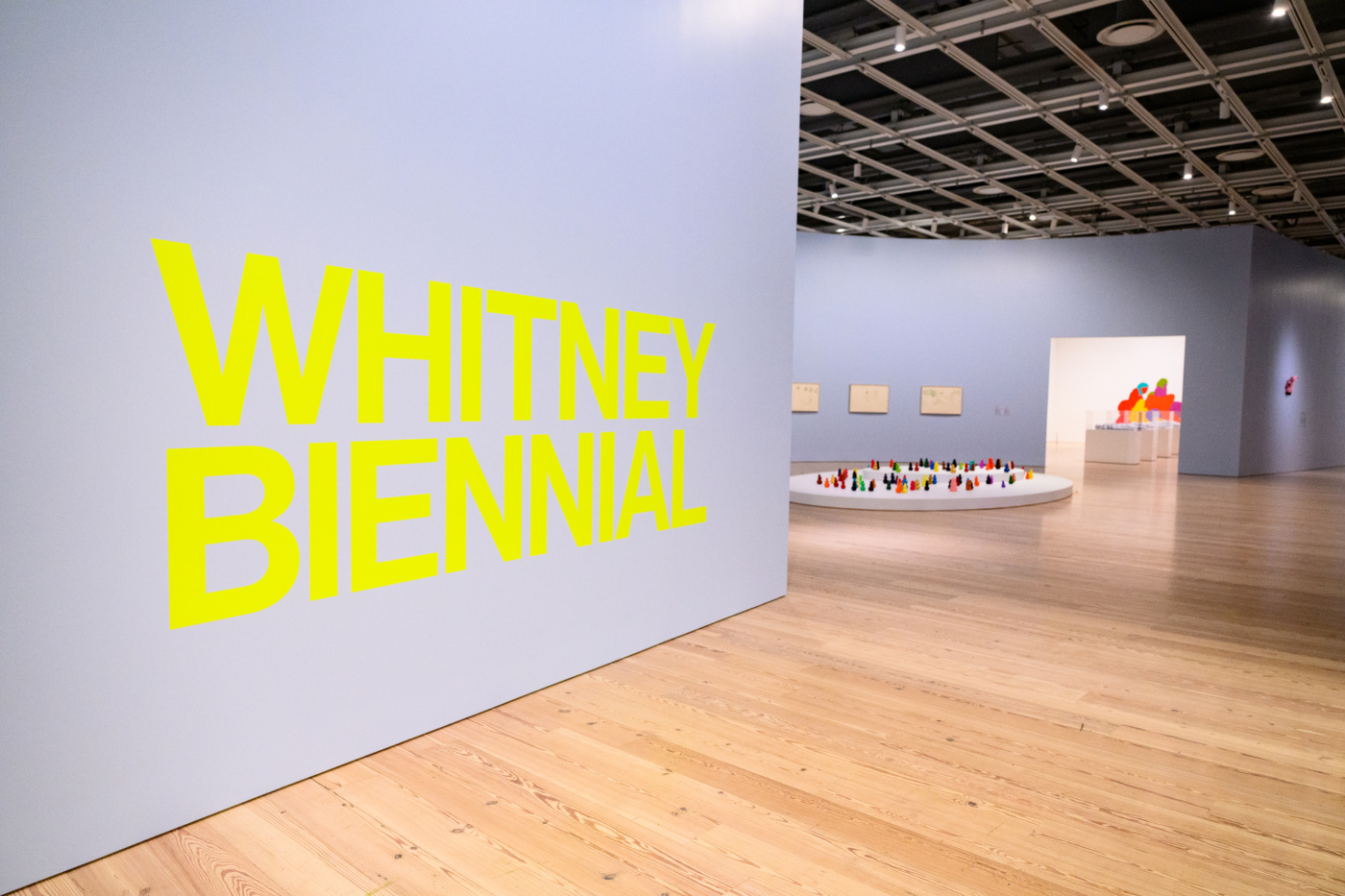
Like those before it, the 2026 Whitney Biennial, curated by Marcela Guerrero and Drew Sawyer, seeks to document the present moment in art in the United States, “asking not only what is being made but also what it means to name something “American” at all.”[1] Spanning works made both in the US and outside of it, the exhibition examines the influence of American power around the world, and inseparably, how outside practices and struggles have entered the American consciousness.
Featuring over a dozen artists connected to the American South and Caribbean, this iteration of the biennial offers links between regional issues and global narratives. After visiting the exhibition separately a few times, we had the following conversation with these questions of place and interconnectivity in mind.
This interview was edited for length and clarity.
Maria Owen: Since my first time at a Whitney Biennial as an art student, it was always discussed as something controversial. I don’t recall ever hearing about it in a collectively positive light––people love to hate it, and that can be contagious. That said, when I saw the artist list this year, I thought, “Oh, this could actually be interesting.” The list was unexpected, and it felt like tapped into the more subtle conversations. Yet there’s always a concern that it won’t be expansive enough.
Carlos Nuñez: I had similar feelings. I’ve been thinking about cyclical exhibitions, and how they can inform the next iteration. I remember going to a Whitney Biennial for the first time in 2019 and feeling this sense of discovery, of expensiveness in my world. This time, I will say, I think I had a lot of questions, which was a promising start. I didn’t feel like I was going there to form an opinion right away. I just wanted to experience it openly.
MO: It seems like there’s this expectation that if something isn’t either entertaining or satisfying, then it’s bad. But I think many of us still feel that a really good exhibition can be challenging and uncomfortable. It doesn’t need to be a euphoric experience to do what it’s meant to.
CN: I think that I wanted to be in discomfort. I was looking for something that didn’t feel so digestible at first. In any exhibition that offers an expansive survey of American art, it’s unrealistic to expect to be entertained given everything that has been happening in and through the US.
I was particularly interested in geographical expansion, and how certain regional tropes could be utilized as curatorial mechanisms. Many of the artists present in this edition have strong ties and influence from the US South and the Caribbean, and I wondered how these might open new avenues to read the survey.
The curatorial texts stood out to me. There are two main ideas fused, one being this more traditional survey of American art, and then one including artists from, as the text reads, “places marked by the broad bridge of U.S. power.” The strongest and more direct statements of the exhibition happen through this lens, either inside or outside the US’ frontiers.
MO: It’s also worth mentioning that since the curators began organizing the exhibition, the US’ involvement in international conflict has only increased. I did feel that, whether people think that it speaks to “Americanness” or not, the Biennial was very attuned to that reality. And by including works like Aki Onda’s radios and Leo Castañeda’s video game, we’re subtly reminded of how culture and identity are consumed through evolving technology. And there’s this constant anxiety, and the world really hasn’t ever been this connected, for better or for worse. To me, that attempt to capture a global phenomenon was a success. It was in other elements of contemporary American culture that I felt like there was less representation.
CN: Like what?
MO: Well, the US feels polarized, ideologically and otherwise, and I didn’t spot any work focused specifically on unpacking that. There was more of an overall theme of extremes. There was an obvious hierarchy of priorities. Maybe the local nuances of that polarization were intentionally left out, or maybe it was an accident, but global connectivity took precedence over specific domestic issues.
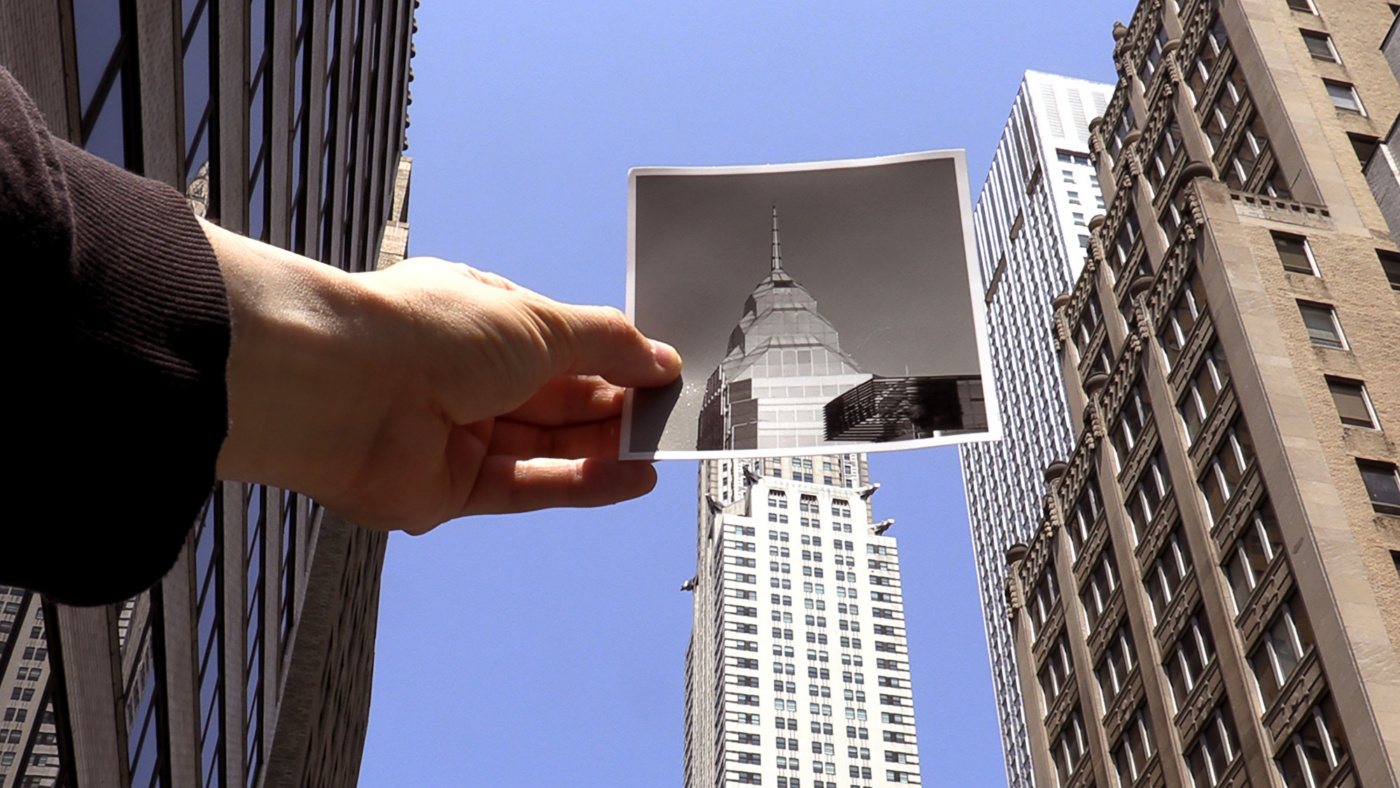
CN: Ignacio Gatica’s video installation is one poignant example of this “American influence.” He researches the financial district in Santiago, Chile. Through a group of economists called the Chicago Boys that implemented a series of neoliberal policies during Pinochet’s dictatorship, we’re able to witness the process of importing not only American materials like glass and metal, but also symbols of capitalism, power, and control over nature.
It struck me halfway through the video how challenging this piece must be if you don’t speak Spanish. So much of it happens within idioms and in the disconnect between the Spanish audio and English captions, polarizing the experience depending on what language one speaks. It’s not that it was lost in translation, but that translation was used to camouflage essential information.
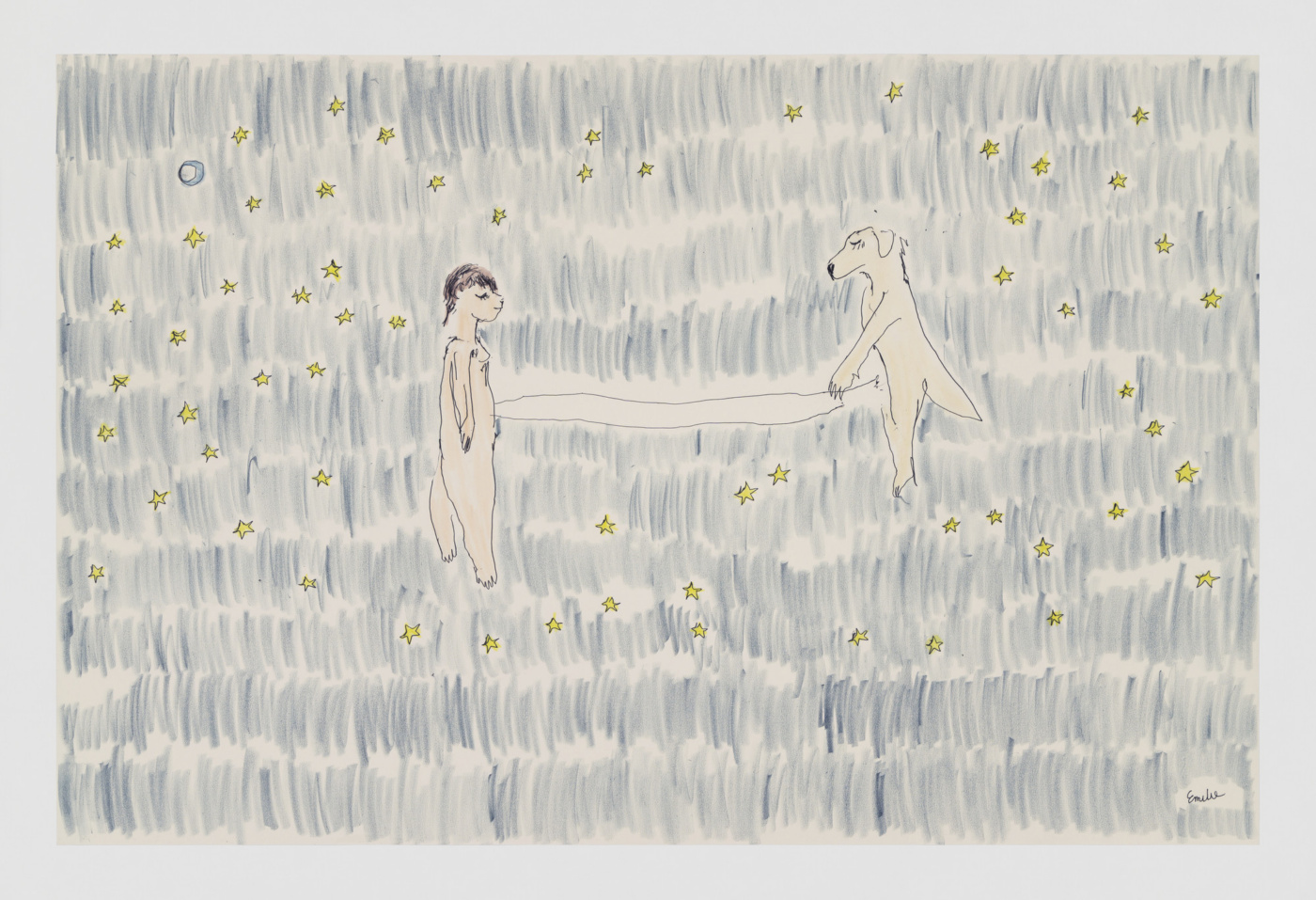
In contrast, the work of Louisiana-born Emilie Louise Gossiaux felt universal. Her drawings of the passing of her guide dog, London, were a tender welcome into the show. They were gestural, “non-art statement–heavy,” intuitive, fresh, documents of grieving. Accompanying the drawings, Gossiaux presented a suite of small clay sculptures of London’s favorite toy. They’re quite ugly, rich-colored, realistic dog toy replicas. With time, they evolve and without revealing nothing more, become extremely potent. I stopped wanting for them to be more than what they needed to be. That was a perfect introduction to the rest of the exhibition.
MO: I felt the same way about Gossiaux’s work, though I experienced it later on. I had a really different first interaction with the show because I went to the eighth floor first, a whole gallery of Precious Okoyomon’s installation of these chimeric toys hanging by their necks. That was a heavy start. That’s the kind of piece that I see and am immediately struck. It’s not that there’s no nuance, but it’s an instantaneous read. While a lot of the biennial is very expansive and international, Okoyomon’s piece was this reference to lynching throughout American history, racial violence, and all that has come from that. The fact that an entire gallery was dedicated to it added to the statement: there are so many ideas present in the show, but this history is one that requires direct acknowledgement.
CN: The power of this installation came from the space and solitude it was given. It resembled an open field, a landscape of possibilities held by perennial violence. One can assume that Okoyomon, raised in Cincinnati, was influenced by the stories and tension found near the edge of what is considered the US South. The tenderness of the pre-loved stuffed animals was confronted by their taxidermy wings and the noose that kept each one suspended mid-air. It felt like a space for grieving as an act of the present.
MO: Even though Cincinnati is not in the South, it’s right across the border. Reflecting on this, I thought about Toni Morrison’s Beloved (1987) and how, in that book, Kentucky is this dark place where Sethe was enslaved, while Cincinnati is a kind of fresh start.
It seemed like the overall aesthetics of the biennial was one of its more divisive qualities. I’ve definitely heard a lot of people accuse it of being too slick. I’ve heard, “This is a show for city people, New York and LA art world-heavy.” I don’t think I agree.
CN: Do you think it needed more––
MO: Painting?
The reality is that so many people are making paintings. Painting and drawing are in many ways more accessible than making a 400-pound sculpture. I did appreciate that one of the few paintings was Ali Eyal’s memory of an amusement park that he visited with family before leaving Iraq, right before the war with the US. It was powerful to have that piece. It spoke to a broader quality of “Americanness,” the idea that you come to America for more opportunity. Yet in this case, the US is very directly responsible for the displacement.
CN: I also enjoyed his drawings. That was a poignant moment in a room where I had been struggling to make a lot of connections, and those drawings really grounded me. Near them there is a two-figure sculpture by Raven Halfmoon titled Sun Twins, two cream-colored figures exploring spiritual ideas of connectivity. I clearly remember going to the Whitney in the past and seeing a bust by Elizabeth Catlett there, and I appreciated connecting works that I’ve seen at the Whitney in the past with the current pieces taking these spaces.
This Biennial honors other artists who have been connected to or shown there. Nanibah Chacon’s rooftop installation merges imagery of sand paintings of Diné gods with the industrial textures of power lines. The material and structural design expands the museum experience and invites the viewer to reengage with David Hammons’ Day’s End installation on the water.
MO: How do you think that experience might translate for someone who is visiting the Whitney for the first time?
CN: Maybe it can be memorable enough to make people consider and analyze things for longer than the show is up. It might be the biggest fault of biennials that we tend to think of them as a way of surveying what’s happened in the past two years, but actually, it could be a way to inspire or make change for the years to come. What if we see this as a way of like a starting point for ideas that haven’t happened yet?
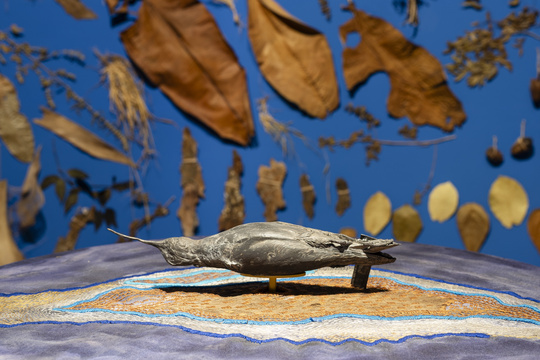
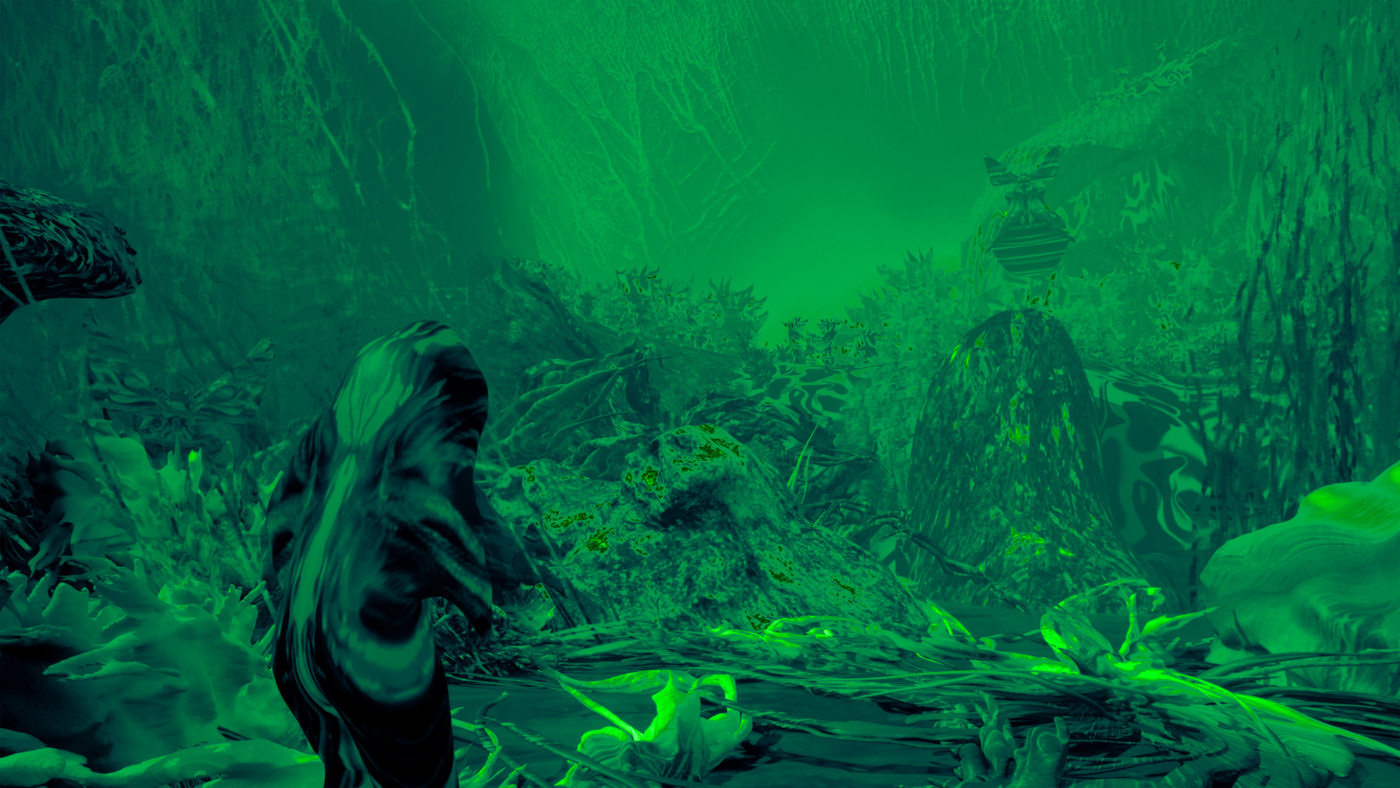
MO: Beyond the international focus, nature and the human relationship to nature and animals was very present. Not only in Gossiaux’s work, but in Sarah M. Rodriguez’s aluminum casts of natural materials, Oswaldo Maciá’s immersive insect room, Leo Castañeda’s surreal environment, and Kainoa Gruspe’s beach detritus.
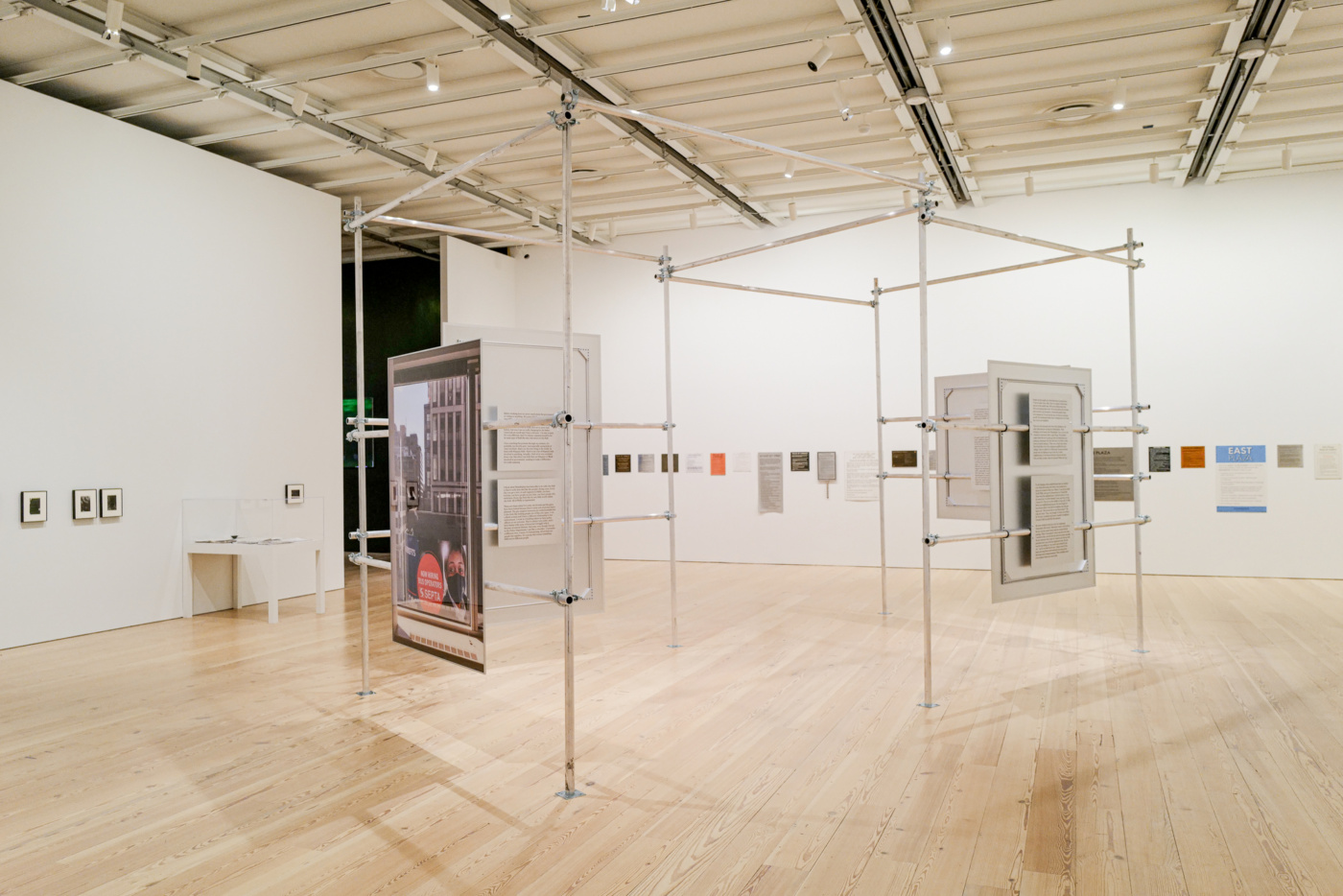
Gruspe’s work, and the room where it was displayed, felt tied to architecture. It felt like a gallery dedicated to the spaces that we build, daily architecture, and how we experience and regulate them. Gruspe stands out, objects made of broken things that have been reconstructed. There’s the element of recycling, but also a sense of impermanence. It felt almost like a warning or reminder of impermanence in the context of the other pieces, like David L. Johnson’s restriction signs, Emilio Martínez Poppe’s window reproductions, and Mo Costello’s photos that are documenting human activity. I felt that was a beautiful curatorial moment, where those works together were articulating how we move through and use space in a way that they couldn’t say individually.
CN: Yes, that was, to me, the most impactful room, and maybe the one that I curatorially connected with the most. There were so many different ways of working, and there were all these subtle and elegant ways of grasping how all these artists are making. For example, Johnson’s codes of conduct signs from New York, materially engaged with the staples in Costello’s photography at different light poles in Atlanta. While Johnson is appropriating said, and Costello is making photographs of staples that once held signage, but now are just a remnant, they both share a tactual presence.
In the material of the scaffolding, silver prints, signage, but also in ideology, this room explored metal and rust. Maybe that connects to what you’re saying about Gruspe’s work not only being about remaking the past, but also about what the world could be.
For example, Mo Costello’s work is looking at local traces of sociopolitical engagement, but through the larger curation, the work feels inherently connected to propaganda overseas. Global issues and ideas are echoed and intertwined with the work of artists from the South and Caribbean. Most of the works in that room feel like they exist somewhere between being a tool and an inconvenience. There’s discomfort in installing it, moving it, the precision of Poppe’s window photographs being printed exactly to scale.
MO: Do you think that it’s important for art to be convenient?
CN: Yes and no. Costello’s photographs are hung at an accessible height for visitors to see. At the same time, there’s something about the work that is inconvenient. It’s not easily digestible, not one line. It forces you to face the realities of the world and the realities of how people are living and making art outside of metropolitan Art hubs, and that can be uncomfortable. That inconvenience creates tension with the viewer.
And then there’s institutional inconvenience, which is also essential. Meaning, how can we challenge museums to present and preserve works that are maybe not easy to store or present or prepare, but things that are showing a different roughness not only to the artist, but to the institution, the canon, and the visitors.
"…interpersonal understanding of the other’s point of view is a huge part of the groundwork set by this exhibition, tying dialogues and issues that often feel regional and isolated to global concerns and responsibilities."
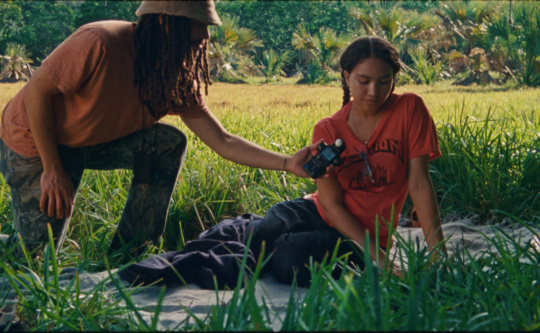
MO: Another element that I wanted to mention was this theme of multi-generational collaboration. For example, Mariah Garnett’s documentary on her great-great aunt’s never-performed opera. Replicating the work of other artists’ is an exercise we’re taught in school in order to learn process, but in this case the engagement was much more intimate. It’s this personal, familial connection.
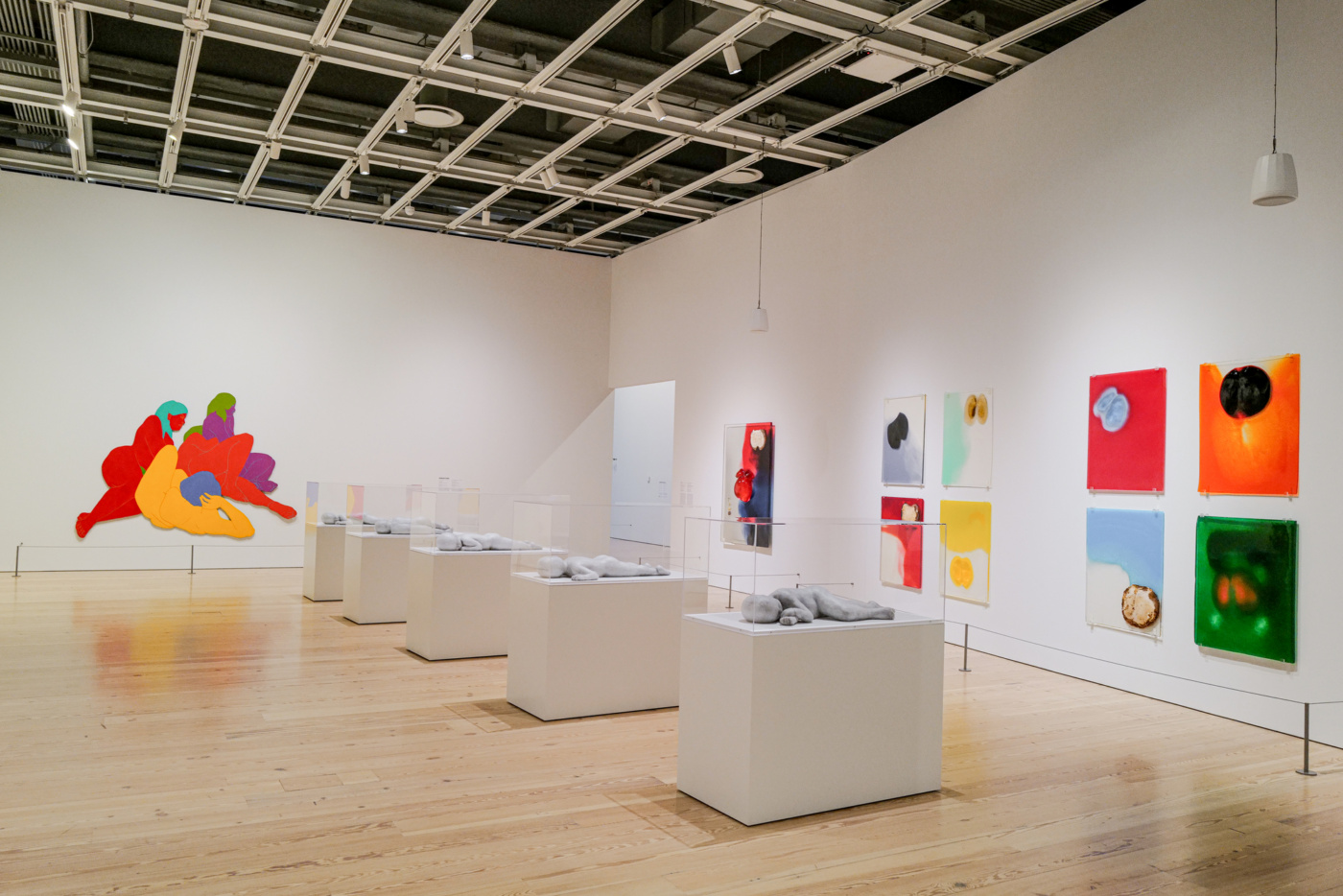
CN: Carmen de Monteflores and Andrea Fraser share a gallery, holding an intergenerational collaboration between mother and daughter, and making me deeply consider the weight of an artwork. Fraser’s sculptures are in the middle of the room, molded by hand in soft, non-drying wax that’s protected by Plexiglas cases, almost like a mournful ICU. I felt helpless looking at them. At the same time they felt protected by the paintings of Fraser’s mother, Carmen de Monteflores. The latter moved to the US from Puerto Rico as a teenager to study art, and during the 60s made incredibly vibrant shaped canvases with a sensibility for color and light not found in many US-born Pop-artists of the time. Her use of color brought me back to Gossiaux’s dog toy sculptures.
MO: And de Monteflores and Fraser’s work was accented by Nour Mobarak’s pregnant body molds.
CN: Which makes me think about the pregnant belly as a place of protection. While everything else in that room felt malleable, the resin of Mobarak’s work brought into matter the feeling of a shield.
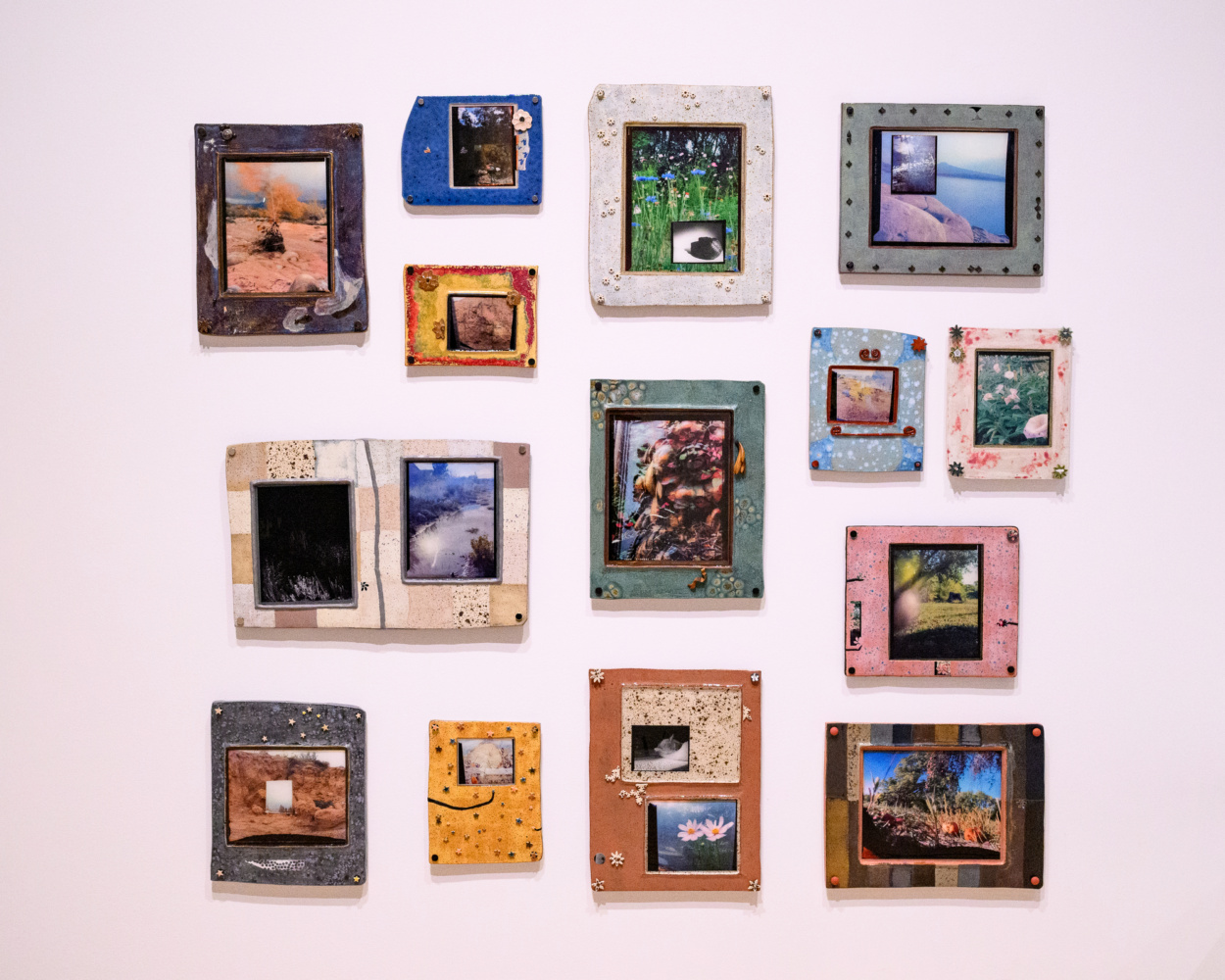
MO: A lot of the galleries were intensely 360. Very immersive without very many flat screens or paintings. There was quite a bit of photography, but not always in the traditional sense. Uses of the camera were found in unexpected ways, like with Erin Jane Nelson’s delicate, ceramic pinhole cameras and Michelle Lopez’s ceiling storm. That decision felt like an effort to bring people out of their phones and back into the physical realm.
CN: Erin Jane Nelson also brings an interesting geographic and intergenerational connection. She was based in Atlanta for at least a decade and then relocated to New Mexico to take care of family, dislodging her practice from the Southern landscapes she had explored in the past. This new territory inspired questions about “American expansion” while thinking about the camera as a tool that can be used to look at climate disaster from a non-human point of view. There are images of the landscape photographing itself, others asking how an ant would see a tree or experience the environment. There’s ideas of grandness and grief expressed through soft compositions.
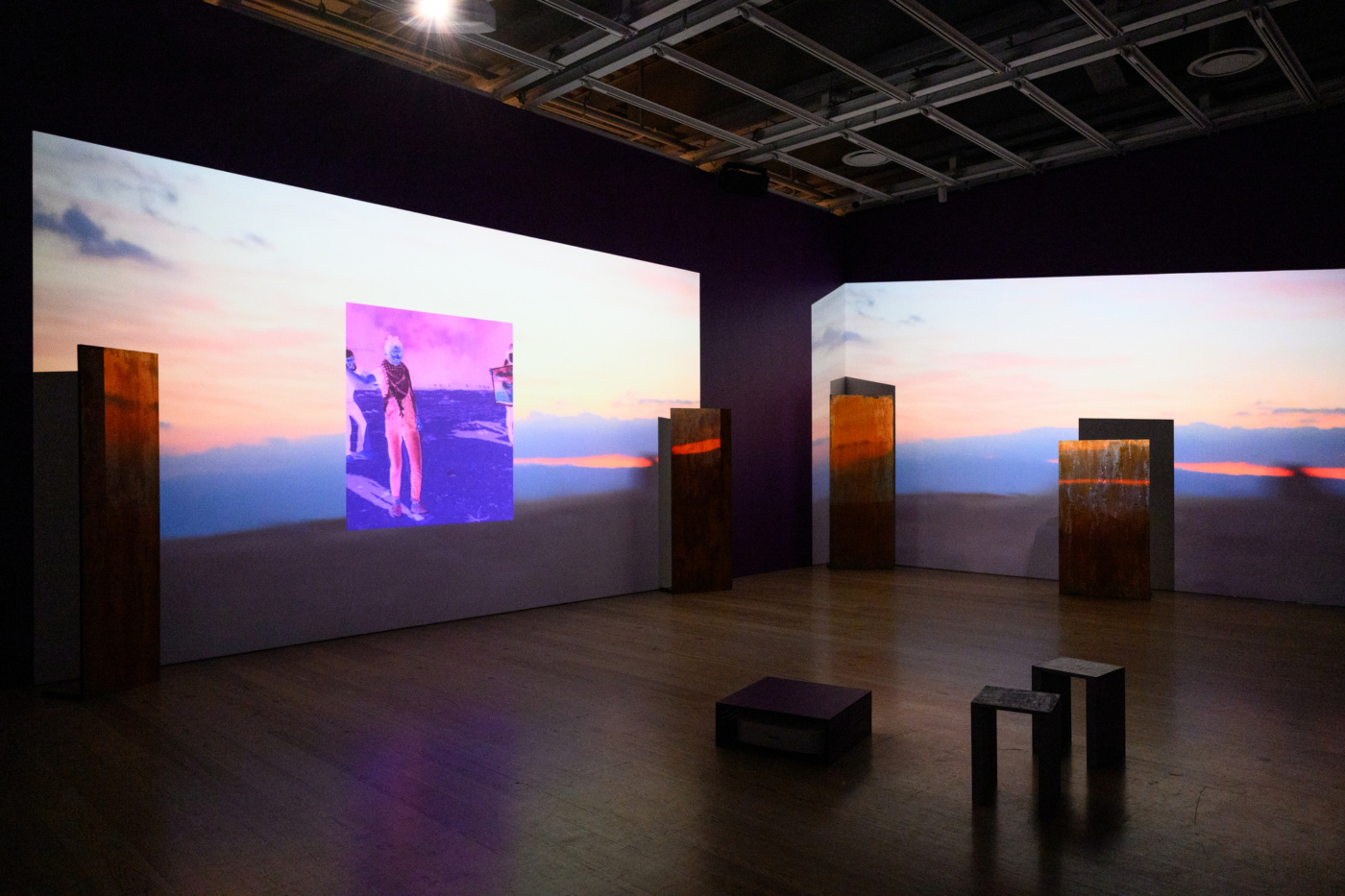
Similarly, Basel Abbas and Ruanne Abou-Rahme are thinking about landscape and ecologies and life cycles that are both existing and fading away. These points of view are also part of that destruction. Their video installation moves over drawings made in Palestine by Abou-Rahme’s father during the 70s and 80s. Besides this being another beautiful multigenerational artistic collaboration, I also want to imagine it as a curatorial collaboration, knowing both of the curators past endeavors and how maybe a project like that elevated both of their strengths. It made me think about light as a tool that can be used to visualize something, not only “shedding light” on the genocide in Palestine, but also on material archives moving through time and space. These drawings have been moved and preserved and now they’re being activated, not only by viewers, but also by video and sound, and this all connects to a broader effort to preserve and escape erasure.
MO: I found that installation especially powerful because it wasn’t about the images. Many people are numb to images of erasure and genocide. So instead, we are met with elements of connection with the land and foraging, and this serious, poetic narrative. While this is playing out, we’re invited to investigate these drawings in the dark. When you realize what the drawings are and that the artist’s father made them, it’s incredibly moving. You’re already immersed in the story, and suddenly presented with this precious artifact from a loved one whose life was completely changed by the atrocities committed in Palestine. You never see an image of people suffering, but you leave with the understanding that they have suffered, and yet keep going.
CN: That interpersonal understanding of the other’s point of view is a huge part of the groundwork set by this exhibition, tying dialogues and issues that often feel regional and isolated to global concerns and responsibilities.
[1] “Whitney Biennial 2026,” Whitney Museum of American Art, accessed June 11, 2026. https://whitney.org/exhibitions/2026-biennial.
The Whitney Biennial 2026 is on view through August 23, 2026.