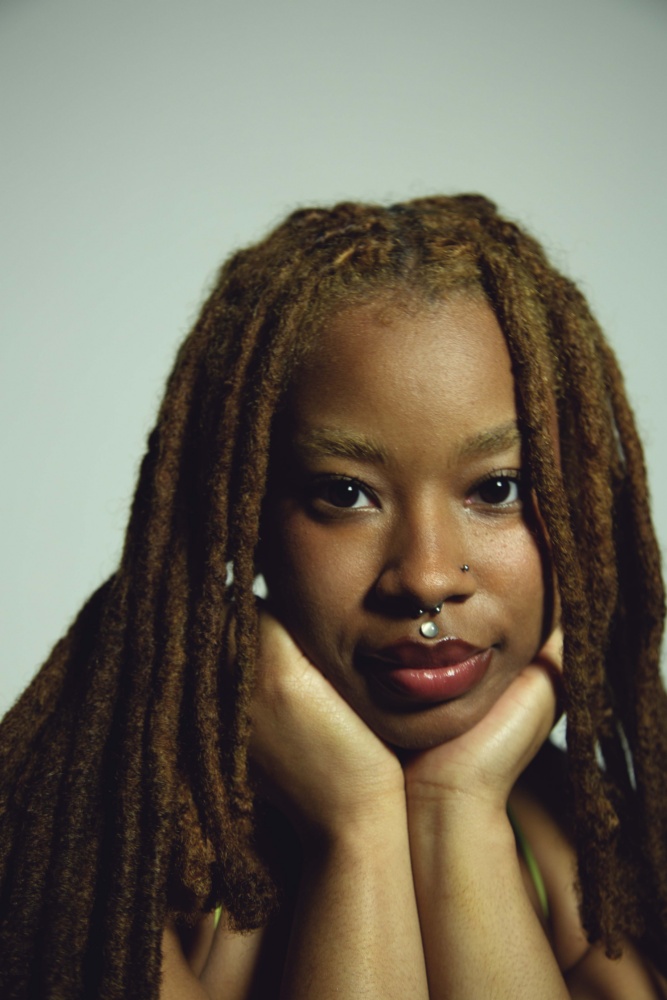
Akeylah Wellington didn’t just choose the loom; she answered its call. The boondoggles and lanyards she crafted throughout her childhood evolved into an ancestral vocation of slow crafting. The loom became her anchor during a constant search for grounding to salve the effects of a nomadic upbringing. Weaving for hours in the warmth of her Columbus, OH, home studio, the meditative practice became a bridge between the defining moments of her personal life and the broader strokes of society. Through the warps and wefts, she sorts through displacement and loss.
Born in Miami, Wellington was raised in the subtropical embrace of her mother’s Guyanese roots. Carrying the nomadic tradition of her family, her mother drifted through the South before ultimately anchoring the family in Louisiana. That stability remained until 2003, when incarceration forced a premature end to Akeylah’s childhood. For the next seven years, her life existed in what she describes as a “gap”—a liminal space while she was raised by family and friends in Miami, Louisiana, and Georgia. The repeated relocations and the severed connection to her mother’s presence birthed a profound sense of displacement. She experienced the Black childhood requirement that is distressingly frequent: developing an astute political awareness while trying to inhabit the glittery simplicity of girlhood.
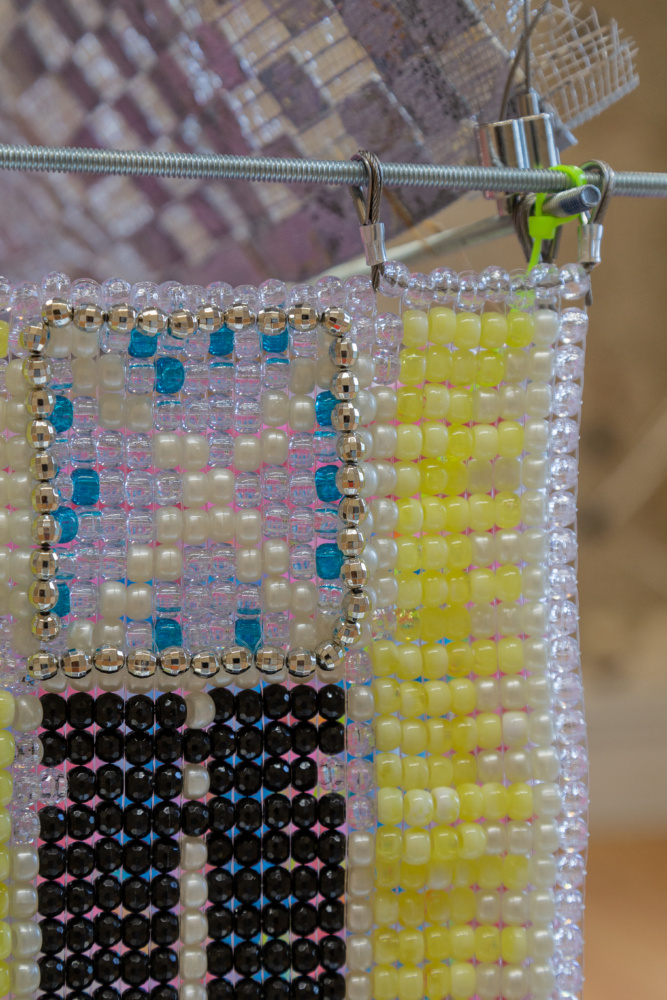
There is a quiet ache that emerges when searching for a belonging that has been stolen. The ache followed Wellington even after she reunited with her mother. Her piece, Baby Book (2024), is an oversized recreation of the record her mother lost during those years of state-sanctioned absence. Its six pages of pony bead tapestries bound together demand the viewer to physically flip through a lost history. Multicolored beads recreate placeholders for handprints, footprints, and an umbilical cord.
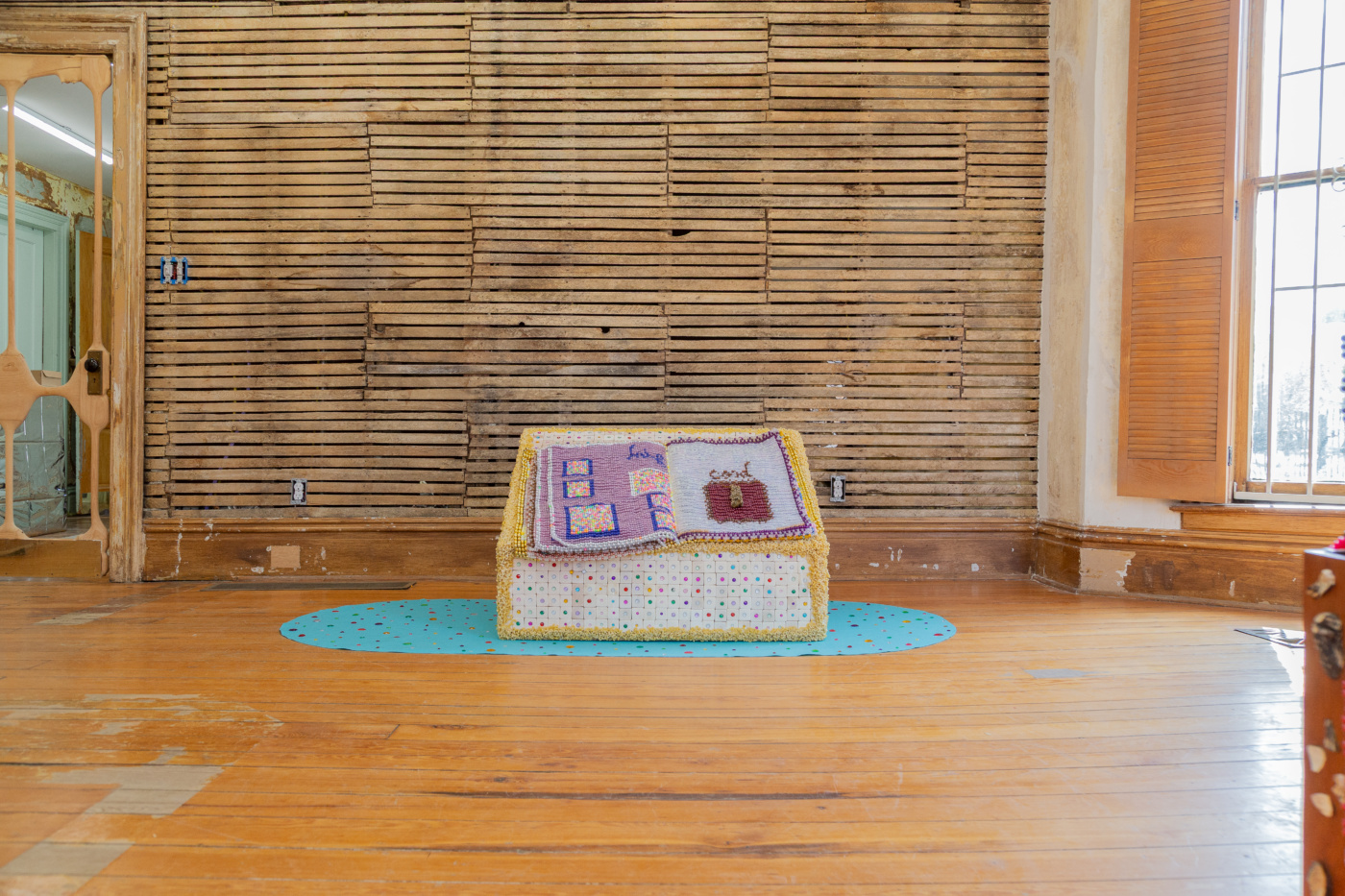
In the early 2000s, a baby book was a physical manifestation of consideration. By recreating this lost object with pony beads, Wellington highlights the true cost of the US prison system. It doesn’t just steal time; it erodes the little things that reinforce one’s personhood. There is a biting irony in the material choice—while the state can “disappear” a person or a paper record, it cannot remove the materiality that outlast the systems that try to erase Wellington. Wellington’s choice of medium is a reclamation of Black domestic culture. Weaving with pony beads began as a routine trip to the beauty supply store but morphed into something weightier. These small, plastic spheres hold the memory of home and culture; they are reminiscent of the beads that used to drip from her braids, clacking together with every movement. The rhythm of the loom now mimics that sound—the clack of the beads against the sink, the percussive music of hair being tended to between a family member’s knees.
The early 2000s were a collision of life-altering shifts—the rise of the digital age and the hardening of the political landscape—all while Wellington navigated the widening gap left by her mother’s absence. This duality is captured in Miss Wilma (2024), a meditation on the 2005 hurricane. Wellington created the large-scale tapestry after reflecting on her mother’s experience being incarcerated during Katrina—watching women being ushered into the jail because their own cells were flooding. The work is a searing look at the luxury of safety and the political implications of being marginalized during a natural disaster.
In Miss Wilma, Wellington captures the storm using green, blue, purple, and white beads that softly mimic microwave satellite imagery. It addresses technology’s inability to truly capture the layers of devastation and displacement of any major historical event. The beads pixelate the image, making it slightly unclear and hard to read, similar to the technological barrier that can collapse the human experience into flat images for entertainment. Similarly, in Baby bush, you made my eyes go wide and stay there (2024), she recreates the “Mission Accomplished” banner from George W. Bush’s 2003 speech. Raised Muslim during the Global War on Terrorism that ensued after 9/11, Wellington uses the tapestry to document how global invasions filtered down into her private reality, recording a moment of institutional betrayal; a dark moment of political dishonesty that filtered into her childhood reality, rendered in beads to juxtapose global lies with private memory.
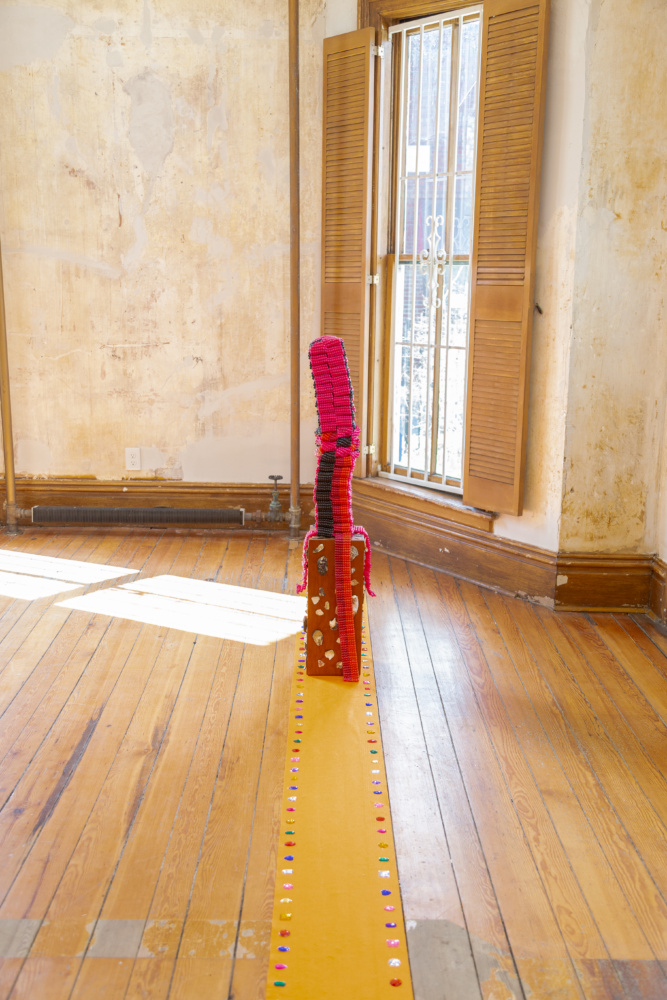
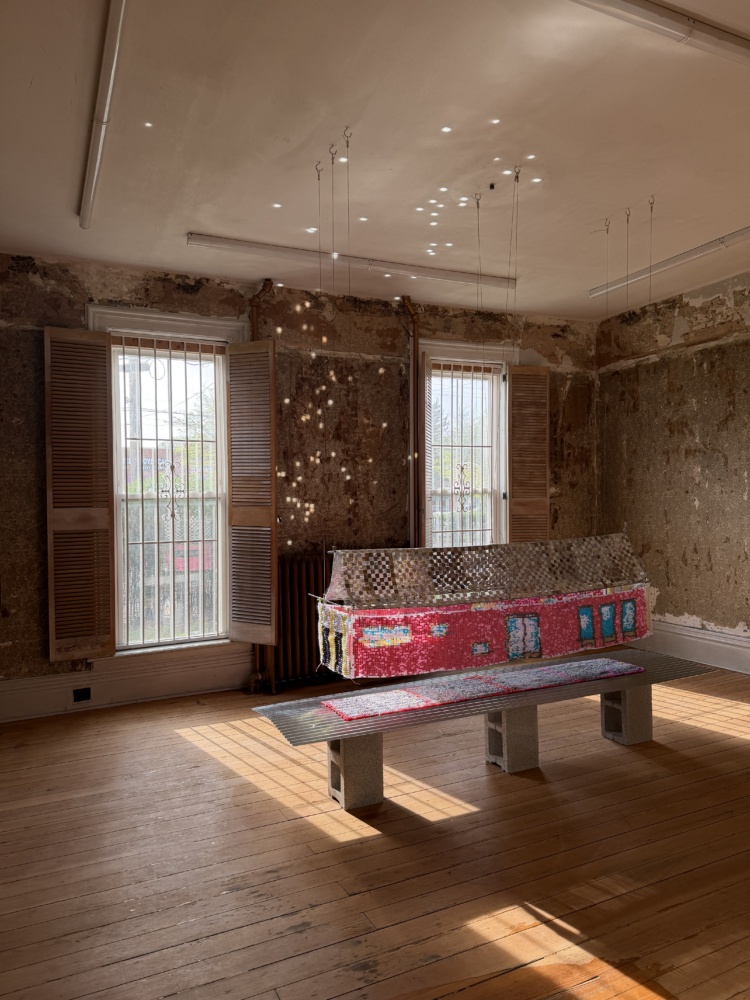
Her work is a humorous “femme-ing” of politics—using humor not as a joke, but as a verb: to humor the world is to endure it. Wellington’s new project, my new build! at SHED in Cleveland, OH, is the culmination of this tone and philosophy. In the center of the room, a play scale shotgun house is suspended in the air. The hot pink tapestry walls, adorned with blue windows, glitter against the sunlight. The shotgun house—a form of architecture stretching across the Caribbean, Africa, and the American South—is known for being a cost-effective, space-conscious, and climate-smart housing solution tailored for Black communities in the South.
There’s a layered beauty to this exhibition existing within the SHED projects space. SHED originated in a shotgun house located in Louisiana before Gabrielle Banzhaf and Jon Gott, founders and curators of SHED, relocated to their home and new space in Cleveland, Ohio. To create a shotgun house as a sense of home, place, and heritage within this space is a full circle moment for all.
Wellington, much like the shotgun house, has lived a life defined by adaptation and movement. In an economy where her generation is priced out of even the most basic shelter, the shotgun house becomes a symbol of the grounding that remains just out of reach. By weaving this house, Wellington is engaging in a radical act of ownership. If the system won’t let her buy a home, she will build one out of the only things she has been allowed to keep: her culture, her labor, and the plastic beads that once clacked in her hair. It is a whimsical, fun, girly-pop protest that finally fills the gap, proving that home isn’t just where one settles—it’s what is carried.