The consideration of the future makes us take responsibility for our nostalgic tales.
Svetlana Boym, “Nostalgia and Its Discontents”[1]
Just because something is a replica, doesn’t mean that it is a fake.
Lauren Bufferd, Museum Assistant Director, The Parthenon[2]
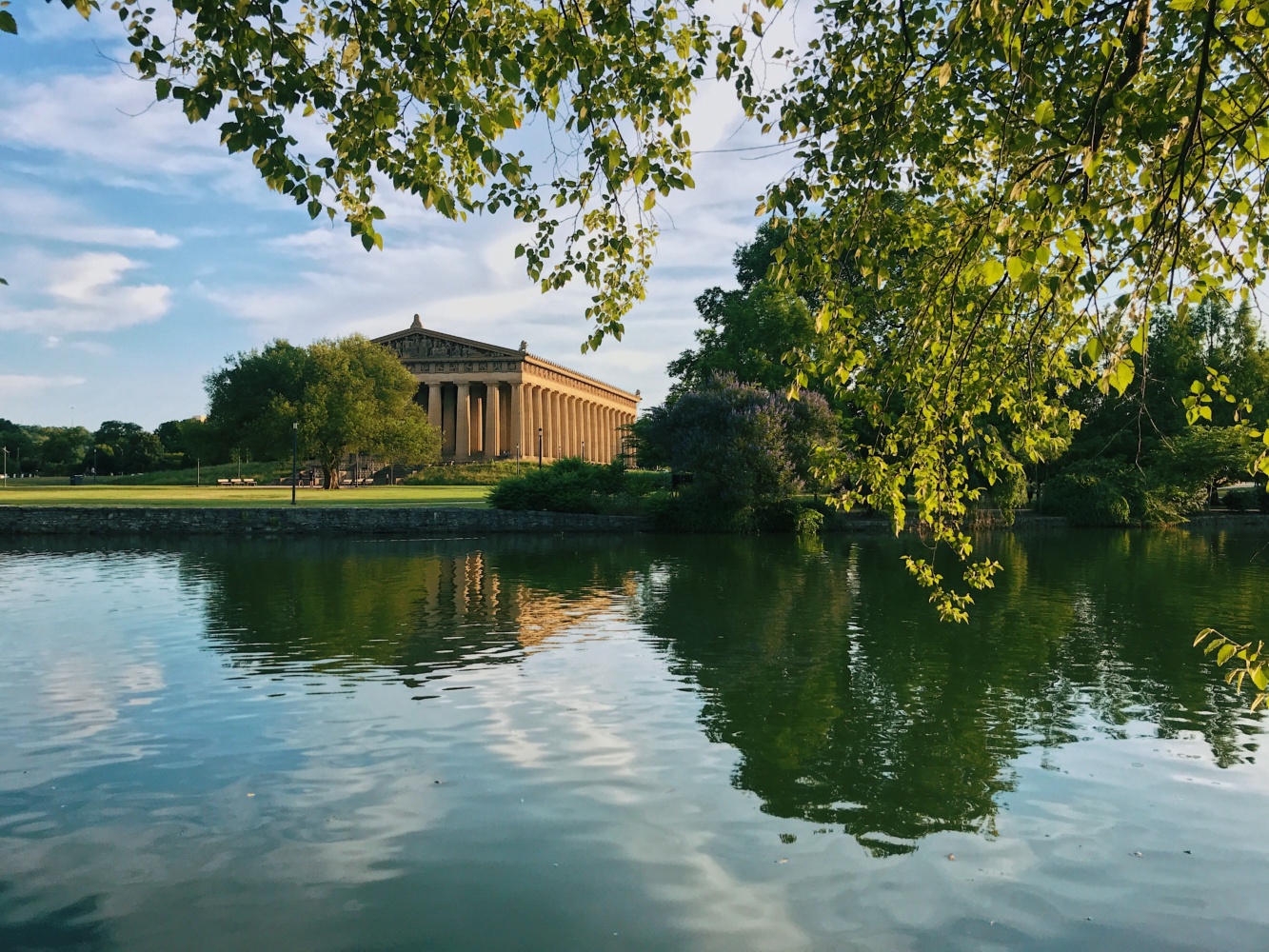
In the summer of 2025, on a hot July day, a friend and I parked in a maze of unmarked spaces, and approached the main attraction surrounded by a meticulously trimmed lawn. We dodged the scooters and strollers of a vast park, and when reaching the concrete steps, I stopped to take a picture for three tourists wearing visors and t-shirts, accompanied by their look-alike dogs. I moved back, attempting to get some of the monumental structure in the frame. Entering the cool lower level, we bought tickets and stepped into the interior of the Parthenon. No, not that Parthenon. I was in Nashville, Tennessee.
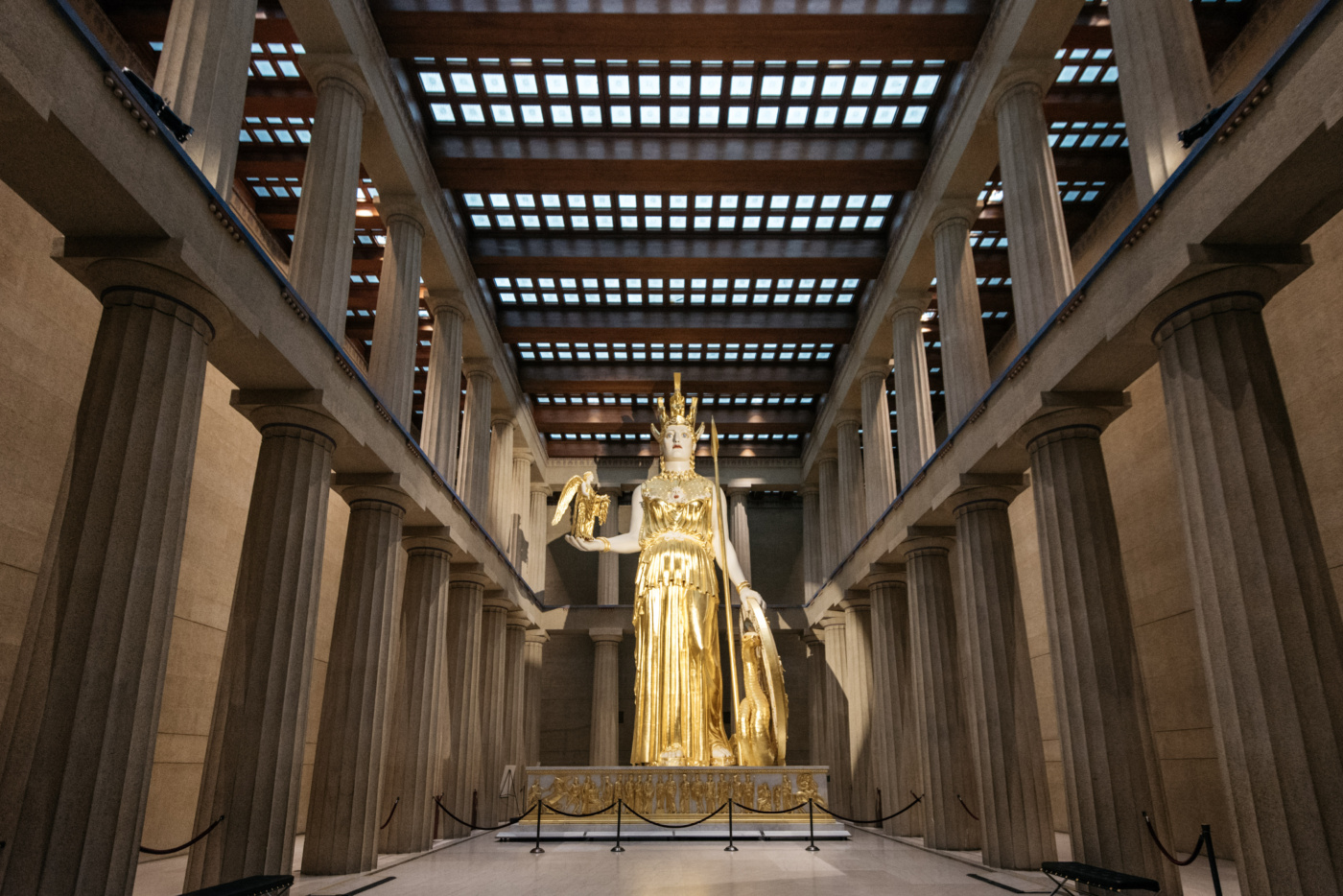
The entrance included an information booth, glass display cabinets, and didactic panels along with a cramped gift shop and an unexpected contemporary art gallery. Ascending the stairs to the main floor, I felt the uncanny sensation that I was stepping into a miniature. By that, I mean I became acutely aware of scale, the scale of the building and the shrinking scale of my body in relation. Inside, I found structurally and metaphorically smooth surfaces: imposing columns, weighty metal doors, checkered skylights, and echoing marble floors. It was perfected in the way a miniature is, pristine and complete.
Everything was physically in place, and because of that, in effect, out of place. Beyond the architecture itself, I was dumbstruck by the gigantic figurative sculpture that occupied the center of the room. Arched eyebrows, gold eyelashes, pale skin, red lipstick, and reflective draping—it was like the Statue of Liberty in gold lamé. On one side of her, an ornate serpentine shield and sharpened spear; on the other, her own hand outstretched and within it a winged, angelic figure that measured six feet tall.
I was inside the only “exact-size and detail replica” of the Parthenon in Athens, Greece.[3] The Greek Parthenon, built in the mid-fifth century BCE, is a prime example of Classical architecture and was intended to be a representation of the Athenian citizens’ refined cultural identity as purveyors of a new political order: democracy. Professing purity, it is named for the Greek word parthénos, meaning “maiden, girl,” as well as “virgin, unmarried woman.”
At the summit of the Acropolis, the storied site of social gathering and political debate, the Parthenon housed a monumental gold and ivory statue of Athena, the goddess of wisdom, reason, and warfare.The building offered a place to commune with the deity, while also serving as the city’s treasury. The Greek structure has gone through many reconstructions and repairs. The remnants of a prior building once erected on the same site are visible in the Parthenon’s limestone foundation. The rest of the structure that remains today is made of Pentelic marble, a new material in the fifth century BCE.[4] Sculptures, pediments, and a detailed frieze adorn the exterior and depict a religious procession of common Athenians.
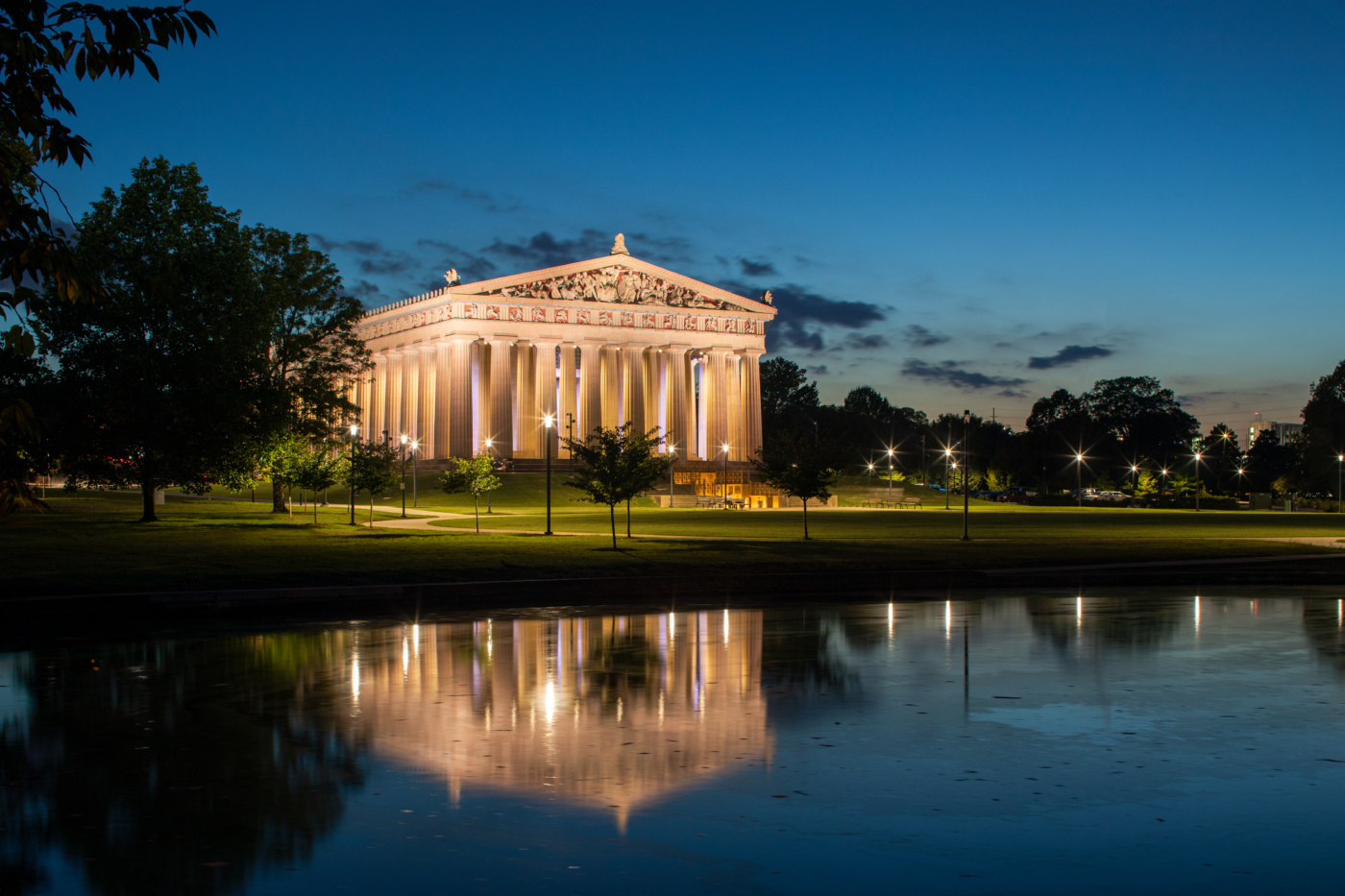
Centuries later, the Nashville Parthenon, also called the Fine Art Building, was constructed as an affirmation of Tennessee’s educated population and to solidify its nickname as the “Athens of the South.” The project was designed by former confederate soldier William Crawford Smith for the 1897 Tennessee Centennial and International Exposition marking Tennessee’s hundred years of statehood.[5] More than 1.8 million people attended the fair, and the Parthenon was just one of several attractions, including an Egyptian pyramid. The interior of the original building, at the center of centennial park, did not mirror the Athenian Parthenon, but instead housed borrowed American and European art.
The origin story of the Fine Art Building lays bare its creators’ intentions. Nashville’s Parthenon is a monument to desire, and the relocation of the Doric order to the American South an expression of collective longing for the formation of legacy. As is often true, this authentication depended upon palliative storytelling around regional identity. The building’s layered anachronism, implemented with form and materiality, works at the behest of nostalgia. Not any nostalgia, but what the theorist Svetlana Boym called “restorative nostalgia”—the impulse toward an idealized past that never was.[6] Activating another place and another time, the building, dropped upon a sprawling park, is not native. Instead, it is self-serious grandeur—irony never really took a strong hold in the South anyway—and a forceful imposition realized in totality beyond the ruinous site of Athens. Through the Nashville Parthenon’s earnest sociopolitical analogy, collective, regional, and national identity shores itself up with aspirations of the past.
Made of degradable materials like wood, brick, and plaster, the Parthenon fell into disrepair not long after the centennial, by 1920. Having “crystallized for Nashvillians their image of themselves and their city,” the replica was to remain, and officials decided to tear down and rebuild.[7] The architect Russell Hart and consulting architectural historian William Bell Dinsmoor were hired to design the new/old building but with a sturdier, twentieth-century material: concrete. The sculptor George Julian Zolnay, who produced the Doric frieze of the earlier iteration, was asked to recreate his work, while the artisans Belle Kinney and Leopold Scholz were tasked with the pediments. In order to most closely reproduce the figures, the project team purchased casts of the original Greek Parthenon’s marble figures from the Victoria and Albert Museum, which were themselves acquired under questionable and still-contested circumstances in the nineteenth century by the collector Lord Elgin.[8]
The new Nashville Parthenon opened in 1931, but without the exterior Ionic frieze or the interior statue of Athena. For decades, the Fine Art Building and surrounding park served as a gathering space, hosting citywide events such as the former Nashville department store Harveys’s nativity scene from 1954 to 1967.[9] In 1982, the sculptor Alan LeQuire won the bid to construct an “accurate” monumental Athena statue for the interior. In part because no current Athena statue is visible in Greece, LeQuire invested eight difficult years of work into the commission. He initially worked in plaster and wood, but later moved to steel, chopped fiberglass, and gypsum in order to make it both structurally sound and physically lighter. Athena was ultimately unveiled to the public in 1990. After further fundraising, the gilding and paint were added to complete the work in 2002. Today, the Parthenon is a bustling tourist site operated by the Metro Nashville Parks and recreation department. The building is a prime example of Greek Revival architecture, and. Athena is “the largest indoor sculpture in the Western world.”[10]
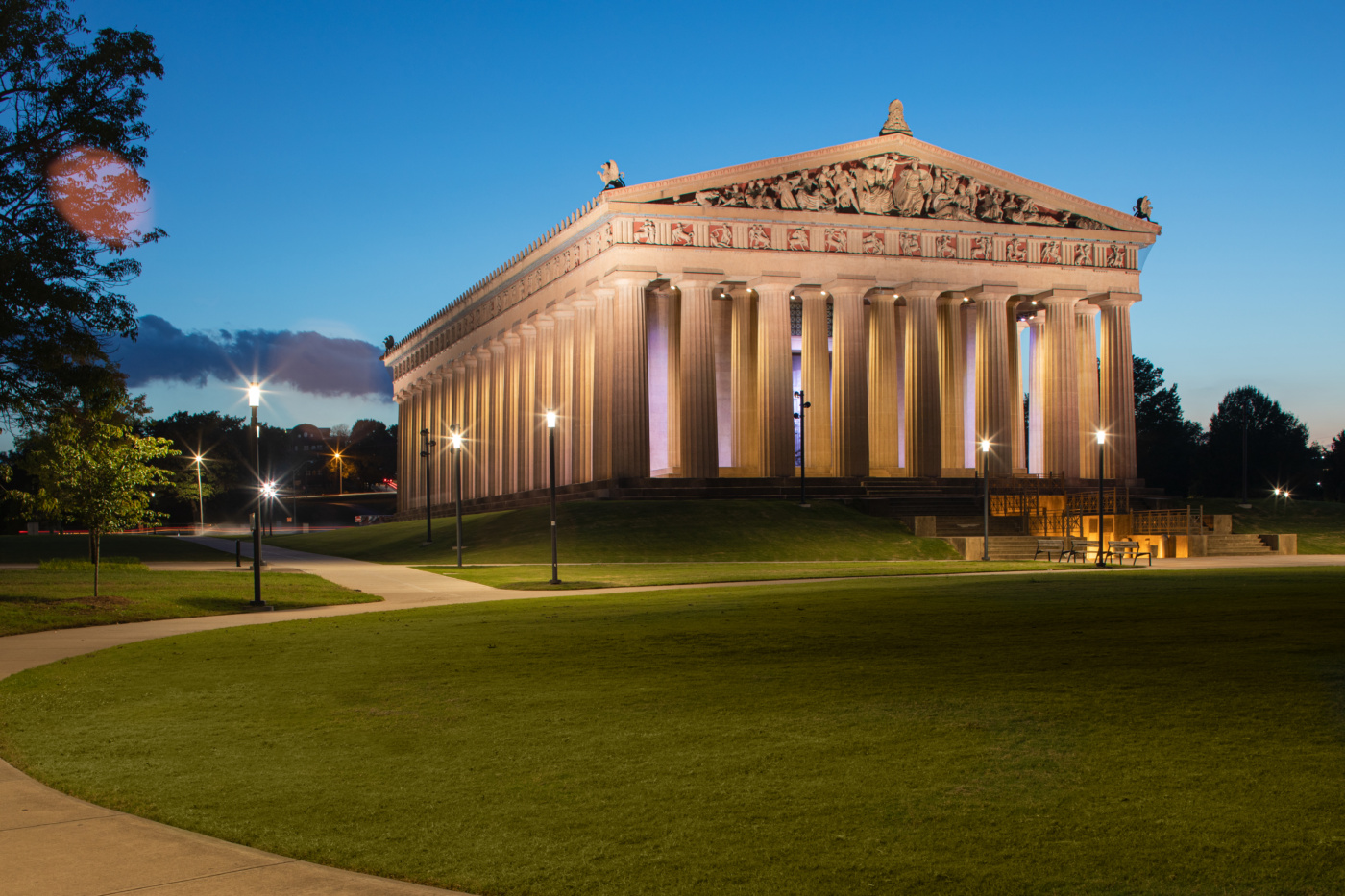
The Nashville Parthenon, in form, propagates culture and democracy, but in material, muddles time periods. The facade, while physically reinforced, metaphorically crumbles. According to the Parthenon’s short educational film “The Real, the Replica, and the Copy,” “a replica is an exact copy, and it has a positive connotation, a copy that someone has worked on to make it accurate and precise.”[11] While authenticity is invoked in a replica, it can never become the original. Yet, the architectural replica signals a clear comparison: Tennessee and the creators of the Parthenon lionized and restored to long-centuries-prior completeness the physical manifestation of Greek democracy without having to articulate how that ideal lives on in the region.
Perhaps even more unique to the Parthenon example is the way that its construction materials clash with and hearken to a more complex reality. Its material developments speak to the means rather than the message. Forgoing the historically accurate limestone or Pentelic marble of the Greek Parthenon, the 1897 exposition iteration was made of available, temporary materials: plaster, wood, and brick. These were later substituted for new, more durable concrete. Further, developments in casting (and dubious travel across national borders) made the detailed pediments of the 1931 reconstruction possible. Athena, decades later and eight years after the sculpture was originally commissioned, came to fruition through chopped fiberglass and gypsum. Each of these gestures—towards improving upon what was already supposed to be an ideal—attests to the Parthenon creators’ symbolic alignment with a structure that never actually existed.
Nashville’s Parthenon is a monument to desire, and the relocation of the Doric order to the American South an expression of collective longing for the formation of legacy.
This striving toward a perfected past through the implementation of a new material is an imposing form of anachronism. From the Greek term anachronismos, anachronism rejects chronology even as it acknowledges time’s passing. In this case, it is not the result of an error or oversight, but an intentional conflation. Upholding the mythical comparison of Nashville to Athens, the United States to ancient Greece, while also staking out supremacy, the reconstruction of the structure is not a wistful, passive longing. It is forceful, with intentions toward the future. Lost, plucked out of time, the Nashville Parthenon is a concrete fantasy.
Anachronism invoked by desire is a tool for nostalgia. The word nostalgia has Greek roots, but originated in the seventeenth century. The sensation is often attributed to a longing for another place but is in fact a longing for a time that never was. The conflict one experiences from that time’s loss or absence ensures that the feeling of nostalgia is insatiable. Nostalgia is a sustained mythology; to what end depends upon the directionality of that desire.
Boym’s conception of nostalgia distinguishes between two kinds: reflective and restorative.[12] Reflective nostalgia is personal, a deep wish to return to another time. It is gauzy, heavy with memory, but holds the possibility for criticality. In contrast, restorative nostalgia (of the kind motivating Nashville’s Parthenon) dresses itself up as truth, but is brought on by a collective fever, a hope to reinstate, and is often nationalistic in agenda. Restorative nostalgia calls upon tradition and universality. Throughout history, it has been invoked on daises in order to incite fear. Though Boym acknowledges that these categories are not clear-cut, their narratives, intentions, and effects remain distinct. Nostalgia as a tool has extended beyond the overtly political sphere; it appears too in the way we remember history. Boym writes, “In the mid-nineteenth century, nostalgia became institutionalized in national and provincial museums, heritage foundations, and urban memorials. The past was no longer unknown or unknowable. The past became ‘heritage.’”[13]
Standing in the Nashville Parthenon, I immediately understood I was in a temple not devoted to the goddess Athena, but to Boym’s restorative nostalgia. It follows a plot Boym articulates, that of “origin.” From the initial motivation to prove that the Tennesseans were an educated people, to the “crystallizing” of identity that inspired its rebuilding, to the didactics in the Fine Art Building that assure audiences that this Parthenon is just as real: Legitimacy, a correlation with the original, is everything. Drawing on another place in another time—which no contemporary visitor could or would have experienced—the Parthenon reaches for validation through a history that is not its own. Evident is Boym’s notion that architectural reconstructions can serve as material embodiments of nostalgia. It is the restorative impulse to fight or erase reflective ruins: Ruins recognize but do not attempt to rectify time; bulldozing existing dilapidated structures, which show time’s passing, reveals that preservation was never the point anyway.
Upon leaving the Parthenon, we wandered around Centennial Park. It was a beautiful day and people were picnicking on benches, eating ice cream, and playing games. The place felt recreational, casual, and innocuous. As we walked to a nearby festival, concrete columns receded behind me. I realized it was the passivity and the pleasantness of the experience that alarmed me. I was not struck by beauty; it was the quiet oddity, the unfettered insistence that made me uneasy. My arm was twisted, the persuasion too convincing. I was out of time, both displaced and at a loss, powerless within a delusion perfected to exert power. It was just as Boym warned: “The danger of nostalgia is that it tends to confuse the actual home and the imaginary one. In extreme cases, it can create a phantom homeland, for the sake of which one is ready to die or kill. Unreflective nostalgia can breed monsters.”[14]

[1] Svetlana Boym, “Nostalgia and Its Discontents,” The Hedgehog Review: Critical Reflections on Contemporary Culture, January 22, 2026, https://hedgehogreview.com/issues/the-uses-of-the-past/articles/nostalgia-and-its-discontents.
[2] Lauren Bufferd, “The Real, the Replica, and the Copy,” posted April 21, 2021, by Nashville Parthenon, YouTube, 4 min., 49 sec., https://www.youtube.com/watch?v=6eAg2s7bhsM&.
[3] “About the Parthenon,” The Parthenon, accessed January 22, 2026, https://www.nashvilleparthenon.com/history.
[4] “The Parthenon Gallery,” Acropolis Museum, accessed January 22, 2026, https://www.theacropolismuseum.gr/en/exhibit-halls/parthenon-gallery.
[5] “History of the Nashville Parthenon,” The Parthenon, accessed January 22, 2026, https://www.nashvilleparthenon.com/history.
[6] Boym, “Nostalgia and Its Discontents.” See also Boym, The Future of Nostalgia (Basic Books, 2001).
[7] “About the Parthenon,” The Parthenon.
[8] In 1802, the Scottish nobleman Lord Elgin claimed to have permission from the Ottoman Empire to remove half of the marbles from the Parthenon. They were shipped to England and later sold to the British Museum, where they are still on view. Elgin also cast many of the marbles that remain at the Parthenon in plaster. The Greek government continues repatriation campaigns to reclaim the extracted frieze from the British Museum. See the “Plaster Casts of the Elgin Marbles Are Actually Better Preserved Than the Marbles Themselves, According to a New Study,” Artnet, December 11, 2019, https://news.artnet.com/art-world/plaster-elgin-parthenon-sculpture-1728849; and “China’s President Pledges His Support to Greece in Its Effort to Recover the Parthenon Marbles from the British Museum,” Artnet, November 13, 2019, https://news.artnet.com/art-world-archives/china-president-supports-parthenon-marbles-1702401.
[9] “About the Parthenon,” The Parthenon.
[10] “Goddess in Progress,” The Parthenon, accessed January 22, 2026, https://www.nashvilleparthenon.com/history.
[11] Bufferd, “The Real, the Replica, & the Copy.”
[12] Boym, “Nostalgia and Its Discontents.”
[13] Boym, “Nostalgia and Its Discontents.”
[14] Boym, “Nostalgia and Its Discontents.”