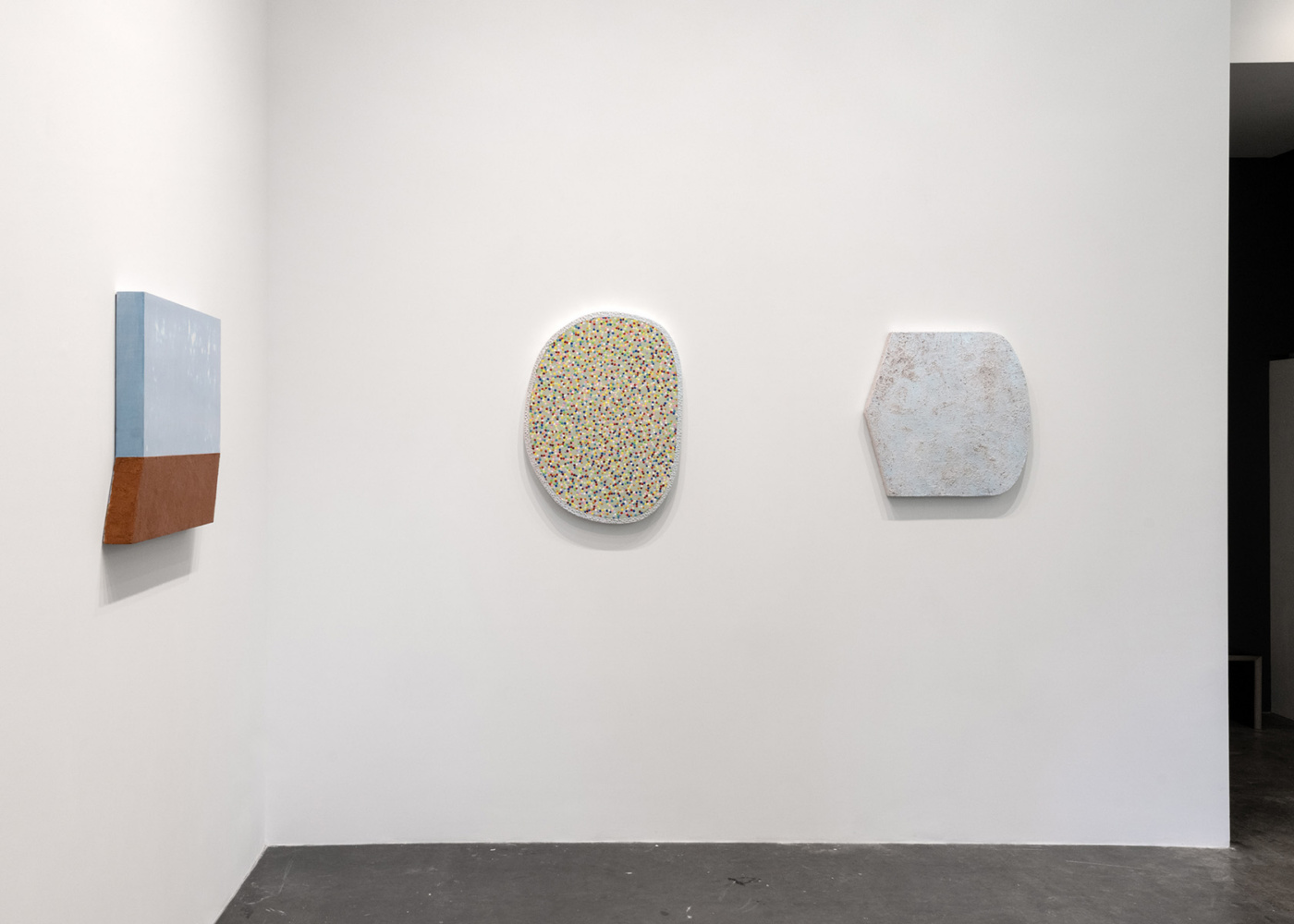
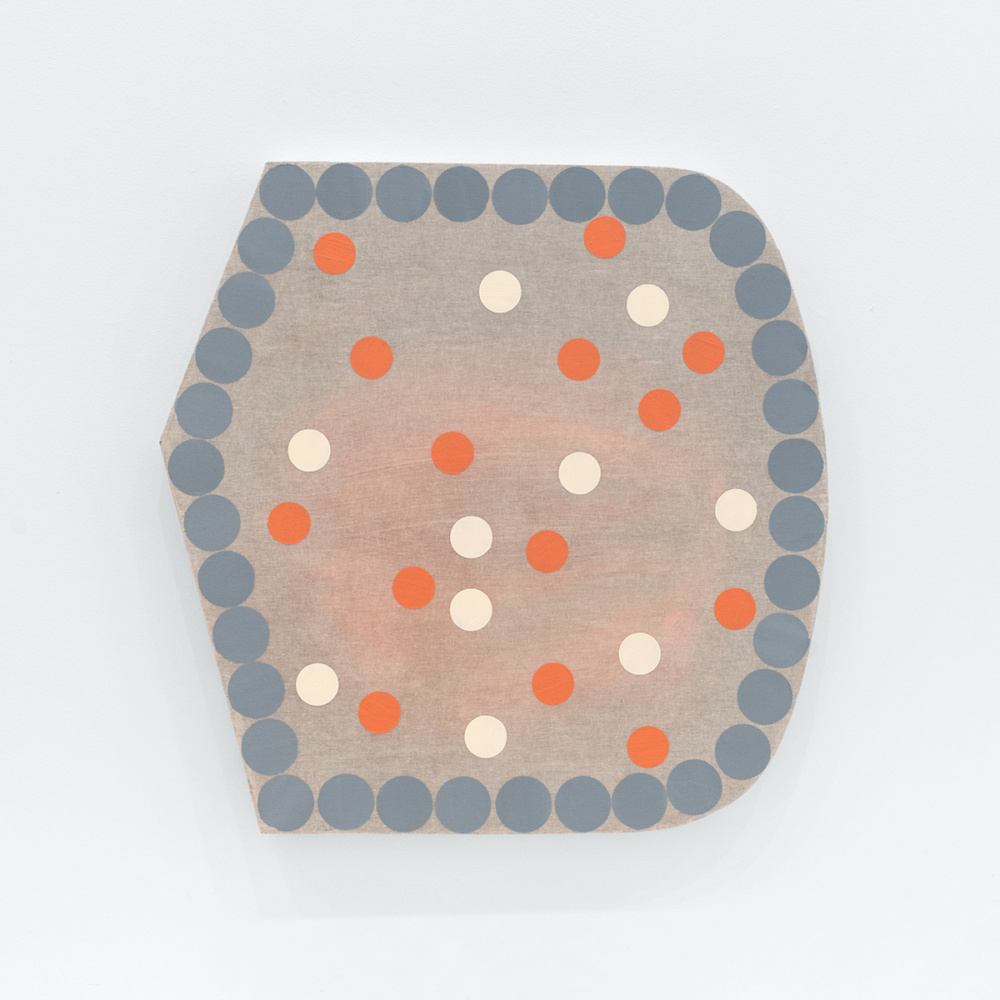
Born in Seoul, South Korea, Yun Dong Nam has been an Art Department fixture at UNC Chapel Hill for 30 years, teaching ceramics while pursuing an interdisciplinary practice of his own that includes painting—the medium he first explored after his immigration to the US in 1982. Nam’s recent solo exhibit at Oneoneone Gallery in Chapel Hill, Plane / Mass: Between Surface and Weight, featured a mix of two- and three-dimensional works that share a sparse, formal language: marks made of dots, on rounded canvases and clay vessels. The palette varied throughout, with colors ranging from highly saturated ones to muted earth tones, implying their choice was more than compositional. I visited his studio shortly after, where we discussed teaching and learning, his own influences, and the fundamental motivations and concepts that animate his practice. This interview has been edited and condensed.
Sterling Bowen: Do you remember your emotions coming to the US?
Yun Dong Nam: Yes, clearly. Coming to the United States was not about ambition to be a success. It was more necessary. I felt that I had to become an artist, and staying where I was would not allow that to happen. In the seventies, in Korea, most parents wanted my generation to attend engineering or business school, not to become artists. I was really lucky that my parents were supportive. I also had an aunt, who lived with us, who was an artist. She had a lot of books and really influenced me.
SB: So you came here to go to university?
YDN: I went to high school first. I had a great art teacher who was really supportive and helped me get accepted to Ohio State. There were a lot of great ceramic artists in the eighties, like Peter Voulkos, so it was an exciting time. I loved the faculty at OSU, who supported me. Without their help, I don’t think I would be in this situation.
SB: Do you think about that often now that you’re a professor?
YDN: Yes. I’ve been teaching for 30 years at UNC, helping students explore and also get to their next stage—graduate school and so on. But there’s a limit to what I can do. They need to find their own destination.
A lot of my students don’t become artists, which is fine. I do want them to be creators in some way in their field, so I try to tie art to physics or biology, etc. For example, when you go to the North Carolina Museum of Art, there’s a wall with glass objects that were produced more than 2,000 years ago. Those people didn’t really look at that work as “craft” or “art,” it was engineering or science.
I try to break up their perception of art, too. For example, I ask, “Why does a pot have to have an opening on the top? Why don’t we just close it and see what happens?” Many students are afraid of making mistakes because of their own perceptions of beauty. I encourage them to make really ugly stuff. There’s a lot of great artists that break with ceramic tradition, like Robert Arneson and the punk/funk movement in California.

SB: Talk about the paintings in the show at Oneoneone; why break up the surface that way—optically, with dots?
YDN: I was influenced, to some degree, by Pointillism in French painting. At a certain moment, I found myself hesitant to use line. The line can feel declarative, even authoritative. The dot, on the other hand, felt more open. The dot is the smallest unit of mark. By repeating it, I build density and vibration. It softens the boundary between surface and space. In ceramics, it animates mass.
SB: Is there something about the simplicity of language that you find to be important?
YDN: After the 18th century, we have so many great things: modernism, then post-modernism, the evolution from impressionism to cubism to pop art. If you ask me to choose one, I don’t think I’m in any of those categories. I really like minimalism because I like really simple things.
SB: I imagine you’re an Ellsworth Kelly fan?
YDN: Yeah. I like his painting. And Rothko. Rothko had one perception, and he did it for more than 40 years. I think that is amazing, but I don’t think everybody can live that way.

SB: Does that mean you like your practice to change?
YDN: I respect artists who sustain a single perceptual framework for decades. For me, perception is more fluid. I don’t think of my work in terms of brand or type. I think of it as a lifelong study.
SB: Would you say you are a ceramic artist who also paints or a painter who loves ceramics?
YDN: I would like to be recognized as a ceramic artist. At the same time, medium is not my identity. I am concerned with mass and emptiness, surface and horizon, the quiet tension between land and sky; these are fundamentally visual questions.
Painting negotiates them on a plane. Ceramics negotiates them in space, with weight and resistance. So I don’t separate those questions by medium. Whether it is paint or clay, the inquiry is the same. The dialogue between them shapes my process and my understanding of art.
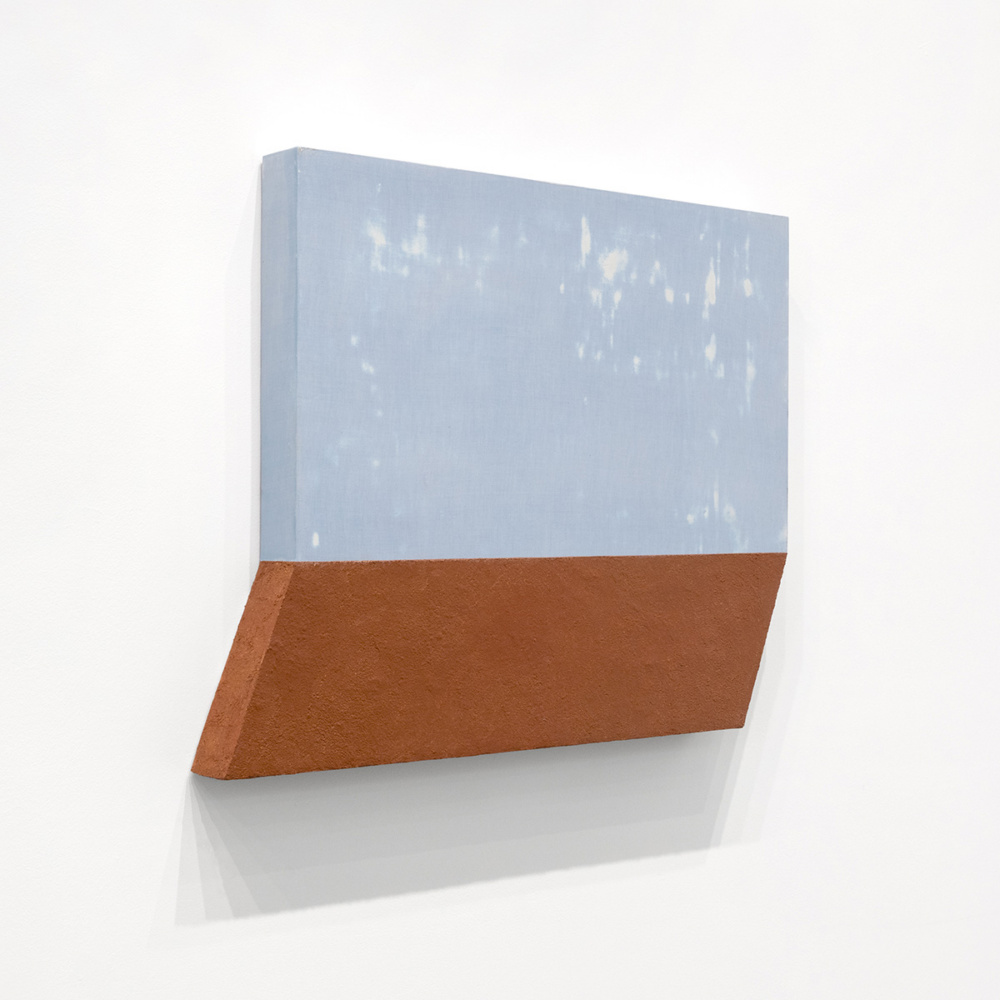
SB: During your gallery talk, you spoke about the piece Earth Color the Sky (2025)—that it was about a deluge of water and moving earth. The piece is blue and brown and has a very strong angle, which seems abstracted but also representational.
YDN: Earth Color the Sky began from a very specific moment. I witnessed the way water and earth collapsed into one another during that storm; brown rising into blue, horizon dissolving. The angle in the painting comes from that instability. Nothing felt level.
As someone who works with clay, I am sensitive to the layered history of soil. The storm revealed those layers. The painting carries that awareness, not as description, but as compression.
SB: Does color always have a relationship to the natural world for you, or is it a tool to convey emotion?
YDN: I think it’s a reference to the object itself, but sometimes it comes with emotional aspects. It’s about motivation, which doesn’t always come from good situations.
SB: Would you say that because the pandemic lockdown was not a good situation, it motivated you to make the paintings you showed at Oneoneone?
YDN: I don’t think hardship is something we seek, but it clarifies things. When circumstances feel unstable, you become more aware of what grounds you.
Coming to Detroit as a young student was not easy. It was culturally unfamiliar, physically cold, and emotionally isolating at times. That difficulty forced me inward, made me pay attention—to materials, to silence, to space. I began to understand that making could be stabilizing.
So, I wouldn’t say hardship is my motivation, but it has sharpened my perception and deepened my lifelong process of learning, both as a person and as an artist. It strips away excess and asks you what truly matters.