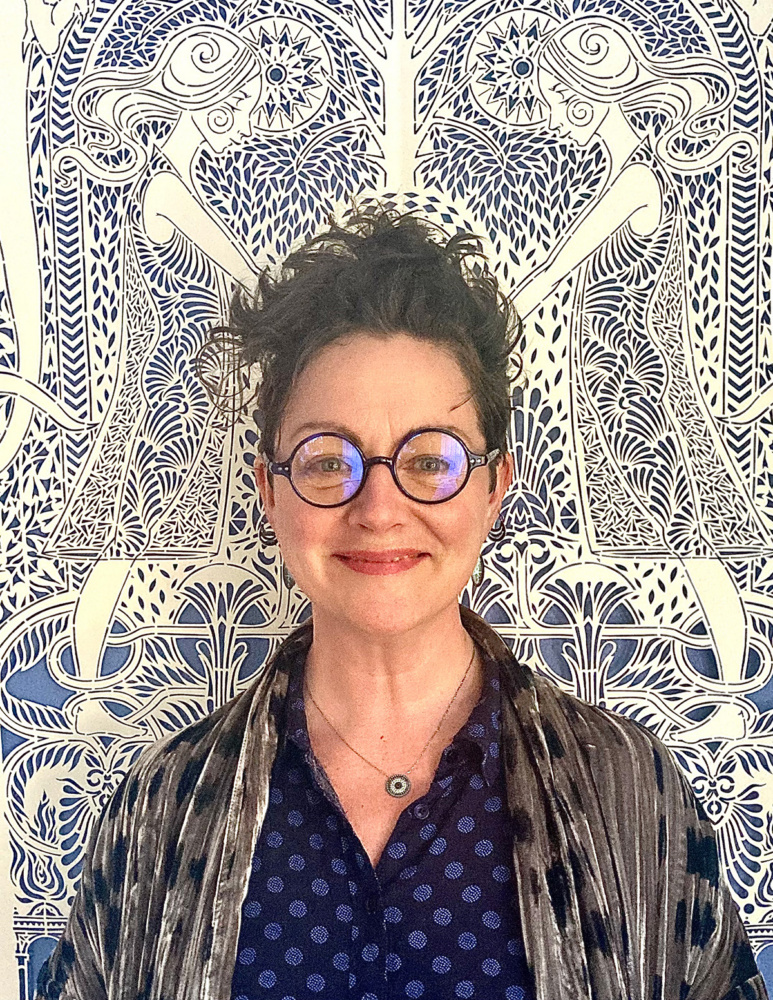
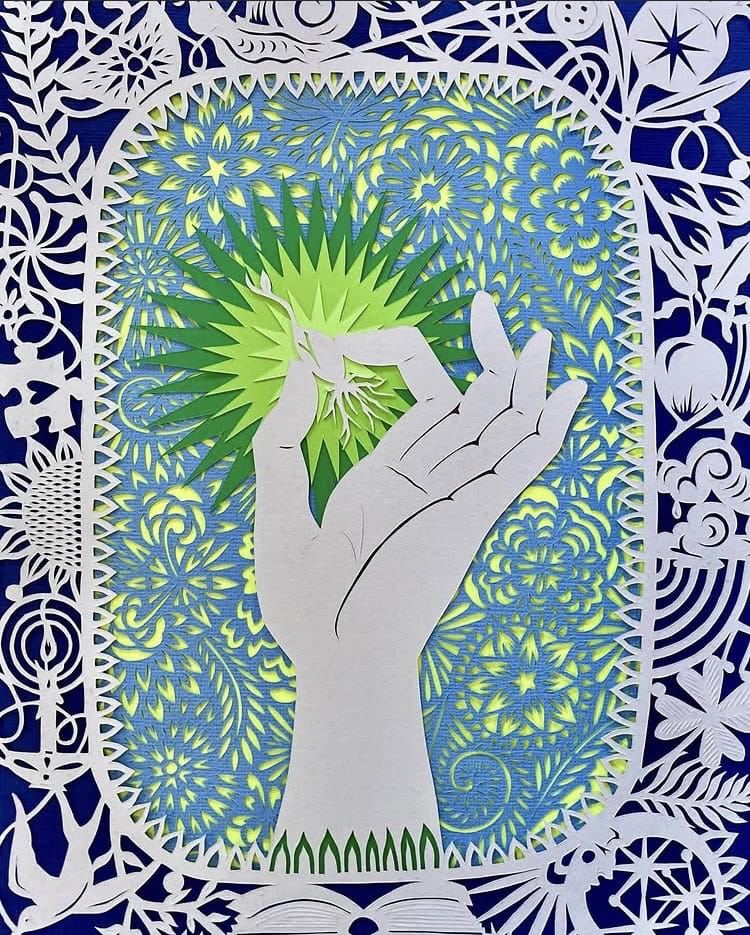
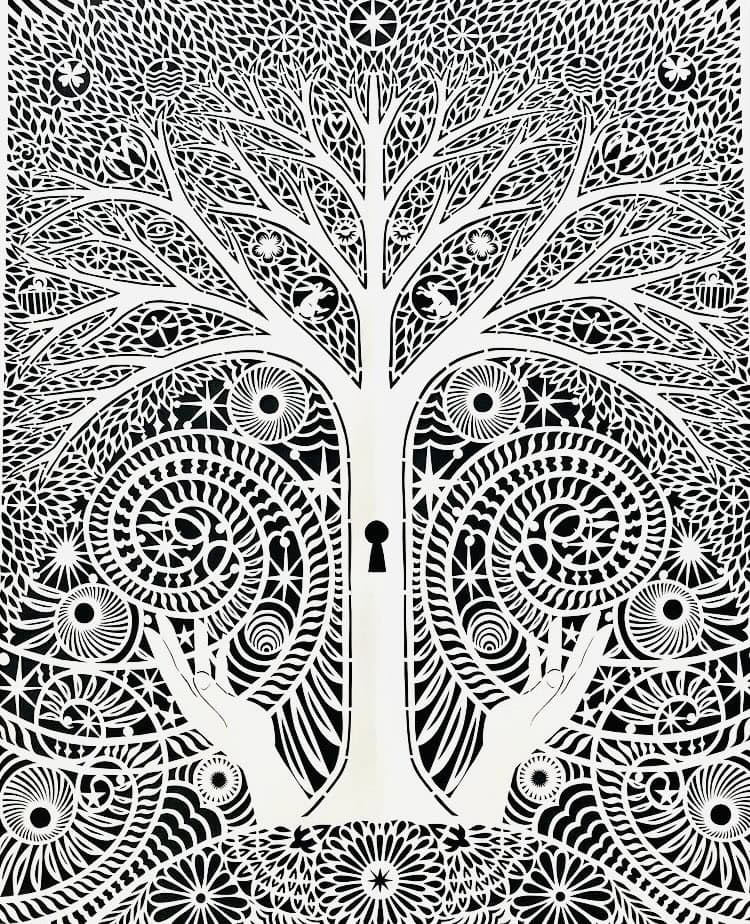
Garnet Goldman begins working with a blade and a sheet of paper, but it rarely ends there. Her intricate cut compositions, dense with flora, hair that transforms into landscape, mirrored figures, wings that double as warning signs, operate somewhere between folk tradition and private mythology. Based in Winston-Salem, North Carolina, and working primarily in paper over the past several years, Goldman has built a visual language that feels devotional without being doctrinal, precise without being rigid. Each piece is drawn entirely by hand before the cutting begins; every strand of hair, every petal, every negative space is deliberate. For Goldman, art is less a product than a constant presence, something that has remained steady through changes in belief, family life, and identity. The paper may be fragile, but the practice is not.
This interview was edited for length and clarity.
Karla James: Your work often carries a strong spiritual charge. Is that intentional, or does it emerge organically through your process?
Garnet Goldman: It is most certainly spiritual. I believe we wouldn’t have art otherwise. I think art is a spirit, like love is. To be an artist, you’re essentially a conduit. You have to have discipline and diligence, those things matter, but you also have to remain flexible. It has to flow.
But at a certain point, that well just… stopped. I couldn’t continue in that vein, and I was so disoriented by it that I couldn’t really make art for two and a half years. When I came back, I assumed I’d return to painting, but it wasn’t there anymore. Around that time, I saw a Ukrainian artist on Instagram making monumental paper cuts, thirty-foot pieces hanging in cathedrals, and something clicked. I wondered how paper cutting might translate into my language. The moment I tried it, the life came back.
The spirituality didn’t go away. It shifted. I was changing. My worldview was expanding. The images that show up now feel freer. Less prescribed.
KJ: Your paper cuts have gained significant traction compared to earlier drawings and paintings. What does that shift in medium mean to you?
GG: It’s fascinating. My color pencil and ink drawings are technically more labor-intensive for me. One 9 x 12 drawing might take two to three weeks. With paper cutting, depending on the design, I might complete a piece in a week or even a few days.
But the effect is somehow bigger. The response has been immediate. From the beginning, people asked, “How long does this take?” or “How do you even do this?” That wasn’t happening with the paintings.
Every single cut is drawn first. I never freehand directly into the paper. I sketch everything and then cut it with an X-Acto knife. For years I worked without a magnifying lamp. I’d hold a little magnifying glass in one hand and cut with the other. I finally bought a proper light last year and it changed everything. I look back at earlier works-and I genuinely don’t know how I did it.
Paper cutting opened something. It felt lighter in effort but fuller in impact. And more people connected to it personally. They’d say the work felt intimate. That matters to me.
KJ: Can you describe how a piece begins? Is there a conceptual framework, or does it unfold more intuitively?
GG: If I try to deliberately create from a concept, it usually doesn’t go well. The rule is: I sit down with a blank sheet of paper and stare at it. If a shape crosses my mind, that’s where I start. I follow it around.
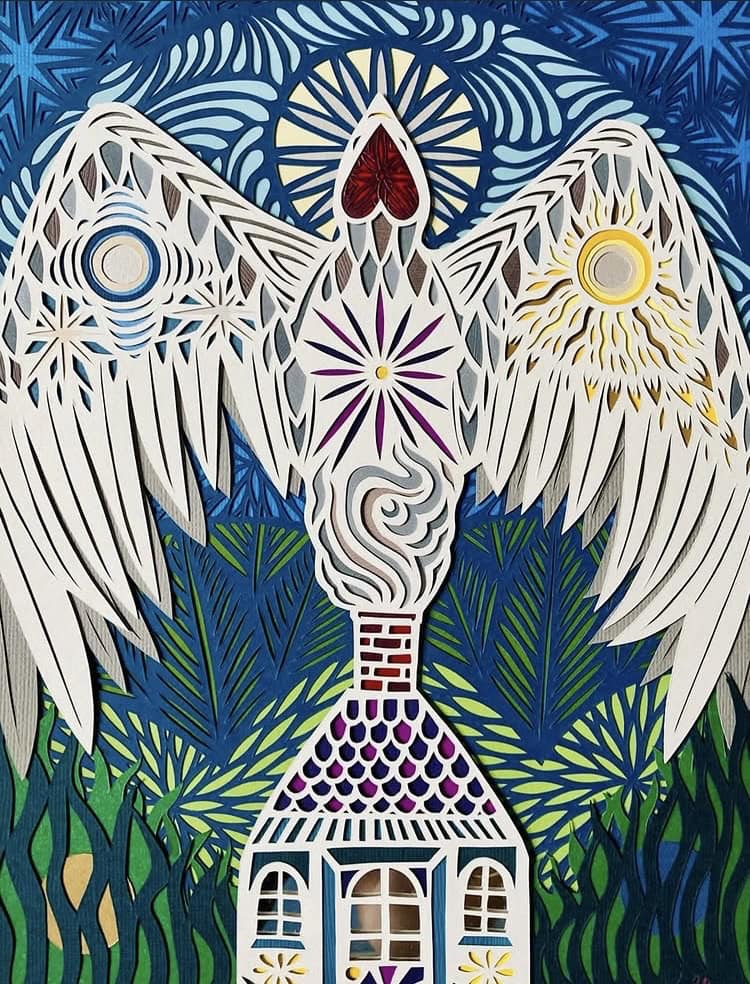
For example, one recent figure began with the shape of her hair. That was the first form I saw. As I began filling in color, the wings appeared-but they didn’t feel angelic. They felt like a canary in a coal mine. So suddenly she became a canary. That thought led to a darker background. It’s a trickle. One thing leads to another. It’s never all there at once. And that’s what makes it alive.
Influences filter in, too, but subconsciously. When I read Women Who Run with the Wolves (1989), I didn’t set out to make goddess figures. But afterward, I noticed them appearing in the work. If I try to force those connections, it kills the energy. The intuition has to lead.
KJ: You’ve spoken about periods of creative drought. How do you navigate those seasons?
GG: I don’t like them. I immediately think something is wrong with me. But the truth is, we’re seasonal. Sometimes we need to rest.
Last year, instead of making art, I poured that impulse into the garden. I felt worn out-like if I kept producing at the level I was pricing and selling, I would break. For years, my focus was on making work to sell. That started hurting me. I thought, “Is this all I’m going to do until I die?”
That’s when I finally took a bookbinding class. I’ve wanted to bind books since middle school. Making books, and small sacred objects, shifted everything. For the first time in years, I made things that weren’t meant for sale. Nobody sees them unless I choose to share them. They’re for my quiet life, my spiritual growth.
KJ: In the piece you’re currently working on, what first appeared as wings became, in your words, a “canary in a coal mine”, a figure historically used to warn of unseen danger. You’ve also said your earlier paintings were rooted in Christian metaphor but now feel more archetypal. How does that evolution shape what you’re making at this point in your life?
GG: When I made those earlier paintings, I was consciously tying everything to a specific religious framework. But even then, they were full of universal symbols – trees, birds, seeds, women, water. Looking back, they function more like archetypal images than strictly religious ones.
With the canary piece, it began as hair. Then wings appeared, and they didn’t feel angelic. They felt like a canary. I follow those shifts when they happen. I’m less interested now in prescribing meaning and more interested in letting the symbol remain open.
KJ: How does the studio itself shape your practice?
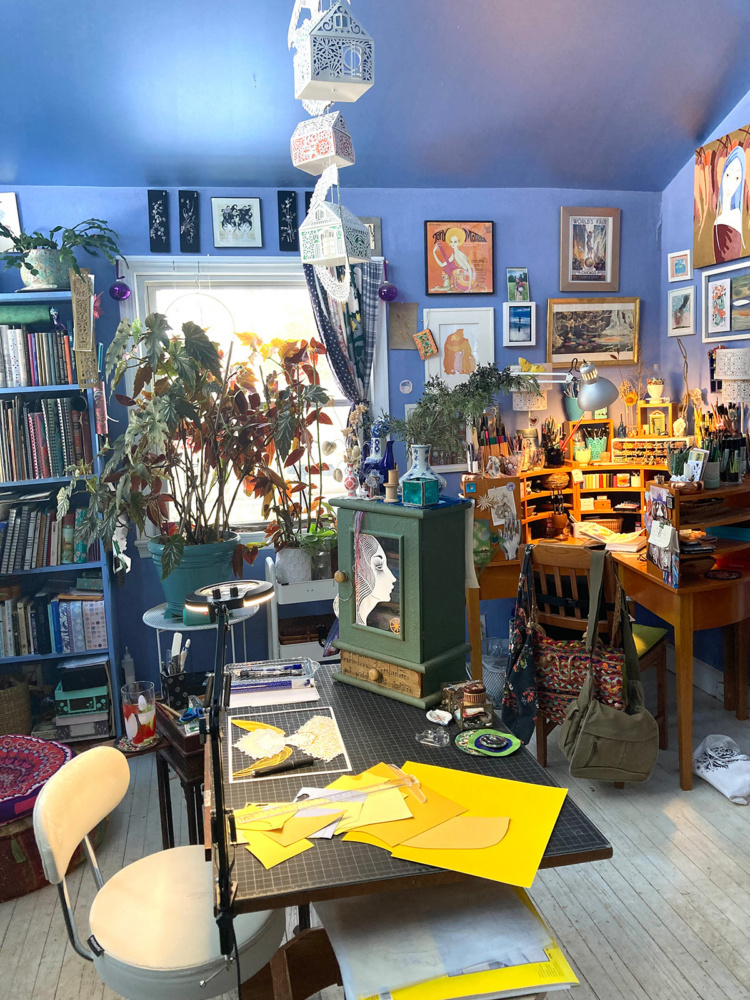
GG: Having a separate space changed everything. My studio used to be in the living room. Then in a windowless room. Now it’s my daughter’s old bedroom. It’s set apart. I keep my altar here. I tend the plants. I tend myself. It’s a sanctuary.
Art is the one consistent thread in my life. Through life’s struggles, it’s the one thing that has never disappointed or left me.