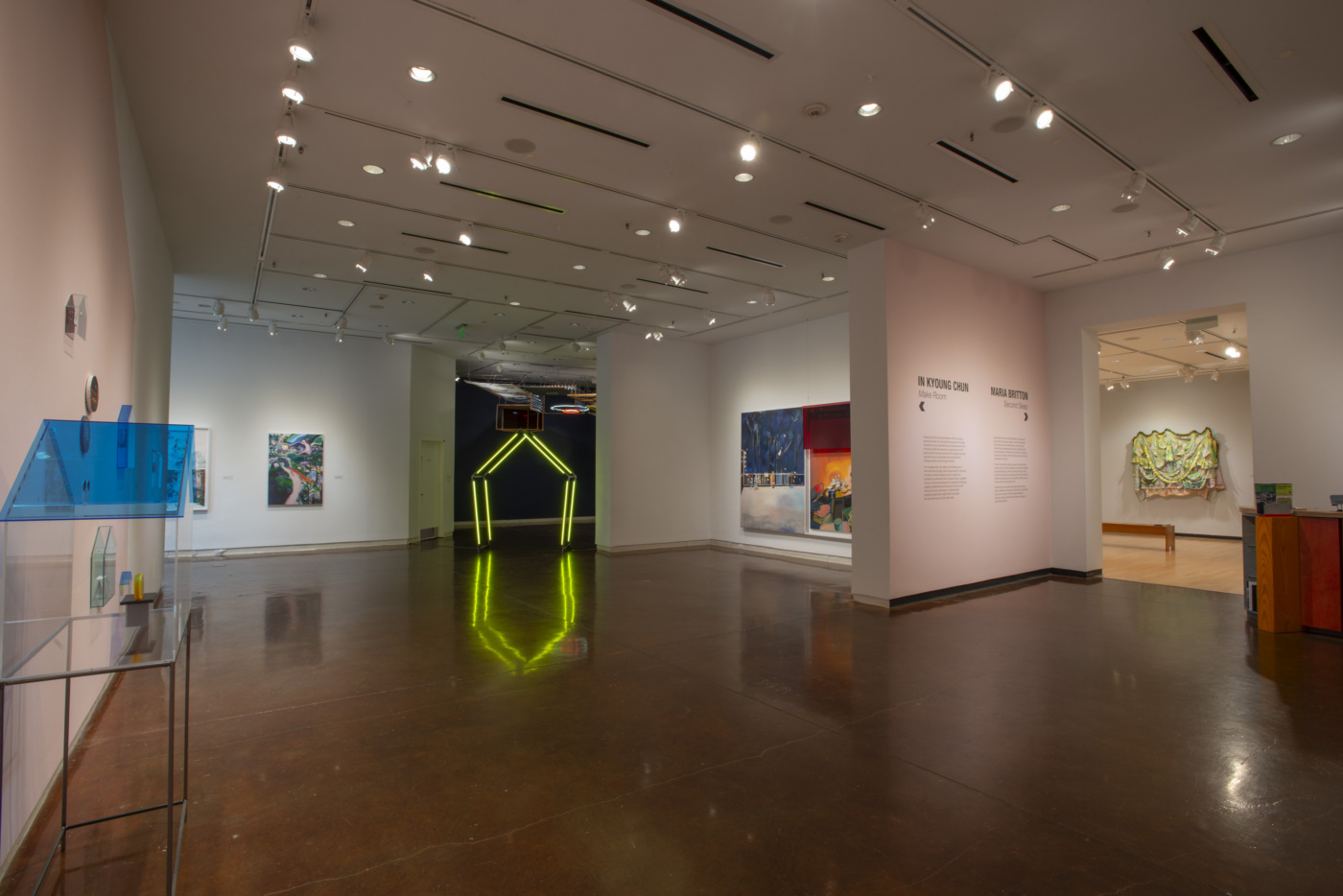
In vibrant color and innovative mediums, In Kyoung Chun’s Make Room and Maria Britton’s Second Sleep, both at the Halsey Institute of Contemporary Art in Charleston, South Carolina, investigate how the rhythms of domesticity create a foundation for the construction of individual and communal identities.
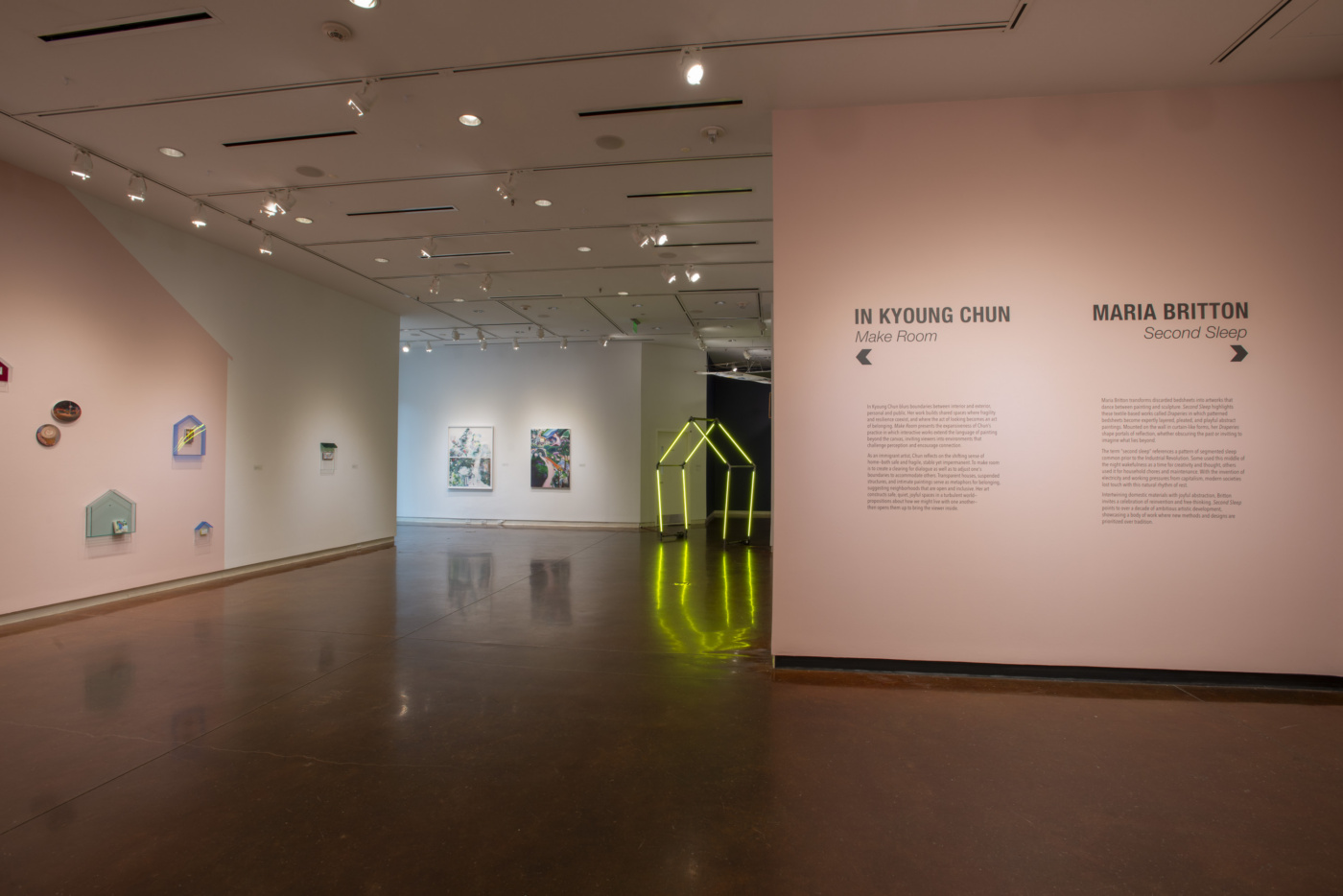
Upon entering In Kyoung Chun’s show, viewers are greeted by a minimalist pink silhouette of a home, which serves as the backdrop for Chun’s installation, Come to my House (2026). Rounded paintings, translucent prisms and pentagons, and mirrored surfaces pepper the walls at varying heights. Tiny paintings and drawings are situated within the plexiglass shapes, vignettes that occupy just a fraction of their containers.
Each of these pieces captures a quotidian moment: A dog naps in the sunlight. A table is set for a meal. A couple sits before a two-tiered birthday cake, candles aglow. Structured as just a fragment of both their individual compositions and the full installation, these scenes suggest that home—and community—is a composite of everyday rituals.

Despite existing within three-dimensional planes, these renderings are depicted in a flattened perspective. Chun’s marks are both decisive and delicate, relying on an economic use of line to articulate forms and faces. This simplicity directly parallels the ordinary nature of her subject matter—in one drawing of a man walking his dog, a single pencil stroke is sufficient to convey his contented smile .
Chun’s standalone paintings also reflect this satisfied tranquility. Scented Creek Near My Place (2023) combines watercolor and oil to form a bright, abstracted depiction of a lush landscape. Tucked away in the back of the scene, behind a plein air painter and a scampering dog, lies a minimalist house silhouette, Chun’s trademark, almost obscured by the bounty that unfurls around it. This exaggerated magnification of the world outside the home inverts and complements her contained distillations of structure in Come to My House.
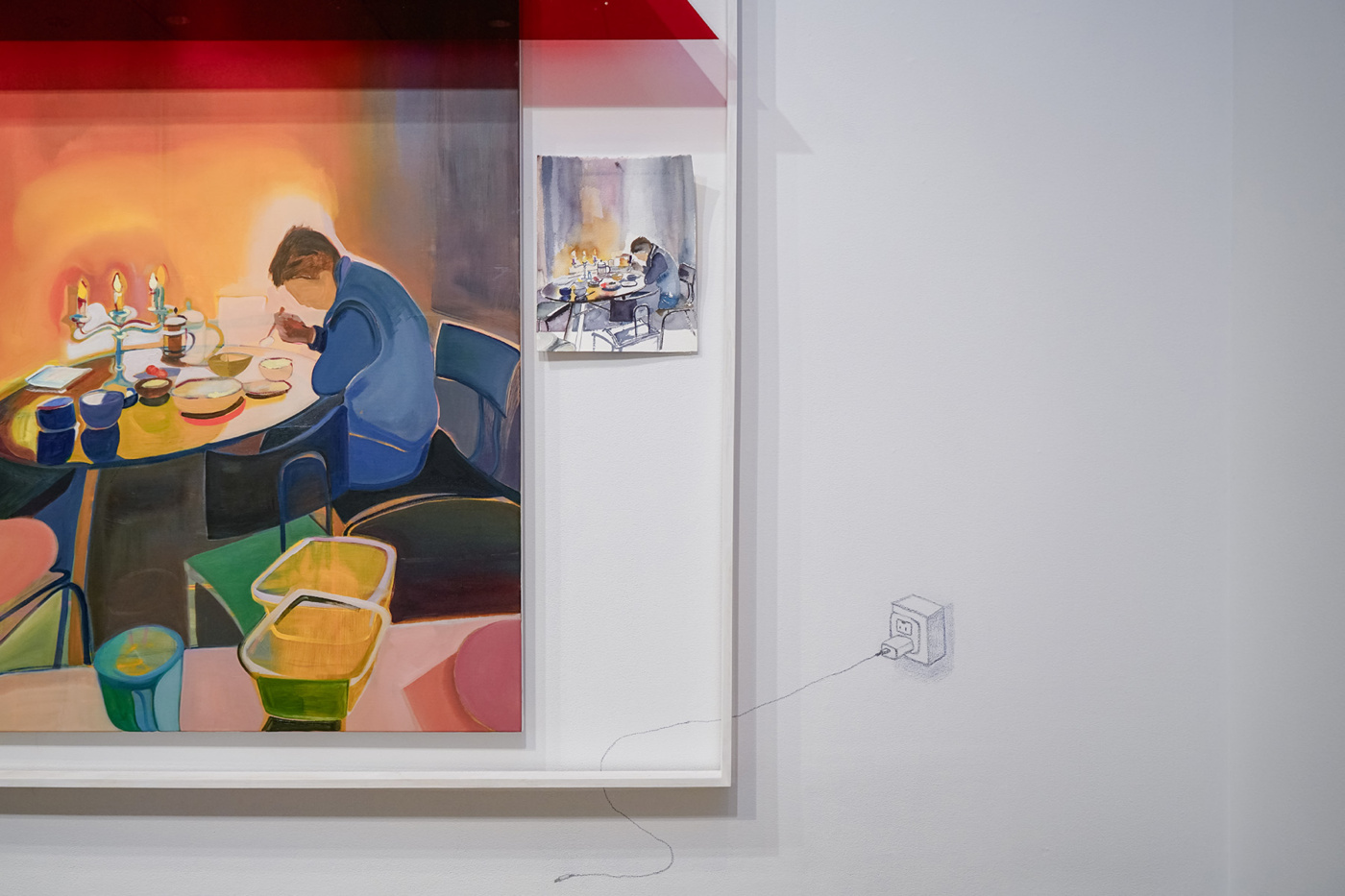
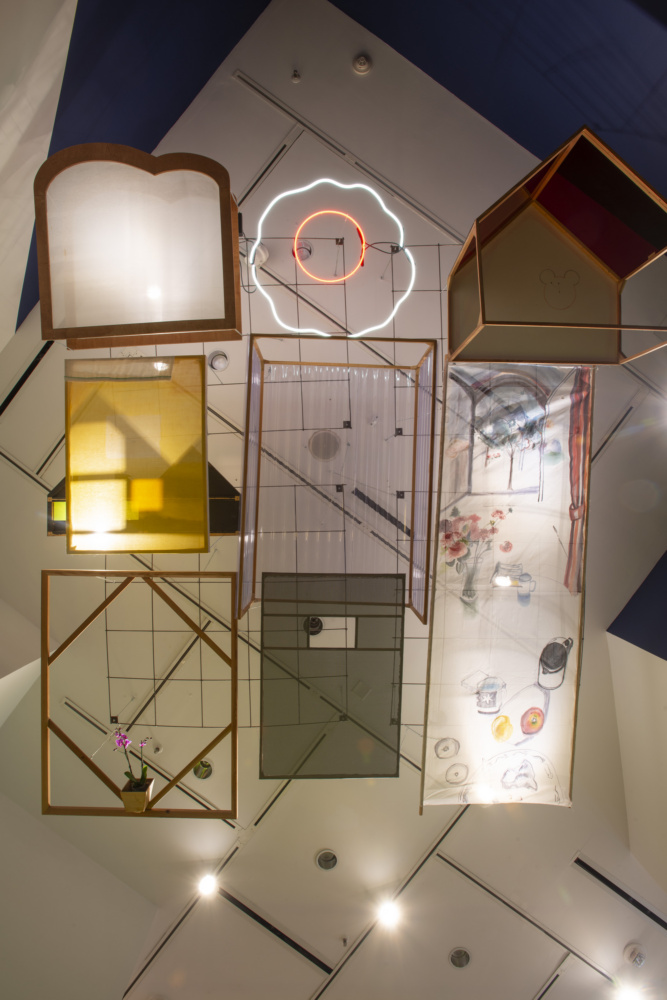
Chun continues to toy with scale with Shine (2026), a pentagon-shaped archway of neon lights that leads into an installation in a nook of the gallery. This threshold gives way to a world turned upside down. An amalgamation of watercolor on fabric, more neon lights, and large, metal-framed prisms hangs from the ceiling, comprising the piece Town Space (2026). A glowing, sunny-side-up egg and a huge piece of luminescent toast, both made from neon lights, float overhead, playfully out of reach.
This simultaneous experience of familiarity and estrangement is at the core of In Kyoung Chun’s work. An artist who immigrated to America from South Korea,[1] Chun examines home as both place and concept, something changeable yet constant.
Beautifully curated, Make Room becomes a pseudo-neighborhood, positioning Chun’s depictions of celebration, routine, and home life as experiences that exist within community, not a vacuum. Juxtaposing constrictive structures with whimsical arcs of color and line, Chun’s fluid shifts in materiality diversify the portrayal of her iterative subject matter. In this manufactured village, solitude (or, more pointedly, individualism) becomes just another illusion.
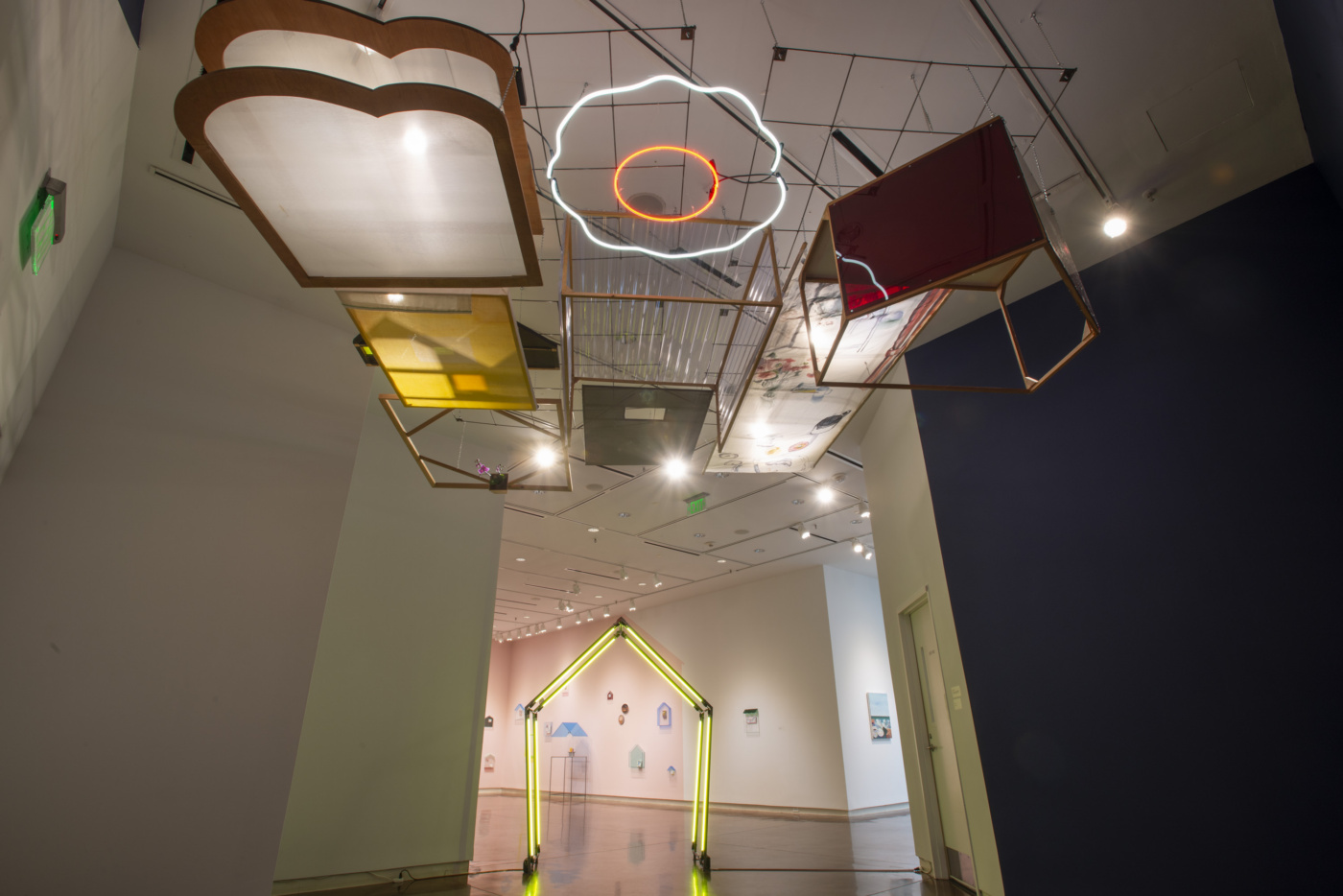
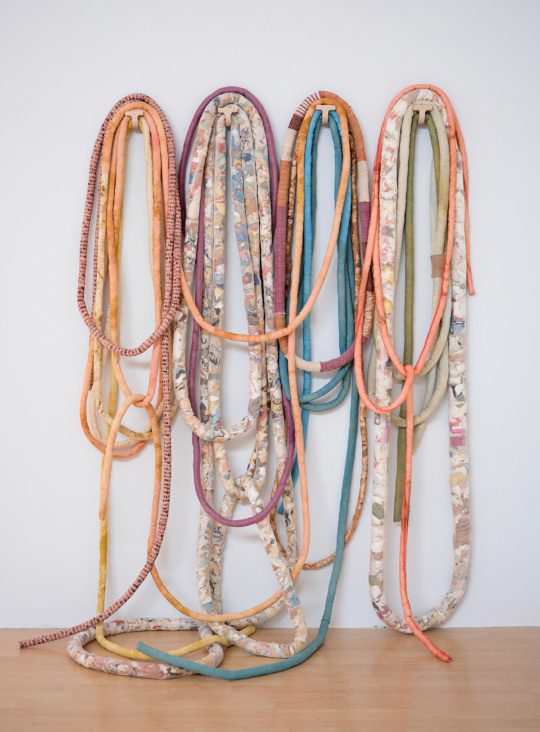
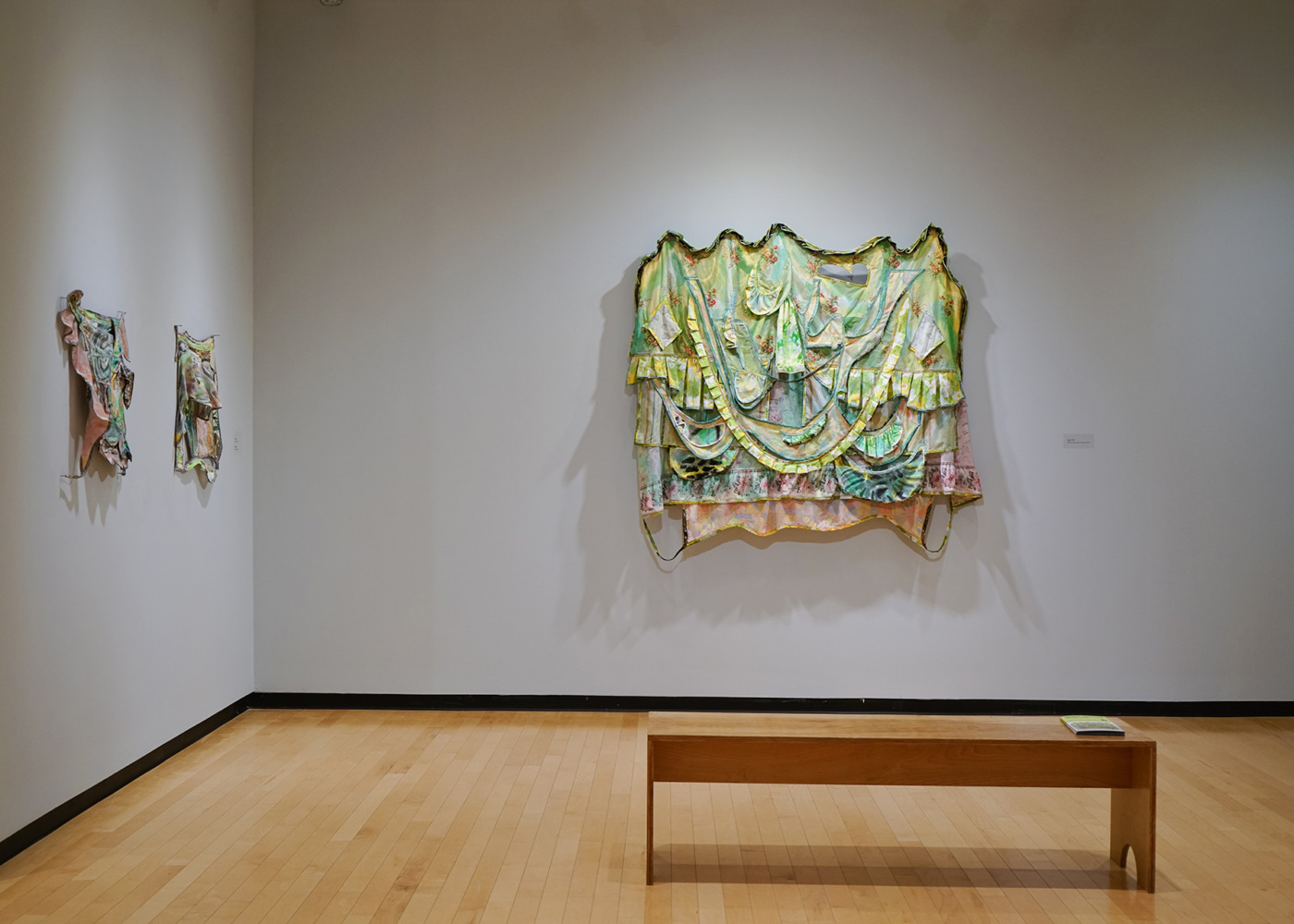
If In Kyoung Chun makes interior life transparent, Maria Britton shrouds it. In stark contrast to Chun’s rigid articulations of the confines of domesticity, Britton’s solo presentation Second Sleep is sprawling. Using repurposed bedsheets, Britton piles dense layers of fabric over wooden frameworks, creating textile abstractions that cascade over their skeletons, evading simple genre categorization.
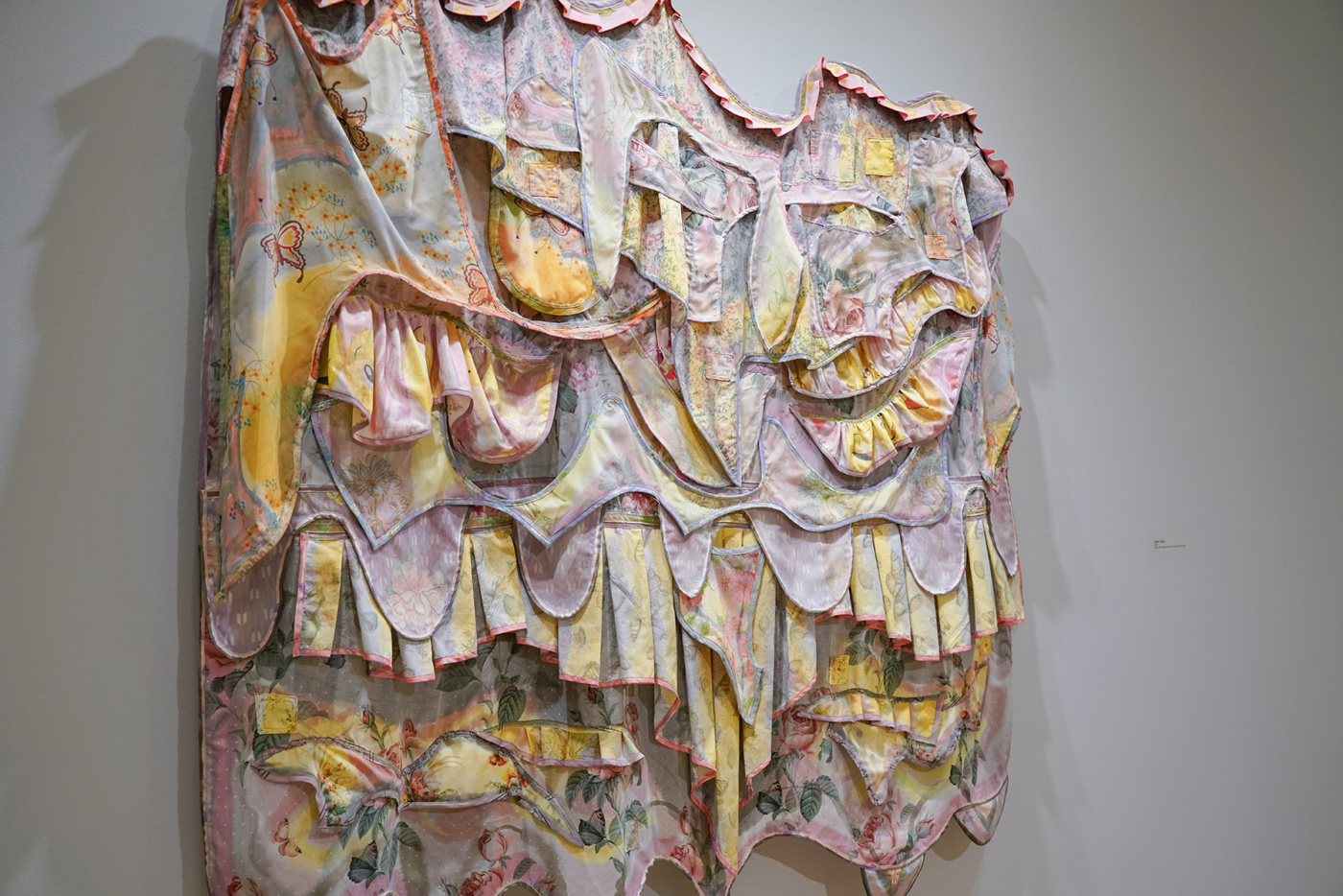
Tinged with luminous pastels, Britton’s work is characterized by sweeping curves and puckered swathes of cloth, forming looming landscapes of material that straddle the lines between painting, collage, and sculpture. Peekaboo cavities offer teasing glimpses at the plies of fabric that hang underneath. Britton’s delicate acrylic additions to the cloth are absorbed into the material, merging with the cartoon faces, patterns, and florals commercially printed on the repurposed sheets.
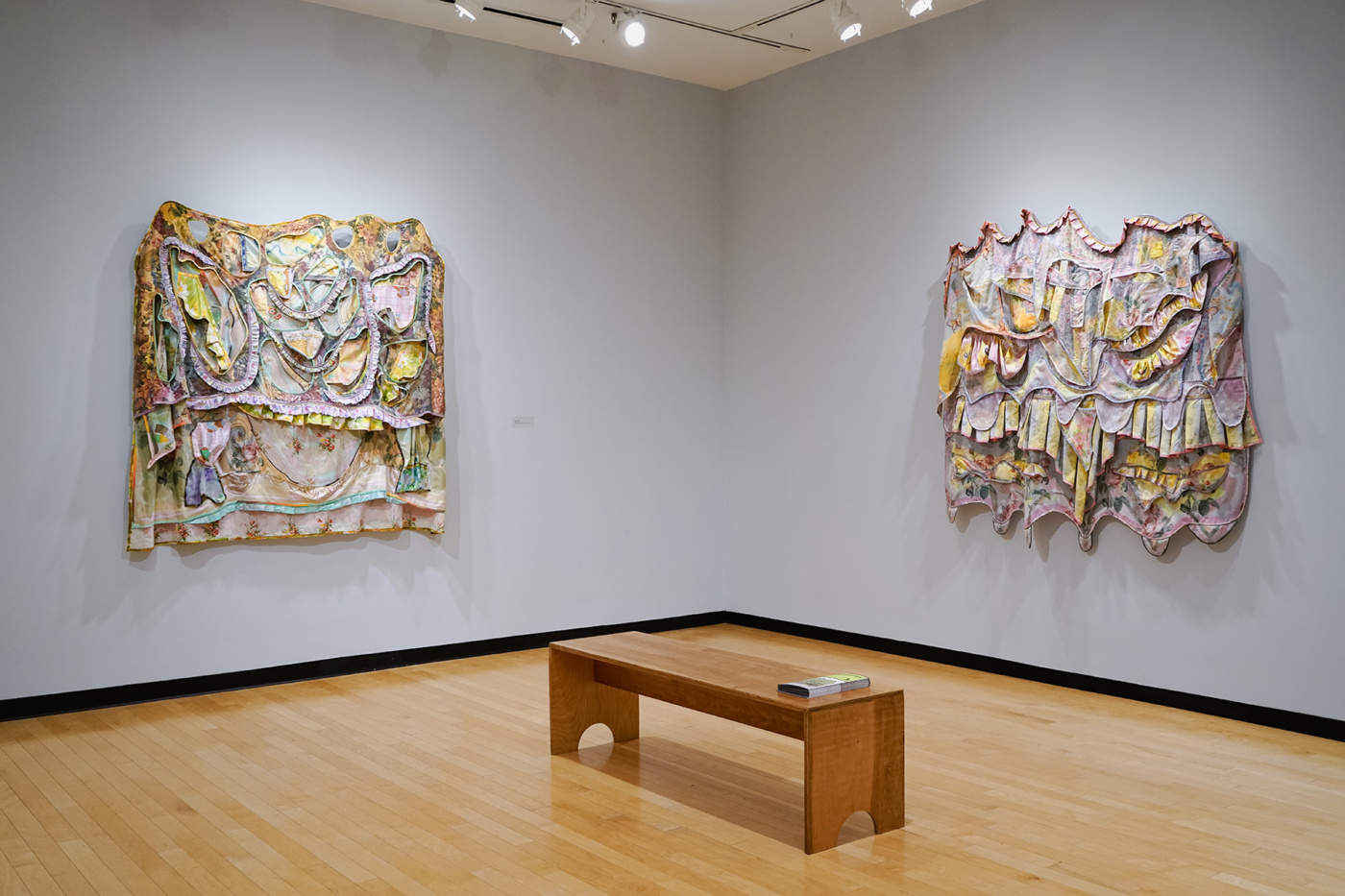
The beauty of Britton’s abstractions is their ability to shapeshift. Resembling piles of laundry and unmade beds, the pieces allude to work that remains undone, or, perhaps, work that never ends. Suggestive, also, of stage curtains, they situate domestic labor as an extension of gender performance.
Spanning up to six feet in both width and height, Rest Note, Suit Case, Hide Outs, and Push Pull (all 2024) are the largest pieces in the show. These works have all the pomp of a theater, with tiered layers of patterned cloth that sporadically alternate between winding organic forms and structured geometric pleats. Any performers remain invisible, decidedly kept backstage. With support structures hidden, the drapings seem to shrug off their own weight, as if breathing a sigh of relief.

The distinct sense of rhythm in Britton’s works—the loose symmetry, the stacked striations of fabric—further emphasizes that these performances are acts of ritual. Named for the practice of segmented sleep that was common before the Industrial Revolution,[2] Second Sleep explores the interconnected cycles of work, oppression, and rest.
When viewed in combination, both exhibitions by In Kyoung Chun and Maria Britton create a fascinating dialogue about the home, identity, and desire. Fluent in both sculpture and painting, each artist uses dimensionality as a tool rather than a defining category of their work. By decontextualizing ordinary objects, places, and habits, Chun and Britton question the neutrality of acts of everyday existence. Normalcy is not to be conflated with triviality.
Through the lens of these artists’ looking glasses, home is not a place, but a passage.


[1] Wall text at Make Room, exhibition at the Halsey Institute of Contemporary Art, Charleston, April 10, 2026 to July 25, 2026
[2] Wall text at Second Sleep, exhibition at the Halsey Institute of Contemporary Art, Charleston, April 10, 2026, to July 25, 2026