
“What are you looking for?” This question is posed in many contexts: a bookstore, on a date, at a panicked moment when keys can’t be found. Regardless of the circumstances, my unspoken answer: tenderness. I’m looking for tenderness. I found it in a Texas-based artist’s observation of the luna moth.
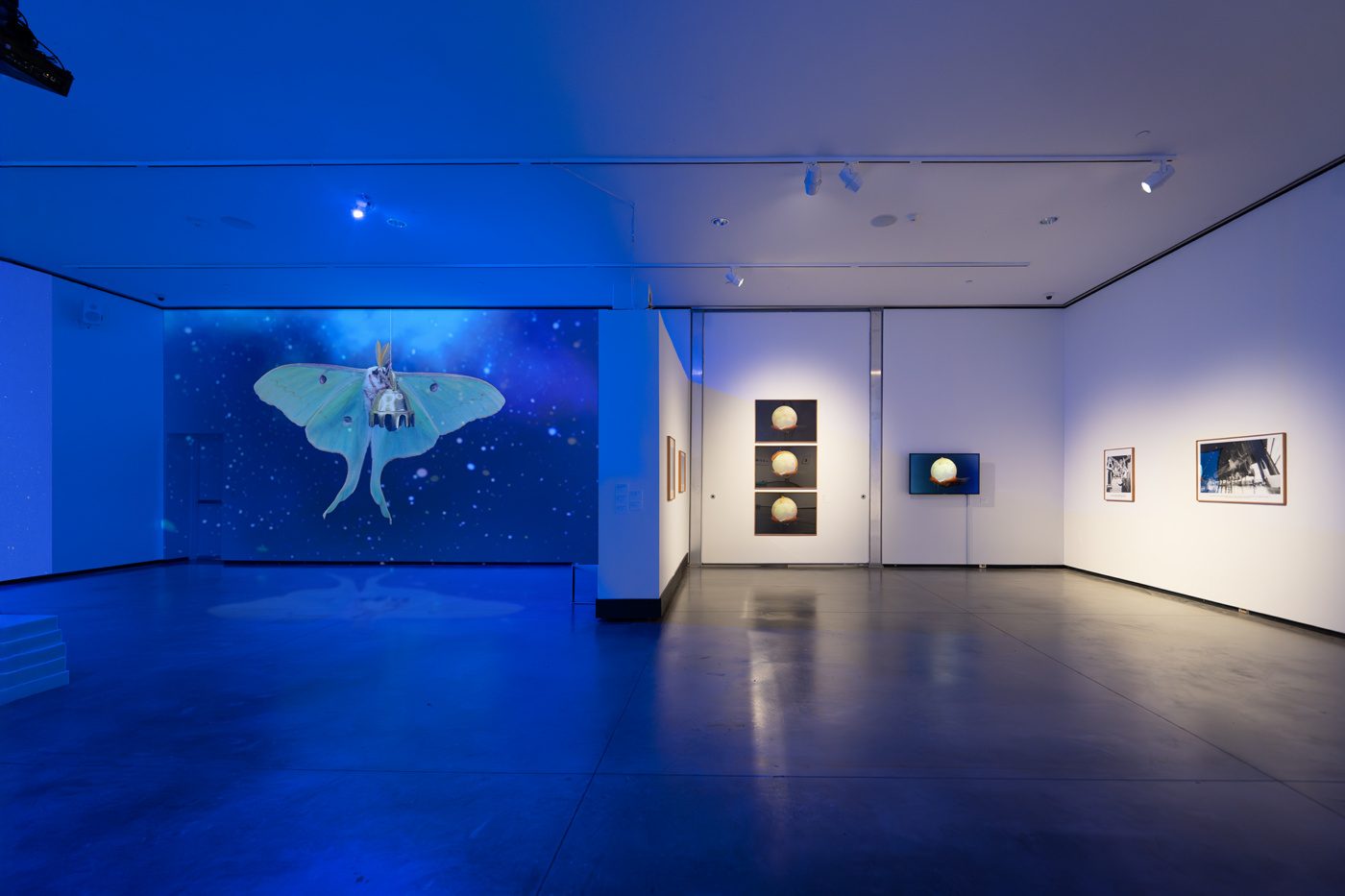
Blue Moon Cocoon, mounted at the Abroms-Engel Institute for the Visual Arts at the University of Alabama in Birmingham, centers Virginia L. Montgomery (VLM)’s bond with the winged insect. It also includes glowing orbs, gelatinous ooze, spinning starscapes, and a sky-facing observatory, all framed by a sharp blue and 90s Encyclopedia Britannica aesthetic.
The lore behind the exhibition follows: During the 2020 pandemic the artist, in search of companionship, began raising luna moths in her studio. An unusual foster pet indeed, VLM documented the life span of these fragile beings. The moths, palm-sized beauties, have soft, bowed antennae and a furry pale body. Their reach appears as fluttering flower petals made of new growth green, edged in eggplant purple. Each ridged wing contains a concentric circle that imitates an animal’s iris or an evil eye.

The luna moth is the main character in the three-channel installation Astrophotography Timelapses with Healing Honey Flows, Stargazer Luna Moth Seeks the Moon, Moon Moth Cosmic Spin (2025). Spliced together are images of it emerging from a tubular cocoon, the creature moving delicately along a branch, and a close-up of the insect’s namesake, the cratered moon. What might start to feel like a children’s nature show is set apart by the artist’s choices. For instance, the branch that the moth traverses is covered in bells. Tinny sounds ring out from the insect’s subtle movements: the artist made a musical instrument for the moth. In another scene, a pulsing drill applies a hole saw to an image that mirrors the concentric circles on the moth’s wing. The other two channels alternate between more footage of the creeping moth, along with an image overtaken by dripping gel and a swirling night sky that surprises with its reference to Vincent van Gogh’s The Starry Night (1889). Throughout, the scenes of familiar imagery find the edge of cliché but never cross over.
One moment of attunement between human and non-human: A manicured hand gives an awaiting moth a miniature telescope. The slight, playful gesture implies a desire for shared experience. Echoing this offering, black and white photographs nearby depict the artist taking a treasured cocoon on a field trip to visit the Marshall Space Center in Huntsville, AL, and SpaceCenter in Houston, TX. In Luna Moth Cocoon Meets the 107” Lunar Research Telescope that Discovered the Exact Proximity between the Earth and the Moon (2025), the artist gently holds the creature up in order for it to “see” the monumental machinery more closely. A parasocial relationship is on display, not only between the artist and the moth, but between the moth and the telescope. The moth can’t truly understand the cosmos or the technology used to probe it, but I am reminded that I too come up short in depth of understanding.
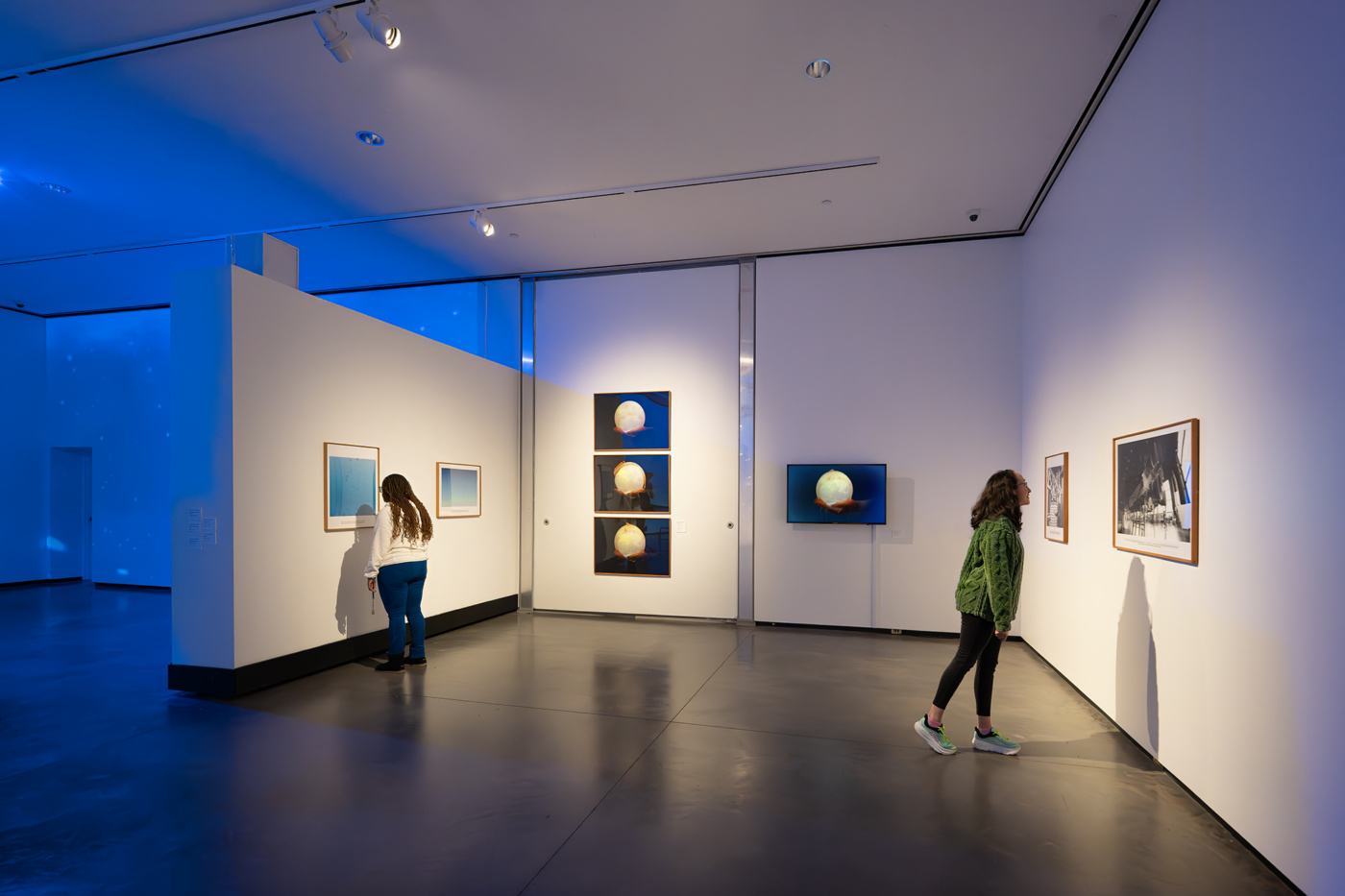
Spherical forms punctuate the gallery. At the center of the video installation room, a large stack of foam sheeting is impressed upon, carved out, potentially displaced by a weighty, perfectly round form. At the exhibition entrance, scaled-down versions of a similar reverent sunken sculpture sit. A nearby wall contains Honey Moon (2019), a video of a handheld glowing moon form that is slowly doused in ribboning honey. The repetition of spheres, large and small, stand in contrast to the occasional circles also present, calling into question the astrophysical, metaphorical, metaphysical difference between an orb and a hole.
Despite the descriptive nature of the exhibition, both in subject matter and in implementation of instructional visual language, room remains for mystery, curiosity. Couching scientific exploration in bright, alluring artifice is a feat unto its own, but by correlating the cosmos with the minutia of an artist and her homegrown companion, unexpected intimacy is found. The effect ripples out. To play with the relationship between mysticism and scientific inquiry at this moment feels risky, potentially widening the gap of misinformation. Yet, VLM’s sensitivity, interspecies relations, and wonder offer a path to connection. As skepticism proliferates, Blue Moon Cocoon proposes a remedy to the tenderness shortage.