
Archiving Place looks, at first glance, less like a museum exhibition and more like a living room. By the door waits a table and chair. Faces in grayscale, sober and unmoving, stare back from their frames. Tufted rugs recall wall-to-wall carpeting.
This fun-house effect, somewhat disorientating, can often be conjured by textile shows. Objects that could be associated with specific locations are removed from their functional contexts and displayed high on walls or on pedestals. Additionally, one’s own personal associations with textiles rush to the forefront, creating an onslaught of individualized connections.
“The shared human experience reflected in textiles creates a bridge between the artist’s personal interpretation and the viewer’s broader understanding, fostering a sense of shared memories and significance,” reads the wall text at the exhibit’s entry.[1] It’s easy to describe some comfort often derived from a family quilt, handmade scarf, or lover’s jacket. With simply the first step into the exhibit space, something innate is conveyed between artist and viewer in these stitches, tufts, weavings, and threadings.
Archiving Place, on view at the Greenville Museum of Art in North Carolina, invites the participating fiber artists to share their perspectives on place. An explicit, overarching definition of place is foregone. For some of these artists, place is a specific, ecological location. Others interpret place more conceptually. This exhibit therefore spans three concurrent locations: the physical environment of the gallery space, the external, natural world of the represented ecologies, and the abstract, ephemeral world where memory, time, and nostalgia reside.
One of the most striking pieces, situated right by the entrance, is Tricia Cooke’s Hollow Chair (2022–24). A pink chair, side table, and rug made from neoprene and polyester boning are suspended from the ceiling with ribbon and thread. The edges of the side table slump like a wilting flower. In the slumping is an exhaustion: long-loved and long-remembered, these representative objects seem one exhale away from disintegration. How many times can a memory be revisited before the structure of the memory itself is worn away?

Memory—that slippery, tenuous thing—is a key theme in the work of Rena Wood. Unraveled II (2025) and Uncontrolled Memory (2025) command the front of the gallery space, their black silk backgrounds stark amid such a colorful show. Unraveled II is a tangled ouroboros of lines where memory has no beginning and no end. In contrast, the precise stitches of Uncontrolled Memory abruptly dissipate into the black background, calling to mind a memory that slips just beyond reach. It is impossible to orient oneself in either set of stitches or deviate from where they lead. Memory is in control here.
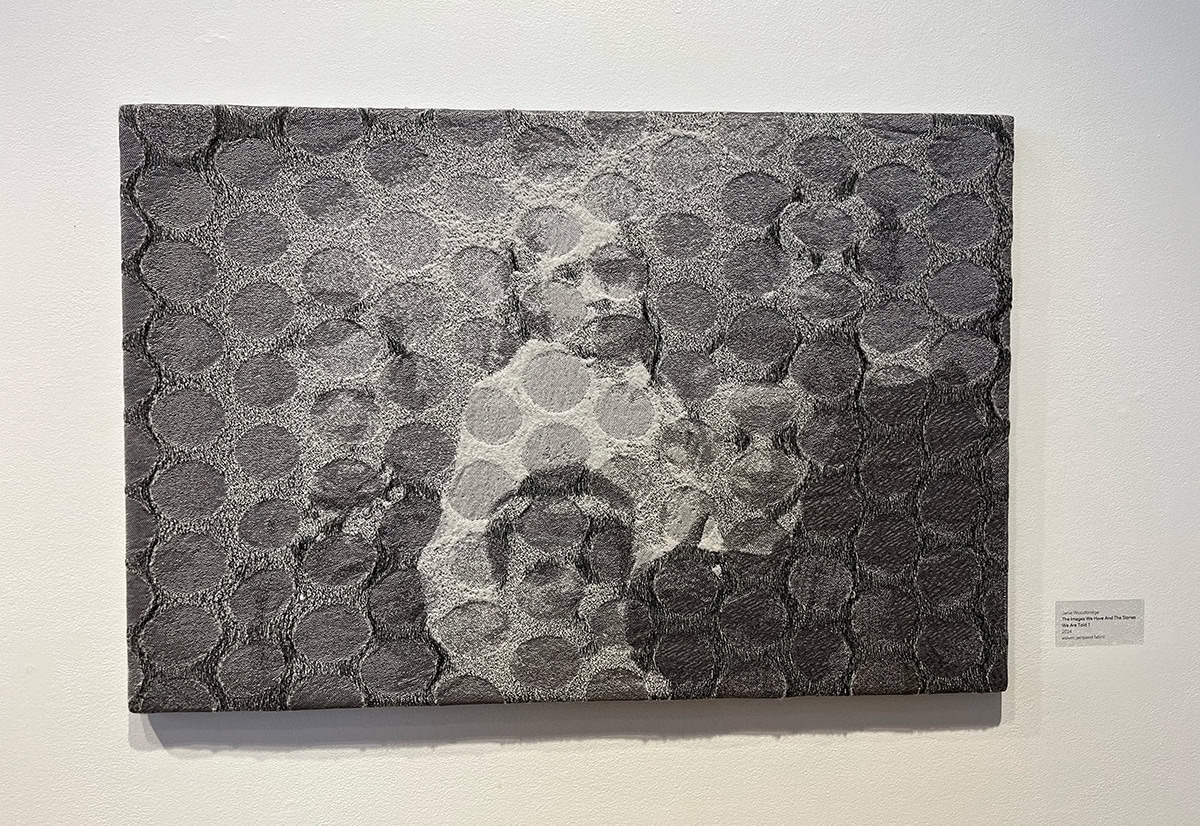
Memory’s dominant hand is similarly examined in Janie Woodbridge’s The Images We Have And The Stories We Are Told 1 (2024). A gray, abstract design—when faced directly—reveals figures created from a daguerreotype of the artist’s great-grandfather and his siblings in the 1890s. Move to the left or right, and the figures fade away, the weave structure and pattern suddenly more dominant—an almost agamographic effect. Though the piece itself does not move, it contains a responsive, almost watchful energy. One may attempt to sneak up on memory, but it’s just as likely to sneak up on you.
Alongside the prevalent themes of nostalgia and memory, ecology of place is at the forefront of many of Archiving Place’s works, including two tufted rugs by Miyuki Akai Cook: There’s Nothing Left for Me: Yangtze Finless Porpoise (2024) and Kotan koru Kamuy: Blakiston’s Fish Owl (2024).
In Yangtze Finless Porpoise, a porpoise with a human face holds a fish in its mouth and leaps across a background of green mountains and blue streams on one side, and dark gray office buildings and a red river of boats on the other. The human face of the porpoise is wide-eyed; the blue drop near its head may suggest water, sweat, or even an agitated tear. Blakiston’s fish owl has a body shaped like a house. Red and orange flames leap from the horns above its yellow eyes.
The porpoise and the owl are colorful, fuzzy, and completely defenseless against the rivers of blood and consuming flames. Their lives are so very fragile. Akai Cook, a mother and educator, depicted these engaged species to educate children about the urgency of preservation. The bright shapes and soft forms seem not just an attempt to translate this urgency into a visual children can understand. Rather, these pieces reflect the innocence of the children themselves and the heavy burden that has been placed on future generations.
A similar hum of climate anxiety sounds in Liz Ensz’ Mixed Reality Ecosystem (it’s easier to imagine the end of the world) (2025). This large-scale woven sculpture stretches from floor to ceiling, and its imagery moves from sunny sky to a landscape marred by industrialization. Integrated into the weaving is digital scrolling text, bright red and quickly paced. This text speeds up the viewing experience and injects a sense of anxiety. Passive observation is transformed into complicit participation.
In contrast to Mixed Reality Ecosystem’s brisk pace, Susan Fecho’s Lichen (2024) shows environmental change at a slower, more elemental level. Mossy growth is depicted on an antique table runner, the natural world from which the runner came overtaking the fibers. There is something familiar in this merging: a naming that, under climate disaster, all things will return to the earth. Or, more accurate to say, all things will return further to the earth, any distinction between the two hazy at best. Hurricane Helene is not explicitly mentioned in this show, but for those of us in the state who lived it, its echoes are ever-present.

In No Archive Will Restore You (2018), Julietta Singh writes of the body as archive. All that one experiences leaves a trace, and Singh argues the necessity of (impossible though it may seem) crafting “an archive of the body.”[2] The body seems an essential component in any attempt to locate place: it is our bodies that move us through our natural environments and that serve as our repositories for memory. Yet the body is largely absent from Archiving Place.
In contrast, body-as-archive was on full display at Revolve Gallery in Asheville this past December. There, I attended a display of seven panels of the AIDS Memorial Quilt, organized by the Western North Carolina AIDS Project. Covering the entire gallery space from floor to ceiling, the three-foot-by-six-foot quilts—intentionally sized to replicate the dimensions of a coffin and created by surviving family members—told stories of lives lost to the AIDS epidemic. (An epidemic that, in 2026, disproportionately impacts Black and Hispanic/Latino communities and the Southern United States.)[3]
T. Gordon Davis’ (1946-1990) memorial quilt includes a red turtleneck stitched onto the ground fabric. A San Francisco t-shirt and rainbow suspenders adorn the quilt honoring Robert David Messer (1956-1991). Among these coffin-shaped quilts, there is a clear throughline from the textiles that adorned the body to the textile of the body. Here, the body is honored with the full weight of its archival prowess, each panel an attempt to stitch down those bodies and archives in perpetuity.

Archiving place seems almost as slippery an ambition as archiving the body. Is there a pin sharp enough to piece through layers of memory, experience, and geography and fix them still? The “shared human experience” and immediate intimacy created by the textiles within Archiving Place only exists because of the body. Is it the body that stitches together this exhibit’s multiple environments and makes sense of what it means to traverse the physical and conceptual worlds simultaneously, to cast back and project forward in equal measure.
“The unconscious is the most evasive archive of all, yet it is pulsing right there inside you,” wrote Singh.[4] To archive place, then, is to ultimately return to the archive of the body: the only archive expansive enough to hold the contradictions and burdens, the fleeting and numerous beauties, of place’s every definition.
1. “GMOA Current Exhibitions.” Greenville Museum of Art. https://www.gmoa.org/current-exhibitions.
2. Julietta Singh, No Archive Will Restore You (punctum books, 2018). p.29.
3. “A Tapestry of Love,” Western North Carolina AIDS Project, November 20, 2025, https://wncap.org/a-tapestry-of-love/.
4. Julietta Singh, No Archive Will Restore You (punctum books, 2018), p. 97.