What do you look for in a crisis? A warning? A way out? A sign that survival is still possible?
Along Peru’s Napo River, a child disappeared beneath the water.
The raft had already capsized by the time his parents reached the riverbank. Caught in a whirlpool while traveling upriver through the Amazon, the family was thrown into the current in an instant. The baby—wrapped in swaddling cloth—vanished beneath the water. His mother and father, believing they had lost him, began mourning on the shore until they noticed fabric snagged atop a cluster of floating logs. Tying a jungle vine around his waist, the father swam back into the violent current and retrieved the child alive.
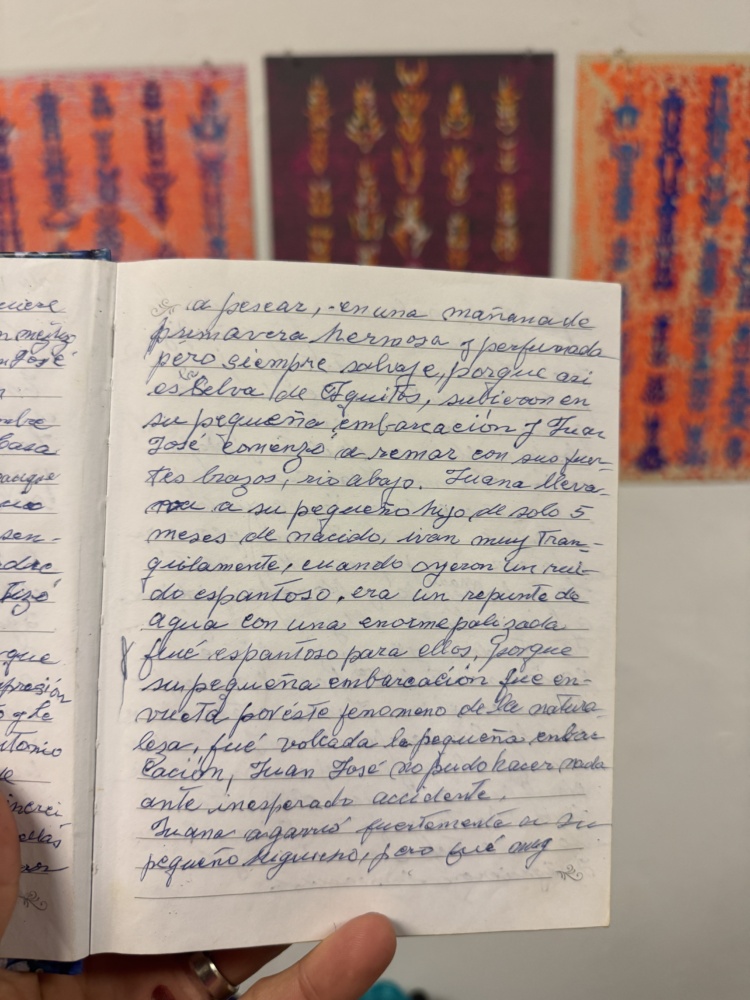
Decades later, Miami-based artist Sterling Rook encountered the story again in the handwritten pages of his grandmother Alicia’s unfinished memoir. Written in cursive script and preserved in fragments, the text recounted the survival of Rook’s maternal grandfather.
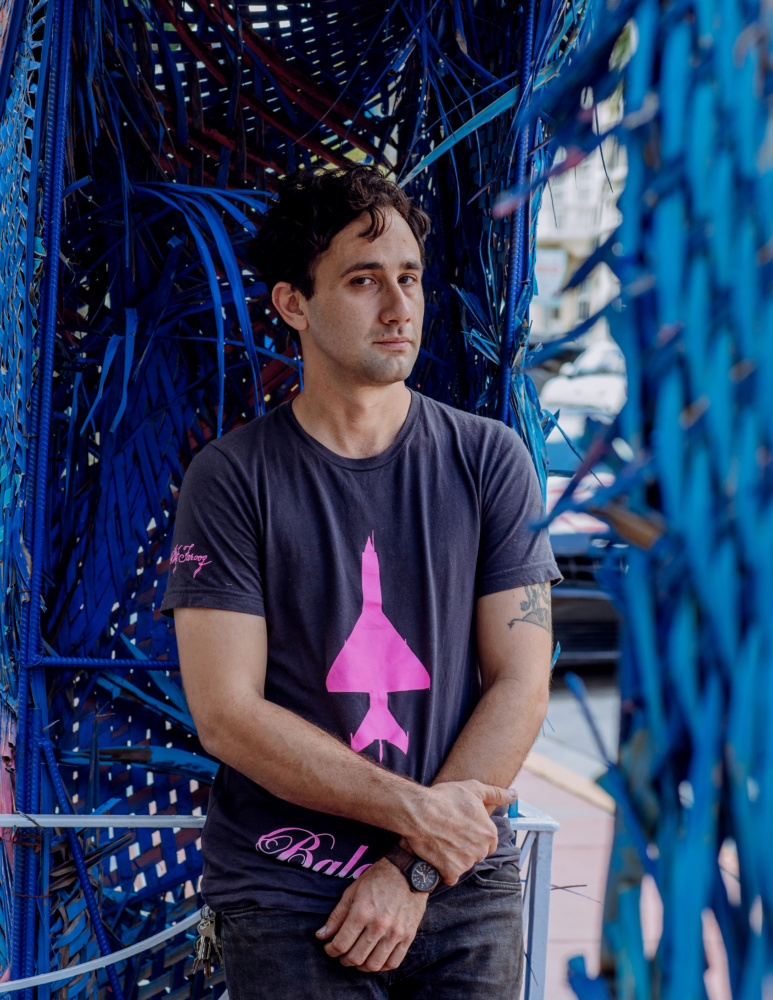
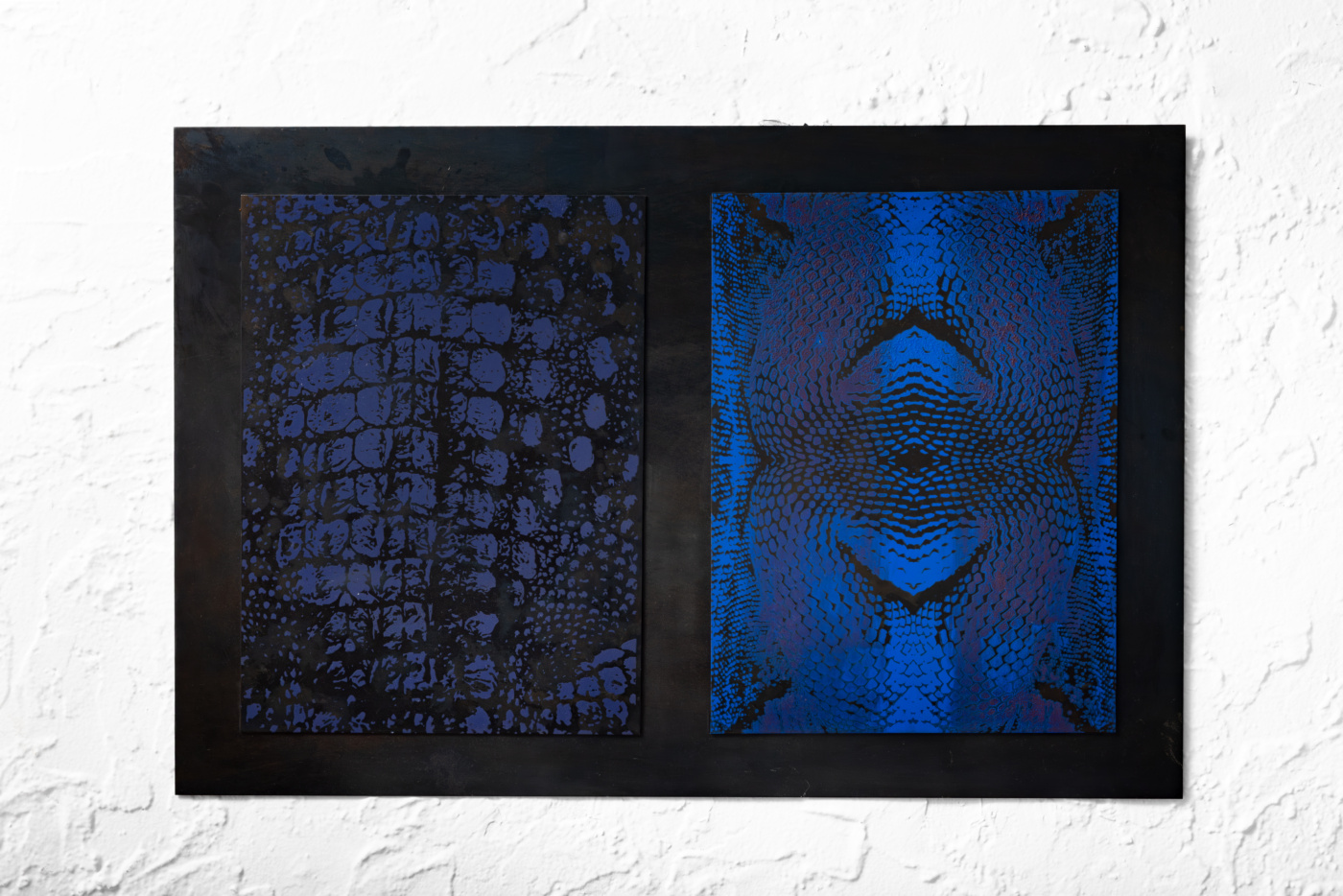
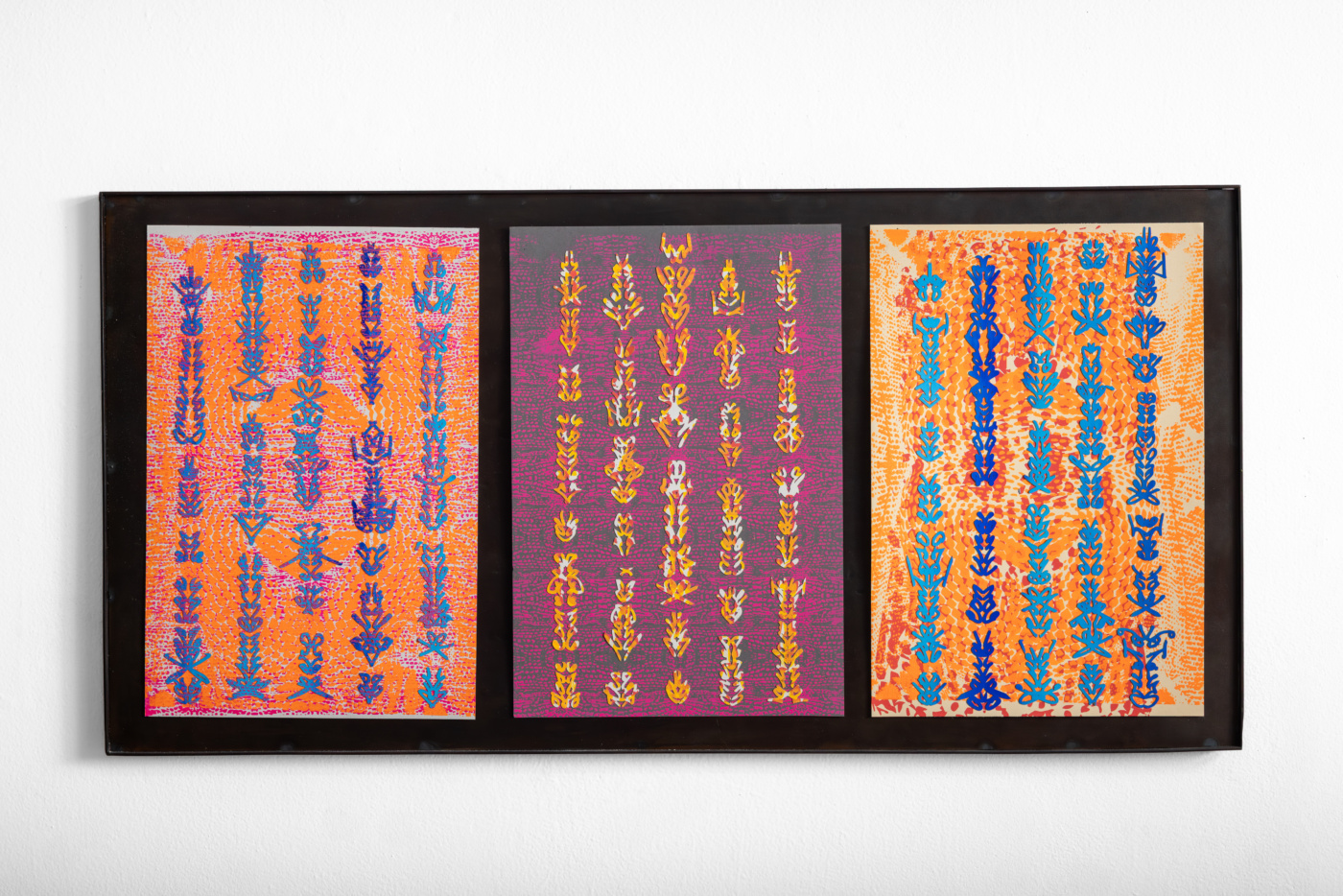
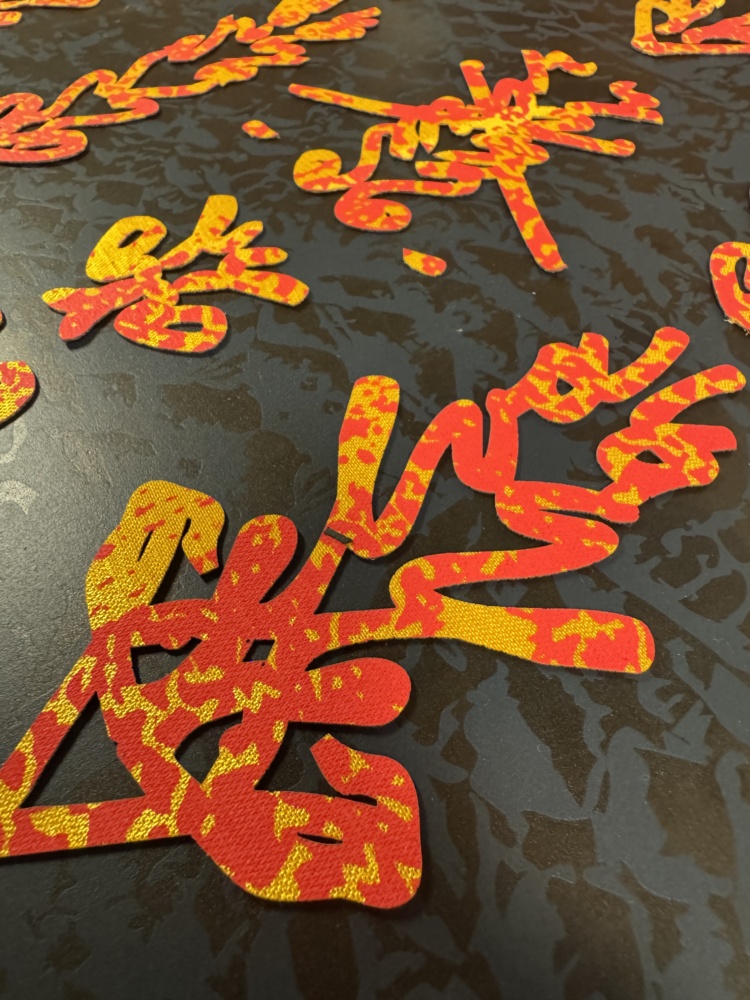
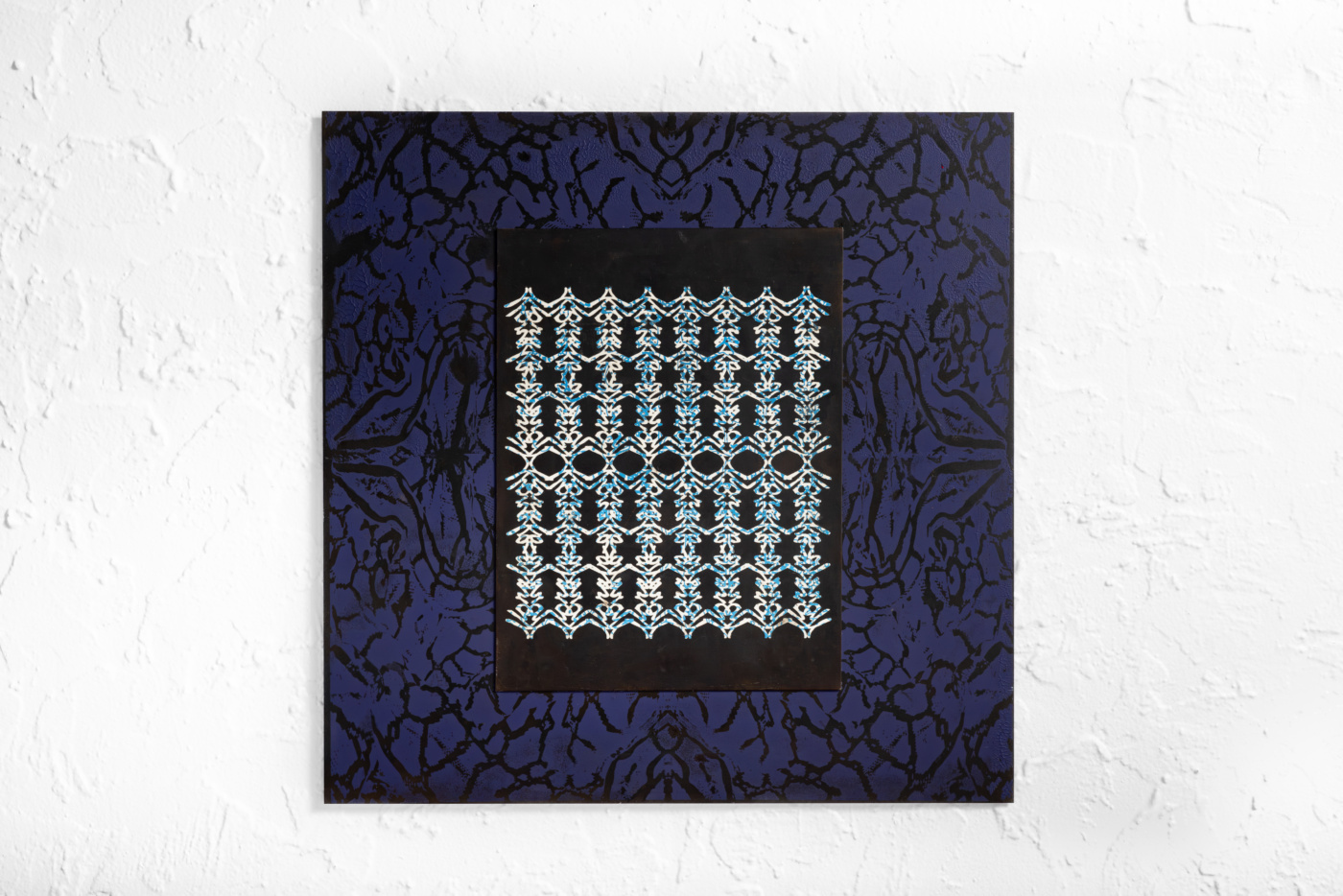
The story became the conceptual and emotional foundation for Shupingagua, Rook’s spring 2026 solo exhibition at Tunnel Projects in Miami, FL. Rook mirrors and fragments his grandmother’s cursive script across steel, fiber, silkscreen, and woven surfaces until language becomes nearly unreadable, transformed into dense visual patterns resembling river currents, camouflage, illuminated manuscripts, or Rorschach images. The work oscillates between revelation and obscurity, asking what survives translation across the storm of time.
I spoke with Rook about the story’s he’s inherited and the fragile ways people attempt to preserve meaning.
This interview was edited for length and clarity.
Alexandra Martinez: Where did the story of Shupingagua come from?
Sterling Rook: I ended up with an early draft of the autobiography my grandmother wrote about her father, and I had already been exploring work related to family and ancestry. Once I started reading and translating it, it became clear there was a story that needed to be told. It stopped being only about me and became about a lost or forgotten history.
There were incredible stories in there, and the fact that my grandmother wrote them down meant she wanted them to be read. I felt it was important that they not disappear in a box somewhere. The image of a father swimming back into a dangerous river to save his child—it’s such a powerful act of bravery.
AM: What was it like encountering your grandmother’s handwriting and learning this history through her words? Did the writing itself become visual material for you?
SR: Growing up, I felt disconnected from part of my family because I didn’t speak Spanish fluently. My cousins spoke English, but there was still a distance there. My mom told me some of these stories when I was younger, but I wished I could have had more direct access to my grandmother.
Reading the manuscript, I was amazed by what my family went through to come here and pursue this idea of the American dream. But I also began seeing reflections of my own life in those stories. I was born with water in my lungs, and there was a moment where doctors told my parents there was a fifty-percent chance I would survive. Later, I nearly drowned in a pool as a child. And it was my grandmother who noticed something was wrong when I was born—she saw I was turning blue and called for help.
So there were these strange parallels between my own experiences and these older family stories. Reading her handwriting felt like reconnecting with something that had always existed beneath the surface.
AM: Water becomes this recurring force throughout the exhibition—something that can consume and in turn heal you. You mentioned that part of this work involved trying to make contact with your ancestry. What kind of contact were you seeking?
SR: I think I was trying to weave myself into a larger narrative—a sense of belonging. Stories give us orientation. They tether us to place, whether that’s physical place or historical place.
For me, reading those stories felt grounding. It gave shape to experiences and emotions I hadn’t fully understood before.
AM: The visual language of the exhibition comes directly from your grandmother’s cursive handwriting, which you mirrored and transformed into repeating patterns. How did you arrive at that process?
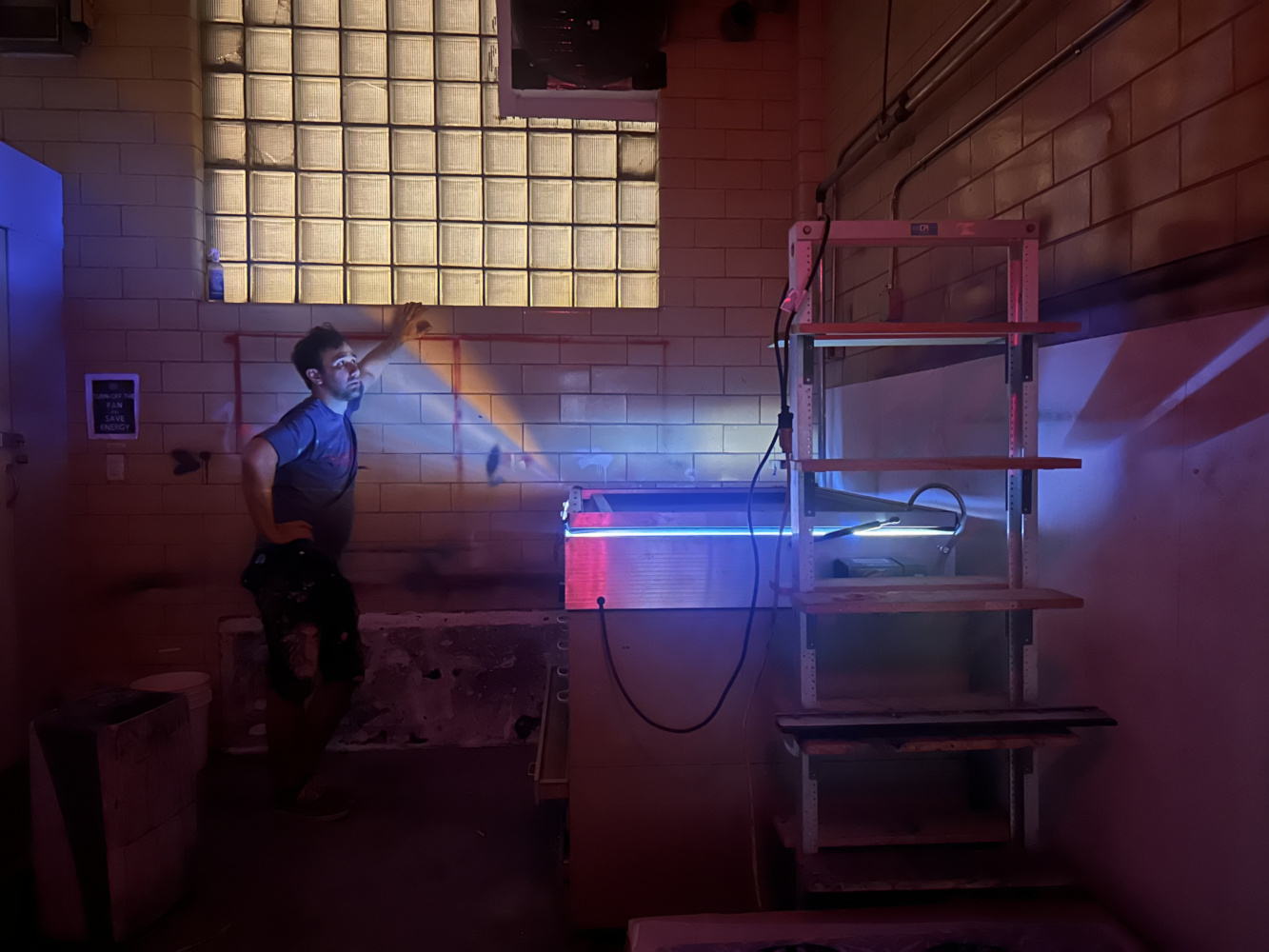
SR: A lot of it came through experimentation. I digitized sections of her handwriting and started manipulating them in Illustrator. It became a kind of digital weaving process. I’d mirror words, distort them, rearrange them, and eventually something would click visually.
Once I began mirroring the handwriting, it started carrying ideas of reflection and inheritance while also obscuring the language. I liked that tension because history is never fully accessible. Even when stories survive, time fragments them.
I wanted viewers to experience some of that estrangement too—to feel close to meaning while still unable to fully grasp it.
AM: The forms resemble Rorschach images, river currents, woven structures. There’s a real visual ambiguity to them.
SR: That ambiguity is intentional. For a few years now, I’ve been deeply interested in illuminated manuscripts like the Book of Kells. Even if you can’t read the language, those manuscripts still carry beauty and mystery. The decorative patterns, the woven knot forms, the animals embedded into the text, they create this transcendent visual experience.
I think I wanted to create my own kind of illuminated manuscript. The mirrored handwriting became a way to build a hybrid visual language that merges family history, textile traditions, religious imagery, and abstraction.
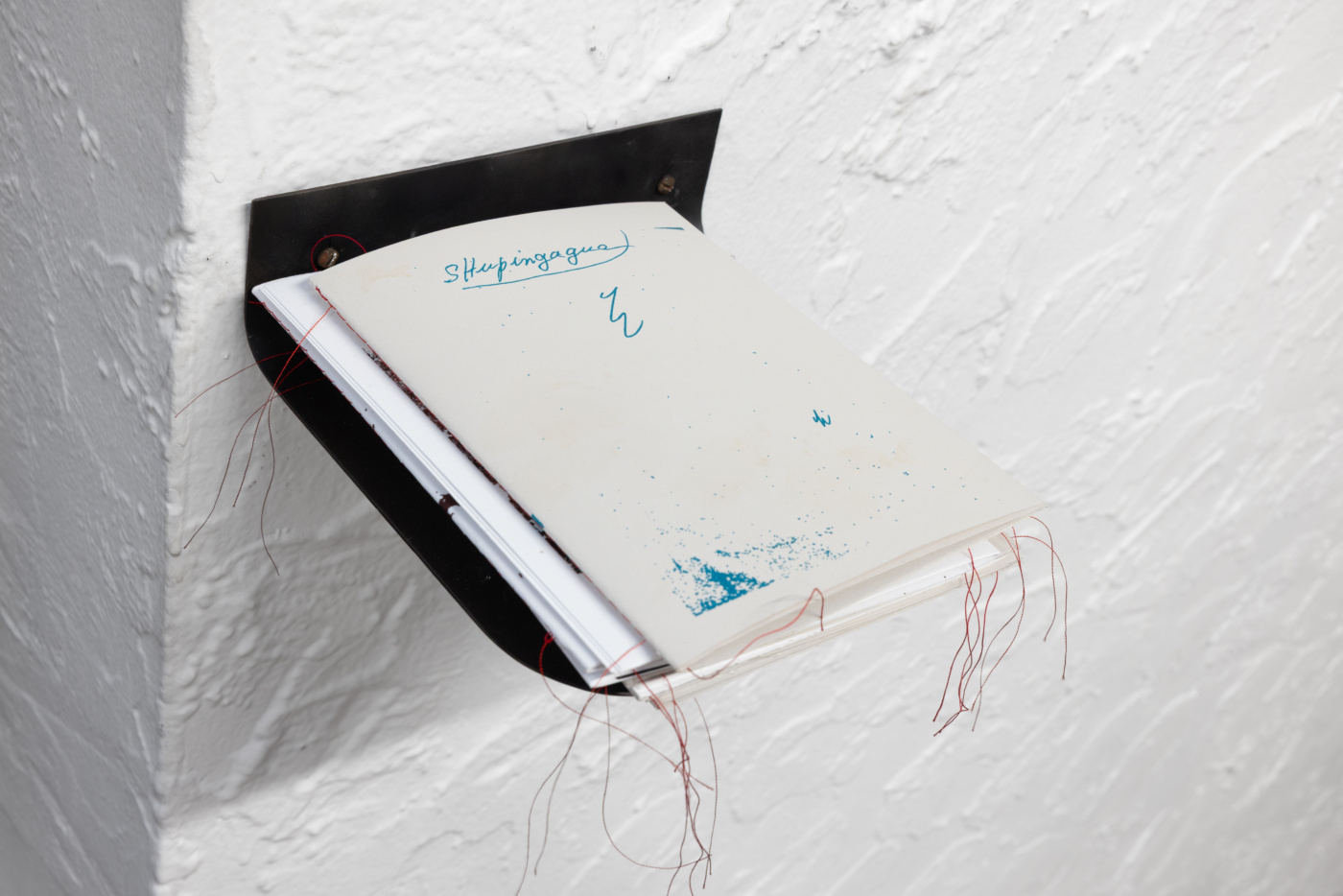
AM: You also included a zine alongside the exhibition that translated portions of the text more directly for viewers.
SR: I wanted to give people something accessible, something they could take with them. The exhibition intentionally obscures language, so the zine functioned almost like a key.
It said: “I know this work may be difficult to access, but here are the words themselves.”
AM: When we first spoke in your studio, we also talked about connections between these survival stories and your own experiences with addiction and recovery. How did those parallels emerge for you?
SR: I just connected to it on that level of survival. There’s a precarity and fragility to life that I think can be taken for granted really easily. Most of the time, it goes unsaid or understated how fragile things can be. Then we get reminders—you put on the evening news and someone gets shot, or there’s a tragedy, or a family member gets sick—and suddenly we’re confronted with how precarious things really are.
AM: I kept thinking about your work in relation to signals—how these stories of survival move through generations almost like transmissions. What do you think gets carried through crisis?
SR: There’s an instinct for self-preservation, or for our own personal, familial, even cultural preservation. I think we try to perpetuate these things because, innately, we understand there’s value in life and in story. But more personally, there’s an instinct for preservation of the self.
Sacrifice is exactly that: going beyond personal preservation in order to ensure the preservation of another. Whether that’s a literal life sacrifice or a sacrifice of time or money, it means going beyond what is perhaps natural or typical for a given moment.
In crisis moments we end up transcending what is the natural modus operandi of the day to day. We reach down, I think, into something deeper. That’s what he did. That’s what [my great grandfather] did. He went beyond his own instinct—beyond the idea that he had to survive—in order to swim into a torrential river to save, hopefully, someone else’s life. And yes, it was his baby’s life, but it didn’t have to be.
I think those moments, where we move beyond what is expected, rupture our assumptions. They create a break in our expectations and open up a sense of a higher possibility than self-interest alone.
"I wanted viewers to experience some of that estrangement too—to feel close to meaning while still unable to fully grasp it."
AM: Material plays such an important role in the exhibition too. Why did steel, fabric, embroidery, and silkscreen feel necessary for telling this story?
SR: Fiber has always existed in my family history. My father’s side of the family is from Nottingham, which has a long history of lace-making and rope-making. My grandfather owned a lace mill. Even my family name before adoption was Stringer, which historically referred to people who made rope or string.
On my mother’s side, my grandfather was a tailor and my grandmother was a weaver. So textile traditions existed everywhere around me.
Then in undergrad I became deeply invested in fiber practices, while graduate school introduced me to metalwork. Since then, I’ve been trying to merge those seemingly dissimilar materials. I’m interested in tension—materials that shouldn’t work together but somehow do.
AM: One thing we discussed in your studio that stayed with me was your description of cursive as a kind of string or continuous thread. And there’s also this incredible connection to your family name.
SR: Yeah, definitely. Language and writing have appeared in different forms throughout my work for years. In some of my earlier sculptures, there are these curved metal forms wrapped in handmade rope, and they almost resemble cursive marks or gestures. Script is like one continuous thread. It’s physical and bodily. You can feel the movement of someone’s hand inside it.
I also love the idea that writing and textiles have always been connected. Even linguistically, “text” and “textile” share roots.
Handwriting carries such a personal trace. It preserves emotion, rhythm, pressure, even state of mind. There’s something powerful about finding an old handwritten letter and recognizing the person through the movement of their hand. Writing is physical memory.
AM: The exhibition also includes imagery drawn from South Florida wildlife, green iguanas, Burmese pythons, peacock bass. How did those animals enter the work?
SR: I was interested in camouflage and patterning, but also in the language we use around invasive species. Most of those animals are non-native to Florida, yet they’ve become embedded in the ecosystem.
The green iguana, for example, is everywhere now. Yes, the Burmese Python is harmful. The peacock bass came from the Amazon and was introduced to curb the population of the Mayan cichlid, which it did. People love fishing for them now. And if you’re brave enough to eat them.
These creatures are here because of humans, it’s not their fault, they’re not native but acclimated nonetheless. There’s a language difference in how we talk about animals versus people and when something foreign enters an environment it raises alarm, but the reality is more complicated. Sometimes introduction creates imbalance, sometimes unexpected balance.
The peacock bass is actually an example where introduction created ecological balance. So these stories are rarely simple. I think the work tries to hold that complexity without reducing it to a singular moral statement.
AM: After making this exhibition, do you feel closer to the histories you were trying to reach?
SR: Yes and no. I know the stories better now, and I feel greater gratitude for the sacrifices people made to create the life my family has today. But there’s still distance there too. Some longing remains unresolved. And I think that’s okay.
I’m going to keep making work about these stories because there are more stories to tell.