
To look at UNTITLED, Petie Parker’s recent solo exhibition at Old Rabbit Gallery, is to enter a lineage of Black artistic strategies—methods of obfuscation, withholding, and reconfiguring visibility that circulate across generations of Black American artists and thinkers. Parker’s acts of obscuring center the antebellum South, a region that remains politically charged as it continues efforts to restrict teaching on slavery, Reconstruction, and racial violence.[1] Two primary demands structure UNTITLED’s engagement with its audience and political themes: labor and patience.
Labor emerges most clearly in works such as Off Our Backs (2025), where the American flag is reconfigured as a symbol of enforced Black labor, particularly that of enslaved Black women. In the NFL (2025), vision itself becomes unstable. From one angle, a Black enslaved man appears upright and resolute; from another, his body registers strain and vulnerability without changing pose. Meaning is governed by position. Narrative authority belongs not to the object alone, but to the viewer’s orientation, showing that neutrality is fiction.


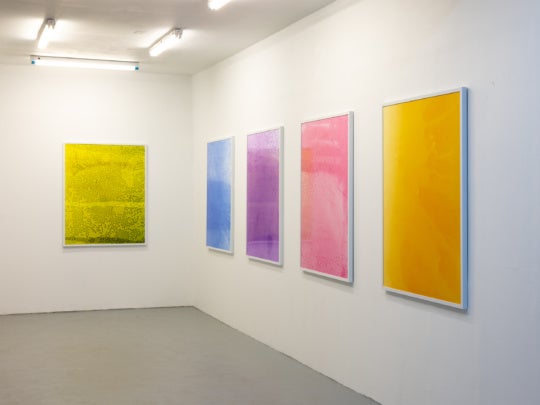
Parker extends the lineage previously mentioned, with contemporaries such as Kara Walker and Tiona Nekkia McClodden, in his engagement with opacity. Specifically, the white paintings on the white walls that punctuate the gallery, which at first appear invisible. Subtle shifts in light or movement reveal faint outlines of Black bodies, such as a Black enslaved man being thrown from a slave ship by three white traffickers, violently, rendered nearly imperceptible. These works extend Southern mythmaking materially: whiteness obscures its own brutality. In this way, the gallery becomes part of the conceptual ecosystem, as its walls serve as additional landmarks in history. Surfaces that will be remembered even after they are painted over.
Patience is the exhibition’s second demand. Parker continuously modifies works already installed, adding details and reshaping compositions. The exhibition’s slow accumulation mirrors the instability of the histories it invokes. Viewers are asked to inhabit an unfolding system that reaches complete comprehension only at the show’s conclusion. Yet a moral question is implicated in Parker here. In a region actively rewriting history, who is made to wait and does the reasoning above justify its implementation? And what is the cost of that delayed legibility?


The relationship between the black on black and white on white is potent, the exhibition’s most conceptually rigorous tension. As the show continues to shift and stockpile, I wonder whether these modes will eventually converge, collide, or diverge further. If they were to engage in a more deliberate conversation with greater thematic degrees of separation between the methods, so that these modes hold their own justification, the dialogue between the works would become sharper.
In UNTITLED, perception becomes a moral test. What is seen, fails to see, or must work to see becomes inseparable from how histories that the South has long attempted to obscure are understood. Parker positions land, wall, and image as co-conspirators in a story that refuses to remain buried.
[1] Briscoe, Kaleb L., and Veronica A. Jones. 2024. ““The House Is on Fire”: A Critical Analysis of Anti-CRT Bans and Faculty Experiences” Education Sciences 14, no. 4: 360. https://doi.org/10.3390/educsci14040360
UNTITLED by Petie Parker at Old Rabbit Gallery, Atlanta is on view through December 9, 2025.