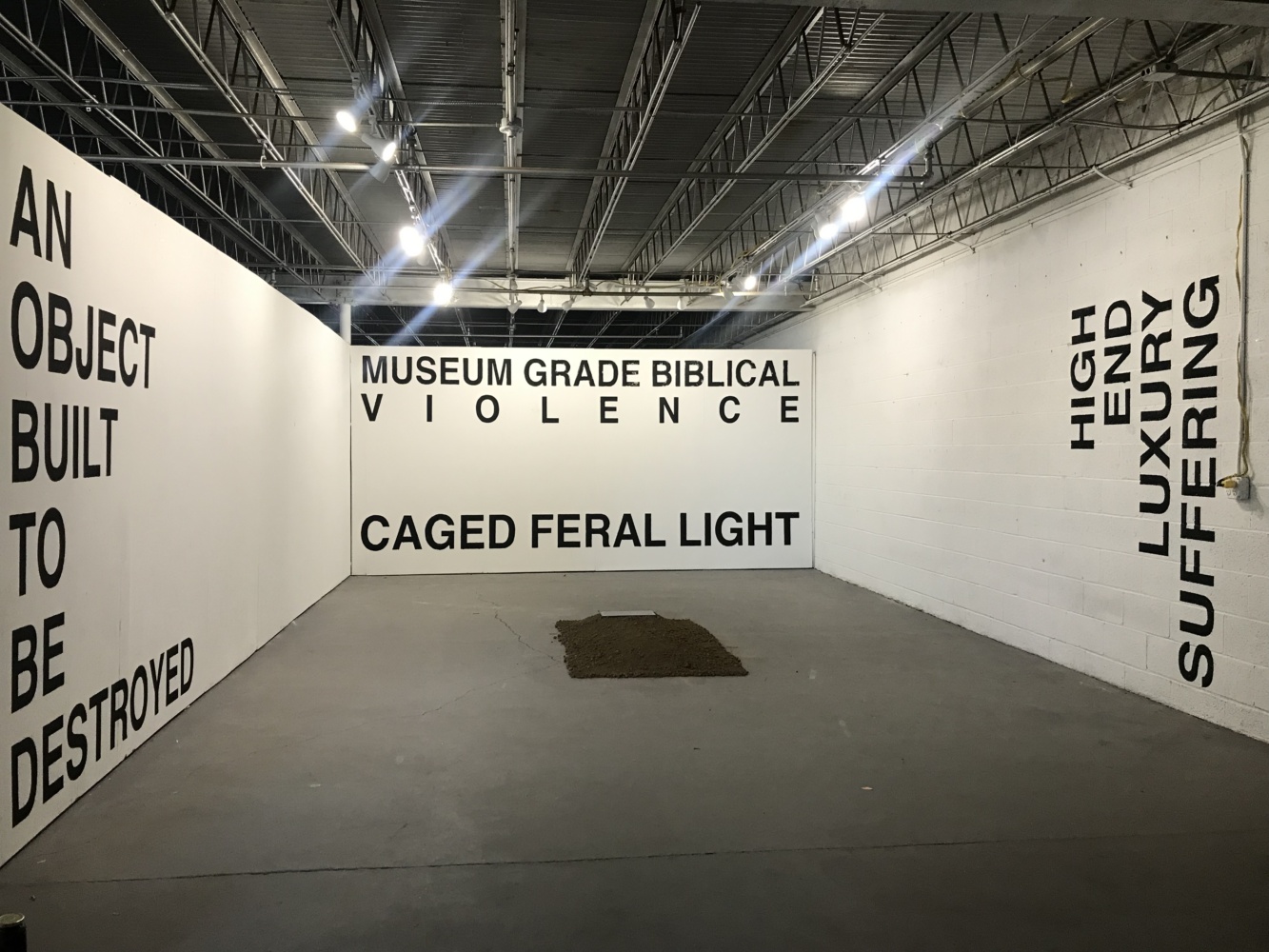
With a playful wit, Thaniel Ion Lee: Six Small Works and a Statement at Louisville Visual Art (LVA) in Kentucky confronts the dystopian manifestations of late capitalism while opening up a space for possibility. The compact but powerful installation includes six text-based works—four painted on the walls and two printed on 8.5 x 11-inch paper—along with a floor-based work made primarily of dirt.
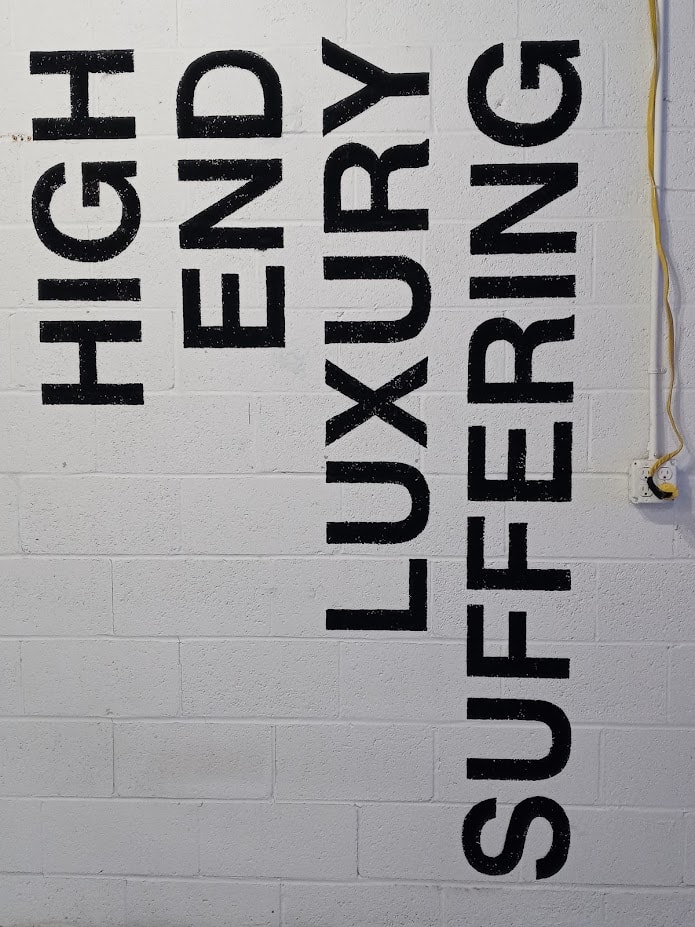
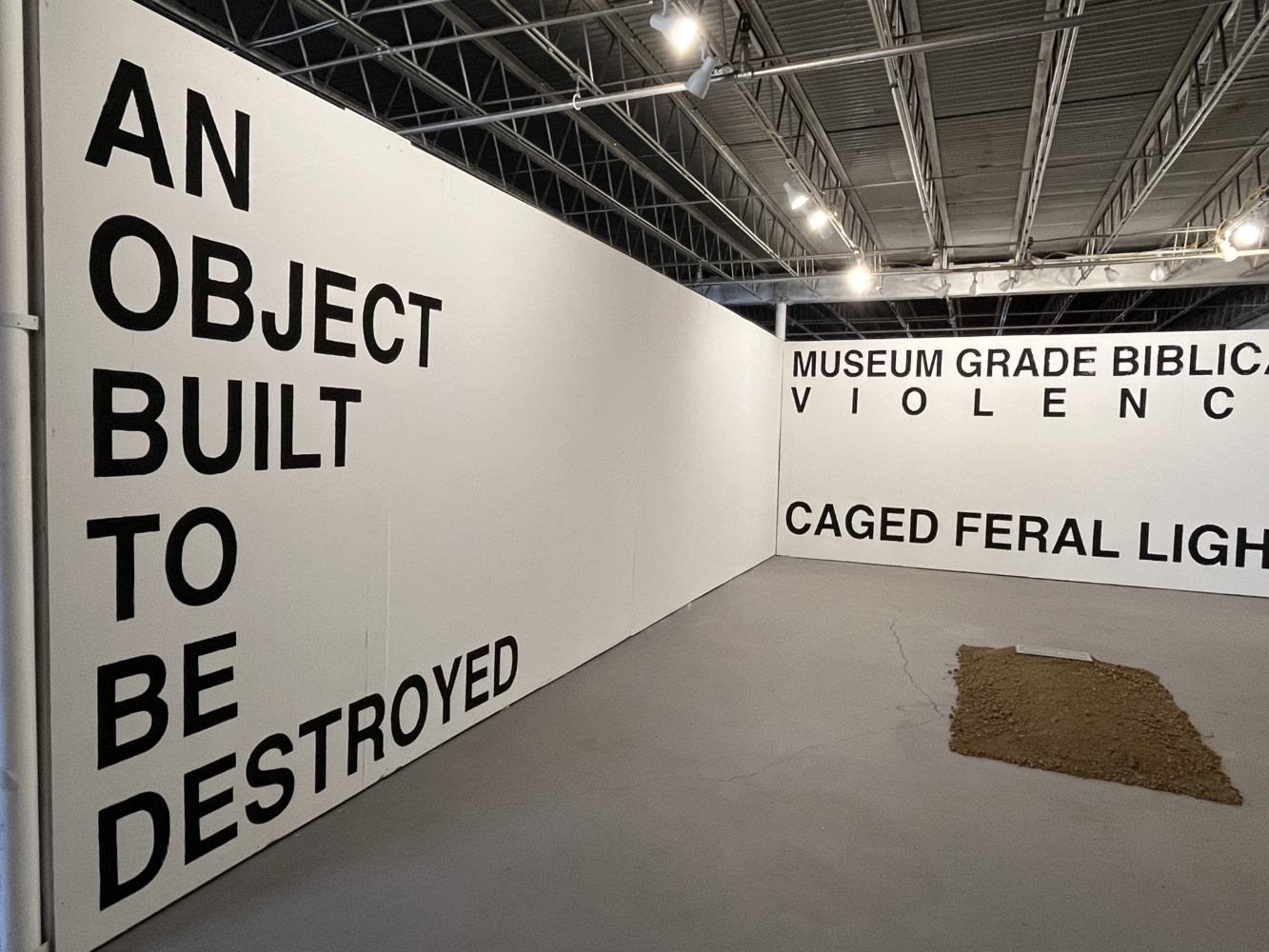
Each wall-based work takes its title as the entirety of the text itself; to name the work is also to describe it. On the gallery’s main wall, MUSEUM GRADE BIBLICAL VIOLENCE (2025) occupies the top portion of the plain white surface, while CAGED FERAL LIGHT (2025) sits close to the cement floor, with the typography in both tracked to fill the entire horizontal distance. AN OBJECT BUILT TO BE DESTROYED (2026) abuts the leftmost side of an adjacent wall, stretching from top to bottom with each word on a separate line. On the opposite wall, the text in HIGH END LUXURY SUFFERING (2025) is rotated to the left, so that words seem to hang, banner-like, from an invisible clothesline. All the works are executed in black, all-caps Helvetica Bold, lending them a weighty blockiness that echoes the architecture of the white cube and a visual restraint that belies their often violent and chaotic implications.
These large works call to mind such diverse figures as the American conceptual artist Lawrence Weiner and the Scottish poet, artist, and gardener Ian Hamilton Finlay. From Weiner, Lee embraces the idea that a work need not be physically created to function as art, but can exist as description; that language itself is a material. With Finlay, he shares a more formal visual execution and an engagement with history, myth, and structures of power.
There’s something delightfully subversive about Lee’s texts that seems to resonate with the current apocalyptic mood. “Museum-grade Biblical violence” feels like the tagline to Jerry Bruckheimer’s next summer blockbuster, and “high-end luxury suffering” like an advertisement for a speculative Amazon-branded refugee camp. There’s a point when everything starts to feel like it’s been “built to be destroyed”—including the planet and the people who inhabit it.
Two smaller works utilize the same typographical treatment for slightly longer texts that speak to a much more personal and embodied pain—one that is quiet and solitary. References to “skin, tendon, and bone” and the “long, slow ache” evokes the kind of weariness that sets in when one has endured physical hardships and systemic oppression for a very long time, maybe even generations. When Lee, who was born with a form of arthrogryposis that severely limits his mobility, describes a “transmogrification documented in DNA and bone,” in a text, the act of dramatic physical change is linked with the act of making art, of using raw human experience to create something new and self-authored.
The final work is placed in the middle of the gallery, a rectangle of dirt about two feet wide and six feet long, marked with a titular granite marker that reads WE BECOME THE SOIL UPON WHICH WE STAND. The memento mori feels particularly apt, reminding the viewer not only of their own mortality, but also of the ephemerality of all things, even powerful empires. If nothing is permanent, then every moment offers the possibility for change.