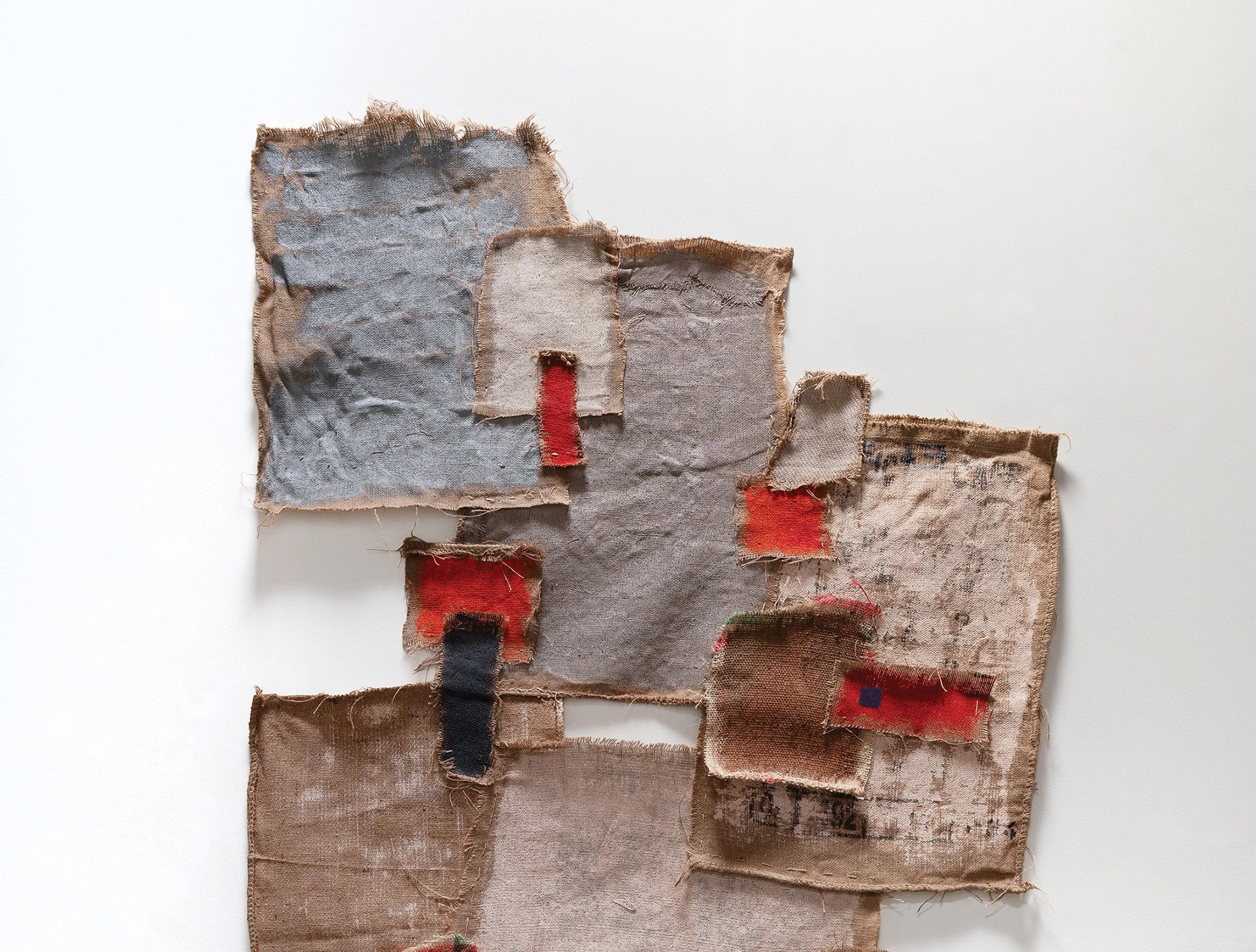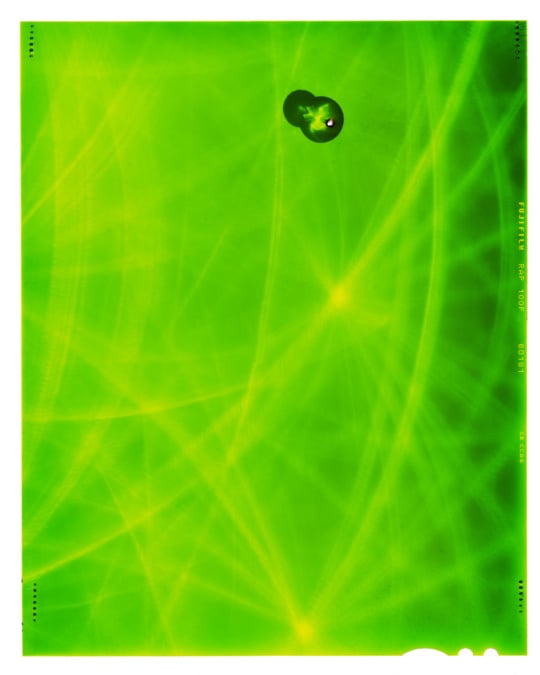
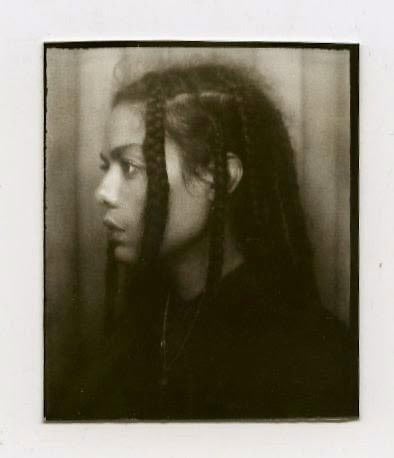
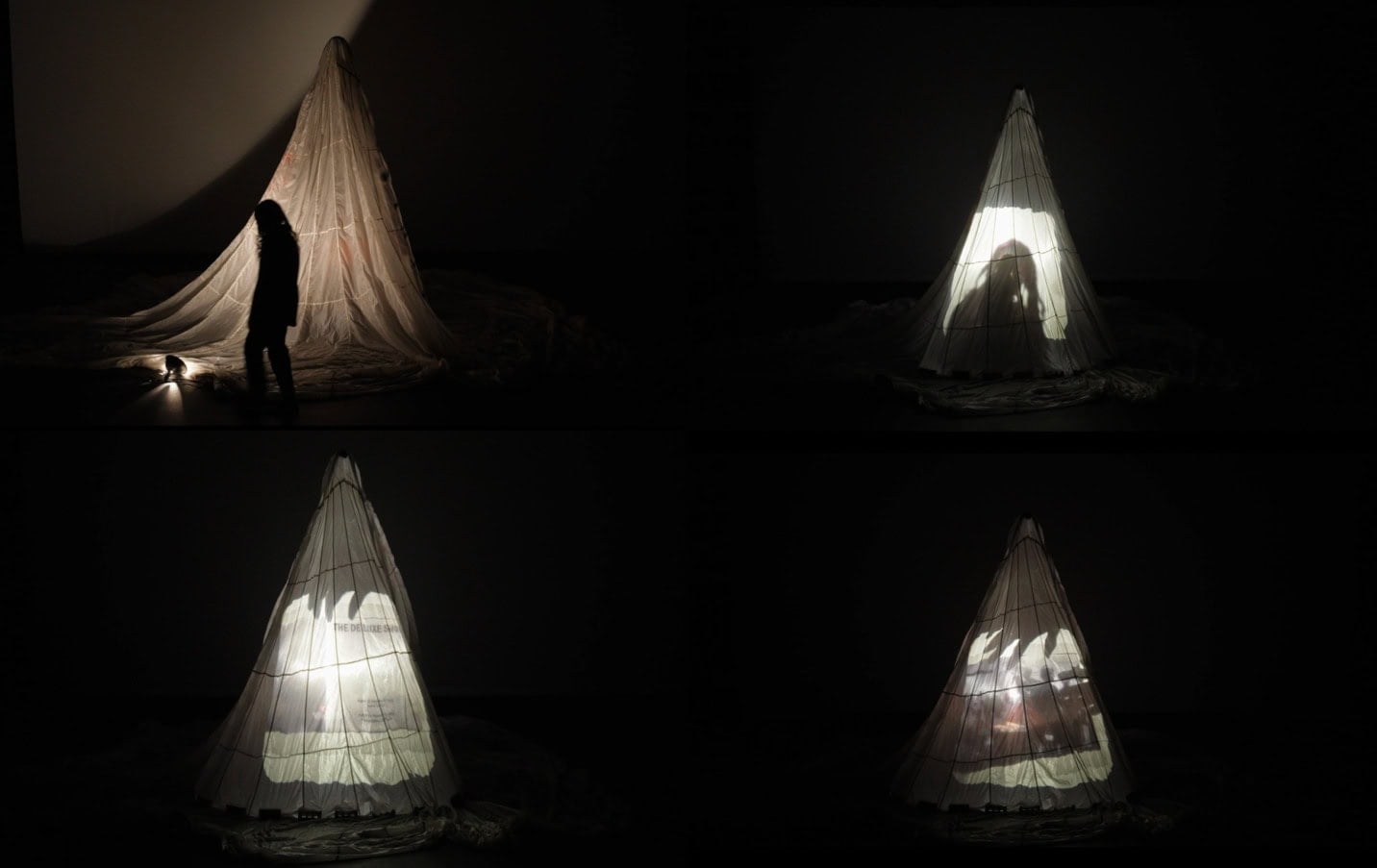
Great artists pick the lock on reality and then take it (and the viewer) for a ride. Eli Greene’s performance On Falling: Part VI (2025) at The DeLUXE Theater was one such ride. For most of the twelve-minute experience little of note happened. Greene spent much of her time on stage setting up a ladder, an overhead projector, a turntable, a fan, and a parachute she draped over herself and her props. This created a weirdly productive palate cleanser; the theater, in its darkness and silence, became a cave of free association. When the projector light began to flicker with images of The De Luxe Show (1971) and The Staple Singers crooned from the artist’s wobbly turntable, I was transported.
With photographic transparencies, Greene told a story about a legendary event that took place in that very same building more than fifty years earlier when artists and curators made history with one of the first racially integrated art exhibits in the US. Greene’s performance was so dialed in I was hurtling past time, subsequently, I knew I needed to talk to her.
This conversation has been edited for length and clarity.
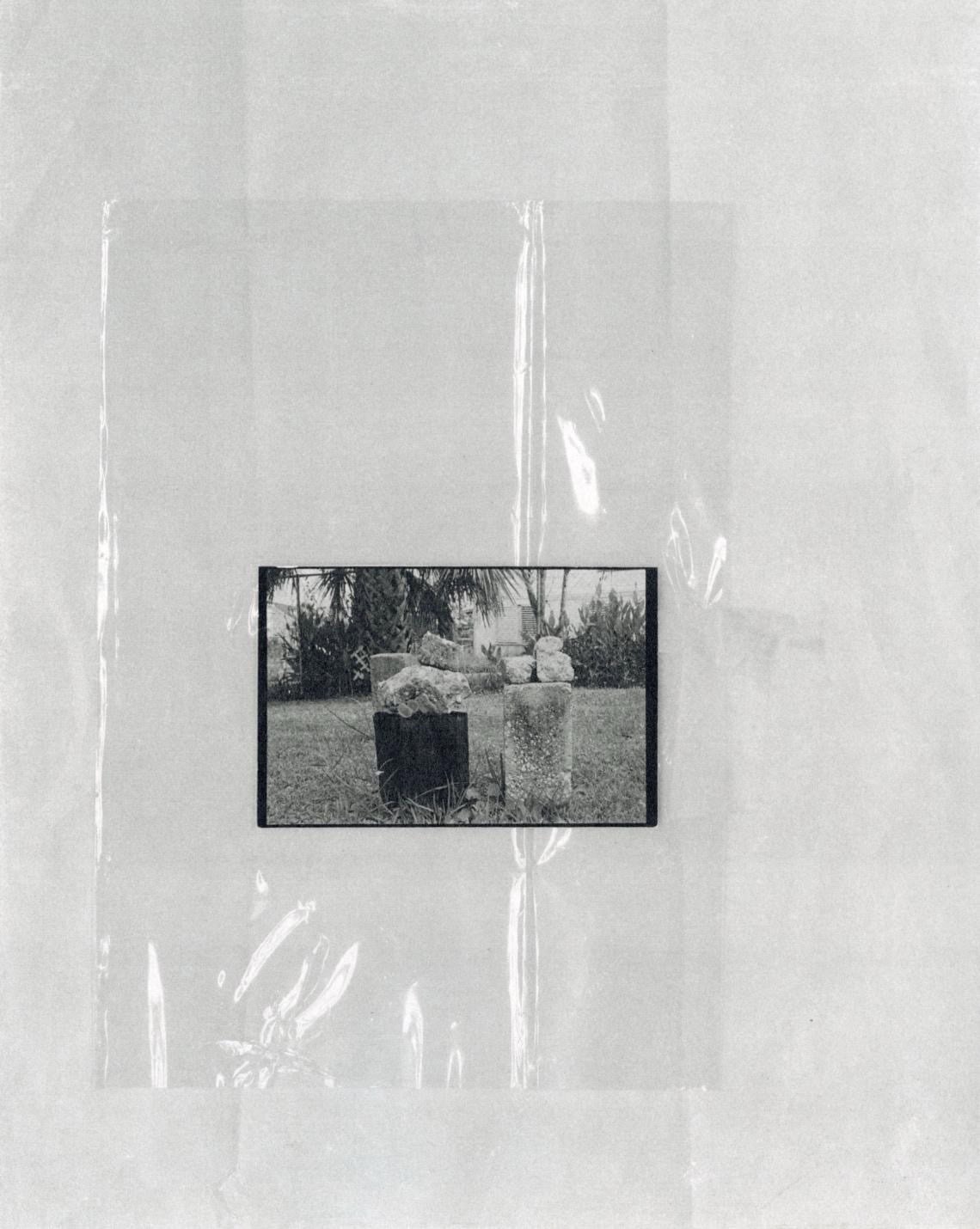
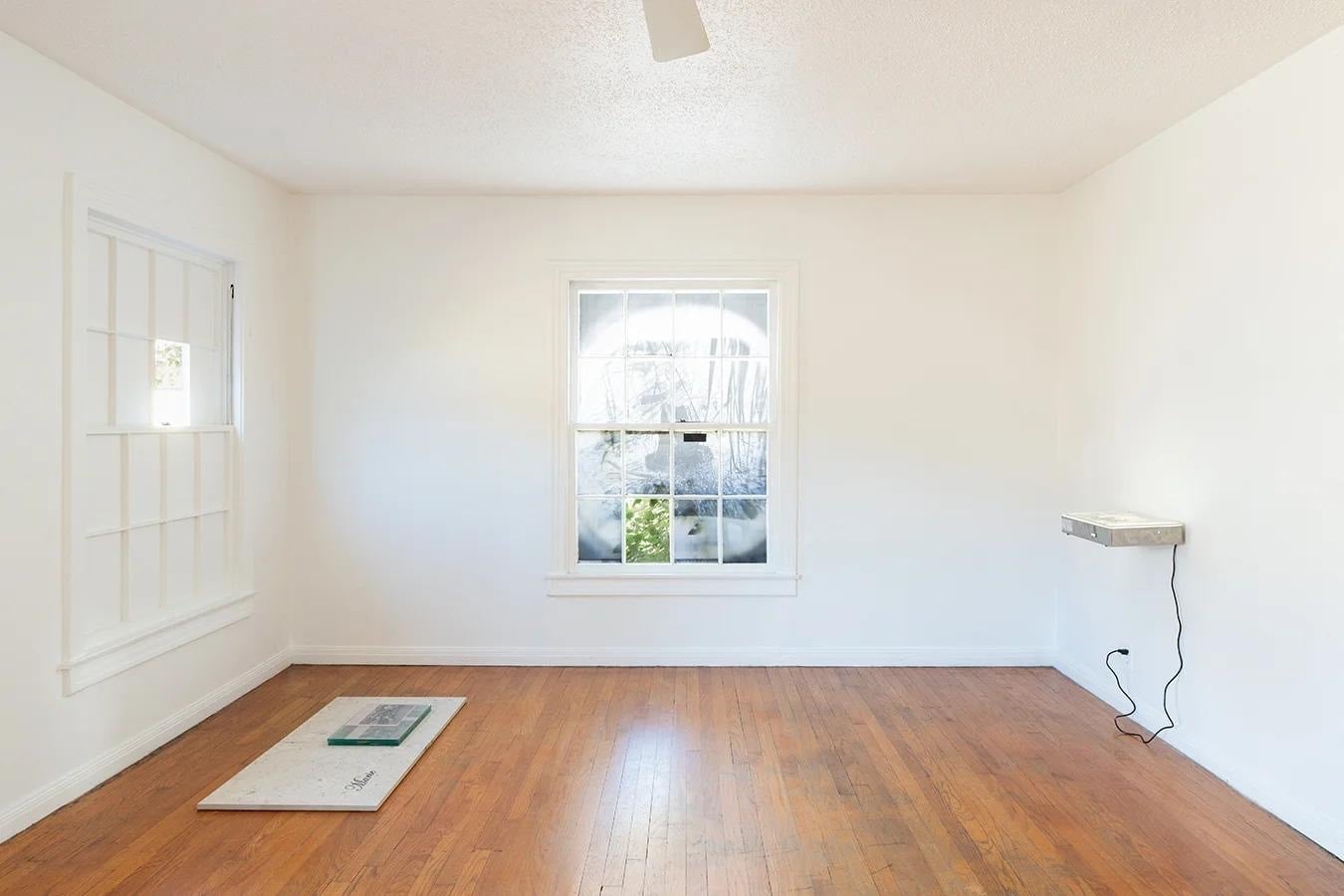
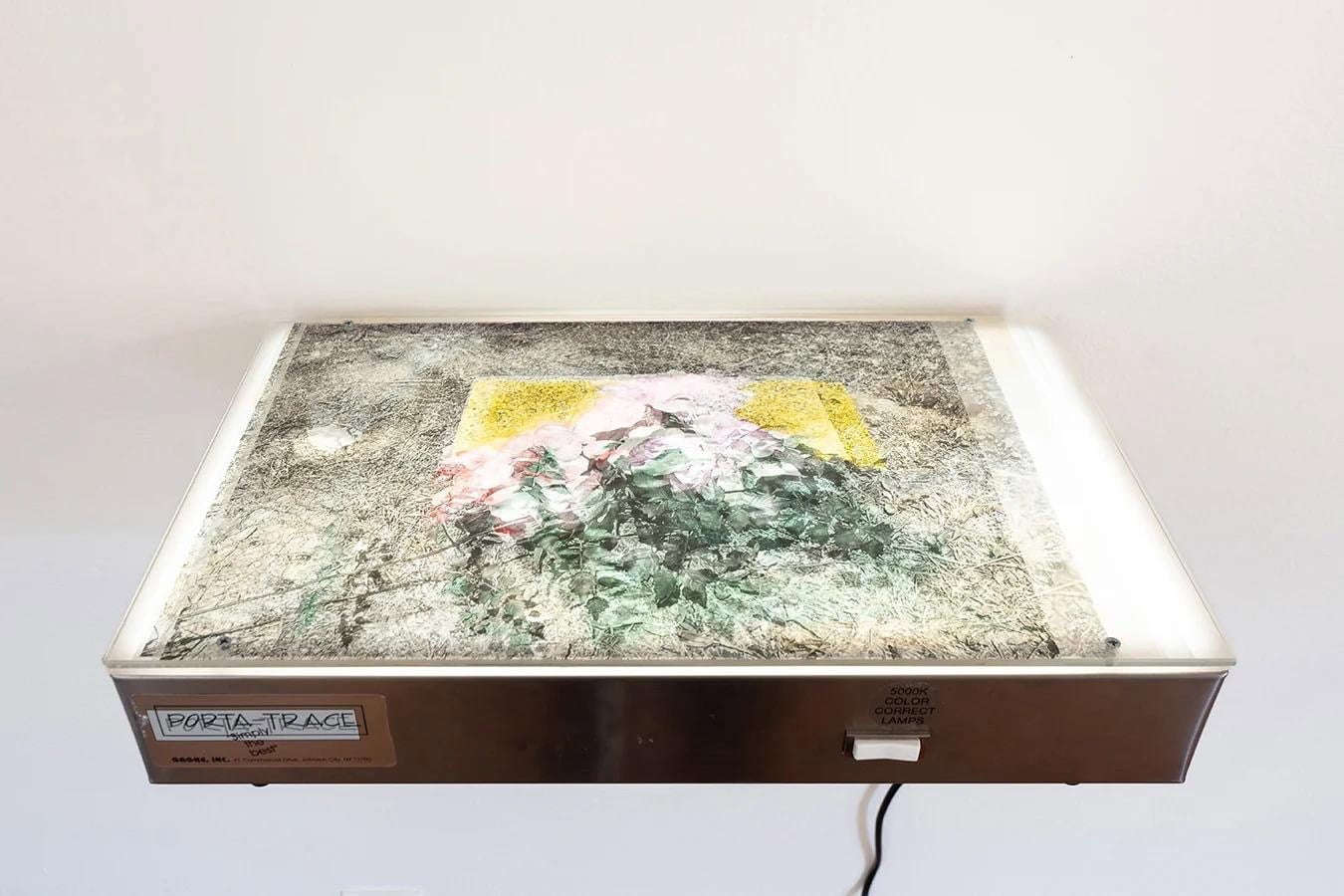
Max Tolleson (MT): In Floods, which took place at F gallery earlier this year, you brought together several sites: a nearly empty lot in Galveston, Texas; burial grounds in Columbia, Tennessee; and the gallery itself, in Houston. Each element was so carefully worked over. I felt as though I were straddling all of these sites at once and it reminded me that photography is such a perfect medium for time travel. However, your work often has many layers. Sometimes you’ll take a 35mm negative, rephotograph it on a light box with an iPhone through a loupe, and then enlarge the result. When I saw Floods, it seemed as though you were intentionally trying to distort or obscure my relationship to these sites. Could you talk about your process for making image-based work and why layering is important to you?
Eli Greene (EG): I think I’m interested in taking one thing and…observing it transform into another, which can take place in a number of ways: through layering, copying, distancing, taking a picture of a picture. In some ways it sort of collapses time, it takes something from another moment, through an analog process, into something more digital and of the now. And there’s something inherently interesting to me about the language of abstraction, of destabilizing sort of what we think we know, that feels more honest to me. There’s often more truth in abstraction and I think I’m still trying to understand why that is. I think it has a lot to do with the felt sensation of an image, and I would say process is the way that I come closer to understanding the image. It’s really through making and through a variety of processes that help me slow down and look closer.
MT: You participated in the program “12 Minutes Max” earlier this year, hosted by DiverseWorks at The DeLUXE Theater in Houston’s historic Fifth Ward. In your performance, On Falling: Part VI, you projected transparencies of the infamous De Luxe Show from 1971, which is one of the first racially integrated art exhibits to take place in the US. I was wondering if you could talk about why you wanted to make this the subject of your performance. Were you aware of The De Luxe Show before moving to Texas?
EG: Yes, I actually studied with Darby English while in grad school and was very impacted by his book, 1971: A Year in the Life of Color (2016), which features The De Luxe Show and the artists, and examines the histories and the lineage of Black abstraction.2 So The DeLUXE Theater was a site and history that was sort of haunting me from afar, and when the opportunity arose to do this performance for DiverseWorks the most exciting part for me was that it would be sited at The DeLUXE.
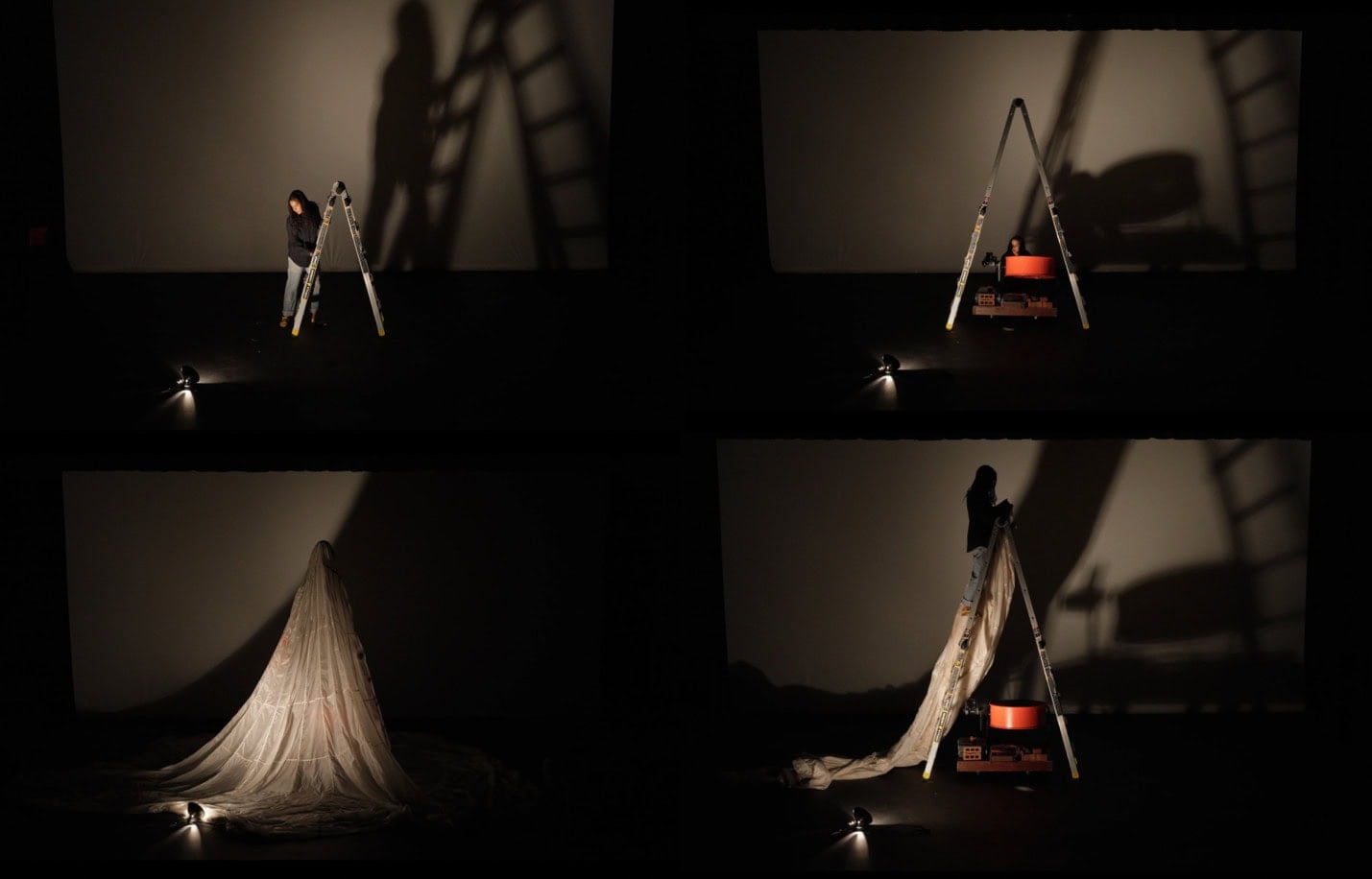
This performance was the sixth iteration in a series that typically takes place with a ladder and the pouring of sand from a high place off the top of the ladder. Other recurring elements of the performance usually include the lighting and the extinguishing of a candle, and the performance typically takes place as a loop of actions often accompanied by music, in many cases a live cellist who I’ve collaborated with several times named Dorothy Carlos. In this case for The DeLUXE Theater, they let me know early on that I could not use sand and I could not use fire of any sort, and so it had me rethinking the conditions of a loop I was pretty familiar with.
“…it’s all art: it’s music, jazz, Thelonious, Buchanan, my neighbor, my uncle, my grandfather, people I’ve never met, all of that is what shapes me and it feels to me that this is what ties me to place…”
In the performance that preceded The DeLUXE Theater, a performance which took place at the First Presbyterian Church in Chicago, I was draping ladders with a backdrop or a curtain. [The] curtain had been a prop in a performance called Hansel and Gretel, which was a class taught by [William] Pope.L in graduate school where the MFA cohort reenacted Hansel and Gretel essentially from memory. The draping of the ladder felt to me like a shroud. And the acts felt like a ritual in a way that I wanted to continue to work with. So I was looking for shrouds on Craigslist and came across this giant parachute in a storage locker somewhere outside of Houston…The whiteness of the curtain of the parachute, when draped over the ladder, occurred to me as a perfect surface for projection. I had already been working with transparencies, in many cases as a teaching tool, because I appreciate the slowness it provides in the classroom. It also occurred to me that the light from the overhead projector could act in the loop like the candle, beginning and ending the cycle. The song, “Standing At the Bedside of My Neighbor” (1964), I first heard as a sample on a track by Westside Gunn featuring Rome Streetz [& Stove God Cooks] called “BDP” (2022). I was listening to this song on loop around the time I was moving to Houston and really wanted to discover what the sample track was because it would not leave my head. So it took me down a rabbit hole that led me to The Staple Singers and I ordered the album on vinyl…While I was rehearsing the moving image projections, it occurred to me that the track, both in time and feeling, could be the perfect accompaniment to the piece.
MT: One reason I find your work compelling is because it’s so much about history and history, of course, is messy: it can be obscure, difficult to see or discern; it can unfold slowly; it can have layers. As an artist who teaches dark room photography, a slow and sometimes laborious process, are you ever asked questions about the relevancy of such old and time-consuming practices? And how do you respond?
EG: The answer is yes, absolutely. It’s funny because this past week in class, as my students are just getting to the point of enlarging their first images, I overheard one student remarking, “Who would ever invent something this difficult?” And it was as if they were not just surprised but offended by the amount of steps, the depth of process, the duration and dedication it takes to develop a single image from in-camera to process, to enlarging their prints in the darkroom, and the testing and experimentation and iterations that take place in between. But—it’s part of the joy of teaching the medium—if they do commit to this fourteen weeks of dedication, by the end…there is some opening, some appreciation for the beauty of process, for the unknowns found in experimentation and for an image that is uniquely touched by its author’s eyes and hands in many cases. And an appreciation for what it means to or what can be seen when the process isn’t instant and the results take some deep listening on many levels. And it’s a joy to see that happening.
MT: There are certain art historical figures who seem to take pride of place in your work (I’m thinking of Beverly Buchanan), but there are others like The Staple Singers or Thelonious Monk (who appeared in a previous exhibition). These are people I associate more with popular culture, music, and entertainment. I have a feeling a good portion of what informs your work is not necessarily coming out of an art historical canon, but from your own lived experience. Could you talk about how you navigate influence?
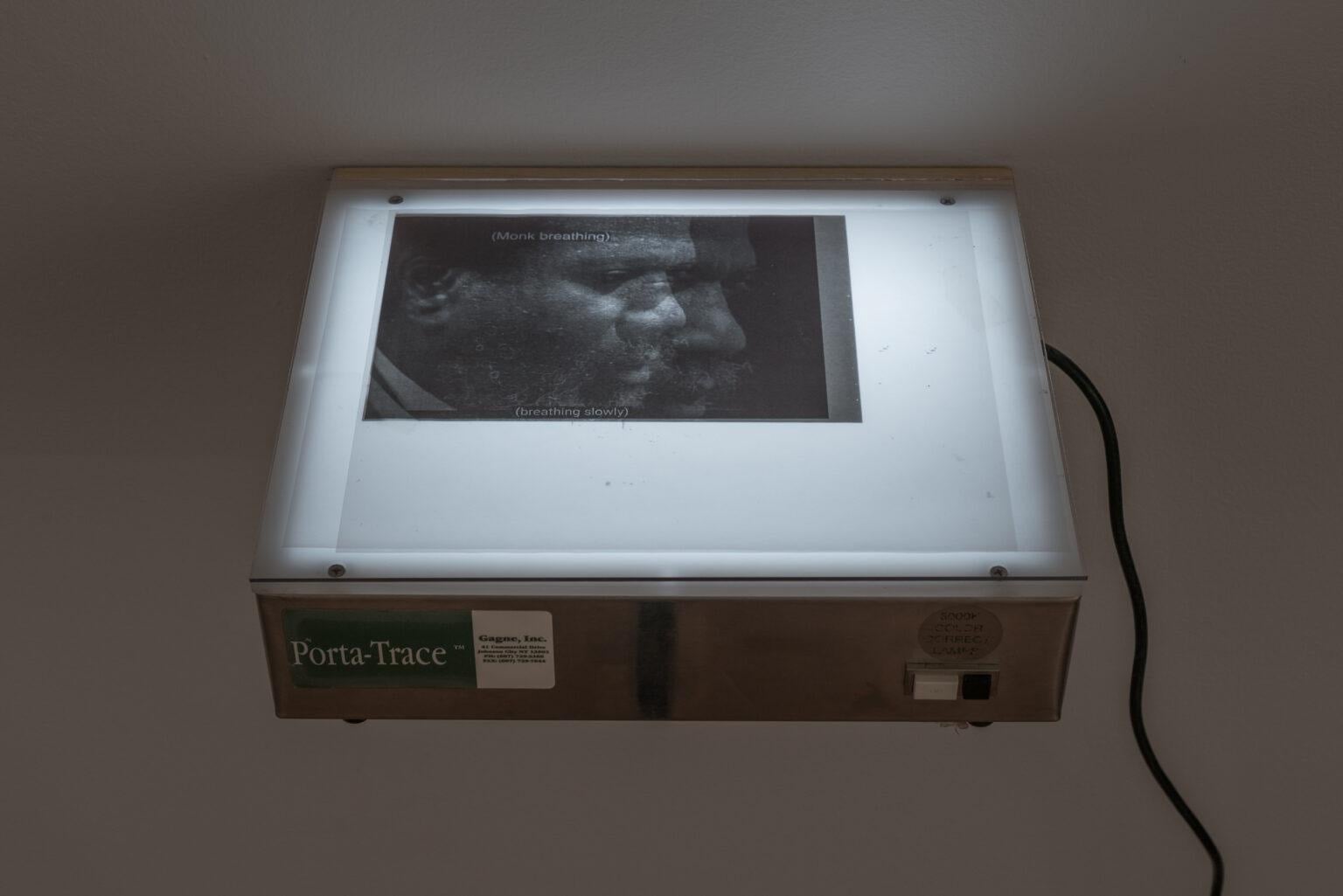
EG: I want to read a quote that was just sent to me by my friend Anna Mayer and it’s a quote by Beverly Buchanan who says, “I think that artists in the South must at some point confront the work of folk artists not so much in the terms of the work but of the persons and the work being of and from the same place with the same influences, food, dirt, sky, reclaimed land, development, violence, guns, ghosts and so forth.”3 And that just came to mind right now thinking of the work that has influenced me most…it’s all art: it’s music, jazz, Thelonious, Buchanan, my neighbor, my uncle, my grandfather, people I’ve never met, all of that is what shapes me and it feels to me that this is what ties me to place, so I’m deeply inspired by all of it.
[1] The title for this article references a song by Sic Alps called “Nathan Livingston Maddox,” recorded by Matthew Hartman, Mike Donovon, and Noel Von Harmonson, released in 2011, Drag City DC455.
[2] Darby English. 1971: A Year in the Life of Color. University of Chicago Press, 2016.
[3] Beverly Buchanan papers, 1912-2017. Archives of American Art, Smithsonian Institution. Box 2, Folder 24. https://edan.si.edu/slideshow/viewer/?eadrefid=AAA.buchbeve_ref90.