Spanning a variety of materials and forms, from acrylic fiber to paper to driftwood, Through the Light at the Spartanburg Art Museum (SAM) presents the kaleidoscopic vision of Asheville, N.C.-based artist Molly Sawyer. These 34 pieces, many using found scrap materials, highlight the full breadth of her recent work, particularly in the aftermath of Tropical Storm Helene.
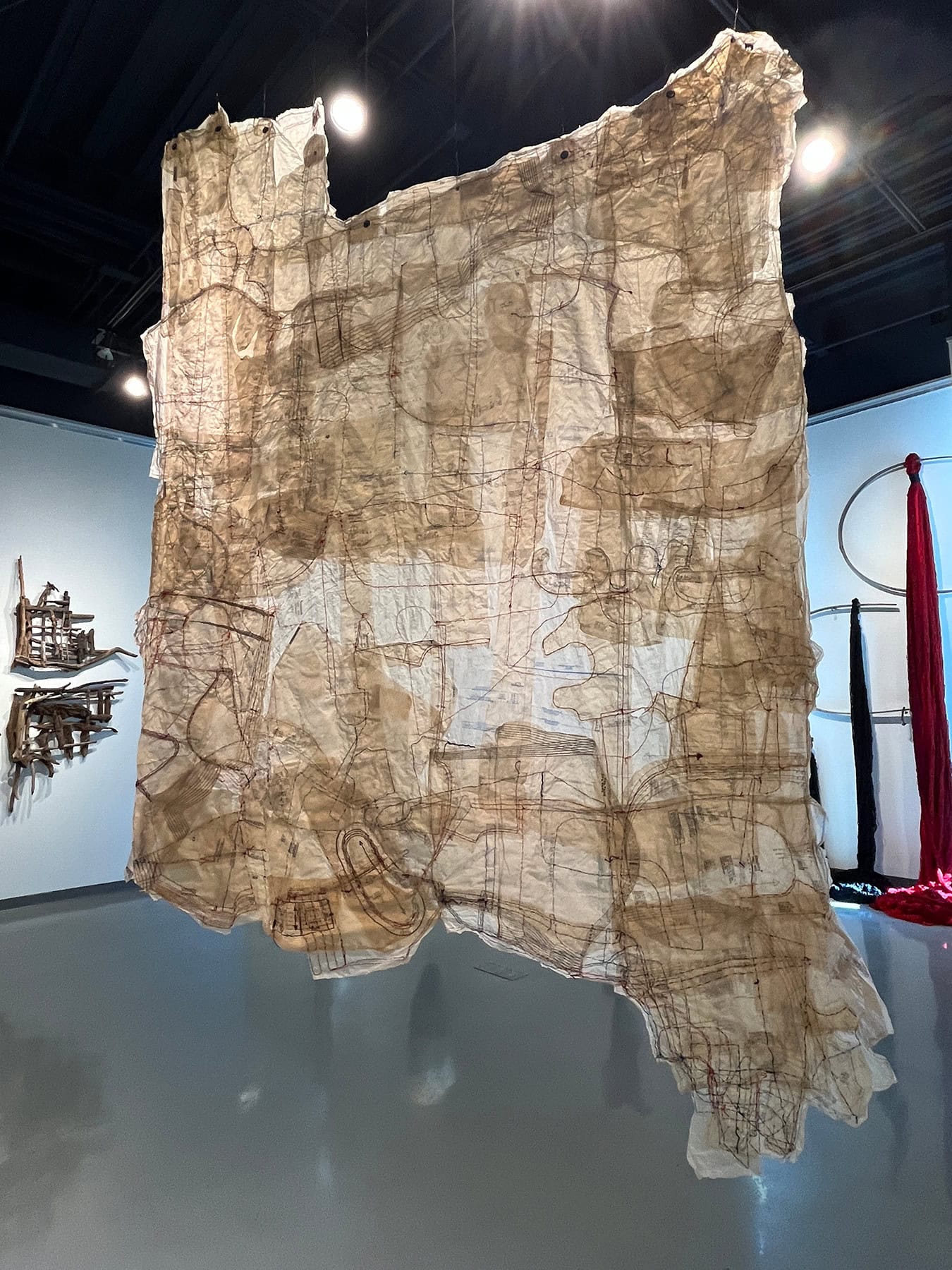
One standout near the entrance, Sale Cloth (2025), initially appears to be an organic map. Tattered, faded cloth in shades of beige and cream hangs from thin ceiling wires, its uneven edges like the contours of a forgotten 51st state. Sawyer, who graciously led me through the exhibition, explained that it’s actually constructed from salvaged sewing patterns. After fusing them together, she alternated between following and diverging from their natural lines while embroidering in red and blue thread. She prefers Sale Cloth to be viewed from the gallery’s inside corner so that light shines through it, silhouetting overlapping patterns and defining shadows.
Sale Cloth embodies the throughlines that run throughout Sawyer’s work: her loyalty to salvaged materials and dedication to highlighting their inherent qualities, rather than molding them to a preconceived vision. While aesthetically quite diverse, many pieces in the exhibition exemplify the artist’s focus on process, materiality, and the museum-goer’s physical and emotional interaction with the art.
The artist was fortunate not to lose her River Arts District studio in Tropical Storm Helene, which significantly impacted much of the region in September 2024. Even though most of her artworks were saved from floodwaters, this tragedy pushed her to produce in overdrive this year. While not site-specific, she installed many of her newly created works in response to the SAM’s lighting, high walls, and cavernous ceilings, exaggerating shadows and volumes. A key example of this is Reaching Through (2025), an acrylic yarn work she personalized to the dimensions of the space. Sawyer finger-knit the piece around aluminum frames, suspending them in an alcove with narrow exterior windows on either side—cool winter light washing over concentric circles of yarn with varying shades of white, degrees of thickness, and looping, loosely coiled textures.
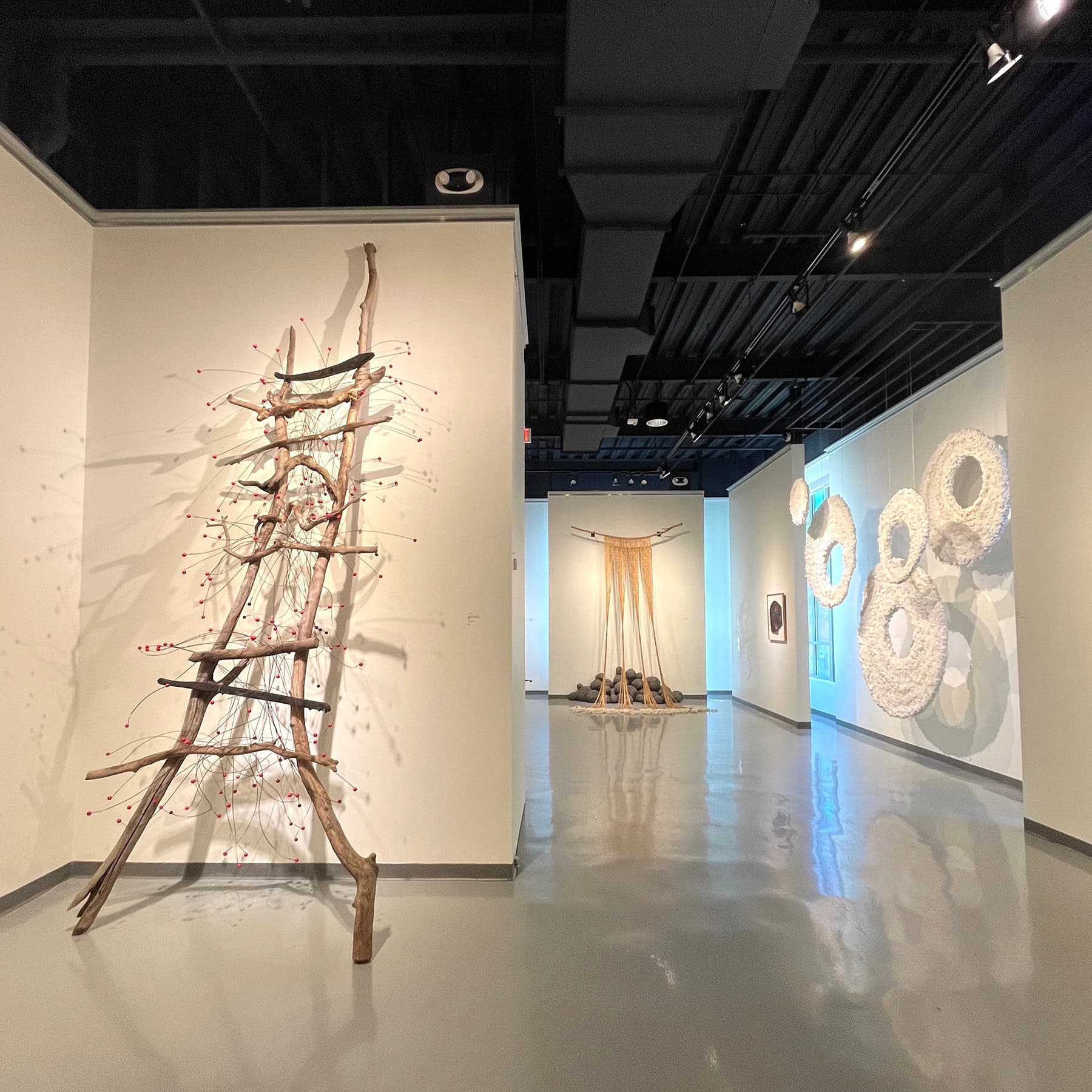
For Reaching Through, the yarn was purchased, but the frames were sourced from area utility companies as they worked to replace downed lines after Helene. Sawyer has always salvaged and crafted obsessively, from discovering treasures on New York City trash day to collecting wire from utility crews post-storm. She sees these materials as reminders of past lives—“precious evidence of another’s gifts and needs,” as she put it—yet through her own process of creation, these materials gain a new life, recontextualized as they spark memories and emotions in viewers. Sawyer continually asked herself, “How can I activate this?” aiming to engage the viewer actively with each work.
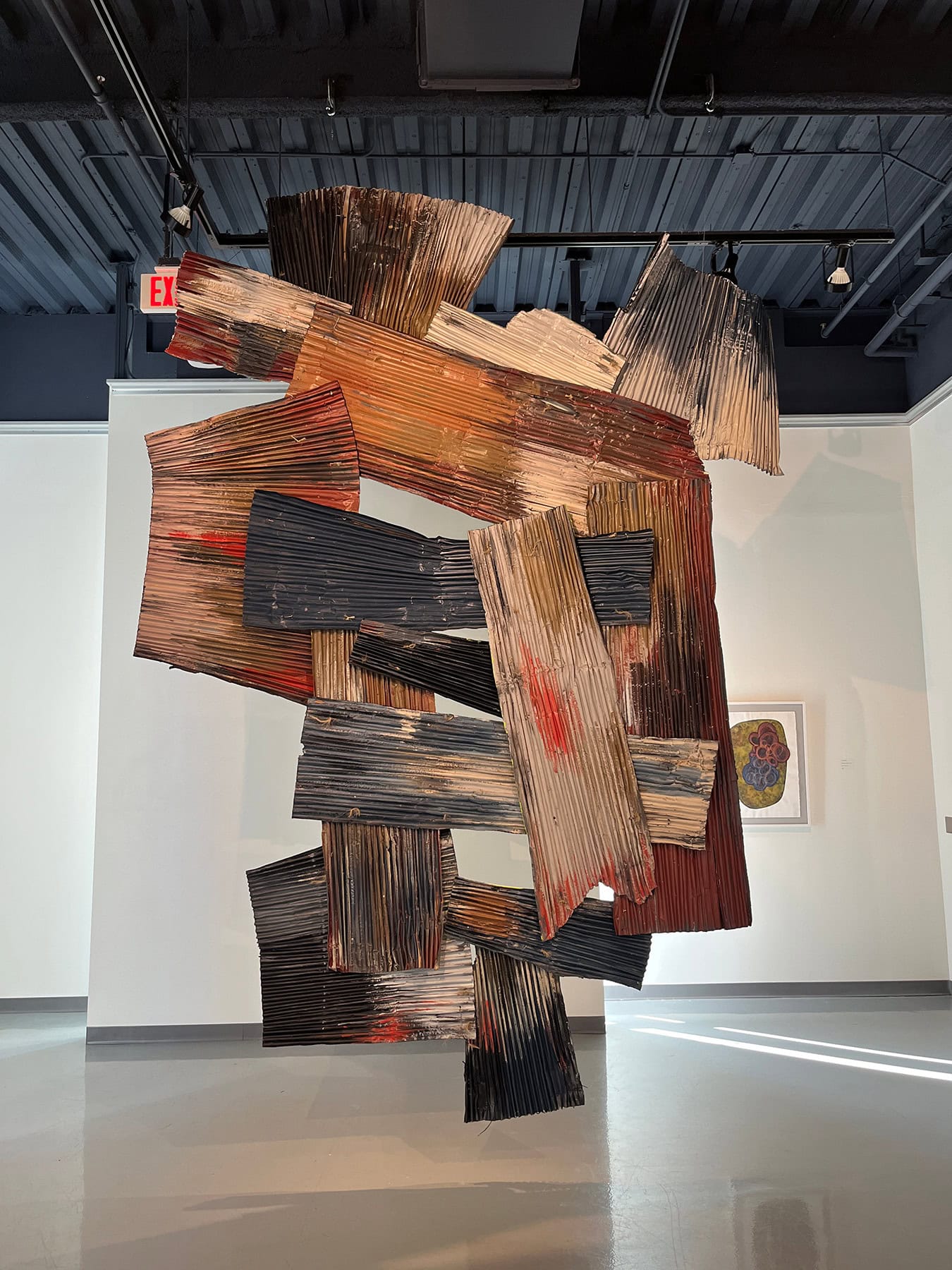
The monumentally proportioned works [Dis]Solution (2024) and Corrugate (2025), both of which rise over 12 feet, invite visitors to get close and experience them from multiple angles. [Dis]Solution not only features salvaged components, tin shingles covered in faded brown and red paints, but is itself a sort of repurposed artwork, reconfigured depending on the exhibition space. While in past iterations she’s displayed [Dis]Solution vertically within an elevator shaft or flat against a wall, here the four rough-edged rectangles huddle closely together, suspended from the ceiling with long wires. Soft twine contrasts dramatically with the sharp metal tiles, wrapped in neat twists that fall into an undulant, luxurious pile on the floor.
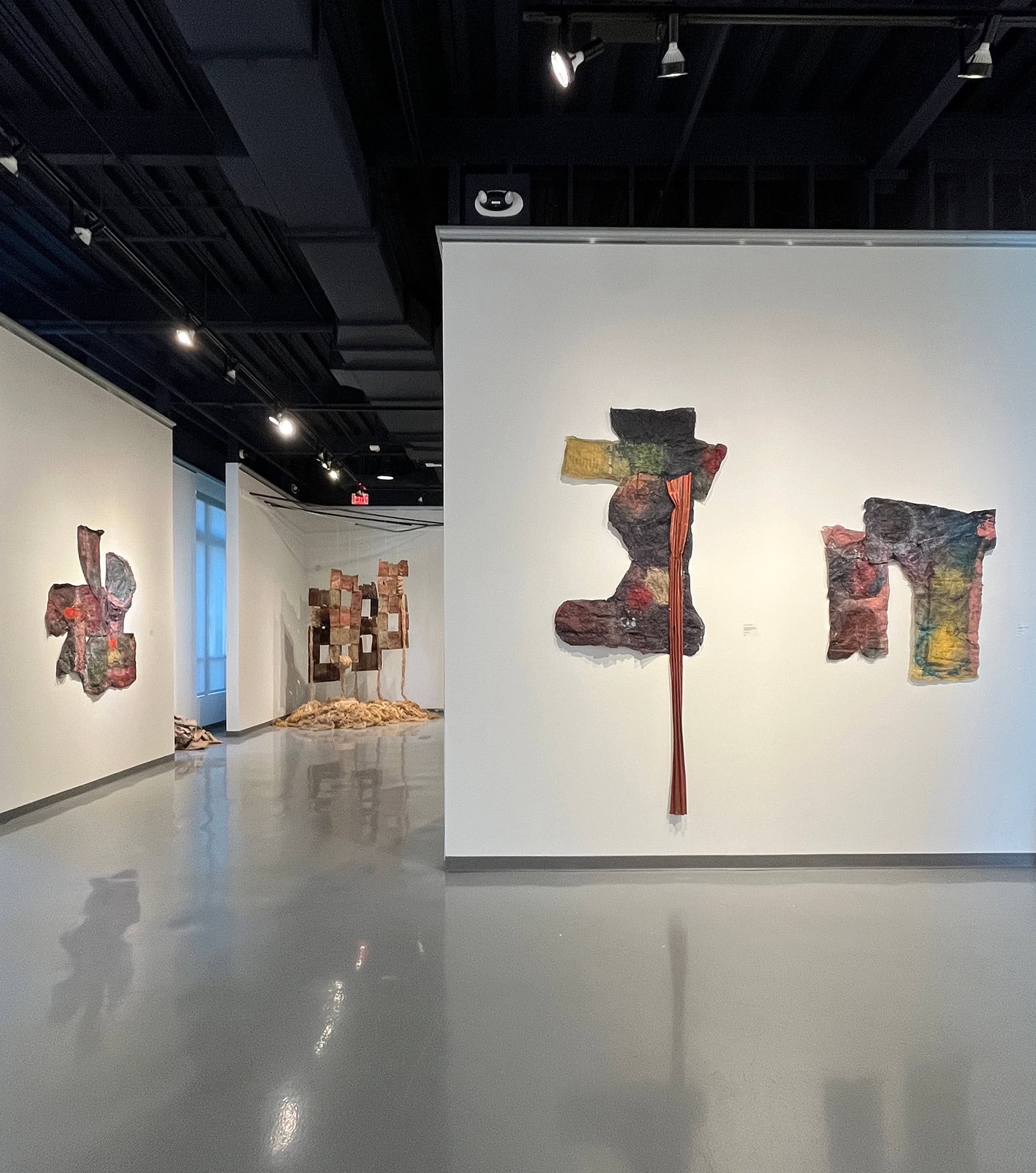
Corrugate’s materiality is slippery, more deceptive. What appears at first glance to be corrugated iron arranged into a haphazard floating collage is really made of thick paper; the artist salvaged this packing material from a flatbed truck in Asheville before it could be discarded. Its ribbed texture mimics corrugated iron, while the colors facing the main gallery evoke rust, darkness, and rich primary hues. Walk around to the wall-facing side, however, and these subdued tones are replaced by a harsh, unexpected black and acidic neon green.
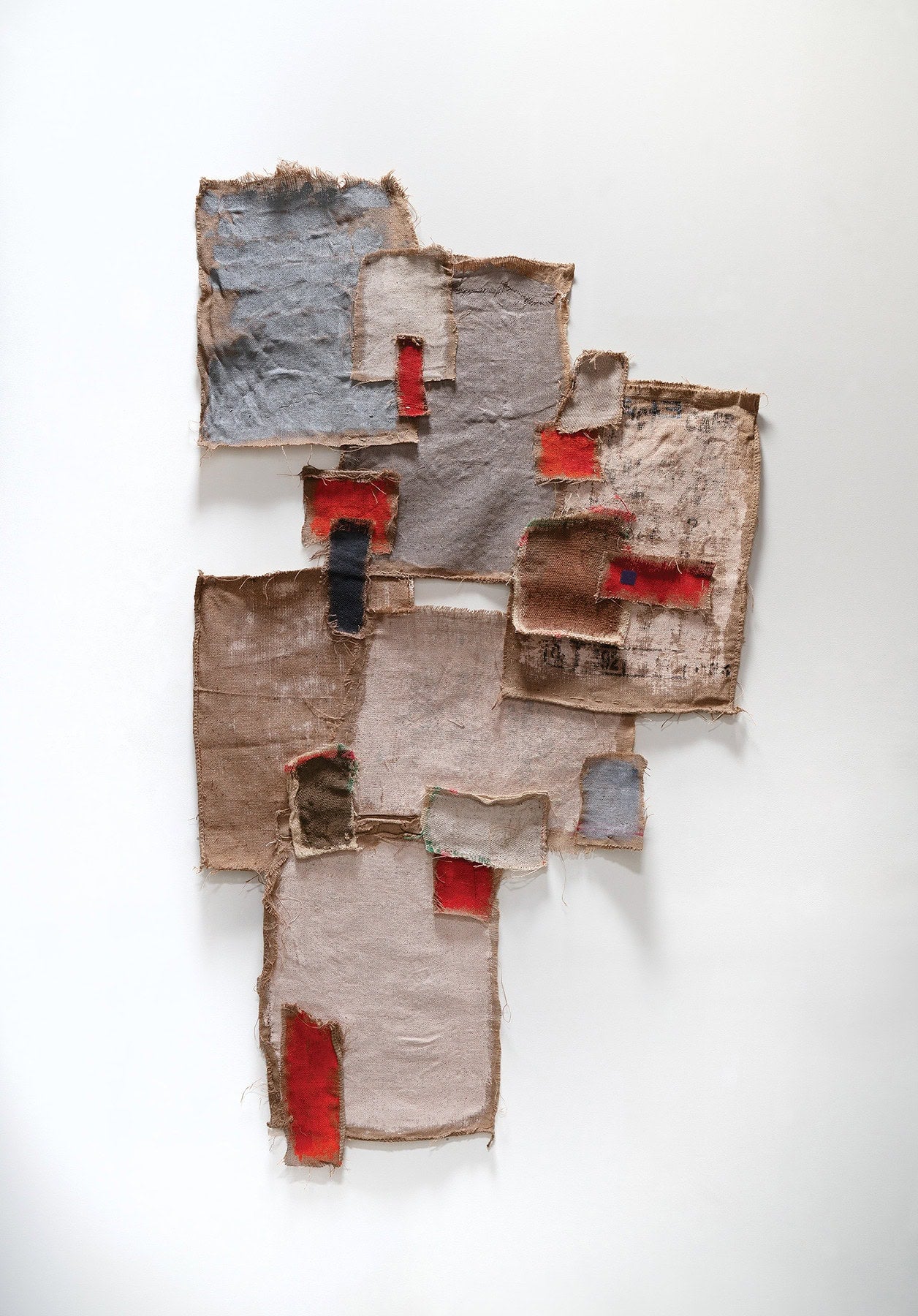
The eye may be naturally drawn to these towering installation pieces, but Sawyer’s smaller, wall-based works exhibit the same commitment to process and reclamation, balance and texture. Among these, which range from papyrus-like amate paper scrolls to amorphous watercolor forms, Big Pink (2025) plays on the artist’s strengths while taking them in new directions. Living so close to the former Black Mountain College, Sawyer is particularly inspired by Anni and Josef Albers, as well as other former instructors and students at the college. Big Pink’s cut-out burlap, arranged in a soothing geometric pattern of tans, blues, and reds, nods at both Anni’s textiles and Josef’s famed color fields.
Whether at a grand or more intimate scale, the most resonant works in Through the Light have a lived-in feel to them, achieving Sawyer’s aim to build a complex, swirling narrative of materials’ past and present—a present that involves the emotional participation of each individual viewer.
Molly Sawyer: Through the Light is on view at the Spartanburg Art Museum through December 27, 2025.