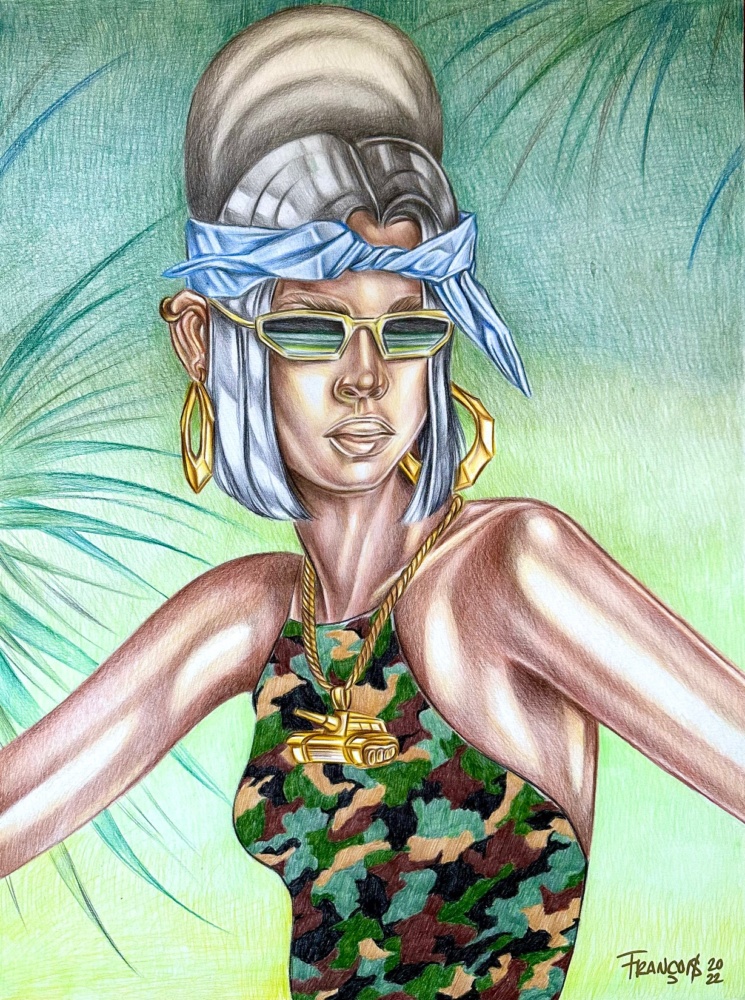
Jacq François is a visual artist born and raised on New Orleans’ West Bank. His works on paper hold humor and history and centers experience, both personal and collective. I visited him recently in his studio to discuss his current and past works. We took a trip down memory lane and ruminated on the importance of memory and the visceral experience of navigating life with his pencil.
This interview has been edited for length and clarity.
Kristina Kay Robinson: How would you to describe your practice? How do you work? What do you work with?
Jacq François: I would have to say my practice really is a focus on blackness. But I have now realized it’s also a practice of memory. Being from New Orleans and specifically, McDonoghville, West Bank, there’s a long, long, long lineage of Black history, Black life, Black lineage. And we all, kind of as a city, have become accustomed to loss through generations. Whether it be storms, whether it be fires, murder, you know. All those things have kind of plagued us. We’ve all become kind of used to losing and forgetting and something new coming. So, through my artwork, a lot focuses on the past whether that’s Black portraits of someone who “looks familiar” to you or I, an actual person or going further into the past, during colonialism and showing our presence in day to day life in New Orleans. I want to bring those memories to the forefront before they’re forgotten. Especially with this administration, this energy thats present in the world. We’re on the brink of everything being forgotten if we don’t bring it forward.
That’s my practice and I do that through paper. As much as I love painting, there is something about the pencil and the paper that brings depth and precision, they come through the pencil for me.
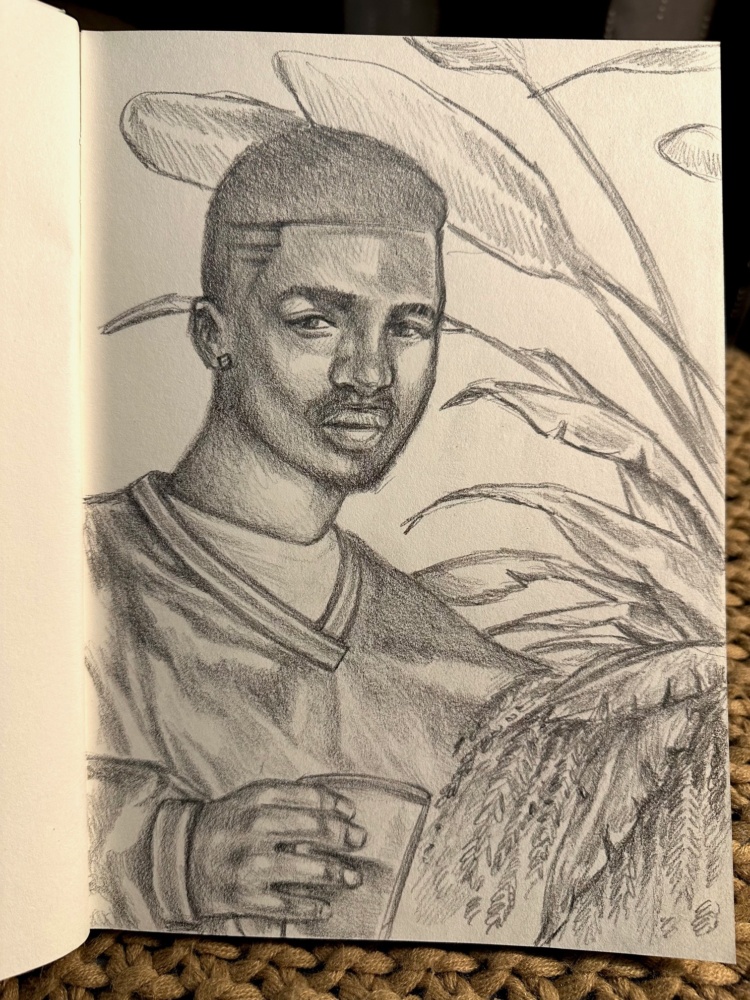
KKR : That is the thing that initially drew me to your work! The drawing. What do you think is special about drawing and why is it special to you and why did you stick with it?
JF: I don’t want to sound too dramatic.
KKR: It’s okay. Go as dramatic as you want.
JF: Okay, good! There is something, I think, so spiritual about the paper. About the process of bringing nothing to something from paper, something that could easily be damaged, ruined, you know, and then making it into something that is so prized through this graphite, lead. Drawing is something so intrinsic to human nature. In the caves and everything, all the figures, hieroglyphics. I’m put off that some people think of drawing as a lesser practice.
For me, I saw my heroes, my grandfather, who was an art teacher at West Jefferson High School for like 50 years, he drew all the time. Or I think about the artist Charles White, who exposed me to Black portraiture and how beautiful those images were on paper. So drawing is my, is my way through life. It really is.
KKR: How would you say a home, history, lineage as well, shows up in your work now? And has it changed over time?
JF: I think it shows up more than ever. Growing up in a small community in Gretna, in McDonoghville, this is a small village, it’s like two blocks. My grandmother built this house in 1940. Every generation afterwards, myself included, was raised in a house. And I think about how blessed I was to be raised not only in a home where my grandmother existed, but my great-grandmother and great-great-grandmother existed.
I was always raised around a matriarchy and once my ancestors start to pass, I find myself still there with them. So memory, you know, it greatly enhances my work. I think in the beginning, I kind of just wanted to be more proficient in expressing myself, or I don’t want to say outrageous, but just being out loud. But now I find myself really thinking about those who I left behind and those who are still with me. And that includes a city, that includes a sound, that includes artists and artisans, and a time, a time of life.
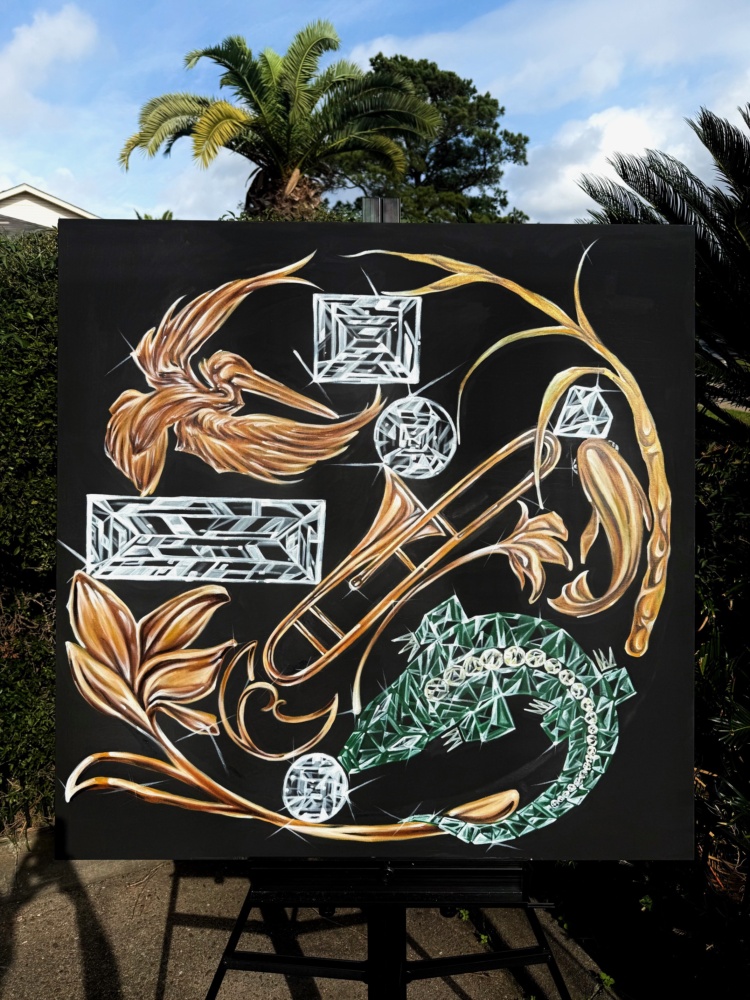
There was a picture I saw recently. And when I saw it, I wept. It was a picture of my grandmother’s house pre-Katrina. And you know how you just see a car. I saw a car parked in front of my grandmother’s house, my aunt”s. And I realized my aunt and my grandmother and my uncle, they’re all gone. And I have to bring that with me. Through everything I do.
KKR: You talk about New Orleans as a Caribbean space, what does that mean to you? How does that play into your work, identity?
JF: At its root, New Orleans is an African city. Various cultural ties are shared with the Caribbean as a result of the Transatlantic slave trade, including cuisines, traditions and religions. My paternal great-grandfather was from Haiti and he migrated to Algiers in the early 1900’s, along with countless other Caribbean immigrants. Along with a rich Creole heritage, New Orleans absolutely reflects various Caribbean cities; both culturally and architecturally. Those histories, heritages and my traditional upbringing as a Black boy of the American South directly influenced my outlook of the world, my approach to storytelling and my responsibility as a Black contemporary artist.

KKR: What do you see as the challenge in your practice right now?
JF: My challenge more so comes through trying to make the art that I really want to make while having to balance that there is a consumerism attached to it. Having to somehow match what an audience may want versus what I may want to see. We live in a technological age, the social media age, everyone wants content. And I fear that the art I make sometimes, especially the newer art I’m making, is not really content. It’s really more narrative-based, more.spiritually grounded. I find that a lot of times the things I want to say maybe don’t translate well through a computer screen or through a phone anymore. Also where I’m at now is that the art I’m making is way more than something to digest. It’s way more than a meme. It’s way more than a repostable image. It really is a story of a time, of a future time and a past time. We really are building worlds. That’s what I’m doing now is world building through memory.
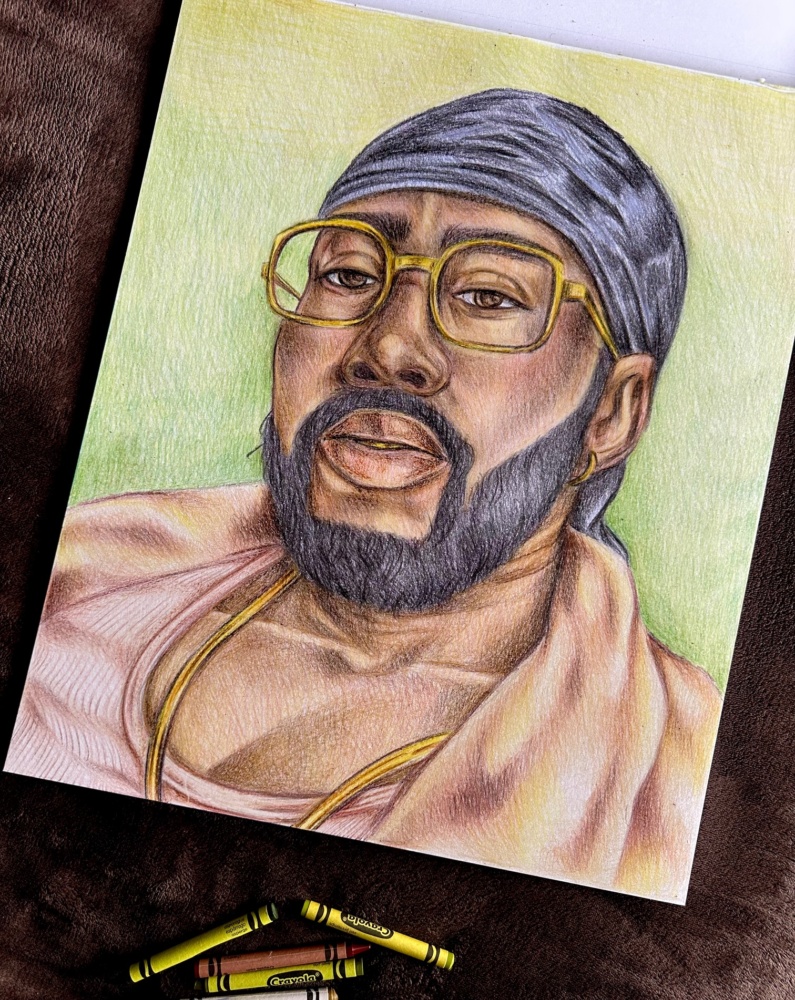
KKR: Would you consider your work related to pop art, distinct from it, a combination of influences from different movements ?
JF: I absolutely consider myself a student of the Pop Art movement, especially since Andy Warhol, Jean-Michel Basquiat, Keith Haring and Roy Lichtenstein were my childhood idols. Also, the figurative work of Charles White, Kehinde Wiley and Toyin Ojih-Odutola have inspired my work greatly. Kerry James Marshall’s masterful paintings influenced how I created narratives within my pieces. Dadaism has also found its way into to my practice, with Ed Ruscha being a guiding light for me. My practice as a Black contemporary artist takes influence from many movements, artists and theories; some more literal, others more theoretically.
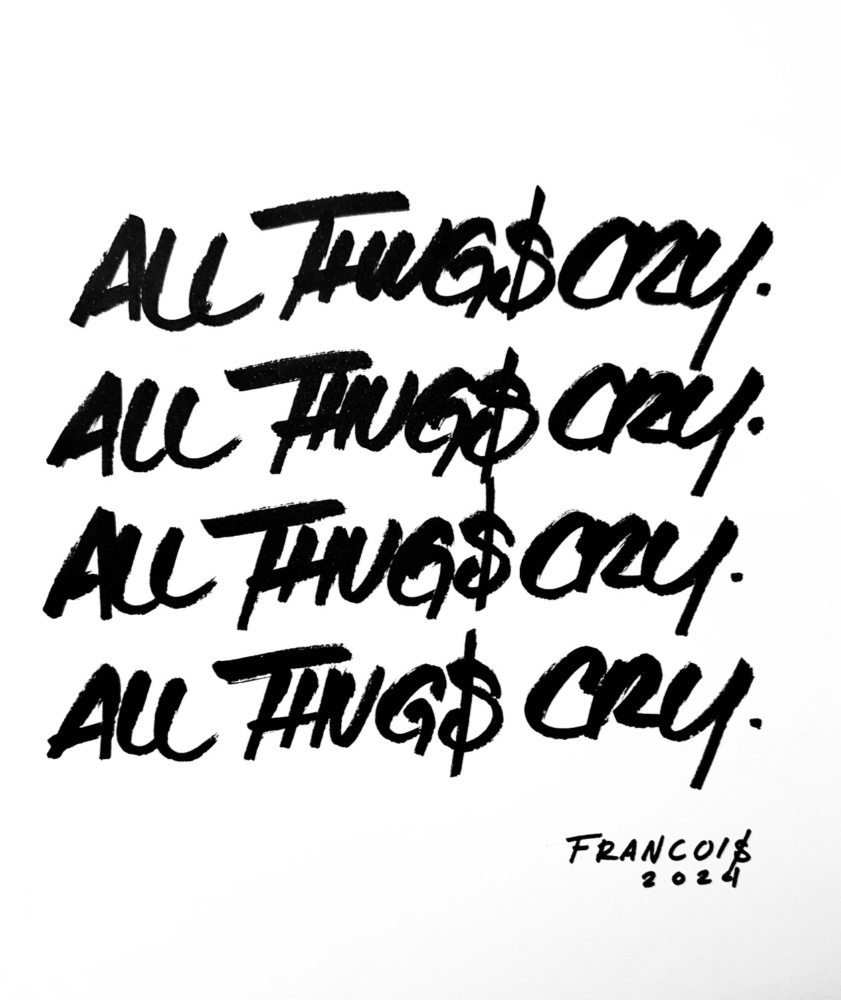
KKR: What has your attention today?
JF: I have really been doing a lot of research and letting that be like, medicinal towards me. Sure, yeah, yeah. I’m revisiting a lot of Toni Morrison’s work. I’m revisiting a lot of Miles Davis, Ella Fitzgerald, and the times they were living in, what they were dealing with. There’s a song I love by Nina Simone, their rendition of Stars by Janis Ian. And when you hear what she’s saying, it’s like every generation of artists had their back against the wall against something, you know?
KKR: What are you, working on currently ?
JF: I recently stumbled upon a big, huge Ziploc bag of old photographs that my my grandparents collected. And so I use that as a base model for these new drawings. And I find myself in a meditative state just looking at cousins in their youth or looking at uncles when they were younger and bringing that forth through paper. You know, it’s a way of honoring them and I find myself using that. Also, digging through Polo Silk’s archive, which is like, it’s a treasure trove for me. So that’s really been my focus is making this body of work of black people who are ready to not only be seen, but give you a gaze as well. That’s another act of memory.
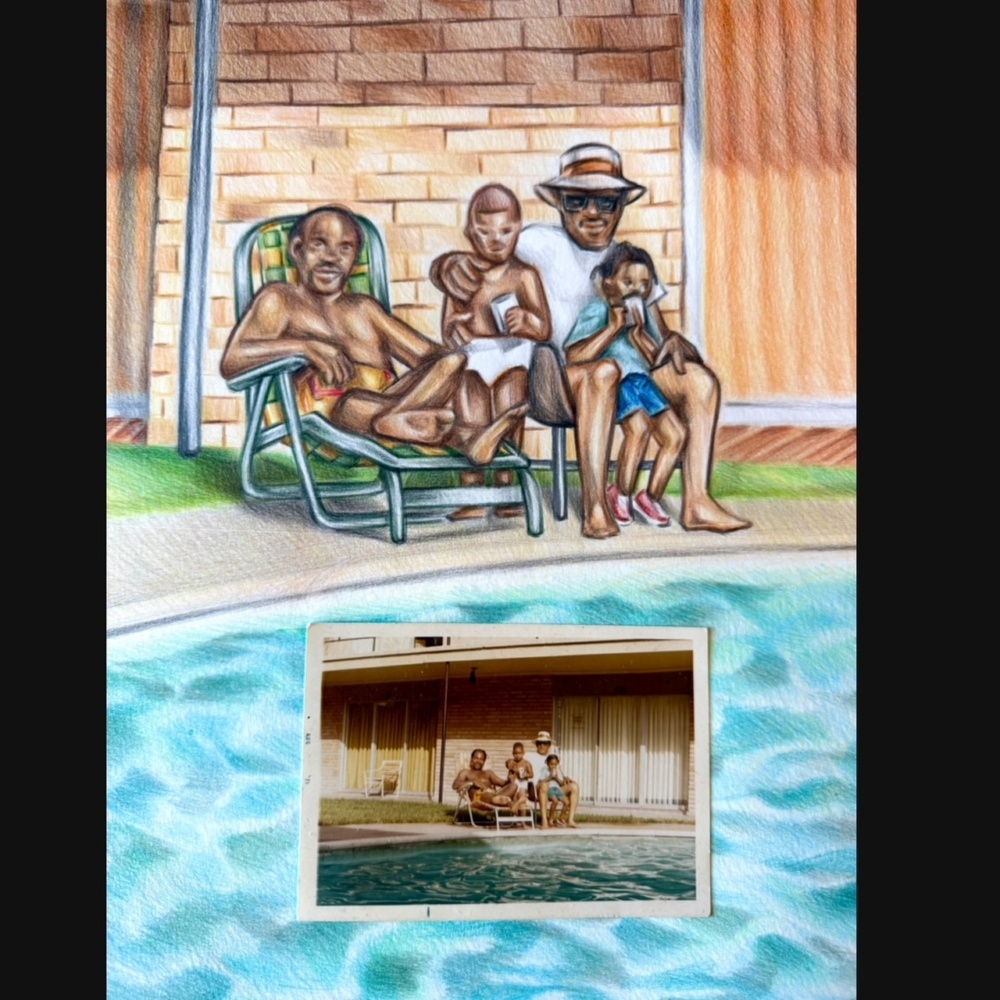
KKR: I went to a show Polo had at Sibyl Gallery, and it just unlocked so many memories. There were all of these just multiple choices of black things to do, you know?
JF: I think about, you know how special and how blessed we were to live in a time where you can turn on a TV and see a show called Phat Phat & All That, you know?
KKR: Right.
JF: As cultural paramount for your region. It’s unheard of today. And we grew up in that time, Nine O’clock Props, where you get the whole city is on one dial at one time. I think of that.
KKR: Slam it or Jam it. Remember?
JF: Slam it or Jam It! It’s like that richness. I think about that and all I can feel when I think of that life, that time of life is such a deep love. I don’t know if we will ever experience again in this city. With my artwork, I’m always trying to bring that feeling back of what life was before the water came, you know? And so that’s is the act of memory.
KKR: I also always appreciate the way you use humor in your work. Was that something that just came naturally to you as part of your personality?
JF: It is. I sometimes say, shut up, you know, shut up. But I can’t, you know, I can’t. As serious I am, it’s like, that man know he loves to laugh, It’s just really how I am. Truth be told its a part of New Orleans, all of us are in some context. Like, Mark Twain, we’re humorous.